A startup accountant is worth having from the moment you decide to trade, not after your first tax bill arrives. The early choices are the ones that are hard to undo: how you record income, which software you use, whether you register with HMRC (His Majesty’s Revenue and Customs, the UK tax authority) as a sole trader or form a company, and how you keep track of cash. I’m Chris White, an AAT Licensed Accountant based in Hildenborough near Tonbridge. I help new businesses across Kent, and remotely across the UK, get those foundations right so that tax is a routine job rather than a last-minute mess.
This guide walks through what a new business actually needs, when to ask for advice, and how to judge whether an accountant suits you. It is written for founders, side hustlers and new limited-company directors, in plain English.
TL;DR
- Speak to an accountant before you start trading, or as soon as you have your first customer. The decisions you make in the first weeks shape your records, your tax and your cash.
- Bookkeeping is the day-to-day record of money in and out. Accountancy is the advice, analysis and filing built on top of it. A startup needs both, in a proportion that suits your budget.
- Choose cloud accounting software that can cope with Making Tax Digital (MTD), HMRC’s digital record-keeping and reporting system, from day one.
- A simple cash-flow forecast does more to keep a young business alive than almost any tax tip.
- When you compare accountants, check qualifications, scope, communication and how fees change as you grow. I work directly with every client and agree pricing clearly upfront.
Table of Contents
- When should a new business speak to an accountant?
- What does a startup accountant actually do?
- Sole trader or limited company: the startup questions to settle first
- Setting up your records and software properly
- Cash flow: what keeps a young business alive
- Tax planning and ongoing compliance in year one
- Making Tax Digital: the change new founders should plan for
- How to choose a startup accountant
- Software or accountant? You need both, in the right mix
- How I help startups from day one
- Need help with your startup accounting?
- My view as your accountant
- FAQ
- Sources
When should a new business speak to an accountant?
The honest answer is earlier than most people think. ICAEW (the Institute of Chartered Accountants in England and Wales) notes that a small business may choose a bookkeeper and an accountant depending on its budget and how much record-keeping it can handle in-house. That is a useful starting point, but the timing matters as much as the choice.
These are the moments when a conversation pays for itself:
- Before you start trading. You decide how to set up (sole trader or limited company), what to record, and which software to use. Fixing these later means re-keying data and untangling records.
- When you make your first sale or buy your first equipment. From this point you have records that HMRC may ask to see.
- When you plan to take on staff or subcontractors. Payroll and, in construction, the Construction Industry Scheme (CIS) bring monthly deadlines.
- When turnover is climbing towards the VAT registration threshold. Registering late, or registering without understanding the effect on your prices, is a classic early mistake.
- When you are close to the Making Tax Digital limits. More on those below.
If you have already started and your records are a shoebox of receipts and a bank app, you are not behind in any way that cannot be fixed. It just means the first job is tidying up, and that is far easier in month three than in month fifteen.
What does a startup accountant actually do?
People use “accountant” and “bookkeeper” as if they were one job. ICAEW draws the line clearly: bookkeeping is record-keeping, while accountancy covers financial analysis, advice and responsibility for filing compliance. A startup usually needs both, and it is simpler when one person looks after them together.
At a minimum, ACCA (the Association of Chartered Certified Accountants) lists the basics a young business must manage: payments and invoices, simple bookkeeping and bank reconciliation, cash-flow forecasting, credit control and tax compliance. Payroll joins the list as you grow.
In practice, for a new business, that breaks down like this:
| What you need | What it means in plain English | Where I can help |
|---|---|---|
| Bookkeeping | Recording every sale and cost, and matching it to your bank | Bookkeeping services |
| Software setup | A cloud system that holds your records and sends invoices | Accounting software setup and training |
| Cash-flow forecasting | A realistic view of what is coming in and going out over the next months | Budgeting and forecasting support |
| Self Assessment | The annual tax return for sole traders and company directors with other income | Self Assessment tax returns |
| Corporation Tax and annual accounts | The company’s tax and statutory filings | Corporation Tax and annual accounts |
| VAT | Registration and regular returns once you are in scope | VAT returns |
| Payroll and CIS | Paying staff correctly and handling construction deductions | Payroll and CIS |
You do not need all of this on day one. Most startups begin with bookkeeping, software and a clear view of their tax position, then add services as the business grows.
Sole trader or limited company: the startup questions to settle first
This decision touches your tax, your paperwork and your personal exposure, so it deserves a proper conversation rather than a guess. I will not repeat the full comparison here, because it depends on your profit, your plans and your other income. What I will do is show you the questions I work through with a new founder:
- How much profit do you realistically expect in the first two years, and do you need to take it all out personally?
- Do your customers or suppliers expect to deal with a company?
- Will you employ people, or use subcontractors, soon?
- Do you have other income, such as employment or rental profits, that affects your tax picture?
- How much admin are you prepared to take on? A company has more filing than a sole trader.
The answers point you one way or the other, and they also decide what you register for. A sole trader registers with HMRC for Self Assessment. A limited company is registered with Companies House (the public register of UK companies) and then with HMRC for Corporation Tax. Virgin StartUp’s finance guide makes the same point that founders should understand from the outset whether they need VAT, Self Assessment, Corporation Tax and PAYE if they hire. I cover that checklist with every new business I take on.
I give practical guidance rather than personalised tax advice in a blog post, so I’d always want to look at your figures before recommending a structure.
Setting up your records and software properly
Good records are the single most useful thing a startup can build, and they are cheap to do well at the start. Business.gov.uk advises keeping accurate records of income, expenses, bank statements and debts, and setting aside time each week for bookkeeping. It also says accounting software can reduce duplicated work and make tax returns easier than spreadsheets.
Here is the routine I set up with new clients:
- Open a separate business bank account. Mixing personal and business spending is the fastest route to confusing records.
- Choose cloud software. I work with Xero, QuickBooks and FreeAgent. The right one depends on your business type, your plans for VAT or staff, and how comfortable you are with software. My guide on choosing bookkeeping software as a startup covers what to prioritise and what to ignore.
- Connect the bank feed. Transactions flow in automatically, so you categorise rather than type.
- Capture receipts as you go. A photo on your phone at the time beats a hunt through pockets in January.
- Set a weekly slot. Business.gov.uk’s advice about time each week is sound. Twenty minutes weekly is easier than a full weekend each quarter.
- Agree who does what. Some clients keep the day-to-day entries and I review and reconcile. Others prefer to hand it over entirely. Either works when it is agreed at the start.
One point worth knowing: Business.gov.uk tells new businesses to pick software that can support Making Tax Digital when their obligations begin. Choosing compatible software now saves a migration later. My accounting software setup service includes training, so you understand the system rather than just owning it.
If you want to see how disciplined records protect you, my article on accurate bookkeeping and HMRC problems explains how tidy books reduce errors, and five signs your bookkeeping needs professional help is a quick check on where you stand.
Cash flow: what keeps a young business alive
Profit and cash are different things. You can invoice a good amount, owe tax on it, and still be unable to pay a supplier because the customer has not paid yet. ACCA names cash-flow forecasting to anticipate shortfalls and credit control among the essential financial capabilities for a growing business.
A first forecast does not need to be complicated:
- List the cash you expect to receive each month, based on when customers actually pay, not when you invoice.
- List fixed costs: rent, software, insurance, loan repayments.
- Add variable costs: stock, materials, subcontractors.
- Set aside tax as you earn. A separate savings pot for tax removes a nasty surprise.
- Look at the closing balance each month. Any month that dips below zero is a conversation to have early.
I have written a step-by-step cash-flow plan for founders and a worked example of a business cash-flow forecast that you can follow with your own numbers. If you would rather build it together, my budgeting and forecasting support covers it.
Business.gov.uk presents regular bookkeeping as a tool for planning and decision-making as well as a tax chore, and says it can help you show your financial health to lenders or investors. If you may want finance later, tidy monthly records are your best evidence.
Tax planning and ongoing compliance in year one
Tax planning for a startup is mostly about no surprises. You want to know what you will owe, roughly when, and how to fund it. Here is how the main obligations usually line up.
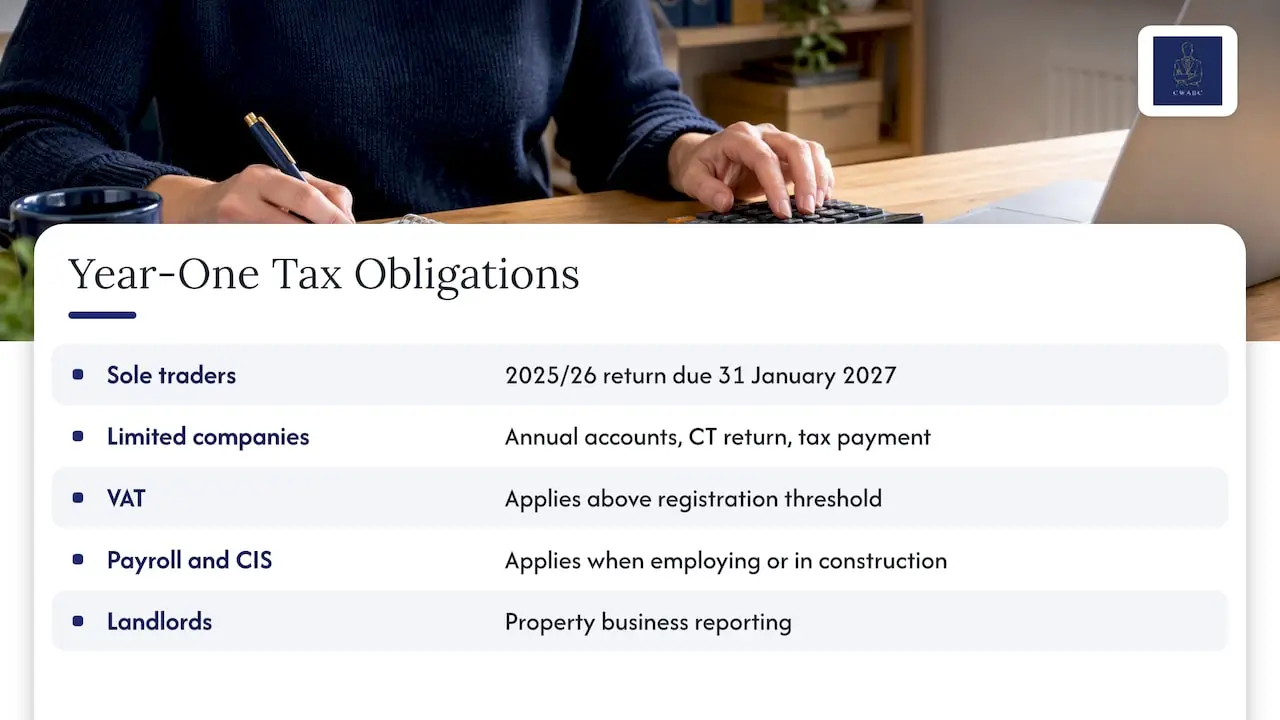
Sole traders complete a Self Assessment return each year. The online filing and payment deadline for the 2025/26 return is 31 January 2027, and it falls on 31 January after each tax year ends. Once you are established, HMRC can ask for payments on account, which are advance instalments towards next year’s bill. My explainer on payments on account shows how they work, and my guide on preparing accounts for a tax return shows what goes into the figures. GOV.UK’s 2026 helpsheet confirms that business accounts generally need not be sent in with the return, but you still need to keep them and to work from them. If you made a slip on a previous return, see correcting tax return mistakes.
Limited companies file annual accounts and a Corporation Tax return, and pay Corporation Tax. Directors usually also have personal tax to consider. I have guides on Corporation Tax for limited companies, paying Corporation Tax correctly and common filing mistakes. If you want it handled for you, see my Corporation Tax accountant page for Tonbridge.
VAT applies once your taxable turnover passes the registration threshold, and some businesses register voluntarily. Both routes have consequences for pricing and admin. Start with when to register for VAT and voluntary registration, then see how a VAT return works. If you sell online, VAT for online sellers has the detail.
Payroll and CIS apply when you employ people or work in construction. See my pages on payroll and CIS, CIS monthly returns and CIS for subcontractors.
Landlords starting a property business have their own reporting. I support rental bookkeeping and tax reporting for landlords across Kent from my main site.
The habit that ties this together is doing a little tax preparation all year. My year-round tax preparation tips show how.
Making Tax Digital: the change new founders should plan for
Making Tax Digital for Income Tax (MTD for ITSA) means that people covered by it keep digital records in compatible software and send quarterly updates to HMRC. GOV.UK’s 2026 helpsheet describes this as creating digital records and sending quarterly updates for self-employment and property income.
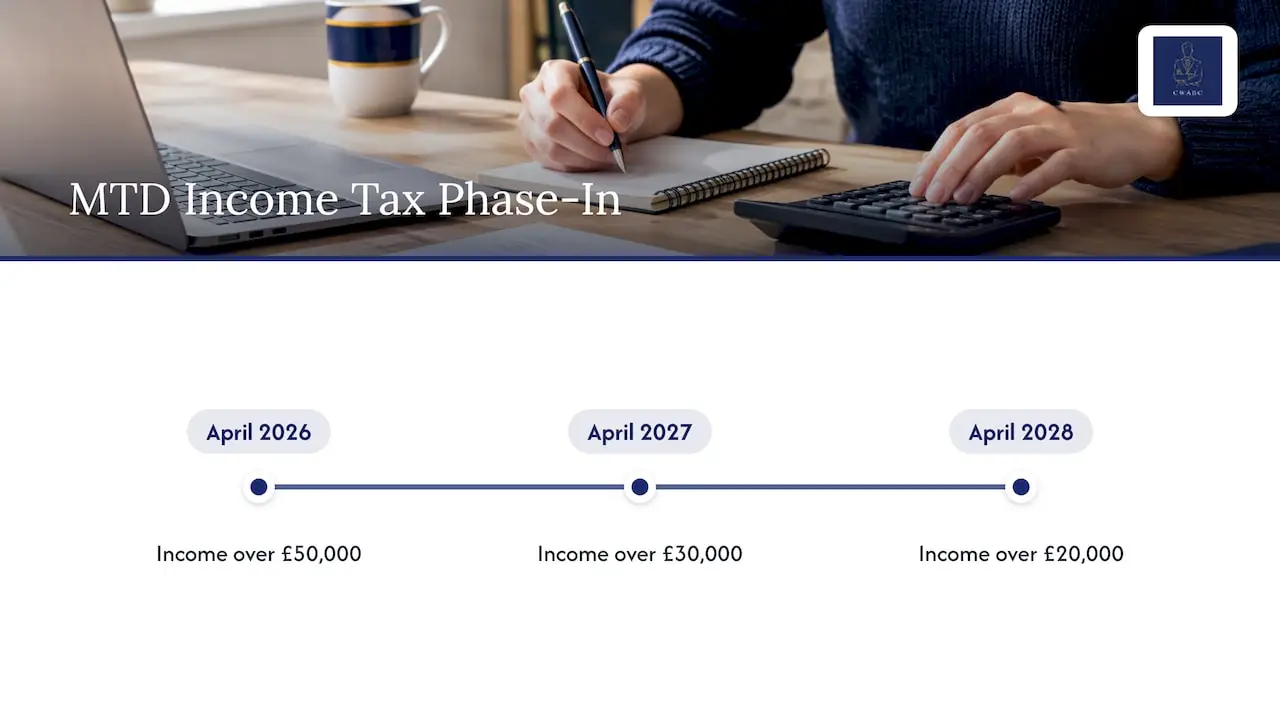
It is being phased in by income. MTD for Income Tax started in April 2026 for income over £50,000, applies from April 2027 to income over £30,000, and from April 2028 to income over £20,000. Many new businesses are below these levels in year one, but growth and side income can move you up faster than you expect. If your business is likely to grow, it makes sense to be in compatible software from the start.
If this sounds like a lot, it is a manageable process once the records are in place. My guides on Making Tax Digital explained, the MTD requirements checklist and your digital tax account cover the practical steps, and my MTD for Income Tax support is there if you want me to handle the quarterly updates.
How to choose a startup accountant
The research on choosing an accountant is consistent. ICAEW advises checking qualifications, experience, service scope, communication, turnaround times and fees. Here is a version tuned for a new business.
| What to check | Why it matters to a startup |
|---|---|
| Professional body and licence | Shows the standards the accountant works to and who regulates them |
| Experience with businesses like yours | Sole trader, limited company, landlord and CIC all have different rules |
| Scope of service | Whether bookkeeping, software, VAT, payroll and tax are covered or sold separately |
| Software | Whether they work with cloud systems that support MTD |
| Communication | Who you speak to, and how questions are handled |
| Fees | Whether pricing is fixed or tailored, and how it changes as you grow |
On fees, a good provider should give you a clear breakdown. Fees typically depend on structure, transaction volume, payroll and VAT needs, and fixed fees help budgeting as long as you know how they change if your needs change. That is the right question to put to anyone you are considering, me included. My pricing is tailored to each client and agreed clearly upfront; the one published starting point is Self Assessment returns, from £250 one-off. For a fuller list of questions, my hire-an-accountant checklist goes through them one by one.
Software or accountant? You need both, in the right mix
Cloud software is excellent at routine tasks: pulling in bank transactions, producing invoices, summarising your position. It does not decide how to treat an unusual purchase, whether you are on the right tax footing, or what to do when HMRC writes to you. That is where professional support earns its fee. A new business usually starts with software and a regular accountant relationship, and adjusts as it grows.
The practical split I see working best looks like this:
- You: raise invoices, snap receipts, answer questions about unusual transactions.
- The software: bank feeds, rules, reports, the digital records MTD needs.
- Me: set it up properly, review and reconcile the books, prepare the tax and filings, and explain what the numbers mean.
How I help startups from day one
I am an AAT Licensed Accountant, a member of AAT (the Association of Accounting Technicians) and an AAT Qualified Bookkeeper, with over 30 years of finance experience. I work as a sole practitioner, so you deal with me directly, with no hand-offs. Here is what that looks like for a new business:
- A clear starting point. We talk through what you are planning, and I explain the registration steps and which obligations apply to you, in plain English.
- Systems that fit. I set up Xero, QuickBooks or FreeAgent, connect your bank, and train you to use it, so your records are organised from the first transaction.
- Regular bookkeeping. I keep your books accurate and ready for HMRC, so you are not rebuilding the year in January.
- Forecasting and budgeting. I help you build a cash-flow view so you can see pinch points before they arrive.
- Tax and compliance. Self Assessment, Corporation Tax, VAT, payroll, CIS and MTD, as your business needs them.
I am based in Hildenborough, close to Tonbridge, and I support clients across Tonbridge, Sevenoaks, Royal Tunbridge Wells, Kings Hill and the rest of Kent. Because everything is paperless and runs through secure digital workflows, I work equally well with startups elsewhere in the UK, remotely. I do not guarantee outcomes, and I do not give tax advice without seeing your circumstances, but I do aim to take the stress out of the process.
Need help with your startup accounting?
If you are starting a business, or you have started and your records are already getting away from you, I would be glad to help. I can set up your software, look after your bookkeeping, and handle the tax and filings so you can focus on your customers. You can see my accounting services or get in touch to talk through what you need.
I agree pricing clearly upfront, based on what your business actually needs, so you know where you stand before we begin.
My view as your accountant
The most expensive mistakes I see in new businesses are rarely clever tax errors. They are ordinary ones: no separate bank account, receipts that are never captured, no idea what tax is building up, and software chosen in a hurry.
That is why I like to meet founders early. An hour spent on structure, software and a simple forecast usually saves many hours later, and it gives you something better than a tax return: numbers you understand and can act on.
I keep my approach practical. I explain things without jargon, I use cloud software and automation to reduce manual work, and I make sure your records stand up to HMRC. If you want an accountant who knows your business and answers to you directly, that is how I work.
Chris
FAQ
When should a startup hire an accountant?
Ideally before you start trading, or as soon as you have your first customer. That is when the choices about structure, software and record-keeping are easiest to get right. If you have already started, it is still worth getting your records in order sooner rather than later.
How much does a startup accountant cost?
It depends on your structure, how many transactions you have, and whether you need VAT or payroll. I tailor pricing to each client and agree it upfront. The one published starting figure is for Self Assessment tax returns, from £250 one-off.
Do I need an accountant if I use accounting software?
Software handles routine recording well, and it works best alongside professional support. An accountant sets it up correctly, reviews the figures, prepares the tax and advises on decisions. For most startups the combination works better than either alone.
Can you help if I am not based in Kent?
Yes. I am based in Hildenborough near Tonbridge and work with clients across Kent, but my paperless, cloud-based approach means I support startups remotely throughout the UK.
Do startups need to worry about Making Tax Digital?
It depends on your income. MTD for Income Tax is phased in by income level, from over £50,000 in April 2026 down to over £20,000 in April 2028. Choosing compatible software from the start means you are ready when it applies to you.
Sources
- Hiring an accountant: a small business guide, ICAEW
- Building your financial capabilities: a guide for growing businesses, ACCA
- Setting up business accounting and finance, Business.gov.uk
- Information from your accounts 2026 (HS229), GOV.UK
- New tax year 2026/27: UK tax rates, deadlines and changes
- How to choose an accountant: what to check in the UK
- Free finance, tax and accounting guide for startups, Virgin StartUp
Recommended
- 7 signs you need an accountant: a practical guide
- Hire accountant small business checklist: UK guide 2026
- How to set up an accounting system for a new business
- Hire a Bookkeeper First. When UK Small Businesses Need an Accountant
This article provides general information based on UK tax and accounting rules at the time of publication. It is not a substitute for advice tailored to your individual circumstances. Tax legislation and HMRC guidance may change. If you need advice about your specific situation, please contact me at CW Licensed Bookkeeper & Accountant.