
You must register for VAT once your taxable turnover passes £90,000 in any rolling 12 months, or if you expect to cross that line in the next 30 days alone. Below that figure, registration is voluntary, and whether it makes sense depends on who buys from you and how much VAT you already pay on costs. The calculations, the paperwork and the commercial trade-offs are all explained below.
TL;DR:
- You must register for VAT within 30 days if your rolling 12-month taxable turnover exceeds £90,000 or if you expect to do so within the next 30 days.
- Taxable turnover includes standard-rated, reduced-rated, and zero-rated sales but excludes exempt supplies and out-of-scope income, which must be separated during calculation.
- The 12-month rolling total must be checked continuously, as a large invoice can push your threshold mid-month, triggering immediate registration obligations.
- Voluntary registration is advantageous mainly for businesses with significant input VAT or selling to VAT-registered clients, but it increases admin and impacts prices for consumer-facing businesses.
- Missing registration deadlines can lead to penalties based on the VAT owed from the correct effective date, emphasizing timely monitoring of turnover.
Table of Contents
- Do you legally have to register for VAT?
- How to calculate VAT taxable turnover (with worked examples)
- Voluntary VAT registration: benefits, drawbacks and who gains
- Registering for VAT: what happens next, including MTD
- How VAT registration affects pricing, invoicing and cashflow
- Deregistering, exceptions and penalties to watch for
- Practitioner perspective: how I decide whether a client should register
- A UK small business VAT decision, not a tax formality
- CWABC: VAT registration and ongoing VAT return support
- Authoritative GOV.UK and HMRC links
- Sources
- FAQ
Do you legally have to register for VAT?
HMRC gives you two separate tests, and you only need to fail one of them to trigger compulsory registration. The first is the rolling 12-month test: if your total taxable turnover for any 12-month period, not just your accounting year, goes over £90,000, you must register for VAT. The second is the 30-day test: if at any point you expect your taxable turnover to exceed £90,000 in the next 30 days alone, you must register immediately, backdated to the day you formed that expectation.
Taxable turnover means sales of standard-rated, reduced-rated and zero-rated goods and services. It does not include exempt supplies, such as certain insurance, finance or property income, so those figures sit outside the calculation entirely. This trips people up constantly. A landlord with mixed residential and commercial lets, or a business selling both VAT-exempt training and standard-rated consultancy, needs to separate the two before doing any threshold maths.
There’s a third scenario that catches overseas sellers out: the non-established taxable person (NETP) rule. If your business is based outside the UK but you make taxable supplies here, VAT Notice 700/1 confirms you must register regardless of how small your turnover is. There’s no £90,000 buffer for NETPs.
Once you know you’ve breached either test, the clock starts ticking:
- You have 30 days from the end of the month you exceeded the rolling threshold to notify HMRC.
- If you expect to exceed the threshold in the next 30 days, you must register from the date you realised this, not the date you cross the line.
- Your effective date of registration is set by HMRC based on which test applied and when you notified them.
- Missing the notification deadline can trigger penalties even if you eventually register.
None of this is optional once you’ve hit either trigger. The threshold has held at £90,000 since it rose from £85,000 in April 2024, and current GOV.UK guidance confirms it remains at that level.
How to calculate VAT taxable turnover (with worked examples)
Getting the running total right matters more than most business owners realise, because HMRC doesn’t care about your financial year. It cares about any consecutive 12-month window, checked continuously, month by month.
Start by separating your income into three buckets:
- Taxable supplies — standard-rated (20%), reduced-rated (5%) and zero-rated sales all count towards your threshold, even though zero-rated sales carry no VAT charge.
- Exempt supplies — income like certain financial services, some education, or residential rents doesn’t count at all.
- Out-of-scope income — grants, some compensation payments, and a handful of other receipts sit outside VAT entirely and are excluded too.
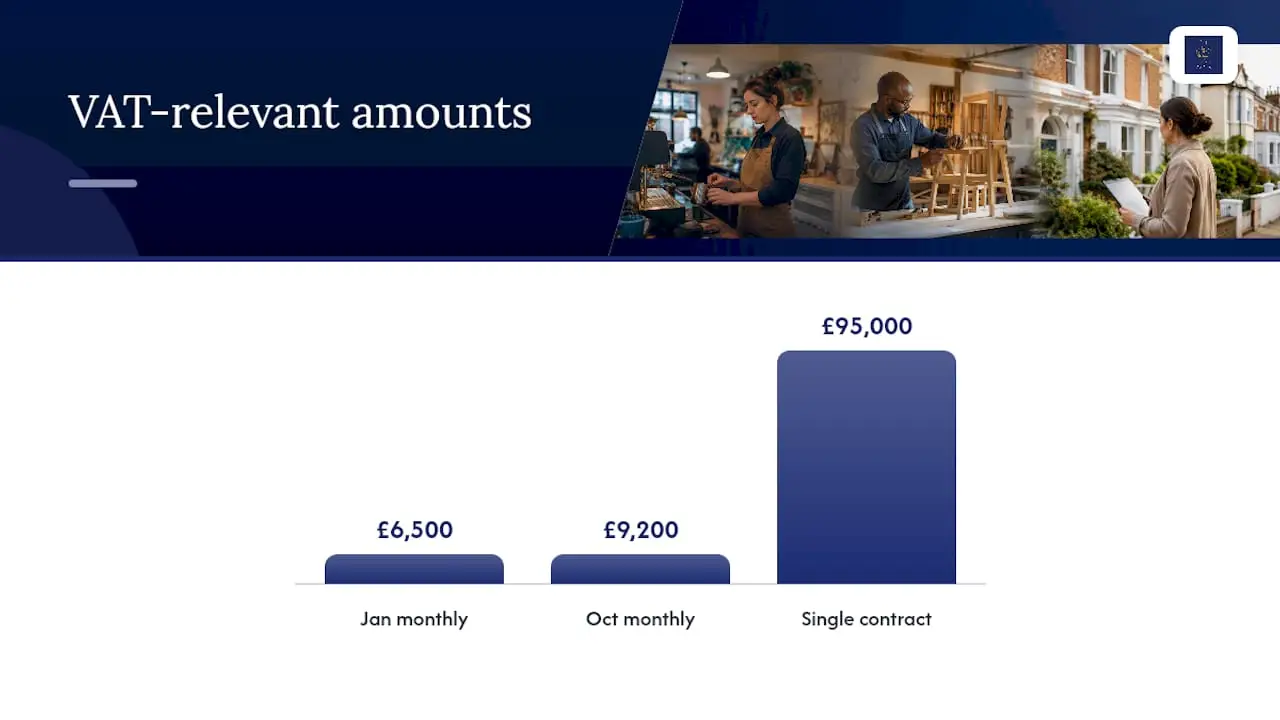
Here’s how a rolling check plays out in practice. Imagine a Kent-based design consultancy with the following monthly taxable turnover: January £6,500, rising steadily as client work builds, then jumping to £9,200 by October after landing two bigger contracts. Checked every month on a trailing 12-month basis, the running total might sit comfortably under £70,000 for most of the year, then tip past £90,000 in November once the two big contracts land. The moment that trailing total crosses £90,000, the business has 30 days from the end of that month to notify HMRC.
Pro Tip: Build a simple running total in a spreadsheet or your accounting software rather than checking annually. A single large invoice can push you over the threshold mid-month, and the 30-day notification clock starts the moment that happens, not at your year-end review.
The 30-day prospective test works differently and catches people off guard more often. Say a sole trader secures a single £95,000 contract in March, to be delivered and invoiced within the next month. Even though their trailing 12-month turnover might still be under £90,000, they now expect to exceed the threshold within 30 days. Registration is required immediately, backdated to the date that expectation formed, not the invoice date.
Two special cases deserve a mention. If you’re taking over an existing business as a going concern (TOGC), you generally inherit the previous owner’s taxable turnover history for threshold purposes, so you can’t reset the clock by buying a VAT-registered business and treating it as a fresh start. And if you run multiple trading activities, whether as sole trader side ventures or connected businesses, HMRC generally expects you to combine turnover across them when checking the threshold, particularly where activities are artificially separated to avoid registration.
Voluntary VAT registration: benefits, drawbacks and who gains
Below £90,000, registering is a choice, and it’s fundamentally a commercial one dressed up as a tax decision. The right answer depends almost entirely on two things: who buys from you, and how much VAT sits in your own costs.
The clearest benefit is reclaiming input VAT on your purchases. Once registered, you recover the VAT you pay on stock, equipment, software subscriptions and most business services. HMRC also lets you claim VAT retrospectively on certain pre-registration costs: goods still in stock bought up to four years before your effective registration date, and services received up to six months before. For a startup that spent heavily on equipment or professional fees before trading began, this can meaningfully reduce net setup costs.
Against that sit real disadvantages:
- You must add 20% VAT to standard-rated sales, which either squeezes your margin or raises the price your customer pays.
- You take on quarterly VAT returns, digital record-keeping under Making Tax Digital, and stricter invoicing rules.
- You collect VAT from customers before you owe it to HMRC, which changes your cashflow rhythm even if the net amount is small.
- Errors in VAT treatment (wrong rate, missed exempt supply, late return) carry penalty risk that non-registered businesses simply don’t face.
Who typically comes out ahead? Businesses that sell mainly to other VAT-registered businesses, because their customers reclaim the VAT charged and feel no price increase at all. Add in high input VAT, businesses buying a lot of stock, equipment or subcontracted services, and voluntary registration often pays for its own administration. A registered business insight from GOV.UK backs this up directly: for B2B sellers whose customers can reclaim VAT, charging VAT is broadly neutral for the buyer while letting the seller recover their own input VAT.
Who typically loses out? Consumer-facing businesses with low input VAT. Think a small hairdresser, a market-stall trader, or a one-person tutoring service, where customers can’t reclaim VAT and cost inputs (mainly labour) attract little or no VAT in the first place.
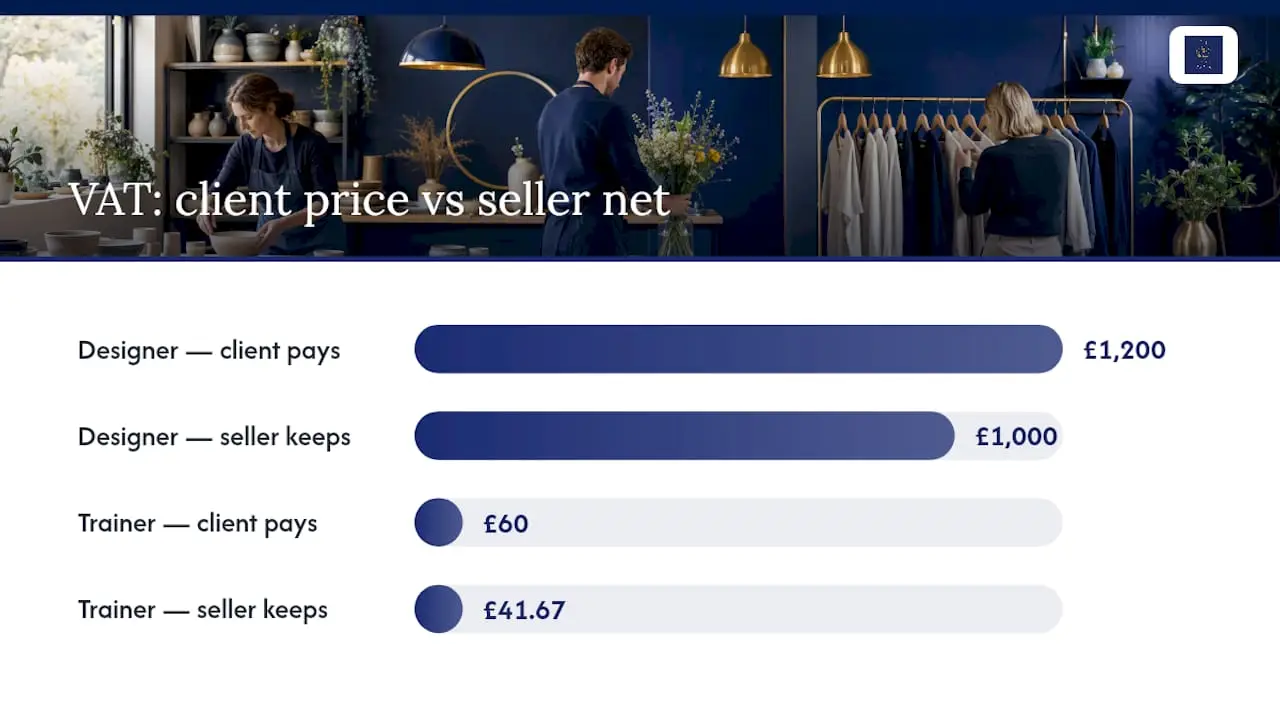
A quick numeric comparison makes the difference concrete. A graphic designer invoicing another VAT-registered agency £1,000 for a project charges £1,200 including VAT; the agency reclaims the £200, so the designer’s real price to the client is unchanged, and the designer now recovers VAT on their own software and equipment. Contrast that with a personal trainer charging a private client £50 per session. Registering forces a choice: either charge £60 and risk losing price-sensitive clients to unregistered competitors, or absorb the VAT and effectively earn £41.67 per session after paying HMRC its share.
Registering for VAT: what happens next, including MTD
Registration itself is done online through GOV.UK’s VAT registration service, and most businesses complete it digitally rather than filing a paper VAT1 form. The VAT1 Notes still apply where a paper application is needed, for example in some exception or exemption cases, and they set out exactly what information HMRC wants: business activity, expected turnover, bank details and the reason for registering.
You’ll need your Unique Taxpayer Reference, business bank details, turnover figures and a description of what you sell. HMRC then confirms your VAT registration number and, critically, your effective date of registration. That date determines when you must start charging VAT, and you cannot add VAT to invoices until your registration number arrives, though you can adjust your prices in anticipation while you wait.
Once registered, Making Tax Digital for VAT applies to almost everyone. That means keeping digital records of your sales and purchases and submitting returns through MTD-compatible software rather than typing figures into HMRC’s old online portal. If you’re still running a spreadsheet-based system, this is usually the point where setting up proper cloud accounting software stops being optional.
Practical tasks to work through in the days after registration:
- Update your invoice templates to show your VAT number, the VAT rate applied and the VAT amount separately.
- Set up MTD-compliant software (Xero, FreeAgent or QuickBooks are the common choices) if you haven’t already.
- Review existing contracts and pricing to decide whether VAT is added on top or absorbed into current prices.
- Diarise your first VAT return deadline, usually one month and seven days after the end of your first VAT quarter.
If you’re a sole trader working through this alongside other registration steps, it’s worth reading through the wider process for sole trader HMRC registration so VAT doesn’t become a separate, disconnected task. For the mechanics of the return itself once you’re through the door, my guide to completing a VAT return walks through the actual submission process.
How VAT registration affects pricing, invoicing and cashflow
Registering changes more than your admin load. It changes how your prices sit against competitors, and it changes the rhythm of your cashflow, sometimes for months before you notice the effect.
The core mechanic is simple but easy to underestimate: VAT you collect from customers isn’t your money. It’s a liability sitting on your books until you pay it to HMRC, typically one quarter in arrears. A business turning over £20,000 a month in standard-rated sales collects roughly £4,000 in VAT each month that it must eventually hand over. Spend that £4,000 as if it were revenue, and the VAT bill at quarter-end becomes a genuine cashflow problem, not just an accounting entry.
The B2B versus B2C split decides how painful the pricing side feels:
- Selling mainly to VAT-registered businesses: adding VAT changes nothing for the buyer, who reclaims it, so your headline price can rise without denting demand.
- Selling mainly to consumers or unregistered businesses: adding VAT is a real price rise that your customer feels in full, and unregistered competitors can undercut you by the full 20%.
You broadly have three pricing choices once you’re registered and selling to price-sensitive customers. You can absorb the VAT and keep your customer-facing price the same, which protects competitiveness but cuts your margin by roughly a sixth. You can raise your headline price to cover the VAT, which protects margin but risks losing custom on price. Or you can show VAT separately on invoices, which is standard B2B practice and works well when your customers expect and reclaim it, but does nothing to soften the blow for consumers.
Pro Tip: If you’re weighing up a price rise against absorbing VAT, model both scenarios against your actual last 12 months of sales rather than guessing. A 20% price rise that loses even a handful of price-sensitive customers can wipe out the extra margin you were hoping to protect.
Two VAT schemes are worth knowing about, though neither suits every business. The Flat Rate Scheme lets you pay a fixed percentage of your VAT-inclusive turnover to HMRC instead of tracking input and output VAT separately, which can simplify admin for businesses with low purchase costs, but it can cost you more if you buy a lot of VAT-rated stock or equipment. Cash Accounting lets you account for VAT when you’re actually paid rather than when you invoice, which helps businesses with slow-paying customers avoid funding HMRC out of their own pocket. Neither is a default choice. Both need checking against your actual figures before you opt in.
If you sell to overseas customers, registration also changes how you treat exports and EU sales, generally allowing zero-rating on qualifying exports while adding import VAT considerations on goods brought into the UK, so it’s worth reviewing your specific trade flows rather than assuming the domestic rules apply unchanged.
For a wider view on communicating a price change to customers without alarming them, the sales-side perspective in this piece on how consultancy drives growth for UK businesses is a useful companion read, even though its focus sits outside VAT itself.
Deregistering, exceptions and penalties to watch for
Deregistration becomes relevant if your taxable turnover falls below the deregistration threshold, or if you stop trading altogether. You apply through your VAT online account, HMRC confirms a deregistration date, and you must account for VAT on any stock or assets you still hold above a certain value. My separate guide on the VAT deregistration threshold covers the exact figures and the exit charge that can catch people out.
Two lesser-known routes are worth flagging. A registration exception applies if you’ve temporarily exceeded the £90,000 threshold but can show HMRC you expect to drop back below it shortly, meaning you can apply to avoid registering at all. A registration exemption applies if your supplies are wholly or mainly zero-rated, since registering would only create paperwork with little VAT to reclaim or pay.
Penalties for late registration are calculated as a percentage of the VAT you should have charged from your correct effective date, and HMRC also charges interest on the unpaid amount. The most common trigger isn’t dishonesty, it’s simply not checking the rolling 12-month total often enough and missing the moment you crossed the line.
A short checklist reduces the risk considerably:
- Check your rolling 12-month taxable turnover monthly, not annually.
- Flag any single contract or invoice likely to trigger the 30-day prospective test.
- Keep exempt and out-of-scope income clearly separated in your bookkeeping.
- Register within 30 days of spotting either trigger, even if the paperwork feels premature.
Practitioner perspective: how I decide whether a client should register
When a client asks me whether they should register voluntarily, I start with three questions: who buys from you, how much VAT sits in your costs, and what your cashflow looks like month to month. Customer mix decides almost everything else. A business selling to VAT-registered clients rarely has a good reason to stay unregistered once input VAT recovery is on the table.
The mistakes I see most often are surprisingly consistent. People check turnover against their financial year instead of a rolling 12 months. They register without realising Making Tax Digital software is now compulsory, not optional. And they misclassify exempt income as taxable, or vice versa, which throws the whole threshold calculation off.
Pro Tip: Pick an effective registration date that lines up with the start of an accounting period where possible. It makes your first VAT return far easier to reconcile against your bookkeeping.
I also encourage clients to document any pre-registration VAT they intend to claim, on stock or services, before HMRC asks questions about it. If any of this feels uncertain, my contact page is the quickest way to get a second opinion before you commit.
A UK small business VAT decision, not a tax formality
The conventional advice on VAT registration treats it as a compliance box to tick once you hit a number. That misses the point for most small businesses reading this. Below £90,000, registration is a pricing and customer-strategy decision wearing a tax disguise, and treating it purely as a legal question leads people to either register too early and lose margin on consumer sales, or delay too long and miss genuine input VAT recovery on a heavy equipment spend.
What the evidence actually supports is simple: check your customer mix first, your input VAT second, and the £90,000 threshold third. A business selling mainly B2B with meaningful purchase costs should usually register voluntarily well before HMRC forces the issue. A consumer-facing business with thin input VAT should usually wait until the rolling 12-month test leaves no choice. Where most owners go wrong isn’t the maths. It’s assuming the threshold is the whole decision when it’s really just the backstop.
— Chris
CWABC: VAT registration and ongoing VAT return support
There are practical alternatives to working through VAT registration alone or leaving it to a generalist adviser unfamiliar with small-business cashflow pressures. Services can include VAT registration applications, Making Tax Digital setup, and ongoing quarterly VAT returns, with pricing agreed clearly upfront to avoid surprises once registered.

Clients benefit from direct access and cloud accounting setup on Xero, FreeAgent or QuickBooks so records stay accurate from day one rather than becoming a scramble at quarter-end. If you’re weighing up whether to register now or wait, or you’ve already registered and want the returns handled properly, my VAT returns service in Tonbridge covers registration support and ongoing compliance in one package. Get in touch through my contact page to talk through your figures before you make the call.
Authoritative GOV.UK and HMRC links
For the primary source detail behind everything above, start with GOV.UK’s VAT registration page, then VAT Notice 700/1 for the full legal explanation of who should register. The VAT1 Notes cover form completion and exception applications, and the MTD registration guidance explains the digital record-keeping requirement that follows registration.
This article is general information, not a substitute for advice from a qualified financial advisor. Consult a qualified financial professional about your own circumstances before acting on anything here.
Sources
FAQ
Is it worth becoming VAT registered?
It’s usually worth it if most of your customers are VAT-registered businesses, or if you have significant input VAT on stock and equipment to reclaim.
Who should register for VAT in the UK?
Anyone whose taxable turnover exceeds £90,000 in a rolling 12-month period, or who expects to exceed it in the next 30 days, must register. Businesses below that threshold can register voluntarily if it suits their customer mix and cost base.
What happens if I don’t register for VAT when required?
HMRC can charge penalties calculated as a percentage of the VAT that should have been charged from your correct effective date, plus interest on the unpaid amount. Late registration doesn’t remove the liability, it just adds a penalty on top of the VAT owed.
At what point should I register for VAT?
You must register once your rolling 12-month taxable turnover passes £90,000, or immediately if you expect to exceed that figure within the next 30 days. Below that threshold, timing becomes a commercial choice based on your customer mix and reclaimable input VAT.