Hiring an accountant for your small business means selecting a qualified professional who can handle your financial management, tax compliance, and advisory needs reliably. The right accountant holds recognised credentials such as ACA, ACCA, AAT, or CIMA, carries professional indemnity insurance, and understands UK obligations including Self Assessment, VAT, and Making Tax Digital. This hire accountant small business checklist walks you through every factor you need to assess before signing an engagement letter, from verifying qualifications to asking the right questions about fees, software, and communication.
What qualifications should a small business accountant have?
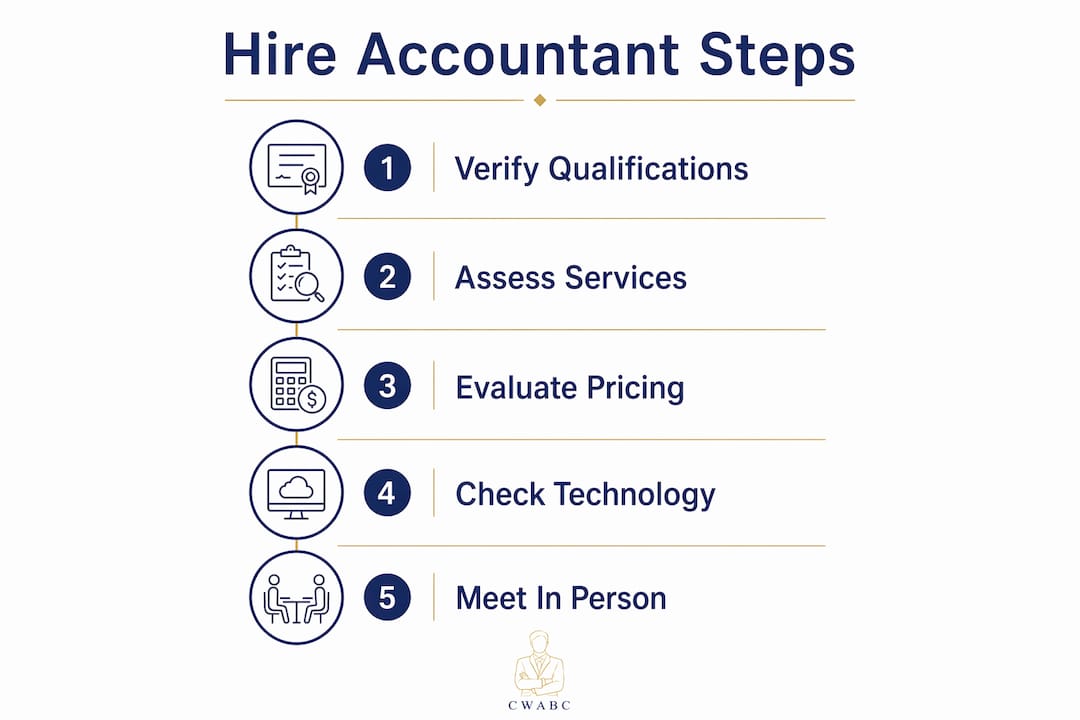
The qualifications an accountant holds determine the standard of advice and protection you receive. UK small businesses should hire accountants holding ACA, ACCA, AAT, or CIMA credentials to ensure professional standards and regulatory oversight. Each qualification signals a different level of specialism.
- ACA (ICAEW): Chartered accountant qualification suited to complex advisory, audit, and corporate work.
- ACCA: Globally recognised chartered qualification covering tax, audit, and financial management.
- CIMA: Focused on management accounting and business finance rather than tax compliance.
- AAT: Covers bookkeeping, VAT, payroll, and Self Assessment returns. Well suited to sole traders and small businesses needing reliable, cost-effective support.
Beyond the letters after a name, membership of a professional body matters. ICAEW, ACCA, CIMA, and AAT all require continuing professional development, ethical codes, and online membership verification. That means you can check whether your accountant is currently registered, not just qualified years ago.
Two further requirements protect you directly. Professional indemnity insurance covers you if your accountant makes an error that costs you money. Anti-money laundering (AML) supervision is a legal requirement for accountants in the UK. Ask any prospective accountant which body supervises their AML compliance. If they cannot answer clearly, that is a serious concern.
Hiring an unqualified or unregistered accountant carries real risk. HMRC holds you responsible for the accuracy of your tax returns, not your accountant. An unregulated adviser has no professional body to answer to if things go wrong.
Pro Tip: Use the official online registers at ICAEW, ACCA, AAT, and CIMA to verify membership before your first meeting. It takes two minutes and removes all doubt.
Which services should you expect from your accountant?
A good accountant does more than file your tax return once a year. Experienced accountants alert clients to industry-specific allowances and reliefs and bring value well beyond basic compliance. Before you appoint anyone, confirm which of the following services they provide.
- Self Assessment tax returns: Required for sole traders and directors.
- Corporation Tax returns: Required for limited companies.
- VAT returns: Quarterly or monthly, depending on your scheme.
- Payroll: PAYE calculations, Real Time Information (RTI) submissions to HMRC, and auto-enrolment pension duties.
- Bookkeeping oversight: Reviewing or maintaining your records throughout the year.
- Financial reporting: Profit and loss accounts, balance sheets, and management accounts.
- Business advice: Cash flow planning, budgeting, and growth decisions.
Specialism matters as much as the list of services. An accountant experienced with sole traders will understand the nuances of allowable expenses and the cash basis of accounting. One who works mainly with limited companies may not be the right fit if you are a landlord or a self-employed tradesperson. Ask directly: “Do you have clients in my sector, and how many?”
Technology proficiency is now non-negotiable. Cloud software supports Making Tax Digital compliance and real-time workflows, meaning your accountant must be confident using platforms such as Xero, QuickBooks, or FreeAgent. If your accountant still works from spreadsheets alone, you may face problems meeting HMRC’s digital record-keeping requirements as MTD expands in 2026. Cwabc provides accounting software setup support for clients across Kent and remotely, which removes the technical burden from you entirely.

Pro Tip: Ask what happens to your account during January, when Self Assessment deadlines peak. Will your usual contact still be available, or will you be passed to a junior member of staff?
How to evaluate pricing and what questions to ask before hiring
Pricing is where many small business owners get caught out. Basic fees often exclude payroll, VAT returns, or director Self Assessment filings, inflating costs significantly if not clarified upfront. Understanding the fee structure before you sign anything protects your budget and your relationship with your accountant.
The three most common fee models are:
- Fixed annual fee: A set amount covering an agreed list of services. Predictable and easy to budget for, but check exactly what is included.
- Monthly retainer: A recurring fee covering ongoing bookkeeping, payroll, and advisory support. Good for businesses that need regular contact.
- Hourly rate: Charged per hour of work. Can be cost-effective for occasional queries but unpredictable for ongoing needs.
Most small businesses pay between £150 and £500 annually for basic tax returns, or £75 to £300 monthly for ongoing bookkeeping and support, with fees varying by complexity and qualifications. Those figures shift considerably once VAT, payroll, or directors’ returns are added. Always ask for an itemised breakdown.
Specific questions to ask about pricing before you commit:
- What is included in your standard fee, and what costs extra?
- Do you charge separately for VAT returns, payroll, or director Self Assessment?
- Are there setup or onboarding fees when I join?
- How do you handle ad hoc queries? Are they included or billed separately?
- Do you offer fee protection insurance to cover the cost of an HMRC enquiry?
Vague answers to any of these questions are a warning sign. A trustworthy accountant gives you a written fee proposal before you start, not a rough estimate that grows over time.
Pro Tip: Ask for a sample engagement letter before you sign. It should list every service, every fee, and the responsibilities of both parties. If one is not offered, ask for it.
What communication and technology should your accountant use?
Communication quality predicts the quality of your working relationship more accurately than qualifications alone. Poor responsiveness before engagement typically forecasts future service issues. If an accountant takes a week to reply to your initial enquiry, that pattern rarely improves once you are a paying client.
Assess the following before you commit:
- Preferred contact method: Do they use phone, email, a client portal, or video calls? Does that match how you prefer to work?
- Response time commitment: Ask directly what their standard response time is for client queries.
- Dedicated contact: Will you always speak to the same person, or be passed around a team?
- Proactive communication: Do they contact you ahead of deadlines, or wait for you to chase?
Cloud accounting software proficiency is equally important. Accounting firms increasingly adopt cloud software due to Making Tax Digital rules focusing on digital records and timely HMRC submissions. Clients benefit from real-time collaboration and fewer errors when both parties use the same platform. If you already use Xero, QuickBooks, or FreeAgent, confirm your accountant is certified or experienced in that specific platform.
Data security deserves a direct question too. Ask how client data is stored, who has access, and whether the firm is registered with the Information Commissioner’s Office (ICO) under UK GDPR. A professional firm will answer this without hesitation. For small business owners interested in how automation tools support accountant-recommended platforms, the efficiency gains from well-integrated software are significant.
Pro Tip: If you are switching from one software platform to another, ask whether the accountant provides migration support. Moving years of data incorrectly can create compliance headaches.
What should you bring to your first meeting with an accountant?
Preparation makes your first meeting productive and helps the accountant give you an accurate fee quote. Clients should prepare recent accounts, turnover, employee count, software in use, and any outstanding tax issues for initial accounting meetings. Providing detailed information enables more accurate fee estimates and avoids surprises later.
Bring or have ready the following:
- Business structure: Are you a sole trader, partnership, or limited company?
- Annual turnover: Your most recent figure, even if approximate.
- Number of employees: Including directors on payroll.
- Recent accounts and tax returns: The last one to two years if available.
- VAT records: Your current VAT scheme and most recent return.
- Current software: What you use now for bookkeeping, even if it is a spreadsheet.
- Outstanding issues: Any late filings, HMRC correspondence, or unresolved tax queries.
- Your questions: A written list of what you need from the accountant.
Most UK accountants offer a free initial consultation in person, by phone, or video call to evaluate fit before signing. Treat this meeting as a two-way assessment. You are evaluating them just as much as they are assessing your needs. If the accountant does not ask about your business goals or future plans, that tells you something about how proactive their service will be.
What are the warning signs when hiring an accountant?
Some red flags are obvious. Others are easy to miss when you are eager to get your finances sorted. Knowing what to look for protects you from a poor appointment that costs time, money, and stress to undo.
Watch out for these warning signs:
- No recognised qualification or professional membership. An unregulated accountant has no oversight body and no professional indemnity insurance requirement.
- Vague or evasive answers about fees. If they cannot give you a clear written quote, expect billing disputes later.
- Slow or unprofessional communication before you sign. Failure to receive timely communication before signing is a reliable indicator of poor ongoing service.
- Promises of unrealistic tax savings. An accountant who guarantees to “slash your tax bill” without knowing your full financial picture is either inexperienced or reckless.
- Generic advice that ignores your sector. A good accountant asks about your business before offering any recommendations.
- No confirmation of AML supervision or professional indemnity insurance. Both are legal or professional requirements. Absence of either is a serious concern.
- No engagement letter offered. Without a written agreement, you have no clarity on what is included or what happens if something goes wrong.
The initial consultation serves to assess mutual fit and communication quality. Trust your instincts on rapport. If the conversation feels one-sided, rushed, or dismissive of your questions, that experience will not improve once you are a client.
Pro Tip: Search the accountant’s name on the relevant professional body register before your meeting. It takes two minutes and confirms they are currently in good standing, not just historically qualified.
Key takeaways
Choosing the right accountant requires verifying qualifications, understanding service scope, and assessing communication quality before you sign anything.
| Point | Details |
|---|---|
| Verify qualifications first | Confirm ACA, ACCA, AAT, or CIMA membership on official registers before any meeting. |
| Clarify the full fee | Ask for an itemised written quote covering VAT, payroll, and Self Assessment separately. |
| Assess software compatibility | Your accountant must be proficient in cloud platforms like Xero or QuickBooks for MTD compliance. |
| Prepare for the first meeting | Bring turnover figures, recent returns, employee count, and a list of outstanding tax issues. |
| Treat communication as a signal | Slow replies before you sign reliably predict slow replies after you sign. |
What I have learned from working with small business owners
The question I hear most often is: “How do I know if an accountant is actually good?” My honest answer is that qualifications tell you the floor, not the ceiling. An AAT Licensed Accountant who communicates clearly, files on time, and flags issues before they become problems is worth far more than a chartered accountant who is impossible to reach in january.
What I have noticed working with sole traders and landlords in Kent is that the biggest frustration is not cost. It is silence. Clients come to Cwabc after leaving accountants who never made contact unless chased, who sent invoices for work that was not discussed, and who gave no warning about upcoming deadlines. That experience is avoidable, and it starts at the selection stage.
The checklist approach works because it forces the conversation before you commit. When you ask a prospective accountant “What is your response time for client queries?” and they hesitate or give a vague answer, you have learned something important. When they hand you a clear written fee proposal without being asked, you have also learned something important.
One thing I would add that most guides miss: ask about their approach to Making Tax Digital requirements. MTD is not a future concern. It is a present reality for VAT-registered businesses and an expanding obligation for income tax from 2026. An accountant who cannot explain how they support clients through MTD is not keeping pace with HMRC’s direction of travel.
The right accountant does not just file your returns. They help you understand your numbers, plan ahead, and avoid the last-minute mess that comes from leaving everything to january. That kind of relationship starts with asking the right questions from day one.
— Chris
Cwabc: accounting support built for small businesses
Cwabc is an AAT Licensed Accountant based in Tonbridge, serving sole traders, landlords, and small businesses across Kent and remotely throughout the UK. If you have worked through this checklist and want to speak with an accountant who gives clear answers, transparent pricing, and proactive support, Cwabc is ready to help.
Whether you need bookkeeping support and answers to common financial questions, help setting up MTD-compliant software, or a straightforward review of your current accounting arrangements, Cwabc offers a free, no-obligation initial consultation. There are no hidden fees and no jargon. If you are not sure whether you need an accountant at all, the guide on signs you need an accountant is a practical starting point. Get in touch today and find out how straightforward good accounting can be.
Need help?
Ready to speak with a qualified accountant who gives straight answers and clear pricing? Contact Cwabc for a free, no-obligation conversation about your accounting needs.
FAQ
What qualifications should I look for when hiring an accountant?
Look for ACA, ACCA, AAT, or CIMA credentials and verify current membership on the relevant professional body’s online register. AAT is well suited to sole traders and small businesses needing bookkeeping, VAT, and Self Assessment support.
How much does a small business accountant cost in the UK?
Most small businesses pay between £150 and £500 annually for basic tax returns, or £75 to £300 monthly for ongoing bookkeeping and support. Costs rise when VAT returns, payroll, or directors’ Self Assessment filings are added.
What questions should I ask an accountant before hiring them?
Ask about their qualifications, which services are included in the fee, how they handle peak periods, what cloud software they use, and whether they provide a written engagement letter. Clear answers to all five indicate a professional, well-organised practice.
Do I need an accountant who knows about Making Tax Digital?
Yes. Making Tax Digital is already mandatory for VAT-registered businesses and expands to income tax from 2026. Your accountant must be proficient in MTD-compatible software such as Xero, QuickBooks, or FreeAgent to keep your records compliant.
What are the biggest red flags when choosing an accountant?
The clearest red flags are no recognised qualification, vague pricing, slow replies before you sign, promises of unrealistic tax savings, and no confirmation of professional indemnity insurance or AML supervision. Any one of these warrants caution.