
To check opening balances in company accounts, take the signed closing balance sheet from the previous year and agree every line to the opening position in your books, account by account. Then prove each balance against outside evidence, such as bank statements, aged debtor and creditor lists, loan statements and the fixed asset register. If the opening trial balance does not agree, find the reason for each difference. Never hide it in a balancing journal.
I’m Chris White, and this is the routine I follow when I prepare annual accounts for limited companies. It is about the accuracy of the financial statements, not software settings. If you are after the Xero set-up side, my guides on opening balances in Xero and day one opening balances cover it.
TL;DR
- An opening balance should equal last year’s closing balance. If it does not, something has changed that needs explaining.
- Check seven areas: bank, debtors, creditors, director’s loan account, fixed assets, accumulated depreciation and retained earnings.
- A trial balance that adds up is necessary but not proof. Two errors can hide inside one total.
- Never plug a difference into retained earnings or a suspense account and leave it there. Find it, explain it, correct it.
- Keep a short working paper for each balance, so the figures can be reproduced if HMRC, a lender or Companies House ever asks.
Table of Contents
- What an opening balance is and why it must match
- Which date and which records to use
- The seven balances I check, one by one
- Why a balanced trial balance is not enough
- A worked example: Harbour Print Ltd
- Why unexplained balancing journals are not acceptable
- How I investigate a difference
- A quick checklist you can run yourself
- Does the size of the company change the check?
- How I can help
- My view on opening balances
- FAQ
- Sources
What an opening balance is and why it must match
An opening balance is the figure an account starts a period with. It is the previous period’s closing balance carried forward, and for a brand-new account it is zero, as BBC Bitesize explains. If January closes at £5,650, February opens at £5,650.
In a ledger you will see this written as b/d (brought down) or b/f (brought forward) beside the opening figure, and c/d or c/f beside the closing one, as Mollie sets out. The abbreviations are old-fashioned, but the idea is simple: the same number appears at the end of one year and the start of the next.
For a limited company, this matters because the accounts you file are a chain. This year’s comparative figures are last year’s signed figures. If this year’s opening position quietly differs from last year’s closing position, one of three things has happened:
- Something was posted after the accounts were signed off.
- Something was entered with the wrong date, so it landed in the wrong year.
- Someone made an adjustment to force the books to balance.
The first two are fixable once you spot them. The third is the one that causes trouble later, because it leaves a number in your accounts that nobody can explain.
Which date and which records to use
For an established company, the opening balance date is the day after the previous year end. A company with a 31 March 2026 year end opens on 1 April 2026, with balances taken at the close of business on 31 March. Pandle’s guidance describes the same approach: use the last day of the previous period, which for a limited company means the day after the Companies House year end.
A new company starts from its incorporation date, and there is usually nothing to carry forward. A company that has traded for a while and is moving its bookkeeping onto new records needs a trial balance from the old records at that date. FreeAgent’s import guide says the accountant should supply that trial balance, covering items such as trade debtors, trade creditors, retained profits, VAT, share capital and fixed assets with accumulated depreciation.
The records I work from are:
- the signed accounts for the previous year and the final adjusted trial balance behind them
- bank statements covering the year end
- aged debtor and aged creditor reports as at the year end date
- loan statements and the director’s loan account ledger
- the fixed asset register with cost and depreciation
- the last VAT return and PAYE/NIC liability for the period
One rule I apply to everything: use one date. A supplier balance taken on 31 March and a bank balance taken a week later do not make a coherent opening position, even if a journal makes the totals agree.
The seven balances I check, one by one
A balance sheet is made up of a small number of building blocks. These are the ones I check on every limited company, and the evidence I expect to see behind each.
Bank accounts
The opening bank balance in the ledger should equal the bank statement balance at the year end, once you allow for items that had been recorded but not yet cleared. That difference is the reconciling items: cheques not yet presented, or payments that were in the bank before they were in the books.
The ICAEW’s student worksheet shows the pattern with a bank statement balance of £12,701.83 less outstanding cheques of £245.60, which equals a cash book balance of £12,456.23. The worksheet is an example rather than a real set of figures, but the method is exactly what I use in practice.
Things I look for:
- every bank account, including savings, deposit and payment-processor balances, not only the main current account
- credit card balances, which are a liability and are often forgotten
- the same unreconciled items still sitting in the list a year later
If you want the routine for the reconciliation itself, I have written it up for QuickBooks and Xero.
Trade debtors
Debtors are the invoices customers owe you at the year end. The opening figure should equal the total of the aged debtors report at that date, and that total should agree to the debtors control account on the trial balance.
Typical problems are an invoice dated 31 March but posted in April, a credit note applied to the wrong period, or a customer payment received in April that was allocated back to a March invoice in the wrong way. Each of these moves a balance between years while leaving the cash correct, which is why the bank reconciliation will not catch them.
I also ask whether each large old balance is realistic. A debt from two years ago that nobody has chased may need a bad debt write-off in the right year, rather than sitting in the opening balance indefinitely.
Trade creditors
Creditors work the same way in reverse. The opening figure should equal the aged creditors report at the year end: bills received and owed, less payments and credit notes.
Check for bills dated after the year end that relate to goods or services received before it. Check also for supplier statements showing a different balance to your ledger. A difference there may be an unrecorded bill, a duplicate or a payment on the wrong account.
Director’s loan account
The director’s loan account (DLA) records money moving between you and your company outside salary, dividends and expenses. If you have put money in, the company owes you. If you have taken out more than you put in, you owe the company.
The opening balance should equal the closing balance in the signed accounts, and I check it against the DLA ledger line by line. The questions I ask are:
- Is the balance on the right side, owed to you or owed by you?
- Were any dividends, salary or expense claims posted to the DLA by mistake?
- Is anything still outstanding that could create a tax charge for the company if it is not cleared in time?
That last point matters, so I check it with you early rather than at filing time. HMRC’s guidance on close company loans to participators is the starting point, and it is a topic where you should take advice on your own figures.
Fixed assets and accumulated depreciation
Fixed assets are things the company keeps to use over several years: equipment, vehicles, computers, fixtures. Two figures matter. Cost is what was paid. Accumulated depreciation is the total written off so far.
Both should agree to the fixed asset register. FreeAgent’s own guidance lists fixed assets with accumulated depreciation among the balances carried across, because the net book value (cost less accumulated depreciation) cannot be rebuilt without both.
I check:
- cost agrees to the register and to purchase invoices for the larger items
- disposals during the year have come out of both cost and depreciation
- the final year’s depreciation charge was actually posted
That last one is the most common gap I see between a set of draft books and the signed accounts. Depreciation is often calculated as a year-end adjustment, and if it sits on a separate schedule it can be missing from the ledger the next year starts from.
Retained earnings
Retained earnings, also called reserves or the profit and loss account on the balance sheet, are the profits the company has kept over its life, after tax and dividends. It is the balance that absorbs everything else, which is exactly why it is dangerous to use as a plug.
The opening figure should equal the closing reserves in the signed accounts. A simple test: opening retained earnings plus profit for the year, less dividends, should equal closing retained earnings. If last year’s profit was posted into reserves in the new year’s books, it is worth checking it has not been counted twice.
VAT, PAYE and corporation tax
These are not on my main list of seven, but I always agree them too. VAT should agree to the last return plus anything after it, PAYE and NIC to the final payroll submission and the HMRC statement, and corporation tax to the computation. My guide on reconciling VAT returns to your bookkeeping shows how to do the VAT side.
Why a balanced trial balance is not enough
A trial balance lists every account balance in two columns. Debits should equal credits. If they do not, there is an error somewhere.
The catch is that the reverse is not true. Save My Exams’ notes point out that totals can be equal despite errors, so bank reconciliations and control accounts are needed to locate them. The AAT’s Level 3 unit pack makes the same point: it expects bookkeepers to verify ledger balances against sources such as bank statements, the receivables and payables ledgers and the non-current asset register, not only to total the columns.
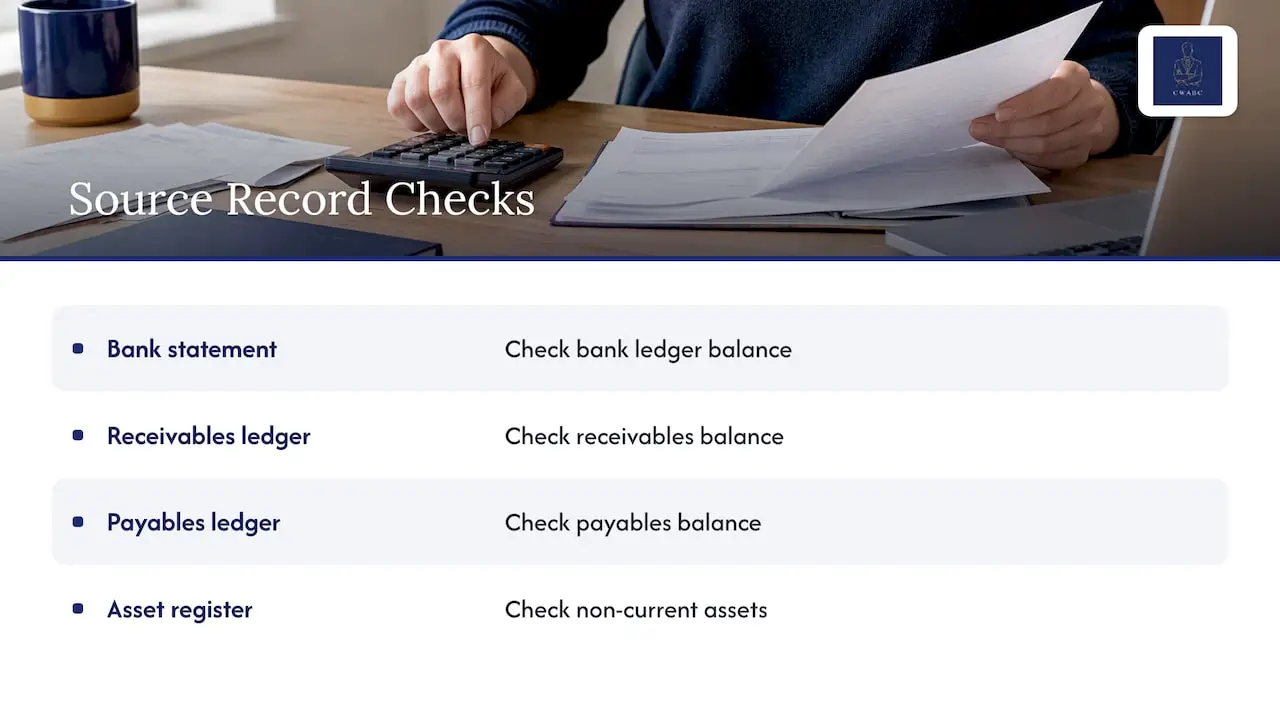
So I work in two directions. First, does the opening trial balance balance? Second, does each line agree to something outside the ledger? A set of books can pass the first test and fail the second.
A worked example: Harbour Print Ltd
The following is a fictional company with made-up figures, to show the method. Harbour Print Ltd has a 31 March year end. Its signed accounts for the year to 31 March 2026 show this closing position:
| Account | Debit (£) | Credit (£) |
|---|---|---|
| Bank | 18,420 | |
| Trade debtors | 12,600 | |
| Fixed assets at cost | 15,000 | |
| Trade creditors | 7,350 | |
| VAT | 3,180 | |
| PAYE and NIC | 640 | |
| Director’s loan (owed to director) | 2,500 | |
| Accumulated depreciation | 6,000 | |
| Share capital | 100 | |
| Retained earnings | 26,250 | |
| Total | 46,020 | 46,020 |
When I open the new year’s books, the trial balance at 1 April 2026 looks like this:
| Account | Debit (£) | Credit (£) |
|---|---|---|
| Bank | 18,420 | |
| Trade debtors | 11,900 | |
| Fixed assets at cost | 15,000 | |
| Trade creditors | 7,350 | |
| VAT | 3,180 | |
| PAYE and NIC | 640 | |
| Director’s loan (owed to director) | 2,500 | |
| Accumulated depreciation | 4,500 | |
| Share capital | 100 | |
| Retained earnings | 26,250 | |
| Total | 45,320 | 44,520 |
Debits exceed credits by £800. The tempting move is to post £800 to retained earnings and carry on. I do not do that. Instead I compare the two tables line by line:
| Account | Signed accounts (£) | Opening books (£) | Difference (£) |
|---|---|---|---|
| Trade debtors | 12,600 | 11,900 | 700 lower |
| Accumulated depreciation | 6,000 | 4,500 | 1,500 lower |
Two accounts disagree, and the £800 is the net of two separate problems, not one. Debtors are £700 lower, which reduces the debit side. Accumulated depreciation is £1,500 lower, which reduces the credit side. Put together, 1,500 less 700 gives the £800 imbalance.
Next I find the cause of each:
- Debtors, £700. The aged debtors report at 31 March includes a £700 invoice. In the new books it was dated 1 April, so it fell out of the opening balance. The fix is to correct the invoice date, not to adjust reserves.
- Accumulated depreciation, £1,500. The year-end depreciation charge was calculated on a separate schedule for the accounts but never posted to the ledger. The fix is to post the charge to the correct year, and then the register, ledger and signed accounts all agree.
After both corrections the opening trial balance matches the signed accounts, with no balancing journal and nothing sitting in reserves that cannot be explained. Had I only plugged the £800, the books would have balanced, and two errors would have stayed buried.
In a real company, if the prior-year accounts have already been filed, a correction may need more care. I would talk it through with you before posting anything that changes a filed number.
Why unexplained balancing journals are not acceptable
A balancing journal posts the difference to an account, often retained earnings or a suspense account, so that the trial balance totals agree. It makes the screen go green. It does not make the accounts right.
Here is why I avoid it:
- It hides the cause. The £800 above was two unrelated mistakes. A plug would have made both invisible.
- It distorts the reserves. Retained earnings feed into what the company can distribute as dividends, so a wrong figure matters beyond the page.
- It cannot be defended. If a lender, buyer or HMRC asks where a number came from, “it was needed to make it balance” is not an answer.
- It builds on itself. A plug carried forward becomes next year’s opening balance and the problem gets harder to trace each year.
A suspense account has a proper place: it is a temporary holding account for an amount you cannot yet allocate, and the SQA’s accounting unit describes using one to record an imbalance while the reasons are identified and rectified. The key word is temporary. It should be cleared to zero with a reason before the accounts are finalised.
The principle is the same for a company with an existing business moving onto new records: balances carried forward are the position the business already had. They are not new income or fresh purchases, so cash should not be posted as sales and unpaid supplier bills should not be posted as new spending.
How I investigate a difference
When the opening position does not agree, I follow a set order. It starts with the cheapest checks and moves to the harder ones.
- Confirm the baseline. I check I am comparing against the signed accounts and the final adjusted trial balance, not an earlier draft.
- Confirm the date. I check every balance is as at the same date. A cut-off error, such as taking closing balances on 31 March but still entering that day’s transactions in the old records, is a frequent source of error, as AccountingCompare’s guide notes.
- List the accounts that disagree. I do this line by line, as in the example, and ignore the total until I have the list.
- Separate size from direction. A single difference of £800 might be one error of £800, or several errors that net off. I look for combinations that explain the total.
- Check the last year’s journals. Year-end adjustments, such as depreciation, accruals, prepayments and tax, are the usual place a difference starts.
- Check dates on transactions around the year end. I look at the last week of one year and the first week of the next.
- Agree each balance to outside evidence. Bank to statement, debtors and creditors to aged lists, loans to lender statements, assets to the register.
- Correct in the right period and record why. I post the correcting entry with a clear narrative, and keep a note of what was wrong and how it was found.
At the end, I keep a short working paper showing each balance, the source it was agreed to, and any correcting entries. It does not need to be long. It means the answer is there if anyone asks.
A quick checklist you can run yourself
If you want to do a first pass before anyone else looks at your books, this is the shortlist:
- Do the opening balances equal the closing balances in last year’s signed accounts, line by line?
- Does each bank balance agree to the statement at the year end, with reconciling items listed?
- Do debtors and creditors agree to aged reports dated at the year end?
- Does the director’s loan account agree to its ledger, on the correct side?
- Do fixed assets and accumulated depreciation agree to the register?
- Does retained earnings roll forward correctly from last year’s closing reserves?
- Is there any balancing journal or suspense balance you cannot explain?
If the last answer is yes, or two or three of the others come back with gaps, that is the point where an accountant earns their fee. The sooner it is looked at, the less there is to unpick.
Does the size of the company change the check?
The checks above apply to every limited company, whatever its size. What changes is how much of the balance sheet you publish. The Companies (Accounts and Reports) (Amendment and Transitional Provision) Regulations 2024 raised the size thresholds for financial years beginning on or after 6 April 2025: small companies now go up to £15 million turnover and £7.5 million balance sheet total, and micro-entities up to £1 million and £500,000. Those figures affect which accounts regime a company files under. They do not change the need for opening balances to agree to last year’s closing position, because the figures still have to reconcile whichever format you file.
How I can help
If you would rather not spend an evening comparing two sets of numbers, this is a job I do for limited company directors, CICs and small business owners across Tonbridge, Sevenoaks, Kent and remotely across the UK. I work through the balances above, agree them to the evidence, explain any differences in plain English and tell you what I found. You deal with me directly.
If your books need tidying first, my bookkeeping cleanup checklist shows how I approach it, and my bookkeeping review for limited companies explains what I look at. Ongoing support is on my bookkeeping services page, and my accounting services page covers annual accounts and corporation tax. Pricing is agreed clearly upfront and depends on what your company needs.

Need help?
If your opening balances do not match last year’s accounts, or you are not sure where a difference came from, get in touch with me and I will take a look.
My view on opening balances
The opening balances are the part of the accounts that nobody looks at until something goes wrong. A bank balance that agrees is reassuring, but it only tells you the cash is right. The debtors, the creditors, the director’s loan and the depreciation are where the quiet errors live.
I would always rather find a difference and explain it than see a clean-looking set of books with a plug underneath. A difference is information. It usually points to a late invoice, a missed year-end journal or a transaction on the wrong date, and those are easy to put right when they are found early.
My approach is practical and calm. I agree each balance to the evidence, I keep a short note of what I did, and I explain the result without jargon, so you understand your own numbers as well as having them filed on time. I use cloud software such as Xero, QuickBooks and FreeAgent to keep records organised, but the judgement about whether a number is right is mine, and I do not leave it to a green tick on the screen.
Chris
FAQ
What does b/d mean in accounting?
B/d means brought down. It appears beside an opening balance on a ledger account to show the figure has been carried from the end of the previous period. Its partner, c/d, means carried down and sits beside the closing balance. You may also see b/f and c/f, meaning brought forward and carried forward.
Should opening balances always equal last year’s closing balances?
Yes, for a continuing company the opening position should equal the previous period’s closing position, because it is the same balance sheet at the same moment. A genuine difference means something has been changed or posted after sign-off, and it needs a documented explanation. If last year’s accounts were already filed with Companies House, talk to your accountant before changing any figure.
Can I just post the difference to retained earnings?
I would not. It makes the totals agree but leaves the cause unknown, and it can hide more than one error, as the Harbour Print example shows. Find the individual accounts that disagree, work out why, and correct each in the right period with a clear narrative.
Where do I find last year’s closing balances?
They are on the balance sheet in your signed annual accounts, and in the final adjusted trial balance behind them. Your accountant should be able to send you both. If you are moving your records onto new software, the trial balance from the old records at the year end is the document that identifies the figures to bring across.
What if my company has just been incorporated?
Then there is normally nothing to carry forward and the opening balances are zero. If you were trading before incorporating, or you put money into the company on day one, those amounts are recorded from the start date as share capital or a director’s loan, and I would agree them to the bank statement and paperwork.
Sources
- BBC Bitesize: Opening and closing balance
- Mollie: What is an opening balance?
- Pandle Help Centre: Opening Balances
- FreeAgent: Import opening balances
- ICAEW student toolkit: Accounting activities
- Save My Exams: The Trial Balance
- AAT Level 3 unit pack
- SQA: Account for income and expenditure
- AccountingCompare: Opening Balances guide
- legislation.gov.uk: SI 2024/1303
Recommended
- Opening Balances in Xero: How to Set Up Your Accounts Correctly
- Day One Opening Balances: Accountant Steps for UK Small Businesses
- Bookkeeping Cleanup Checklist for UK Sole Traders and Companies
This article provides general information based on UK tax and accounting rules at the time of publication. It is not a substitute for advice tailored to your individual circumstances. Tax legislation and HMRC guidance may change. If you need advice about your specific situation, please contact me at CW Licensed Bookkeeper & Accountant.