
Build two things this week: a 12-month monthly cash flow forecast and a 13-week rolling projection. That single move does more for your survival odds than almost any other piece of financial admin you’ll tackle in your first year.
Here’s how to start in the next hour:
- Pull your last 12 months of bank statements and invoices (or your best sales estimates if you’re pre-revenue)
- List every expected cash receipt against the month it will actually land in your account without specifying exact figures
- List every outgoing, including VAT, PAYE, and any one-off costs like renewals or equipment purchases without specifying amounts
Quick facts: Most lenders and investors expect at least a 12-month forecast before they’ll talk seriously about funding, while a 13-week rolling projection is the tool that keeps you on top of week-to-week reality once the money starts moving.
Table of Contents
- Cash flow forecasting for startups: why it matters more than your profit line
- How to build a 12-month cash flow forecast step by step
- A worked example: three months that show the VAT cliff
- Using a 13-week rolling forecast to manage the next quarter
- Modelling base, downside and best-case scenarios
- Common forecasting mistakes and quick fixes
- How I help startups get their forecasts right
- What the research says about cash flow forecasting for startups
- Why the conventional forecasting advice falls short for founders
- Get hands-on help building your forecast
- Need help?
- Frequently asked questions
- Sources
Cash flow forecasting for startups: why it matters more than your profit line
Here’s the distinction that catches out even sensible founders: a cash flow forecast records money when it actually hits or leaves your bank account, not when you raise the invoice. Profit is an accounting figure. Cash is what pays your staff on Friday.
You can be entirely profitable and still run out of money. It happens constantly to startups with long payment terms, because the sale sits as profit on paper while the cash is stuck in someone else’s accounts payable queue for 30, 60, sometimes 90 days.
A few timing risks catch founders out again and again:
- Customers paying 30 to 60 days late against your 14-day payment terms.
- VAT quarter payments arriving as a lump sum rather than a smooth monthly cost
- PAYE and pension contributions due monthly regardless of how sales are going
- Annual renewals (insurance, software licences, domain and hosting) landing all at once
Profit tells you whether the business model works. Cash tells you whether you’ll still be trading next month. Startups don’t usually fail because the model was wrong. They fail because the cash ran out while the model was still being proven.
This is where runway and net burn become useful concepts rather than jargon. Runway is simply how many months your current cash balance will last at your current spending rate. Net burn is the money going out minus the money coming in, averaged over a short period. Watching both weekly, not just at month end, is what gives you time to react before a shortfall becomes an emergency.
How to build a 12-month cash flow forecast step by step
You don’t need accounting software or complicated formulas to start. A spreadsheet and an hour of focused time will get you a working first draft.
-
Choose your structure. Use monthly columns across 12 months for the big picture. You’ll build a separate, more detailed weekly version later for the near term.
-
Gather your source data. Pull bank statements, outstanding invoices, supplier bills, your payroll calendar, and your tax due dates. If you’re pre-launch, use realistic sales assumptions rather than best-case guesses.
-
List inflows by the month cash actually arrives. Sales receipts, loan drawdowns, grant payments. Not the month you invoiced. The month the money lands.
-
List outflows by month. Payroll, rent, supplier payments, VAT, Corporation Tax, and any one-off costs. Don’t smooth annual costs across 12 months if they’re actually due as a single payment; show them where they hit.
-
Calculate net cash flow for each month, then carry the closing balance forward as next month’s opening balance. This running total is the single most useful number on the whole sheet.
-
Add a conservative receipts buffer. Reduce your expected sales income by a conservative buffer in the early months until you have proof customers pay on time.
Pro Tip: Build the first version in a spreadsheet even if you already use Xero, QuickBooks, or FreeAgent. Seeing the mechanics by hand makes it far easier to trust and interrogate the numbers once your accounting software starts generating forecasts for you.
Once you’ve run this manually for a couple of months and trust the inputs, migrating to cloud accounting software saves real time. It pulls bank feeds automatically and updates your actual-versus-forecast comparison without you re-entering figures. For sole traders juggling this alongside everything else, a simple cash flow routine built early avoids a messy scramble later.

A worked example: three months that show the VAT cliff
Numbers make this real in a way explanations never quite manage. Here’s a simplified extract from a small startup’s forecast, showing how one VAT payment changes everything.
Nothing dramatic happens in Month 1. Sales and costs roughly balance. Then Month 2 arrives with a VAT quarter payment, and the closing balance drops sharply even though trading itself hasn’t changed. That’s the cliff. If this founder hadn’t spotted it three months in advance, they might have committed to a new hire or an equipment purchase in Month 1 that Month 2 simply couldn’t afford.
Seeing the drop early gives you options: delay a discretionary cost, chase a slow-paying customer before the VAT date, or arrange a short-term facility ahead of time rather than in a panic.
- Copy this three-column structure across all 12 months
- Add rows for Corporation Tax, annual renewals, and any loan repayments
- Flag any month where the closing balance falls close to zero in a different colour, so it’s impossible to miss when scanning quickly
Using a 13-week rolling forecast to manage the next quarter
The 12-month view tells you the shape of the year. The 13-week rolling forecast tells you whether you can pay next Tuesday’s supplier invoice. It’s the operational control tool, and most founders who survive their first two years are running one whether they call it that or not.
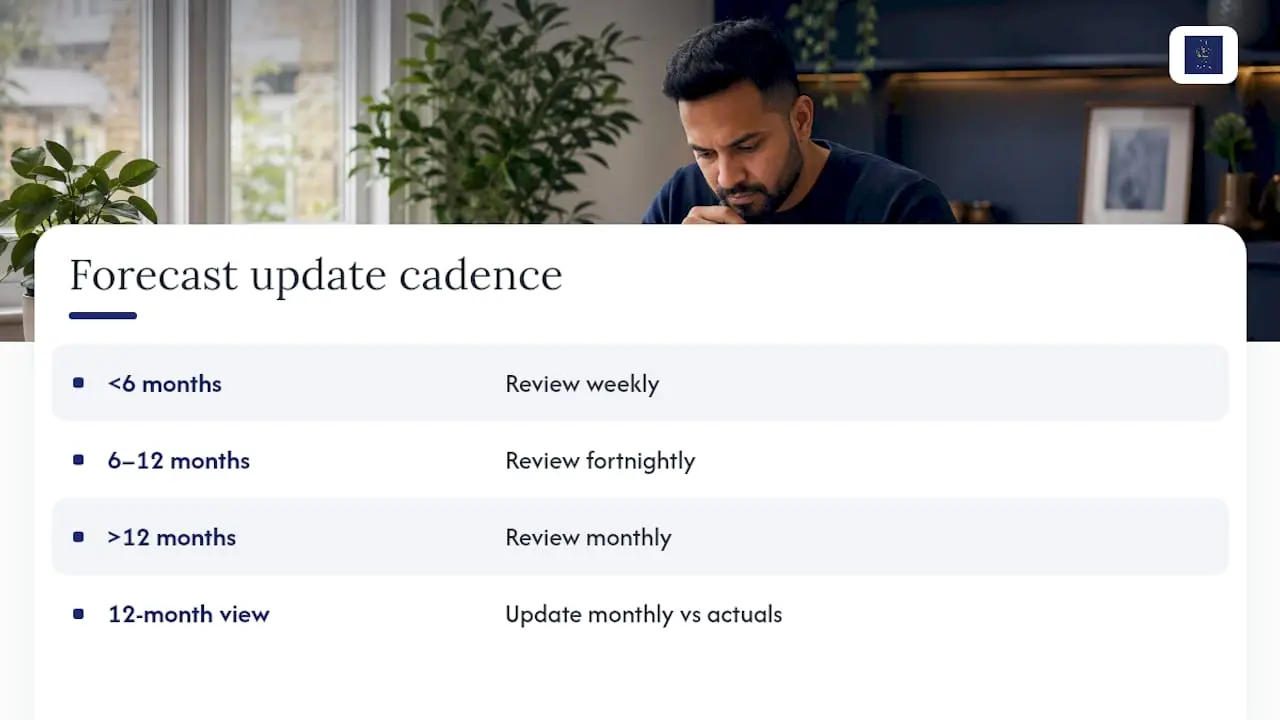
Update frequency should track your runway, not a fixed calendar habit:
- Weekly, if your runway is under six months. At this stage, every payment date matters.
- Fortnightly, if runway sits between six and 12 months.
- Monthly, once runway is comfortably above 12 months and trading is stable.
For accuracy, use confirmed invoices and known payment dates for the next four to eight weeks, then fall back on reasonable averages for the weeks beyond that. Trying to forecast week 12 with the same precision as week 1 wastes effort you don’t have spare.
Modelling base, downside and best-case scenarios
A single forecast line gives you one version of the future, and it’s rarely the version that happens. Building three scenarios, base, downside and best case, gives you a realistic range instead.
The downside scenario is the one that actually matters operationally. It’s what tells you when to pull the trigger on cost-cutting, not the optimistic case you’d love to be true.
- Base case: your realistic, most-likely trading assumptions
- Downside case: a delayed launch, a lost customer, or slower payment terms than expected
- Best case: faster growth or an early contract win, useful for planning but not for survival decisions
Your runway calculation should come from the downside scenario, and that number should set your fundraise timeline. Founders who start fundraising conversations when they have six months of runway left are usually raising under pressure, which shows in the terms they accept.
Pro Tip: Write down your trigger points now, while you’re calm. “If runway drops below four months, I freeze hiring.” “If it drops below two, I start bridge conversations.” Deciding this in advance removes the emotion from a decision you’ll otherwise make in a panic.
Common forecasting mistakes and quick fixes
Most forecasting failures trace back to a small handful of avoidable habits, and the Federation of Small Businesses flags optimistic payment timing and missing one-off costs as the two most common.
- Mixing up profit and cash, so the forecast quietly becomes a profit projection instead
- Assuming customers will pay on your invoice terms rather than their actual habits
- Missing one-off cliffs entirely: VAT quarters, annual insurance, software renewals
- Building the forecast once and never updating it against what actually happened
How I help startups get their forecasts right
I’m Chris White, an AAT-licensed accountant running CWABC from Hildenborough, near Tonbridge, and forecasting is one of the areas where I see the biggest gap between what founders know they should do and what they actually have time to build properly.
I work with founders across Kent and remotely throughout the UK using Xero, QuickBooks, and FreeAgent to turn a rough spreadsheet into a live, workable forecast that updates as your bank feed does.
Support typically covers:
- Building your first 12-month and 13-week forecasts from your actual data
- Scenario planning so you know your trigger points before you need them
- Ongoing Making Tax Digital and VAT support so tax cliffs stop being a surprise
- Bespoke pricing agreed upfront, with no vague hourly guesswork
If you’d rather see the finished shape before we talk, my budgeting and forecasting service page sets out how engagements work.
| Point | Details |
|---|---|
| Build both forecasts | A 12-month monthly view plus a 13-week rolling forecast covers strategic and operational cash needs. |
| Cash isn’t profit | Track money when it lands in the bank, not when the invoice is raised. |
| Buffer your receipts | Reduce expected sales income by 10 to 20% until customers prove they pay on time. |
| Model the downside case | Let the downside scenario, not the base case, set your fundraise timing. |
| Get hands-on support | CWABC builds and maintains startup forecasts using Xero, QuickBooks and FreeAgent. |
What the research says about cash flow forecasting for startups
A well-built cash flow forecast beats a profit projection for survival planning because it exposes exactly when your bank balance runs short, not just whether the business model works.
| Point | Details |
|---|---|
| Cash timing beats profit totals | Runway decisions must come from a monthly bank balance forecast, not a profit and loss statement. |
| Two forecasts, two jobs | The 12-month view satisfies lenders; the 13-week view runs your week-to-week decisions. |
| Downside scenario drives action | Set hiring freezes and fundraise timing from your worst realistic case, not your hoped-for one. |
| One-off costs need their own line | VAT, Corporation Tax and annual renewals should appear as dated cliffs, never smoothed into monthly averages. |
| Professional support closes the gap | CWABC builds and maintains forecasts alongside cloud accounting setup, so figures stay current automatically. |
Why the conventional forecasting advice falls short for founders
Most guidance on this topic treats forecasting as a form-filling exercise for lenders. Build the 12-month spreadsheet, tick the box, move on. That misses what actually keeps startups solvent.
The founders who survive treat the 13-week rolling forecast as the daily instrument, not a nice-to-have layered on top of the annual version. The 12-month forecast satisfies an investor or a lender. The 13-week version is what tells you, this week, whether you can make payroll.
The other gap I see constantly: founders build one forecast line and treat it as fact. A single number gives you false confidence. Three scenarios, base, downside and best case, give you a plan for what you’ll actually do when reality diverges from the spreadsheet, which it always does eventually.
Prioritise this: get the downside scenario right before you polish the best case. It’s the one that tells you when to act, not just when to celebrate.
Get hands-on help building your forecast
If you’d rather have someone build this with you than wrestle with formulas after a long day running your startup, that’s exactly where CWABC fits and how to schedule regular finance reviews with advisers is explained in The business appointment guide for UK service firms – SemLocal. I work directly with founders across Tonbridge, Sevenoaks, Kent, and remotely across the UK to turn scattered bank statements and invoices into a forecast you can actually trust and act on.
Unlike a generic template downloaded from the internet, the forecast I build reflects your actual VAT quarters, payroll dates, and the specific cliffs your business faces, not a smoothed-out average that hides the details that matter. I also set you up on Xero, QuickBooks or FreeAgent so the numbers update themselves rather than needing a manual refresh every month.
If your bookkeeping isn’t quite ready to support a reliable forecast yet, my guide on avoiding common bookkeeping errors is a useful starting point. When you’re ready to talk about building your forecast properly, get in touch through my budgeting and forecasting page and I’ll talk you through how an engagement works and what it costs.
Need help?
If you’d like support building your first cash flow forecast, setting up cloud accounting, or working through a scenario plan before a fundraise, get in touch via my contact page. I’ll talk you through it in plain English, no jargon required.
Frequently asked questions
What’s the difference between a cash flow forecast and a budget?
A budget sets planned income and spending targets for the year. A cash flow forecast tracks when that money actually moves in and out of your bank account, which is why a business can hit its budget and still run short of cash mid-month.
How often should I update my cash flow forecast?
Review your 13-week rolling forecast weekly if your runway is under six months, fortnightly if it’s between six and 12 months, and monthly once you’re comfortably beyond a year. Update your 12-month forecast at least monthly against actual results.
Do I need accounting software to forecast cash flow?
No. A spreadsheet works perfectly well for your first few forecasts. Cloud accounting software like Xero, QuickBooks or FreeAgent becomes genuinely useful once you want automatic bank feeds and real-time actual-versus-forecast tracking.
How far ahead should a startup forecast cash flow?
Build a 12-month view for strategic planning and lender or investor conversations, alongside a rolling 13-week forecast for week-to-week decisions. Anything beyond 12 months becomes increasingly unreliable, so treat longer projections as directional rather than precise.
What should I do if my forecast shows a cash shortfall?
Act on the downside scenario early: consider a hiring freeze, delay discretionary spending, chase overdue invoices, or start fundraising conversations before your runway gets critically short. Predefining these triggers removes the panic from the decision when the shortfall actually appears.
Sources
- How to create a cash flow forecast in 4 steps | British Business Bank
- Cash flow projection for UK small businesses | Capitalise
- Cash flow vs profit: differences and why they matter | Xero UK
- How to write a cash flow forecast (UK guide) | Complete Business Start-up
- How to prepare a cash flow forecast | Federation of Small Businesses (FSB)