Most sole traders should hire a bookkeeper first to keep records current, then bring in an accountant before their first year-end or when a tax or company filing is due. If you run a limited company, employ staff, or face a VAT or Corporation Tax decision soon, get an accountant involved earlier. Some qualified professionals cover both roles under one engagement.
TL;DR:
- A bookkeeper manages daily transaction recording, reconciliation, and VAT preparation, while an accountant interprets data, files taxes, and offers strategic advice.
- Small businesses processing high volumes of transactions or with complex structures like limited companies generally need both roles, especially when approaching deadlines.
- Cloud software like Xero enables real-time collaboration between bookkeepers and accountants, reducing errors and improving efficiency at tax time.
- Qualification standards are more important than job titles, with AAT for bookkeepers and chartered statuses for accountants signifying professional competency.
- Fixed-fee arrangements and thorough qualification checks help avoid unexpected costs and ensure the adviser can handle digital record-keeping requirements.
Table of Contents
- Small business accountant vs bookkeeper: what does each actually do?
- What a bookkeeper does day to day
- What an accountant does: filings, tax and advice
- Bookkeeper vs accountant: the real differences and where they overlap
- When do I need a bookkeeper, an accountant, or both?
- Qualifications and safeguards worth checking
- What does a bookkeeper or accountant cost?
- Questions to ask before choosing an adviser
- How I work with small businesses at CWABC
- Does business size or industry change the decision?
- How does software change the way bookkeepers and accountants work together?
- Editorial take: the job title matters less than you think
- Need help? Get started with CWABC
- Sources
Small business accountant vs bookkeeper: what does each actually do?
The confusion between these two roles usually comes down to one thing: job titles in the UK aren’t regulated the way many people assume. Anyone can call themselves a bookkeeper or an accountant without holding a single qualification. That’s exactly why the distinction matters more in practice than in name, and why “which do I need” is the right question to ask before “who should I hire”.
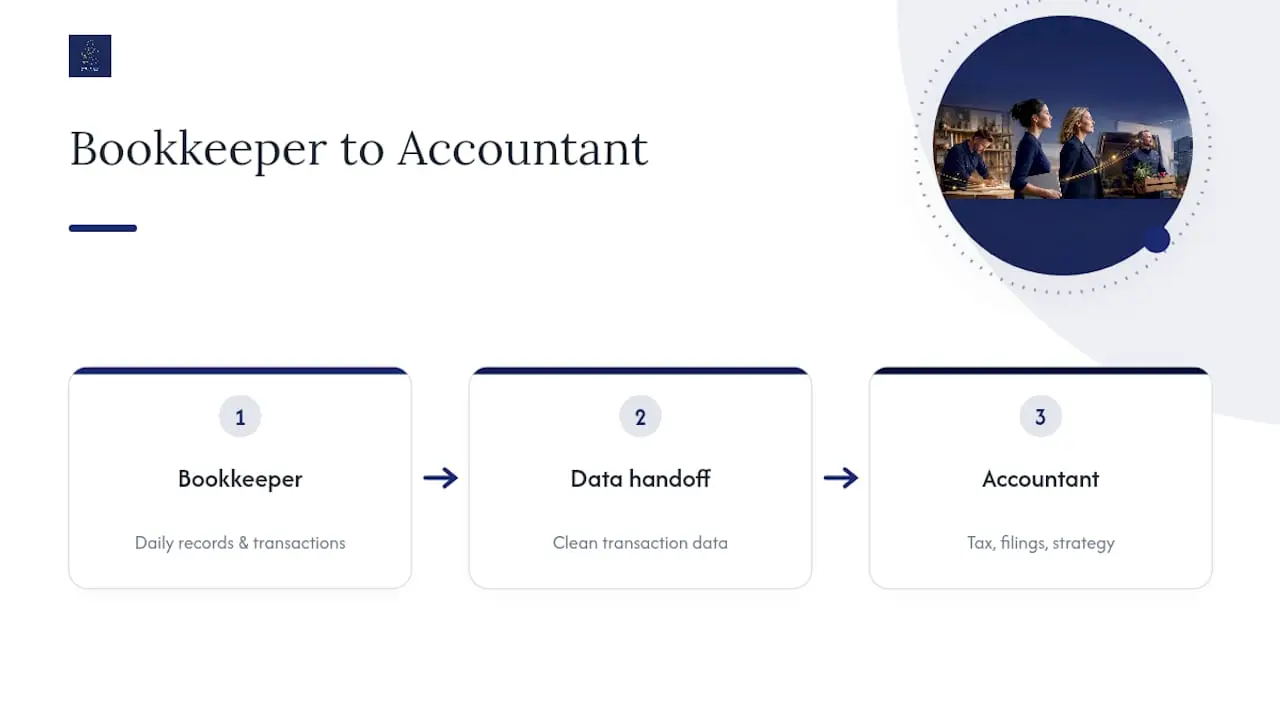
A bookkeeper deals with the raw data of your business, the transactions themselves. An accountant takes that data and turns it into filings, tax positions and decisions. Xero’s guidance on the split puts it plainly: bookkeepers handle daily record keeping and transaction processing, while accountants provide tax planning, statutory filings and strategic analysis. One feeds the other.
What a bookkeeper does day to day
A bookkeeper’s job is repetitive by design, and that’s exactly the point. Consistency is what keeps your numbers reliable. On a weekly or monthly cadence, depending on how your business runs, a bookkeeper typically handles:
- Entering transactions, matching receipts and reconciling your bank accounts
- Raising or recording invoices and capturing expenses accurately
- Preparing VAT-ready ledgers and, where agreed, submitting your VAT returns
- Running basic payroll or CIS processing if that’s part of the engagement
- Keeping everything logged in cloud software such as Xero, so figures are ready whenever you need them
The AAT’s own course content for its Level 3 Certificate in Bookkeeping confirms this scope includes preparing VAT returns and even draft final accounts for sole traders, which shows how far a well-qualified bookkeeper’s remit can stretch.
Pro Tip: Ask any prospective bookkeeper how often they reconcile your bank account. Monthly is the minimum for anything approaching real financial control; weekly is better if your transaction volume is high.
Up-to-date books do more than tick a compliance box. They shorten the time your accountant spends untangling a mess at year-end, which directly affects what you pay them.
What an accountant does: filings, tax and advice
An accountant’s work usually starts where a bookkeeper’s ends: interpreting the numbers rather than just recording them. For a limited company, that means preparing annual accounts and calculating Corporation Tax, both filed against deadlines set out by Gov. For sole traders and company directors, it usually means completing Self Assessment against the deadlines HMRC publishes on GOV.UK.
Beyond the statutory filings, an accountant’s value often shows up in less visible work:
- Producing management accounts that show trends, not just totals
- Building forecasts and budgets to support decisions on hiring, pricing or investment
- Advising on tax planning, including how you extract director’s salary versus dividends
- Keeping filings compliant with both Companies House and HMRC rules
- Reading bookkeeping records critically, spotting errors or opportunities a simple ledger wouldn’t reveal
None of this is legally compulsory for every business structure, but once you incorporate, employ people, or register for VAT, the filing obligations themselves become non-negotiable, whoever completes them.
Bookkeeper vs accountant: the real differences and where they overlap
The clearest way to separate the two roles is by what they produce. A bookkeeper produces accurate records. An accountant produces interpretation, filings and strategy built on those records. That’s the core distinction behind “accountant vs bookkeeper, which is better for small business”: it isn’t really a competition, because they answer different questions.
Some tasks sit in a genuine grey zone. VAT returns and basic payroll are often handled by either, depending on who you’ve engaged and how they’re qualified. Other tasks, like statutory accounts and Corporation Tax computations, are almost always accountant territory.
A useful shorthand: if the task is about recording what happened, it’s bookkeeping. If it’s about deciding what it means or filing it with HMRC or Companies House, it’s accountancy. Payroll and VAT can sit on either side depending on the provider’s scope.
- Bookkeepers typically charge on a recurring basis, reflecting the ongoing nature of the work
- Accountants often charge periodically, usually linked to VAT quarters or the annual accounts and tax return cycle
- A scenario: a sole trader with tidy bookkeeping might only need an accountant around Self Assessment time once a year
- A scenario: a growing limited company might need both working in tandem year-round
This overlap is precisely why Unbiased’s comparison of the two roles notes that many small businesses end up using both, rather than picking one.
When do I need a bookkeeper, an accountant, or both?
Deciding “do I need a bookkeeper” versus “do I need an accountant” comes down to a handful of practical triggers rather than guesswork. Work through these in order:
- Check your transaction volume. If you’re processing dozens of invoices or expenses a month and losing hours to admin, a bookkeeper earns their fee quickly.
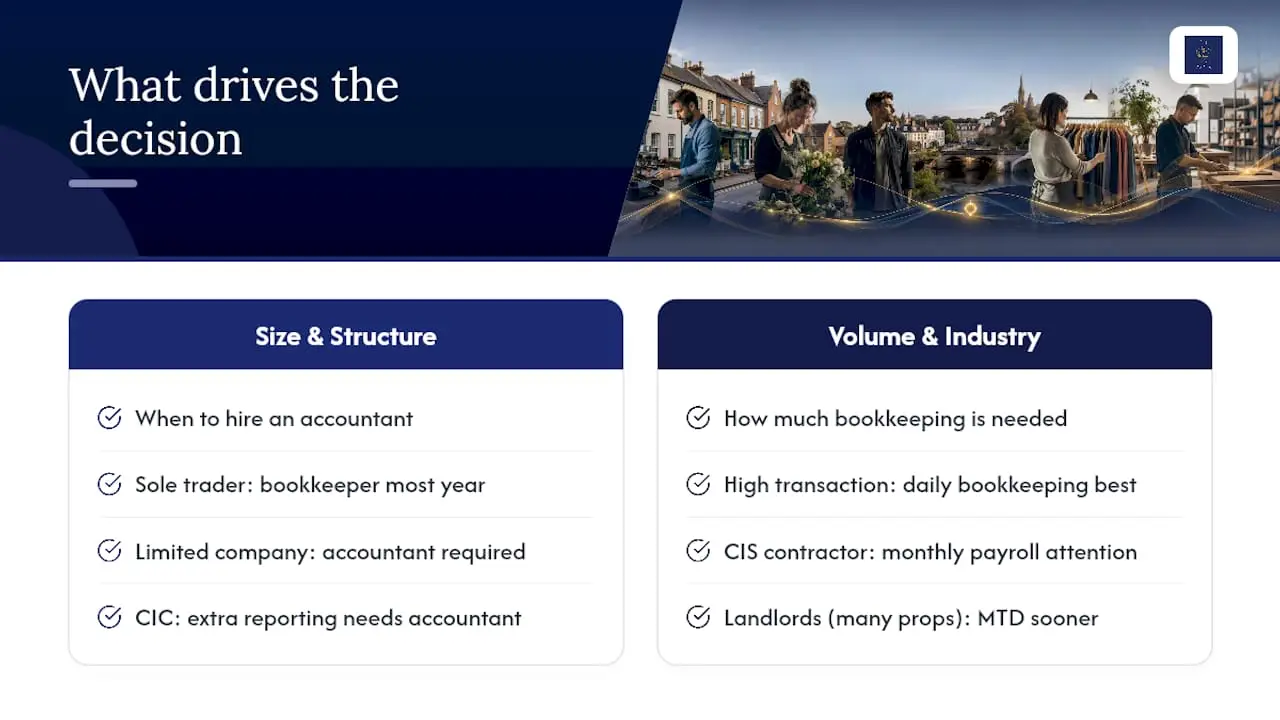
- Check your structure. Sole trader with simple affairs? A bookkeeper may cover most of the year, with an accountant stepping in for Self Assessment. Limited company, CIC or employer? You’ll need accountancy support for statutory filings regardless.
- Check for warning signs. Being months behind on reconciliations, receiving HMRC contact, or chasing your own invoices late are all signals you’ve outgrown DIY bookkeeping.
- Check your tax timeline. If a VAT registration, payroll setup or your first year-end is approaching, bring an accountant in before the deadline, not after.
Making Tax Digital for Income Tax raises the stakes on point four. GOV.UK has confirmed the rollout affects a large number of sole traders and landlords, which is why acting on digital record keeping now, rather than scrambling later, matters.
Pro Tip: Hire the bookkeeper first if your records are behind. Clean data makes every later conversation with an accountant faster and cheaper.
Qualifications and safeguards worth checking
Job titles aren’t protected in the UK, so credentials do the real work of reassurance. For bookkeepers, look for AAT qualifications, which set out defined skill levels from basic data entry through to VAT returns and draft accounts. For accountants, chartered status through ACA, ACCA or CIMA signals recognised training and ongoing professional standards.
Beyond letters after a name, check for:
- Current membership with the stated professional body (most bodies offer online verification)
- Anti-money laundering (AML) supervision, either through HMRC or their professional body
- Professional indemnity insurance in place
- Familiarity with the cloud software you use or want to use, such as Xero, QuickBooks or FreeAgent, particularly for MTD readiness
What does a bookkeeper or accountant cost?
Pricing shapes vary more than most people expect. Bookkeepers commonly charge a fixed monthly fee scaled to transaction volume, though some still bill hourly. Accountants tend to charge either an annual fee for year-end accounts and Self Assessment, or a fixed monthly retainer that bundles ongoing support with the yearly filings.
- VAT registration, payroll headcount and any historic “clean-up” work all push fees upward
- Messy books handed to an accountant cost more in their time, which shows up in your bill
- Always ask for a fixed fee on routine, predictable work rather than accepting open-ended hourly billing
Xero’s research makes the cost link explicit: automating and keeping bookkeeping current reduces the time an accountant needs at year-end, which lowers your overall bill. If you’d rather know the number upfront than guess, fixed-fee accounting removes that uncertainty entirely.
Questions to ask before choosing an adviser
A short call or email exchange should tell you most of what you need to know. Work through this list before committing to anyone:
- What qualifications do you hold, and which professional body are you registered with?
- Are you supervised for anti-money laundering purposes, and by whom?
- Which cloud accounting software do you use, and can you handle Making Tax Digital submissions on my behalf?
- How do you charge, exactly what’s included, and can I see a sample engagement letter?
- How often will we communicate, what are your typical turnaround times, and how do you keep my data secure?
Compare answers side by side rather than relying on gut feel. My checklist for hiring a small business accountant covers this in more depth if you want a fuller version to work through.
How I work with small businesses at CWABC
I run a system-led practice, meaning cloud software such as Xero, QuickBooks and FreeAgent sits at the centre of how I work, not as an add-on. Fees are agreed upfront and tailored to scope, so there’s no surprise billing at year-end. Most clients start with bookkeeping to get records current, then bring me in as their accountant ahead of their first year-end or a major tax decision. Because I hold AAT qualifications and cover both roles, clients get one point of contact for MTD deadlines, HMRC correspondence and everything in between, rather than juggling two advisers who don’t talk to each other.
Does business size or industry change the decision?
Scale changes the calculation more than most guides admit. A sole trader with one income stream and modest turnover can often manage with a bookkeeper for most of the year, calling in accountancy support only for Self Assessment. That’s a genuinely light touch model, and it works.
Add complexity and the equation shifts fast. A limited company automatically brings statutory accounts and Corporation Tax into play, both of which need accountancy input regardless of turnover. A CIC has its own reporting expectations on top of standard company filings. Landlords with multiple properties face MTD requirements sooner than many other sole traders, given how GOV.UK’s guidance on the MTD rollout is being phased in.
Industry matters too, though less obviously. A CIS-registered contractor needs payroll and subcontractor deductions handled correctly every month, not just at year-end, which usually means bookkeeping support has to be tighter and more frequent than a simple service business would need. A business with high transaction volume, such as retail or hospitality, benefits from a bookkeeper’s daily attention far more than a consultancy invoicing three clients a month.
The honest rule: size and structure decide when you need an accountant. Volume and industry decide how much bookkeeping support you need to get there cleanly. Startups sit in an odd middle ground, often needing accountancy advice early, on structure and forecasting, well before they need daily bookkeeping.
How does software change the way bookkeepers and accountants work together?
Cloud accounting has quietly rebuilt the relationship between these two roles. A decade ago, a bookkeeper handed over a spreadsheet or a box of receipts, and an accountant rebuilt the picture from scratch every year-end. That handover was slow, and it was where most errors crept in.
With software such as Xero, both roles now work from the same live ledger. A bookkeeper enters transactions and reconciles the bank feed; the accountant logs into the same file to review management accounts, run forecasts or check a VAT position, often in real time rather than waiting for a year-end handover. That shared visibility is a large part of why Making Tax Digital leans so heavily on digital record keeping rather than paper ledgers.
It also changes what “good” looks like in a bookkeeper. Software accreditation, genuine fluency with Xero, QuickBooks or FreeAgent rather than a passing familiarity, has become as important as the bookkeeping fundamentals themselves. An accountant who can’t work inside your software, or a bookkeeper who can’t produce MTD-compliant digital records, creates friction that costs you money in duplicated effort. For further reading on the practical side of this, Aibarra’s 2026 guide to bookkeeping for small business owners is a useful companion resource.
Editorial take: the job title matters less than you think
The conventional advice on this topic obsesses over the wrong question. “Accountant or bookkeeper” implies a binary choice, when the more useful question is “what qualifications, software fluency and scope does this person actually offer, regardless of what they call themselves”. A bookkeeper with AAT Level 3 can prepare VAT returns and draft accounts competently. An accountant without proper software fluency can be slower and costlier than a well-equipped bookkeeper for routine work.
Where most guides fall short is treating the two roles as permanently separate. In practice, a suitably qualified professional can cover both, and for many small businesses that’s the better outcome: one point of contact, one login, one person who already understands your numbers when a tax decision needs making quickly.
It is best to prioritise credentials, AML supervision and software fluency over job titles every time. Ask the questions in this guide before you ask “accountant or bookkeeper”. The answer usually sorts itself out once you know what the person in front of you can actually do.
— Chris
Need help? Get started with CWABC
If you’ve read this far and you’re still not sure whether you need a bookkeeper, an accountant, or both, that’s exactly the conversation worth having before you commit to anyone. I offer bookkeeping, Self Assessment, VAT returns, payroll and CIS, and Making Tax Digital setup and support, all built on cloud software with fees agreed upfront rather than guessed at.
An initial chat covers your current setup, what’s behind or missing, and which combination of bookkeeping and accountancy actually fits your situation, whether that’s a sole trader needing clean monthly records or a limited company approaching its first year-end. Scope and pricing get agreed clearly before any work starts, so there are no surprises later. If you’re ready to sort this properly, get in touch with CWABC and I’ll talk you through the options.
Sources
- Bookkeeper vs accountant: which does your business need? | Xero
- AAT Level 3 Certificate in Bookkeeping