Payments on account are two advance instalments towards next year’s Self Assessment bill, each worth half of what you owed the year before. If your Income Tax and Class 4 National Insurance came to more than the threshold that requires payments on account last year, and less than most of your tax was already collected at source (through PAYE, for example), you’ll normally need to make them.
The two dates to circle on your calendar are 31 January and 31 July. A balancing payment, settling up the difference between what you’ve paid and what you actually owe, then falls due the following 31 January too.
- 31 January: first payment on account (plus any balancing payment from the previous year)
- 31 July: second payment on account
- Following 31 January: balancing payment for the year just ended
Key Takeaways
Payments on account split your Self Assessment bill into two advance instalments, each based on half your previous year’s Income Tax and Class 4 NIC liability, due 31 January and 31 July.
| Point | Details |
|---|---|
| Who pays | Required if last year’s tax plus Class 4 NIC exceeded £1,000 and under 80% was collected at source. |
| Key dates | Instalments fall due 31 January and 31 July, with the balancing payment the following 31 January. |
| Watch the January double bill | First-time payers can see a bill significantly larger than last year’s liability when both land together. |
| Reducing payments | Use SA303 or HMRC’s online service, claim by 31 January after the tax year ends, and keep your reasoning documented. |
| Getting help | CWABC can estimate your instalments, assess whether a reduction is justified, and set up payment plans to avoid cash-flow shocks. |
Table of Contents
- Who has to make self assessment payments on account?
- How is your payment on account worked out?
- What’s the difference between a balancing payment and payments on account?
- Can you reduce or cancel your payments on account?
- How do you pay, and how far ahead should you allow?
- What happens if you miss a payment on account?
- How do you check your figures in your HMRC Personal Tax Account?
- Common mistakes I see with payments on account
- A quick word from Chris
- How I can help with your payments on account
- Need help with your payments on account?
- Sources
Who has to make self assessment payments on account?
You’ll normally fall into payments on account if your Self Assessment Income Tax plus Class 4 NICs exceeded £1,000 last year, and less than 80% of that tax was collected automatically at source. Capital gains, student loan repayments and voluntary Class 2 National Insurance don’t count towards that £1,000 test, even though they might appear elsewhere on your return.
Two quick examples make this clearer:
- A sole trader whose profits pushed their tax bill to £1,400 last year will almost certainly be asked for payments on account this year.
- An employed person with a small side income, where most tax is already deducted through PAYE, may sit comfortably under the 80% exception and pay nothing extra in advance.
Landlords with rental profits above the threshold are treated exactly the same as sole traders here. Nobody gets a free pass just because the income is passive.
How is your payment on account worked out?
The formula behind payments on account is refreshingly simple once you see it written down:
- Take your previous year’s Income Tax liability.
- Add your Class 4 National Insurance liability for that same year.
- Halve the total. That’s one payment on account.
- Repeat the same figure for the second instalment.
Capital gains and the High Income Child Benefit Charge are left out of this calculation entirely. They only appear later, in your balancing payment, which sometimes surprises people who assumed everything was already covered.
The 50% rule in practice: if your 2024/25 tax and Class 4 NIC liability came to £3,000, each payment on account for 2025/26 is £1,500, one due 31 January, one due 31 July.
Say your final 2025/26 bill turns out to be £3,600 rather than £3,000. You’ve already paid £3,000 through your two instalments, so you’ll owe a £600 balancing payment, plus your first payment on account for 2026/27, which is half of the new £3,600 figure, or £1,800. That’s £2,400 landing on the same day.
Pro Tip: If this is your first year making payments on account, or your income jumped last year, brace for a January bill that can be significantly larger than your previous year’s liability, due to paying the balancing figure and the first instalment together, because you’re often paying the balancing figure and the first instalment together.

What’s the difference between a balancing payment and payments on account?
The balancing payment is the final reckoning: your actual tax bill for the year, minus whatever you’ve already paid through your two instalments. It falls due on the following 31 January, alongside your first payment on account for the new tax year.
- It captures anything payments on account don’t, including capital gains and student loan repayments.
- It can be a bill you owe HMRC, or occasionally a refund if you’ve overpaid.
- Because it lands on the same date as your next first instalment, late January is usually the most expensive date in a self-employed person’s calendar.
Can you reduce or cancel your payments on account?
If you genuinely expect this year’s profits to fall, perhaps you’ve lost a major client, claimed new reliefs, or moved into employment with more tax deducted at source, you can apply to reduce your payments on account using form SA303 or HMRC’s online service.
To make a claim, you’ll typically need:
- Your Unique Taxpayer Reference (UTR).
- The office reference shown on your latest Self Assessment statement.
- A realistic estimate of your expected tax liability for the year, and your reasoning for it.
The claim must reach HMRC by 31 January following the end of the tax year. One successful claim adjusts both the January and July instalments together, so there’s no need to submit separately for each date.
Here’s the catch: if you reduce your payments and your actual liability turns out higher than estimated, HMRC charges interest on the shortfall from the original due dates, and can apply penalties where the reduction looks unreasonable rather than a genuine, careful forecast.
- Reasonable grounds to reduce: a clear drop in trading profits, new reliefs or losses, more income now taxed at source.
- Reason to be cautious: guessing low just to ease cash flow without solid evidence behind the figure.
Pro Tip: Keep a short written note of why you reduced your payment, your figures, your reasoning, your date. If HMRC ever queries it, you’ll want more than “it felt about right.”
How do you pay, and how far ahead should you allow?
You can pay your Self Assessment bill several ways: through the HMRC app, Faster Payments or online banking, Bacs, CHAPS, Direct Debit, debit or credit card, or a bank paying-in slip. Each has its own lead time, so leaving everything to the last afternoon is risky.
| Payment method | Time to allow |
|---|---|
| Faster Payments (online/telephone banking) | Same or next day |
| CHAPS | Same or next working day |
| Debit or credit card | Same day |
| Bacs | Three working days |
| Direct Debit (not already set up) | Five working days |
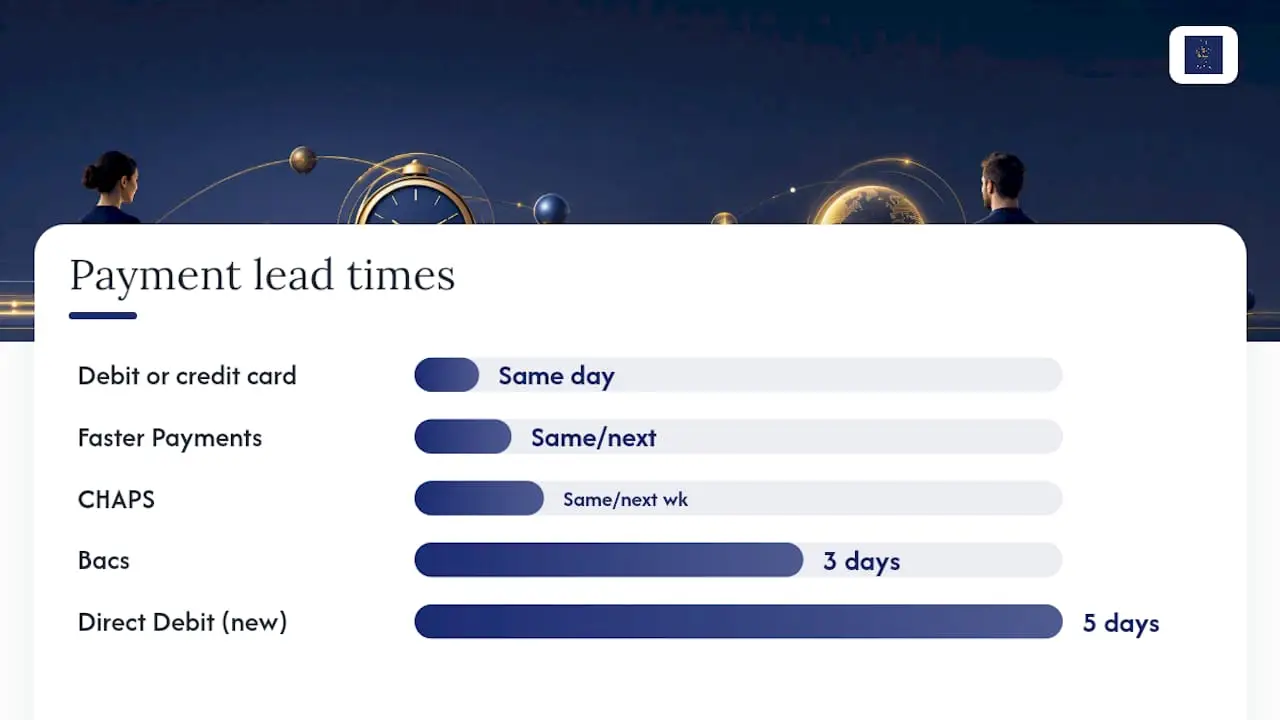
If a deadline falls on a weekend or bank holiday, HMRC still expects payment to clear by the same date, so build in the extra time unless you’re using Faster Payments or a card.
Pro Tip: HMRC has encouraged more taxpayers to use the app to check what’s owed and pay directly, and setting up a Direct Debit or a weekly or monthly payment plan both help make sure your money reaches the right tax year without a last-minute scramble.
What happens if you miss a payment on account?
HMRC charges interest on any unpaid tax from the day after the due date, at rates set by HMRC and reviewed periodically. Unlike a late balancing payment, missed payments on account don’t usually trigger the same late-payment penalty structure, but the interest clock starts regardless.
- Interest accrues daily until the balance is cleared.
- Balancing payments that stay unpaid can eventually attract penalties on top of interest.
- Amended returns or late notices can shift the usual payment timetable, so check your statement if your circumstances have changed.
If you can see a payment coming that you won’t be able to meet in full, contact HMRC before the deadline rather than after it. A Time to Pay arrangement, spreading the amount over instalments, is far easier to agree proactively than once the debt has escalated.
How do you check your figures in your HMRC Personal Tax Account?
Your Personal Tax Account shows your Self Assessment statement, including each payment on account and any balancing payment due.
- Sign in to your Government Gateway account and open the Self Assessment section.
- Check the tax year label on each line, the amount shown, and whether payments already made have been credited.
- Confirm that tax deducted at source, such as PAYE or CIS deductions, has been reflected correctly.
If something looks wrong, don’t just assume HMRC is right. You may need to correct an error on your return, contact HMRC directly, or submit an SA303 claim if the figures need adjusting downward.
Common mistakes I see with payments on account
Three mistakes come up again and again. People forget the January double payment is coming and get caught short. They reduce their payments on account too optimistically, based on hope rather than numbers. And they forget capital gains sit outside the instalment system entirely, only surfacing in the balancing payment.
Two habits fix most of this. Keep a separate savings pot for tax, topped up monthly rather than found in a panic. And if your income shifts significantly mid-year, revisit your figures rather than waiting for the January surprise.
As an AAT-licensed practice, I spend a good part of January and July helping clients work out exactly what they owe and why, before the deadline rather than after it.
A quick word from Chris
Early planning is what separates a manageable tax bill from a stressful one. I typically get involved with clients a few months before a payment deadline, when there’s still time to forecast properly, check whether a reduction genuinely makes sense, and avoid the January scramble altogether. Every situation is different, so treat this guide as general information rather than advice tailored to your own figures.
How I can help with your payments on account
Working out your payments on account shouldn’t mean guessing and hoping for the best. As an AAT-licensed practice based in Hildenborough near Tonbridge, I help sole traders and landlords estimate their instalments accurately, decide whether an SA303 reduction genuinely stacks up, and set up payment plans that suit their actual cash flow, rather than a one-size-fits-all approach.
My services cover Self Assessment filing, payments on account estimates, SA303 claims where a reduction is justified, and the kind of ongoing bookkeeping that means fewer surprises come January. If you’d like a clear, practical read on what you’re likely to owe and when, visit my Self Assessment services for Tonbridge and Kent page, or get in touch to talk through your figures before the next deadline creeps up on you.
Need help with your payments on account?
If you’d rather have a clear figure than a guessing game, contact CWABC and I’ll help you work out exactly what you owe, when, and whether a reduction makes sense for your circumstances.
This article is general information, not a substitute for advice from a qualified financial advisor. Consult a qualified financial professional about your own circumstances before acting on anything here.
Sources
- Gov