If your bookkeeping has slipped by a few months, or a few years, you are in good company, and it is very fixable. The way out is a set order of work: establish which periods are missing, gather the bank statements and invoices, reconcile, chase what is still missing, correct the VAT coding, and file in order of urgency. I help sole traders, landlords, startups and limited company directors across Tonbridge, Sevenoaks and Kent, and remotely across the UK, do exactly that, and this guide walks through the same recovery process so you can see what is involved.
TL;DR
- Start by listing the periods that are missing, then rank your filing deadlines before you touch a single transaction.
- Your bank statements are the backbone of any catch-up. Rebuild the books from them, then match invoices and receipts to each line.
- If records are genuinely lost, recreate them as best you can and tell HMRC what happened and which figures are estimates.
- Late filing penalties grow over time, so a filed return with clearly labelled estimates is usually better than a perfect one filed late.
- If you have more than a quarter or two to recover, or VAT is involved, professional help is often the quicker and calmer route.
Table of Contents
- First, take a breath and look at the real size of the problem
- Rank your deadlines before you start the books
- Step 1: Establish exactly which periods are missing
- Step 2: Gather bank statements first, then invoices and receipts
- Step 3: Get every bank line into the books
- Step 4: Reconcile and match the paperwork
- Step 5: Identify what is missing, and replace what you can
- Step 6: Correct the VAT coding
- Step 7: File in priority order, using labelled estimates where needed
- A realistic recovery checklist
- When professional help is worth it
- How I approach catch-up work
- Starting a new business and not wanting to fall behind
- Making Tax Digital makes tidy records matter more
- Where I can take the weight off you
- A word from me
- FAQ
- Need help catching up?
- Sources
First, take a breath and look at the real size of the problem
Being behind on bookkeeping feels worse than it usually is. The pile of unopened statements and half-labelled receipts looks like chaos, but most catch-ups turn out to be a finite job: a known number of months, one or two bank accounts, and a stack of invoices.
Before doing any bookkeeping at all, answer four questions on a sheet of paper:
- Which business are we talking about? A sole trader, a limited company, a landlord with rental income, or a mix?
- Which periods are missing? Write the first and last date with no up-to-date records.
- Which accounts were used? Business bank accounts, personal accounts used for business, credit cards, PayPal, Stripe or similar.
- What has already been filed? VAT returns, payroll submissions, Self Assessment, a Company Tax Return, and accounts at Companies House (the public register of UK companies).
That last question matters most. Work that has already gone to HMRC (HM Revenue and Customs, the UK tax authority) is the work you must be careful not to contradict. Work that is still due is where your deadlines sit.
Rank your deadlines before you start the books
The most common catch-up mistake is starting at the oldest month and working forwards for weeks, while a nearer deadline quietly passes. Rank first, then recover.
The usual deadlines for a small business look like this:
| Obligation | Who it applies to | What to check |
|---|---|---|
| Self Assessment tax return | Sole traders, landlords, partners | The return is due by 31 January after the tax year ends; paper filing has an earlier date |
| VAT return | VAT-registered businesses | Each return has its own due date, normally a month and seven days after the period ends |
| Payroll submissions | Employers | Reported to HMRC each time you pay staff |
| CIS monthly return | Contractors in construction | Due monthly |
| Company Tax Return | Limited companies | Due 12 months after the accounting period ends |
| Annual accounts | Limited companies | Filed with Companies House on a separate deadline |
My guides to sole trader tax deadlines and the small business tax deadline calendar set these out in more detail.
Why order matters: what late filing costs
Penalties are the reason to rank. For Self Assessment, GOV.UK sets out an initial £100 penalty for a late return, then daily penalties of £10 per day after three months up to a maximum of £900, and a further penalty after six months of 5% of the tax due or £300, whichever is greater. Late payment has its own penalties on top.
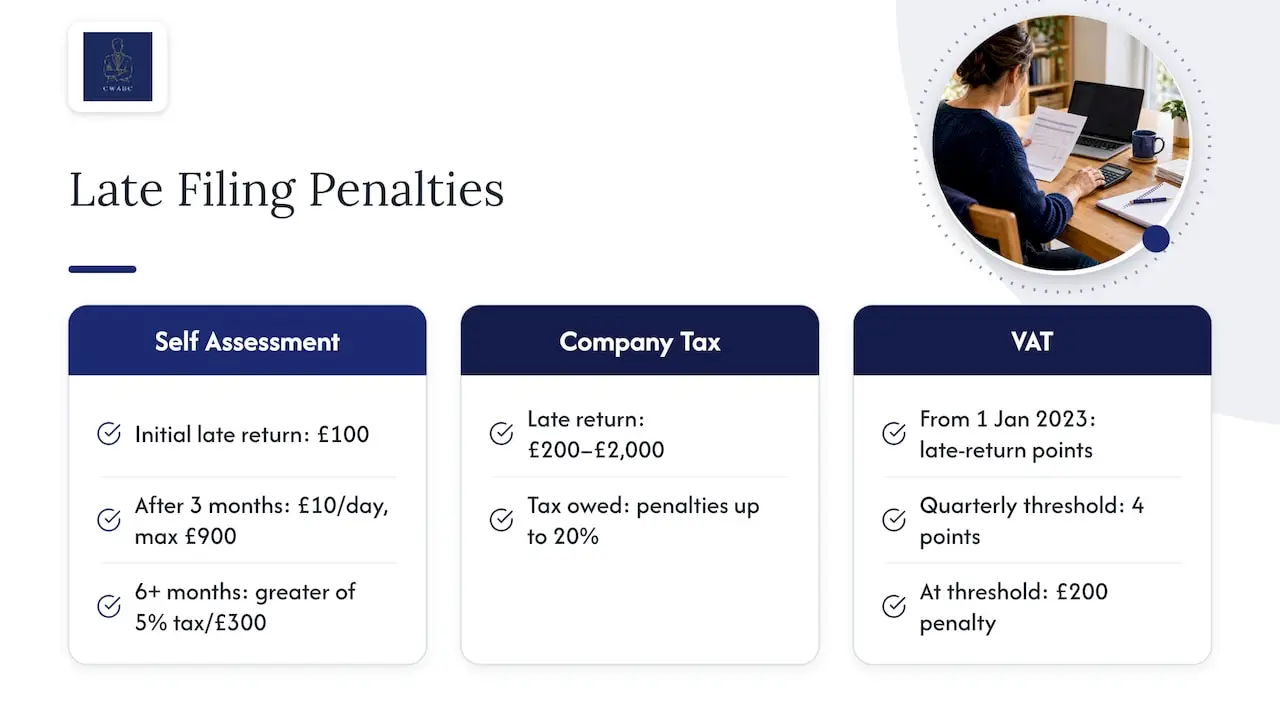
For limited companies, HMRC’s guidance says late Company Tax Return penalties start at a flat £200 and can rise to £2,000, with tax-related penalties of up to 20% of any unpaid tax added where tax is owed.
For VAT, late returns earn penalty points from 1 January 2023, and reaching the threshold (four points for quarterly filers) triggers a £200 penalty.
So the rule of thumb is simple: anything already late and still growing in cost comes first, then whatever is due next, then everything else. A VAT return that is a month overdue usually outranks a tax return that is not due for another six months, even if the tax return covers older transactions.
Step 1: Establish exactly which periods are missing
Open your accounting software, spreadsheet or folder and find the last point where you can say with confidence, “everything up to here is right.” That is your restart date. If you use software such as Xero, QuickBooks or FreeAgent, check the last bank reconciliation date. If you use a spreadsheet, check the last row that you actually matched to a statement.
Then set your end date as today’s date, or the most recent full month. The period between the two is your catch-up window.
Two things to watch here:
- Accounting periods that do not line up. A sole trader’s accounting date may match the tax year (6 April to 5 April), which GOV.UK notes can make the return easier because HMRC works out tax by tax year. If yours differs, profits have to be split across two periods, so note your accounting date now.
- Gaps hiding inside the window. A business can be “up to date” in the software while a whole credit card or a PayPal account was never added. Check that every account that touched the business is accounted for.
Step 2: Gather bank statements first, then invoices and receipts
Bank statements are the backbone of the recovery. HMRC’s record-keeping guide says you need to keep statements for any account that business money was paid into or drawn from, and if you do not have a separate business account you must be able to show which transactions were personal and which were business.
Download statements for the whole catch-up window, for every account. Where you can, use the bank’s CSV or direct feed rather than PDFs, because a feed can be imported in minutes instead of typed in line by line.
Then collect the supporting paperwork:
- Sales invoices you issued, including any you never chased.
- Purchase invoices and receipts, paper or electronic. Check email inboxes, supplier portals and card statements for the digital ones.
- Payroll records if you employ anyone, and CIS statements if you work in construction.
- Loan, hire purchase and asset details, as these affect more than one line of the books.
- Previous VAT returns and the last set of accounts, which give you opening balances.
GOV.UK’s list of what self-employed people must keep includes records of all sales and income, all business expenses, VAT records if registered, and PAYE records if you employ people. Proof can be receipts, bank statements, sales invoices, till rolls and bank slips.
Do not wait until the folder is perfect. Gather what you can in one sitting and move on, because the next steps will show you exactly what is still missing.
Step 3: Get every bank line into the books
With the statements imported or entered, every line has to land in a category: income, a type of expense, a transfer between your own accounts, a personal drawing, a loan repayment, a tax payment and so on.
Two habits keep this quick:
- Do the obvious ones in bulk. Software bank rules can sort repeat payments such as software subscriptions, insurance, fuel or rent in one go.
- Park the unknowns. Put anything you do not recognise into a holding or suspense category and carry on. Chasing one £48 payment for an hour is how catch-ups stall.
If you are a sole trader mixing personal and business spending through one account, this is where the work is slower. HMRC’s guide also expects you to record amounts taken out for personal use and money paid in from personal funds, so those lines need a clear label rather than being dropped into expenses.
Step 4: Reconcile and match the paperwork
Reconciling means checking that the balance in your books agrees with the balance on the bank statement at the end of each month. It is the single best test that the recovery is right.
Work one month at a time:
- Match each bank line to an invoice or receipt.
- Check the closing balance in the software against the statement.
- If they differ, the difference is a missing, duplicated or mis-typed line. Find it before moving on.
- Lock or note the month as done.
Doing it month by month matters. A difference found in January is easy to trace. The same difference discovered after twelve months of entries is a weekend’s detective work.
If you are on the cash basis, which GOV.UK says is now the default for self-employed businesses from the 2024 to 2025 tax year, income is recorded when the money arrives and expenses when you pay, so bank dates drive the picture. My guide to cash basis accounting for sole traders explains how that affects your records.
Step 5: Identify what is missing, and replace what you can
After matching, you will have a list of bank lines with nothing behind them. That list is your “queries” list, and it is the most useful output of the whole exercise.
Sort it into three groups:
- Replaceable. Suppliers can re-issue invoices, online accounts hold history, and email confirmations can be searched. Request them in a single batch.
- Explainable. A bank statement line with a clear description, a diary entry or a message thread can often show what a payment was for, even without a receipt.
- Genuinely lost. Nothing can be replaced and nothing explains it.
For the last group, the official position is calm and practical. HMRC says that if records are lost or destroyed and cannot be replaced, you should tell HMRC what happened, do your best to recreate them, use the replacement information to complete your return, and say if you used provisional figures. For a limited company, GOV.UK says you should recreate records as best you can, tell your Corporation Tax office straight away and include this in your Company Tax Return.
It also helps to know how HMRC views this. Its enquiry manual on small businesses acknowledges that owners often keep incomplete records because books are not written up regularly, and describes reconstructing accounts from bank statements, paying-in books and cheque stubs, totalling expenditure by heading and using estimates where records are missing. Reconstruction from bank evidence is a recognised method, not a confession.
Step 6: Correct the VAT coding
If you are VAT-registered, catch-up bookkeeping carries an extra risk. Quick, bulk coding often gets VAT wrong, and VAT returns are built directly from those codes.
Check these before any return is prepared or amended:
- VAT rate on each purchase. Standard, reduced, zero-rated, exempt and outside the scope are different things, and not every expense carries reclaimable VAT.
- Invoices that do not support a reclaim. For VAT-registered businesses, invoices should show the VAT amount, VAT registration number and rate. Without a valid document, the VAT on a purchase is often not reclaimable.
- Mixed-use items. A phone or vehicle used partly for business should only have the business portion treated as an expense. The Tax Confident guidance gives the example of a phone used 50% for business at £30 a month, where £15 a month is recorded.
- Sales without VAT charged. If you crossed the registration threshold at some point, work out when. My VAT registration guide covers the threshold, and VAT return explained shows how the boxes on a return are built.
- Returns already filed. If earlier returns contain errors, the correction has to be made properly, not by quietly adjusting this quarter.
Outstanding VAT returns are also where an overdue business is most exposed, since late submission points build quickly. If this is your position, my VAT returns service is there for exactly this kind of backlog.
Step 7: File in priority order, using labelled estimates where needed
Now go back to your ranked deadline list. Once a period is reconciled and the query list is down to a handful of items, prepare the filing for it.
A few principles:
- File the most urgent period first, even if later periods are untidy. An accurate filed return stops penalties growing.
- Label estimates honestly. If a figure is provisional, say so when you file, and tell HMRC why.
- Pay what you can. Filing and paying are separate. A late payment attracts its own penalties and interest, so if you cannot pay in full, contact HMRC early.
- Keep a note of what you did. A one-page record of how the books were rebuilt and which items were estimated helps if HMRC asks questions later.
If an already-filed return turns out to contain mistakes, my guide to correcting tax return mistakes explains how.
A realistic recovery checklist
Here is the whole process in one place. Tick each step off in order.
- Write down the restart date and the end date of the missing window.
- List every account used: bank, card, PayPal, payment processors.
- List what has already been filed, and what is overdue or due soon.
- Rank deadlines: already late first, then next due, then the rest.
- Download statements for every account across the window.
- Collect sales invoices, purchase invoices and receipts into one folder.
- Import bank data into your accounting software.
- Categorise obvious lines in bulk; park unknowns in a holding category.
- Reconcile month by month against the statement balance.
- Build a query list of unmatched lines and request replacements in one batch.
- Decide what is estimated, and note why.
- Correct VAT coding before any VAT return is prepared.
- Prepare and file the most urgent period first.
- Set a weekly slot, even 20 minutes, so you never fall behind in the same way again.
A realistic pace is a month or a quarter per sitting, rather than the whole backlog in one night. For small businesses with simple, single-account records, a few evenings may be enough. Where there are several accounts, VAT, payroll and lost paperwork all at once, it takes longer.
When professional help is worth it
Catching up alone is perfectly possible. But some situations are where help typically saves time and stress:
- You are more than two or three months behind and the periods include VAT.
- Deadlines have already passed and penalties have started.
- Personal and business spending are mixed and you cannot untangle them.
- You have lost records and are unsure how to describe the gap to HMRC.
- You are a limited company director and both a Company Tax Return and annual accounts are outstanding.
- You employ staff or work under CIS and the monthly submissions are behind.
- You simply cannot face it. That is a good enough reason too.
My post on five signs your bookkeeping needs professional help is a quick way to check where you stand. If you are choosing who to hire, the hire an accountant checklist lists what to ask.
How I approach catch-up work
When someone gets in touch about being behind, I start with a conversation, not a correction. The order I work in is:
- Assess the records. I look at what exists: bank statements, invoices, software files, previous returns and filings. I check which periods are covered and which are not.
- Identify the queries. I draw up a clear list of unmatched transactions, missing documents, possible VAT issues and anything that looks unusual, so you know what I need from you.
- Agree the scope. Before making any changes to your books, we agree what the catch-up covers, which periods, which filings and what you will provide. Pricing is tailored to each client and agreed clearly upfront.
- Make the corrections. Only then do I reconcile and correct the books, working in the priority order set by your deadlines.
- Set up so it stays fixed. Where it helps, I set up or tidy cloud software such as Xero, QuickBooks or FreeAgent, and train you to keep records up to date. My accounting software setup in Kent page covers this.
You deal directly with me, I explain things in plain English, and the work is paperless, so it is just as easy remotely from anywhere in the UK as it is for clients in Tonbridge, Hildenborough or Sevenoaks.
Starting a new business and not wanting to fall behind
If you are a startup, or a side hustle that is becoming a business, the cheapest bookkeeping is the kind you never have to catch up on. Business.gov.uk advises setting aside time each week, keeping accurate records of all money in and out, and using dedicated accounting software, which saves duplication and makes tax returns easier.
The basics from day one:
- Open a separate business bank account so personal spending never muddies the books.
- Photograph receipts the day you get them and attach them to the bank line.
- Raise invoices with a unique number, date, both parties’ details, a description and the amount.
- Choose software that fits your size. My guide on bookkeeping software for startups keeps it simple.
- Know how long records must be kept; see how long to keep tax records.
If you run a limited company, monthly bookkeeping for directors keeps you ready for HMRC without a year-end scramble. For more on avoiding slips, see avoiding bookkeeping errors as a self-employed person and year-round tax preparation tips.
Making Tax Digital makes tidy records matter more
Making Tax Digital for Income Tax (MTD) is HMRC’s move to digital record-keeping and regular reporting for sole traders and landlords above the income thresholds. Under the rules, as explained in Counsel Magazine, quarterly updates of income and expenses go through a digital interface and figures that have been digitally recorded and submitted cannot be altered. That makes up-to-date records a practical necessity, not a nice-to-have. If MTD applies to you, my MTD for Income Tax support page explains how I help you prepare.
Where I can take the weight off you
If you would rather not do the recovery alone, I can take it on. I am an AAT Licensed Accountant, and my work covers bookkeeping, VAT, payroll and CIS, Self Assessment, Corporation Tax and cloud software setup. Once your books are up to date, I can also prepare your return: Self Assessment tax returns start from £250 one-off.

Landlords, sole traders, startups, CICs and small employers are all welcome. You can see the full range on my accounting services page.
A word from me
Falling behind is almost never about laziness. It happens because the business is busy, because the paperwork is dull, and because every week of delay makes the pile feel heavier.
What I have learned across more than 30 years in finance is that the fear is usually bigger than the job. The records are a puzzle with a clear order: periods, statements, reconciliation, queries, filings. Take that order step by step and the stress falls away.
My approach is to look at what you have first, list the queries, and agree the scope with you before I change anything. You deal with me directly, I explain each step without jargon, and I use cloud software and secure digital workflows so your records end up organised and ready for HMRC.
Chris
FAQ
How far back do I need to catch up my bookkeeping?
Back to the start of any period for which a return or filing is still outstanding, and to the last point where your records were right. You must also keep records long enough for HMRC; for Self Assessment that is at least five years from 31 January following the tax year, and for a limited company six years from the end of the relevant financial year.
Can I file a tax return with estimated figures?
Where records are lost and cannot be replaced, HMRC’s guidance is to recreate them as best you can, use that information in your return and say that provisional figures were used. Do not leave the return unfiled while waiting for perfect records, because late filing penalties grow over time.
What if I have no receipts, only bank statements?
Bank statements are the strongest starting point, since HMRC expects them to be kept for any account used for business. Match each line to whatever evidence exists, such as an email confirmation, supplier account history or a re-issued invoice, and list the remainder as estimated or unsupported.
How do I know if I am too far behind to do it myself?
There is no set limit, but if VAT returns are outstanding, penalties have started or personal and business spending are mixed, help is usually worthwhile. A single quarter of one bank account is often manageable alone.
Do you work with people outside Kent?
Yes. I work with clients in Tonbridge, Sevenoaks and across Kent in person, and remotely with businesses throughout the UK using secure digital workflows.
Need help catching up?
If your bookkeeping has got away from you, I am happy to look at where things stand and talk through the next steps in plain English. Get in touch on my contact page and tell me which periods are missing and what has been filed.
Sources
- Self Assessment tax returns: Penalties, GOV.UK
- Corporation Tax penalty determinations (CT211 Notes), GOV.UK
- Penalty points and penalties if you submit your VAT Return late, GOV.UK
- Business records if you’re self-employed, GOV.UK
- What records to keep if you’re self-employed, GOV.UK
- A general guide to keeping records for your tax returns (RK BK1), HMRC
- Running a limited company: company and accounting records, GOV.UK
- Examining Accounts: Systems: Small Businesses (EM2851), HMRC Enquiry Manual
- How to keep records as a small business, Tax Confident
- Setting up business accounting and finance, Business.gov.uk
- Making Tax Digital for barristers, Counsel Magazine
Recommended
- Bookkeeping Cleanup Checklist for UK Sole Traders and Companies
- Accurate bookkeeping: save tax and avoid HMRC problems
- 5 signs your bookkeeping needs professional help
- Avoid bookkeeping errors: a practical guide for the self-employed
This article provides general information based on UK tax and accounting rules at the time of publication. It is not a substitute for advice tailored to your individual circumstances. Tax legislation and HMRC guidance may change. If you need advice about your specific situation, please contact me at CW Licensed Bookkeeper & Accountant.