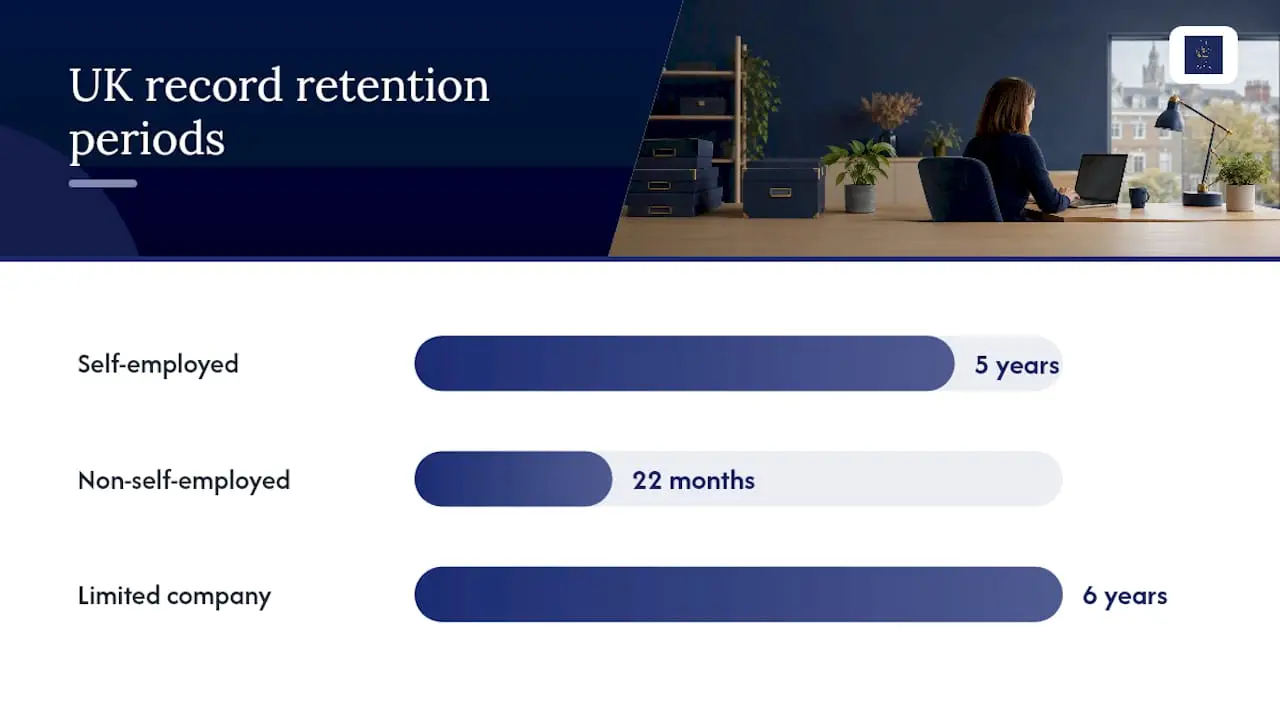
How long to keep tax records depends entirely on who you are. If you’re an employee or a non‑self-employed taxpayer who files Self Assessment, keep records for at least 22 months after the end of the tax year, assuming you filed on time. If you’re self-employed or a landlord, keep business records for at least 5 years after the 31 January submission deadline. Limited companies must generally keep records for at least six years from the end of the last financial year they relate to.
- **Employees / non‑self‑employed Self Assessment filers: keep records for at least 22 months after the tax year ends (longer if you filed late).
- Self-employed and landlords: 5 years after the 31 January deadline for that tax year.
- **Limited companies: at least six years from the end of the relevant financial year.
- VAT, payroll and CIS each carry their own rules, covered below.
When one record touches more than one tax, keep it for the longest period that applies. That single principle solves most of the “how long” confusion.
Key Takeaways
Retention periods differ by taxpayer type, and applying the longest relevant period whenever records overlap is the safest way to stay compliant with HMRC and Companies House.
| Point | Details |
|---|---|
| Know your category | Employees keep records 22 months; self-employed and landlords keep them 5 years after 31 January; companies keep them 6 years. |
| Start dates vary | The clock starts at the tax year end, the 31 January deadline, or the company’s financial year end, depending on your status. |
| Overlap means longer | Where one record covers VAT, Self Assessment and Corporation Tax, keep it for the longest of those periods. |
| Digital compliance isn’t optional | Making Tax Digital for VAT requires functional compatible software, not just scanned paperwork in a folder. |
| Get organised properly | CWABC sets up compliant digital workflows on Xero, QuickBooks and FreeAgent for Kent and remote clients, with retention dates built in. |
Table of Contents
- What counts as tax records you must keep
- Individuals and Self Assessment: the 22‑month rule
- Self-employed and landlords: the five‑year rule
- Limited companies: the six‑year rule and when to go longer
- VAT records and Making Tax Digital: the digital bit matters
- Payroll and CIS: what employers and contractors must retain
- When does the clock actually start?
- If records are lost, stolen or destroyed
- Digital security and organising records: what I set up with clients
- A yearly checklist to keep records tidy and compliant
- Why I recommend erring on the side of caution
- How I can help you get this organised
- Need help?
- Sources
What counts as tax records you must keep
HMRC doesn’t just mean your tax return itself. It means everything you used to work out the figures on it, and Companies House expects something similar for limited companies.
- Sales and purchase invoices
- Receipts and till rolls
- Bank and credit card statements
- Contracts and agreements with suppliers or clients
- VAT invoices, both issued and received
- Payroll payslips, PAYE records and P60s/P45s
- CIS deduction statements
- Asset purchase invoices and disposal paperwork (for capital allowances and capital gains)
If a spreadsheet, diary or even a messaging thread formed the basis for a figure on your return, it’s a record too, not just a working note. Capital gains paperwork, corporation tax computations and VAT account summaries all sit in a special category because they often need to be cross-referenced years after the transaction happened. My guide on types of sole trader financial records goes into more detail on what belongs in each folder.
Individuals and Self Assessment: the 22‑month rule
If you’re not self-employed but still complete a Self Assessment return, say you have savings income, dividends, or rental income taxed through PAYE adjustments, the retention rule is more forgiving than for business owners.
- On-time filing: keep records for at least 22 months after the end of the tax year the return covers.
- Practical example: for the 2025/26 tax year (ending 5 April 2026), keep records until at least 31 January 2028.
- Late filing or amendments: the clock resets, and you generally need to keep records for 15 months from the date you actually submit.
- HMRC enquiry opened: if HMRC opens a check into your return, keep everything until that enquiry is formally closed, regardless of the standard deadline.
Self-employed and landlords: the five‑year rule
Sole traders, partners and landlords face a longer minimum than employees, because HMRC needs a longer window to check business income and expenses.
- Keep business records for at least 5 years after the 31 January submission deadline of the relevant tax year.
- Example: records for the 2025/26 tax year (deadline 31 January 2027) must be kept until 31 January 2032.
- File more than four years late? HMRC may treat the retention clock differently, and it’s worth keeping records for longer than the standard five years as a precaution.
- If a record also supports a VAT claim or a capital gains calculation, keep it for whichever period runs longest, not just the five-year self-employment minimum.
Landlords juggling multiple properties often find this the trickiest part of the job. My landlord bookkeeping guide walks through a folder structure built around this exact five-year rule.
Limited companies: the six‑year rule and when to go longer
Companies House and HMRC broadly align here, but the reasons for keeping records beyond six years are worth understanding rather than just noting the number.
- The general rule is six years from the end of the last company financial year the records relate to.
- Keep records longer if a transaction spans more than one accounting period (a multi-year contract, for instance).
- Assets with a long working life, such as vehicles or machinery, need paperwork retained until well after disposal, to support capital allowances claims.
- A late Company Tax Return or an open HMRC compliance check both extend the retention clock past six years.
Directors sometimes assume Companies House and HMRC obligations are separate. In practice, the accounting records supporting your annual accounts and your Corporation Tax return are usually the same documents, so one retention policy covers both.
VAT records and Making Tax Digital: the digital bit matters
VAT-registered businesses face a firmer rule and an extra layer most guides gloss over.
- Keep VAT records for at least six years, including VAT invoices issued and received, VAT account summaries and import/export documentation.
- Under Making Tax Digital, certain records must be kept in functional compatible software, not just as scanned PDFs sitting in a folder. The software needs to preserve a digital audit trail.
- Deregistered from VAT? You still need to keep VAT records for the full retention period, even though you’re no longer submitting returns.
Payroll and CIS: what employers and contractors must retain
Running payroll or working through the Construction Industry Scheme brings its own paperwork trail, and HMRC checks these figures closely because they affect employees and subcontractors too.
- Wage records, PAYE data, Full Payment Submissions and Employer Payment Summaries.
- CIS deduction statements for every subcontractor payment.
- Statutory payment records (sick pay, maternity pay) and workplace pension contribution evidence.
Retention broadly follows the six-year company rule where payroll sits within a limited company, or the relevant Self Assessment period for sole trader employers. Accurate payroll records matter because employees sometimes query historic pay years later, and gaps here are a common trigger for HMRC checks. My payroll and CIS support page covers the practical side of getting this right from day one.
When does the clock actually start?
This trips up more people than the length of the retention period itself.
- Self Assessment (non‑self‑employed): the clock starts at the end of the tax year the return covers, not the date you filed.
- Self-employed and landlords: the clock starts on the 31 January submission deadline for that tax year, whether you filed early or not.
- Limited companies: the clock starts at the end of the company’s financial year, as fixed in your accounting reference date.
- Multiple taxes overlapping: where one record supports both VAT and Self Assessment, say a supplier invoice, HMRC’s own guidance confirms you apply the longer of the two periods.
A sole trader who’s also VAT registered, for example, should default to the six-year VAT rule for anything touching both, even though the Self Assessment minimum is shorter.
If records are lost, stolen or destroyed
Losing paperwork doesn’t remove your duty to keep it, and HMRC still expects you to reconstruct figures using the best evidence available.
- Notify HMRC promptly if records are lost through theft, fire or flood, particularly during an open enquiry.
- Gather bank statements, supplier invoices and any third-party records that can rebuild the missing figures.
- Document exactly how you reconstructed each number. HMRC expects a clear, evidenced estimation method, not a rough guess.
- Reconstructed records are assessed on their own merits during a compliance check, so the more thorough your paper trail of the rebuild, the less likely you face penalties.
Digital security and organising records: what I set up with clients
A folder of scanned receipts isn’t automatically a compliant digital record under Making Tax Digital. For VAT, the software itself needs to hold the data and preserve an audit trail, which is why I set clients up on Xero, QuickBooks or FreeAgent rather than relying on scanned PDFs sitting in email inboxes.
- Build folders by tax year and tax type (VAT, payroll, Self Assessment, Corporation Tax).
- Use consistent file names, date plus document type plus supplier or client name.
- Label each folder with its “keep until” date so nothing gets deleted early.
- Run encrypted, automatic backups rather than relying on a single laptop or drive.
- Restrict access to sensitive records, particularly anything containing employee or client personal data.
Pro Tip: When a record could apply to more than one tax, label it with the latest expiry date across all of them, not the earliest. It costs nothing to keep something an extra year, but it costs plenty to have destroyed it too soon.
If you’re moving off spreadsheets, my guide on switching from Excel to cloud accounting covers the transition step by step, and remote or Kent-based training is available if you’d rather have someone set it up alongside you.
A yearly checklist to keep records tidy and compliant
Treat this as an annual habit rather than a one-off tidy-up.
- Finalise your ledgers for the year once your return or accounts are filed.
- Archive the closed year into its own labelled folder, separate from the current year’s working files.
- Mark each archived folder with its correct “keep until” date based on the rules above.
- Run a backup check to confirm archived files are genuinely recoverable, not just present.
- Review who still has access to old folders and remove anyone who no longer needs it.
Permanent paperwork, incorporation documents, property purchase deeds, and pension scheme setup records, should never be pruned on a schedule at all. When in doubt about reconstructing a gap or reviewing what to keep, it’s worth a quick chat with an accountant rather than guessing. For further reading on avoiding the mistakes that trigger these situations in the first place, see the Tolliver blog for a broader perspective on record-keeping discipline.
Why I recommend erring on the side of caution
I always advise clients to keep records for the longest applicable period rather than the bare minimum. It costs little and removes one more thing to worry about if HMRC ever comes knocking. Working from Hildenborough, I set up cloud workflows on Xero, FreeAgent and QuickBooks for clients across Kent and remotely, so retention becomes automatic rather than a yearly scramble.
How I can help you get this organised
Sorting six years of paperwork retroactively is far harder than setting up a system that files things correctly from the start. I help sole traders, landlords, startups and limited companies across Tonbridge, Sevenoaks and Kent (and remotely, wherever you’re based) build a bookkeeping process that keeps VAT, payroll and Self Assessment records exactly where HMRC expects them, with retention dates built into the folder structure rather than left to memory.
That means less time hunting for a five-year-old invoice and more confidence that your records will hold up if HMRC ever asks questions. I offer setup and training on Xero, QuickBooks and FreeAgent, along with bespoke retention policies tailored to your specific mix of taxes. If your current system is more folder-chaos than filing cabinet, get in touch through my contact page for a straightforward conversation about tidying it up, or have a look at my bookkeeping FAQs for common questions clients ask before getting started.
Need help?
If you’d like a second opinion on your record-keeping setup or help moving to a compliant digital system, get in touch via my contact page and I’ll talk you through what fits your situation.
Frequently asked questions
How long to keep tax records if I’m self-employed?
Keep business records for at least five years after the 31 January submission deadline for the relevant tax year. For 2025/26, that means keeping records until 31 January 2032.
How long do I need to keep tax records if I’m not self-employed?
If you file Self Assessment but aren’t self-employed, keep records for at least 22 months after the end of the tax year, provided you filed on time.
How long should a limited company keep accounting records?
Generally six years from the end of the last financial year the records relate to, longer if a transaction spans multiple periods or HMRC opens a compliance check.
What happens if I lose my tax records?
You must still make a best-efforts reconstruction using bank statements and supplier records, and document how you arrived at the figures. This helps if HMRC later opens an enquiry.
Do VAT records need to be kept differently under Making Tax Digital?
Yes. Certain VAT records must be kept digitally in compatible software that preserves an audit trail, rather than as scanned copies stored separately.