
Landlord bookkeeping is the process of systematically recording and managing your rental income, expenses, and financial documents digitally to comply with UK tax rules and Making Tax Digital (MTD) requirements. Done well, it saves you money, keeps HMRC happy, and removes the year-end scramble that catches so many landlords off guard. From april 2026, unincorporated landlords with gross property income over £50,000 must comply with MTD, with thresholds dropping further in 2027 and 2028. Getting your landlord accounting in order now is not just sensible. It is becoming a legal requirement.
What rental income and allowable expenses should landlords record?
Good landlord bookkeeping starts with knowing exactly what to record. Every pound coming in and going out of your rental business needs a home in your records.

What counts as rental income?
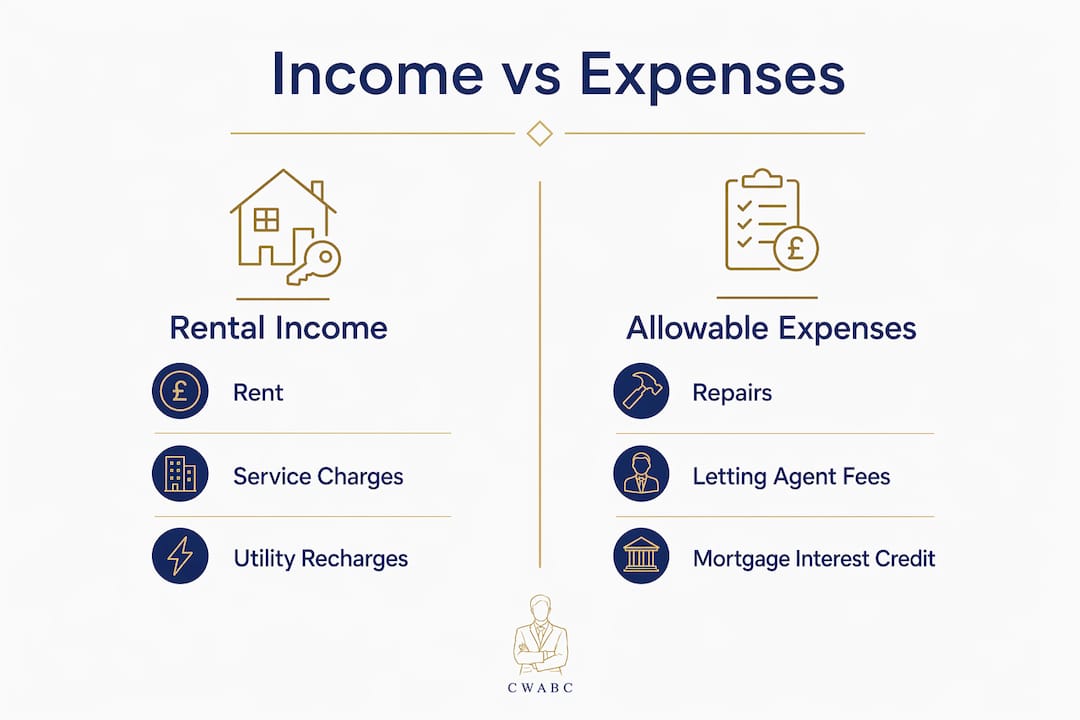
Rental income covers more than just the monthly rent. You must record all of the following:
- Rent payments from tenants, including any rent paid in advance
- Service charges you collect from tenants for communal areas or utilities
- Charges for additional services such as laundry facilities, parking, or furnished lettings premiums
- Insurance payments received from tenants to cover damage
- Any other property-related income, including compensation for loss of rent
HMRC taxes rental income on a cash basis by default for most landlords. That means you record income when you receive it, not when it is due. Recording income on an accrual basis instead is one of the most common errors landlords make, and it leads to mismatched tax calculations.
Which expenses can you deduct?
Allowable expenses must be “wholly and exclusively” for the rental business. That is the HMRC test, and it applies to every cost you claim. Common deductible expenses include:
- Repairs and maintenance (fixing a broken boiler, repainting walls, replacing a fence)
- Letting agent fees and property management charges
- Buildings and contents insurance premiums
- Accountancy and legal fees directly related to the rental
- Utility bills you pay on behalf of tenants
- Ground rent and service charges on leasehold properties
- Advertising costs for finding new tenants
Mortgage interest is no longer a direct deduction. Instead, landlords receive a 20% basic-rate tax credit on mortgage interest payments. Tracking this separately in your records is critical because it affects your tax calculation differently from standard expenses.
Capital versus revenue expenses
Revenue expenses like repairs are deductible in the year you incur them. Capital expenses, such as building an extension or converting a loft, are not deductible against rental income. The distinction matters enormously. Misclassifying a capital improvement as a repair is a common trigger for HMRC disputes. Capital costs can, however, reduce your capital gains tax liability when you eventually sell the property, so record them carefully regardless.
If you use a property partly for personal purposes, you must apportion expenses fairly. Only the rental portion is deductible. Keep a clear record of how you calculated the split.
How to meet Making Tax Digital requirements as a landlord
Making Tax Digital (MTD) is HMRC’s programme for moving tax records and submissions fully online. For landlords, it changes how and when you report your finances.
Who needs to comply and when?
MTD compliance begins on 6 April 2026 for unincorporated landlords with gross property income above £50,000 in the 2024–25 tax year. The threshold drops to £30,000 in 2027 and £20,000 in 2028. If you are not affected in 2026, you likely will be within two years. Starting your digital records now avoids a rushed transition later.
What MTD requires you to do
- Keep digital records of all rental income and expenses using HMRC-recognised software
- Submit quarterly updates to HMRC by 7 august, 7 november, 7 february, and 7 may each year
- Submit a final declaration by 31 january, replacing the traditional Self Assessment return
- Maintain digital links so data flows electronically from your records to HMRC without manual re-typing
- Retain digital records and supporting documents for at least 5 years after the submission deadline
The quarterly submission deadlines are firm. Missing them risks penalties, so building a monthly bookkeeping habit is far safer than leaving everything to the last week of each quarter.
What “digital link” actually means
The digital link requirement catches many landlords out. Your data must flow electronically from your records to HMRC. Manual re-typing or copy-pasting between spreadsheets and your submission software breaks the digital link and makes you non-compliant. A basic spreadsheet without bridging software does not meet the standard. Cloud-based accounting software with a direct API connection to HMRC is the cleanest solution. If you prefer spreadsheets, you must use HMRC-approved bridging software to connect them.
Pro Tip: HMRC hosts free webinars to help landlords understand MTD software requirements. Attending one before april 2026 is a practical way to check your setup is compliant without paying for advice you do not need yet.
For a full breakdown of what MTD means for your situation, the MTD landlord guide from Cwabc covers the requirements in plain English.
How to handle bookkeeping for HMOs, deposits, and service charges
Houses in Multiple Occupation (HMOs) and properties with service charges add a layer of complexity to your rental income tracking. The principles are the same, but the detail increases significantly.
Tracking income and expenses for HMOs
With an HMO, you may have four, six, or more tenants paying rent simultaneously. Tracking income at individual property level is strongly recommended, even where HMRC does not strictly mandate it. Doing so gives you a clear picture of which rooms are profitable, which tenants are in arrears, and how shared costs should be split. Record each tenant’s rent separately, with the payment date and amount. Do not lump all HMO income into a single monthly figure.
Handling tenant deposits correctly
Tenant deposits are not income. You must not record them as rental income when received. A deposit sits in a protected scheme (such as the Tenancy Deposit Scheme or MyDeposits) and only becomes income if you make a legitimate deduction at the end of the tenancy. At that point, record only the deducted amount as income and document the reason clearly. Keeping deposit records separate from your rental income prevents confusion and protects you if a tenant disputes a deduction.
Service charges and shared utilities
If you pay utilities or communal costs and recharge them to tenants, both the cost and the income must appear in your records. The income side is the amount you collect from tenants. The expense side is what you actually paid. These should not be netted off against each other. Record both in full. This approach gives an accurate picture of your property management finance and avoids underreporting income.
Shared expenses in an HMO, such as broadband, cleaning, or garden maintenance, should be allocated proportionately across tenants or rooms. Document your allocation method and apply it consistently. Consistency matters if HMRC ever queries your records.
A simple monthly bookkeeping checklist for UK landlords
Staying on top of your records monthly is far less stressful than a quarterly catch-up. This checklist keeps your property management finance tidy throughout the year.
- Record all rent received and note any arrears or partial payments against the correct tenant and property
- Log every expense with the date, amount, supplier name, and category (repairs, insurance, agent fees, and so on)
- Scan and store receipts digitally for all expenses, particularly those over £25, and file them against the relevant transaction
- Reconcile your bank statement against your records to catch missing transactions or duplicates
- Check mortgage interest payments and record them separately from other expenses for your tax credit calculation
- Update your accounting software so your records are current ahead of each quarterly MTD submission
- Review your records for completeness and flag anything unusual before it becomes a problem at year-end
Pro Tip: Set a recurring calendar reminder on the first working day of each month. Thirty minutes of monthly bookkeeping prevents hours of year-end stress. The advantages of digital bookkeeping include automatic bank feeds that pull transactions directly into your software, cutting that monthly task down considerably.
Keeping records current also means your quarterly MTD submissions are straightforward. You are simply confirming what is already recorded, not scrambling to reconstruct three months of transactions from memory. For a detailed checklist of everything you need to prepare, the MTD requirements checklist from Cwabc is a useful starting point.
Common landlord bookkeeping mistakes and how to avoid them
Most bookkeeping problems are predictable. Knowing what to watch for means you can sidestep the errors that cost landlords time, money, and penalties.
-
Mixing personal and rental finances. Using one bank account for both makes it almost impossible to separate deductible expenses from personal spending. Open a dedicated account for your rental business from day one.
-
Failing to keep digital, contemporaneous records. Common bookkeeping mistakes include recording transactions weeks after they happen from memory. Records must be kept as you go, not reconstructed at quarter-end.
-
Confusing capital improvements with repairs. Replacing a broken window is a repair. Installing double glazing throughout is a capital improvement. The tax treatment is completely different, and HMRC will query misclassifications.
-
Recording income on an accrual basis. Most landlords must use the cash basis. Recording rent as income when it is due rather than when it is received overstates your income and creates a tax liability on money you have not yet received.
-
Ignoring the digital link requirement. Copying figures manually from a spreadsheet into your submission software breaks the digital link. Use software with a direct HMRC connection or approved bridging software.
-
Missing quarterly deadlines. The four MTD quarterly deadlines (7 august, 7 november, 7 february, and 7 may) are fixed. Late submissions attract penalties. Build your monthly habit so quarterly deadlines feel routine.
-
Not retaining supporting documents. HMRC requires you to keep digital copies of receipts, invoices, and bank statements. Records must be retained for at least five years after the filing deadline.
Good bookkeeping is not about being perfect. It is about being consistent. A landlord who records every transaction promptly and keeps every receipt will always be in a stronger position than one who relies on memory and a shoebox of paper at year-end.
Pro Tip: If you are unsure whether a cost is a repair or a capital improvement, ask before you claim it. Getting it wrong costs more to fix than getting advice upfront. Cwabc offers clear, jargon-free guidance on allowable expense categories for landlords.
Key takeaways
Effective landlord bookkeeping requires digital records, correct expense classification, and monthly consistency to meet MTD deadlines and reduce your tax liability.
| Point | Details |
|---|---|
| Record all income types | Include rent, service charges, and utility recharges. Never net income against expenses. |
| Apply the “wholly and exclusively” test | Only claim expenses used entirely for the rental business. Apportion costs for mixed-use properties. |
| Separate capital from revenue costs | Repairs are deductible now. Capital improvements reduce capital gains tax later. Record both carefully. |
| Meet MTD digital link rules | Data must flow electronically to HMRC. Manual re-typing breaks compliance and risks penalties. |
| Adopt a monthly bookkeeping habit | Monthly updates make quarterly MTD submissions straightforward and reduce year-end stress. |
My honest view on landlord bookkeeping in 2026
Working with landlords every day, I see the same pattern repeatedly. The landlords who feel calm about their tax obligations are not the ones with the most properties or the most complex finances. They are the ones who update their records regularly and understand what they are recording and why.
The shift to Making Tax Digital is genuinely significant. Quarterly submissions are a new discipline for most landlords, and the digital link requirement is stricter than many people realise. I have seen landlords assume that a basic spreadsheet is sufficient, only to discover that without bridging software, it does not meet HMRC’s standards.
My honest advice is this: do not wait until you are mandated. If your gross property income is anywhere near £50,000, start your digital records now. Choose cloud-based software that connects directly to HMRC. Set up bank feeds so transactions import automatically. Then spend thirty minutes each month keeping everything current.
The landlords who struggle most at year-end are those who treat bookkeeping as a once-a-year task. The ones who thrive treat it as a monthly habit, no different from checking their rental income has arrived. That mindset shift, more than any particular software choice, is what makes the difference between a stressful january and a calm one.
If you are managing an HMO or multiple properties, the complexity increases but the principles do not change. Track each property separately, allocate shared costs consistently, and keep deposits completely separate from income. Professional support is worth considering not because the rules are impossible to follow, but because having someone check your setup is correct from the start saves far more than it costs.
— Chris
Bookkeeping support for UK landlords from Cwabc
Managing rental income, allowable expenses, and MTD submissions alongside everything else that comes with being a landlord is a lot to handle. Cwabc works with landlords across Kent and beyond to set up digital bookkeeping systems that are compliant, clear, and genuinely easy to maintain.

From accounting software setup to quarterly MTD submissions and Self Assessment property tax returns, Cwabc provides straightforward support with upfront pricing and no jargon. Whether you are just starting out or preparing for the april 2026 MTD deadline, the annual tax return guide for landlords is a good place to see what is involved. For answers to common questions, the bookkeeping FAQ covers the queries landlords ask most often.
Need help?
If you would like a free, no-obligation conversation about your landlord bookkeeping, get in touch with Cwabc today. We are happy to talk through your situation and explain exactly what you need to do.
FAQ
What is landlord bookkeeping?
Landlord bookkeeping is the process of recording and managing rental income, allowable expenses, and financial documents digitally to comply with HMRC rules and Making Tax Digital requirements.
When does Making Tax Digital apply to landlords?
MTD applies from 6 April 2026 to unincorporated landlords with gross property income above £50,000, with lower thresholds of £30,000 in 2027 and £20,000 in 2028.
What expenses can a landlord deduct?
Landlords can deduct expenses that are wholly and exclusively for the rental business, including repairs, letting agent fees, insurance, and utility bills paid on behalf of tenants.
How long must landlords keep their records?
HMRC requires landlords to retain digital records and supporting documents for at least five years after the relevant submission deadline.
Do tenant deposits count as rental income?
Tenant deposits are not rental income and must not be recorded as such. Only the portion of a deposit legitimately deducted at the end of a tenancy becomes income, and it should be recorded at that point with a clear explanation.