Professional tax advice is defined as qualified, accountable guidance from a licensed adviser who ensures your tax affairs are accurate, compliant, and structured to your advantage. For UK sole traders, landlords, limited company directors, and small business owners, getting this right is not optional. Small businesses account for 62% of the UK tax gap, with 35% of errors caused by failure to take reasonable care. HMRC’s late payment interest rate sits at 7.75%, and penalty cancellation rates have fallen sharply in recent years, signalling a tougher enforcement climate. Whether you run a limited company, let out a property, or work for yourself, understanding why professional tax advice matters could be the difference between financial confidence and a costly mistake.
What are the risks of managing UK tax without professional advice?
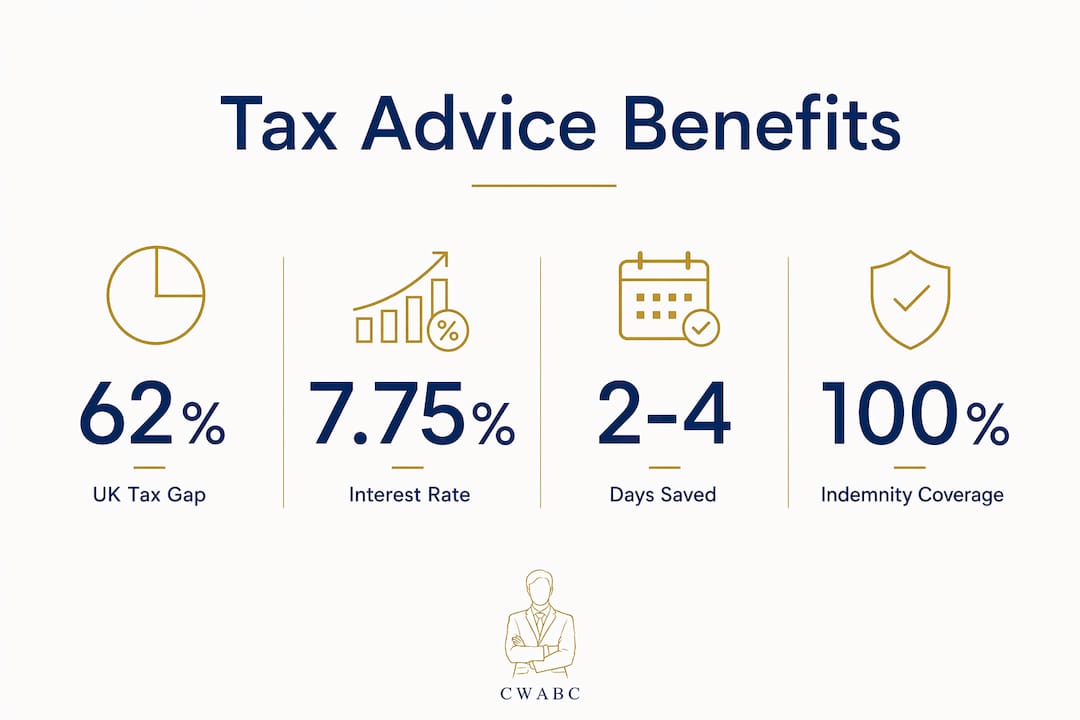
The risks of going it alone with your tax affairs are real and measurable. Small businesses represent 62% of the UK tax gap, and the most common cause is not deliberate fraud. It is simply a failure to take reasonable care. That is a problem that professional advice directly solves.

Common and costly errors
Tax mistakes tend to cluster around a handful of areas:
- Self Assessment: Missed income, unclaimed expenses, or incorrect figures on your return can trigger an HMRC enquiry or an automatic penalty.
- VAT: Registering late, applying the wrong VAT scheme, or miscalculating returns creates both financial and administrative problems.
- Payroll: Errors in PAYE calculations, National Insurance contributions, or statutory filings can result in penalties from HMRC’s Real Time Information system.
- Corporation Tax: Limited company directors often underestimate the complexity of allowable deductions, capital allowances, and filing deadlines.
Each of these areas has its own rules, deadlines, and penalty structure. Getting one wrong does not just cost you money in tax. It costs you time, stress, and potentially your reputation with HMRC.
The financial cost of getting it wrong
HMRC’s late payment interest rate is 7.75%. That figure compounds quickly on an unpaid tax bill. Penalty cancellation rates dropped from 16% in 2019/20 to just 11% in 2022/23. HMRC is granting fewer concessions, not more. If you miss a deadline or submit an inaccurate return, the chances of having a penalty waived are lower than they were just a few years ago.
Hybrid income sources such as self-employment combined with rental income or investment returns add another layer of complexity. Multiple income streams mean multiple reporting obligations, and errors across any one of them can affect your overall tax position.
The hidden cost: your time
Business owners typically spend 2–4 days a year on financial administration when managing their own tax affairs. That is time you are not spending on your clients, your tenants, or growing your business. Outsourcing to a professional reclaims that time and redirects it where it generates real value.
How does professional tax advice reduce errors and prevent penalties?
Professional tax advice reduces errors by placing your obligations in the hands of someone who is trained, regulated, and accountable. That accountability is not just a comfort. It has practical consequences.
Qualified advisers carry professional indemnity insurance
Professional accountants carry indemnity insurance, which means that if an error occurs during an HMRC enquiry or audit, you have financial protection. DIY software does not offer this. If your self-filed return contains a mistake, the liability sits entirely with you. A qualified adviser shares that responsibility and has the professional standing to engage with HMRC on your behalf.
This matters most when HMRC opens an enquiry. An adviser who knows your records, understands the relevant legislation, and can communicate directly with HMRC is far more effective than a business owner trying to navigate that process alone.
Proactive engagement with HMRC
Early engagement with HMRC is now more critical than ever, given the falling rate of penalty cancellations. A professional adviser does not wait for a problem to arrive. They flag risks before deadlines, identify discrepancies in your records early, and communicate with HMRC proactively when issues arise. That approach consistently produces better outcomes than reactive damage control.
Staying current with Making Tax Digital
Making Tax Digital (MTD) is HMRC’s programme requiring digital record keeping and quarterly submissions. It applies to VAT-registered businesses now and is expanding to cover income tax for sole traders and landlords. Keeping up with MTD requirements, compatible software, and submission schedules is a moving target. A professional adviser tracks these changes and ensures your systems are compliant before a deadline catches you out.
Pro Tip: If you are a sole trader or landlord approaching the MTD for Income Tax threshold, get advice now rather than waiting for HMRC to write to you. Early preparation is always cheaper than late correction.
Good bookkeeping habits underpin everything an adviser does. Clean, organised records mean faster, more accurate filings and fewer questions from HMRC.
What financial benefits does professional tax advice provide?
The financial benefits of professional tax advice go well beyond avoiding penalties. A good adviser actively reduces your tax bill and improves the quality of your financial decisions.
Here are the four main ways professional advice delivers measurable financial value:
-
Claiming all allowable expenses and reliefs. Landlords can claim mortgage interest relief, allowable repairs, letting agent fees, and more. Limited company directors can claim a wider range of expenses than sole traders. Many business owners miss legitimate deductions simply because they do not know they exist.
-
Salary and dividend optimisation. For limited company directors, the split between salary and dividends has a direct impact on your tax and National Insurance liability. An adviser calculates the most tax-efficient combination for your specific circumstances each tax year.
-
Cash flow forecasting and budgeting support. Knowing your tax liability in advance allows you to plan your cash flow properly. An adviser can model different scenarios, such as a change in turnover or a new property purchase, and show you the tax impact before you commit.
-
Tax savings that offset the advice fee. Tax savings in the first year often exceed the accountant’s fees, particularly for business owners who previously self-filed. The advice pays for itself, and then some.
For landlords specifically, the tax rules around property income have changed significantly in recent years. Getting specialist accountancy support ensures you are not overpaying tax on rental income or missing reliefs that apply to your situation.
The importance of tax advice becomes clearest when you look at what it prevents. Missed reliefs, overpaid tax, and poor timing of income or expenditure all cost money. A qualified adviser catches these issues before they become expensive habits.
How does professional advice support Self Assessment, VAT, payroll, Corporation Tax, and MTD?
Each major UK tax obligation has its own rules, deadlines, and filing requirements. Professional advice simplifies each one and keeps you on the right side of HMRC.
| Tax area | Key obligation | How professional advice helps |
|---|---|---|
| Self Assessment | Annual return for sole traders, landlords, and directors | Accurate income reporting, expense claims, and on-time submission |
| VAT | Quarterly returns and registration management | Correct scheme selection, accurate calculations, and MTD-compliant filing |
| Payroll (PAYE) | Real Time Information submissions to HMRC | Correct deductions, statutory payments, and employer compliance |
| Corporation Tax | Annual return and payment for limited companies | Allowable deductions, capital allowances, and deadline management |
| Making Tax Digital | Digital records and quarterly updates | Software setup, compatible record keeping, and submission compliance |
Self Assessment for sole traders and directors
Sole traders report their income and expenses through Self Assessment each year. Directors of limited companies often have personal tax obligations on top of their company’s Corporation Tax return. Getting both right requires an understanding of which income goes where and how different reliefs interact. You can find a plain-English breakdown of the process in this Self Assessment guide.
VAT registration and scheme selection
VAT registration becomes compulsory once your taxable turnover exceeds the current threshold. But the scheme you use, whether standard, flat rate, or cash accounting, affects how much VAT you pay and when. An adviser selects the right scheme for your business model and manages your returns accurately. Understanding your full tax obligations as a business owner is the first step toward managing them well.
Making Tax Digital compliance
MTD requires digital record keeping and quarterly submissions, increasing complexity for many small businesses. The software must be HMRC-recognised, and the data must flow directly from your records to HMRC without manual re-entry. An adviser sets up the right system from the start, so you are not scrambling to fix a non-compliant process later.
Key takeaways
Professional tax advice is the most reliable way for UK sole traders, landlords, and limited company directors to reduce errors, avoid HMRC penalties, and improve their financial outcomes.
| Point | Details |
|---|---|
| Tax gap risk is real | Small businesses cause 62% of the UK tax gap, mostly through avoidable errors. |
| Penalties are harder to cancel | HMRC penalty cancellation rates fell to 11% in 2022/23, making early advice critical. |
| Advisers carry indemnity insurance | Professional accountants provide financial protection during HMRC enquiries that DIY tools cannot. |
| Advice pays for itself | Tax savings in the first year typically exceed the cost of professional fees. |
| MTD compliance requires preparation | Making Tax Digital demands digital records and quarterly submissions, which advisers manage from the outset. |
Why I think most small businesses engage with tax advice too late
Having worked with sole traders, landlords, and small business owners in Kent for years, the pattern I see most often is this: people seek professional help after something has gone wrong. A missed deadline, an unexpected HMRC letter, or a tax bill that is larger than expected. By that point, the options are narrower and the costs are higher.
The businesses that benefit most from professional advice are the ones that engage early. Not because they have complicated affairs, but because they build good habits from the start. Clean records, timely filings, and a clear picture of their tax position throughout the year. That foundation makes everything else easier.
What surprises many new clients is how much they were leaving on the table. Unclaimed expenses, the wrong VAT scheme, a salary and dividend split that was not tax-efficient. These are not exotic planning strategies. They are basic entitlements that go unclaimed simply because no one pointed them out.
HMRC’s tougher stance on penalty cancellations is not going to reverse. The direction of travel is clear. Compliance is getting more demanding, not less, and MTD will extend that pressure further. The business owners who treat professional advice as a cost are often the ones who end up paying more in the long run. The ones who treat it as an investment tend to sleep better and keep more of what they earn.
If you are on the fence about whether you need professional support, read through the signs your business needs a tax professional. The answer is usually clearer than you expect.
— Chris
How Cwabc supports small businesses and landlords with tax advice
Cwabc is a licensed bookkeeper and accountant based in Tonbridge, Kent, working with sole traders, landlords, and small business owners who want clear, jargon-free support with their tax affairs.
Whether you need help with Self Assessment, VAT, Corporation Tax, payroll, or MTD-compliant software setup, Cwabc provides practical, upfront support without the confusion. Pricing is clear from the start, and every client gets personalised attention rather than a one-size-fits-all service. If you are not sure whether you need an accountant, the 7 signs you need an accountant guide is a good place to start. When you are ready to talk, Cwabc offers a free, no-obligation conversation to understand your situation and explain how we can help.
FAQ
What is professional tax advice?
Professional tax advice is guidance provided by a qualified, regulated adviser who helps you meet your tax obligations accurately and efficiently. It covers areas including Self Assessment, VAT, payroll, Corporation Tax, and Making Tax Digital compliance.
Why does professional tax advice matter for sole traders?
Sole traders face Self Assessment obligations, potential VAT registration, and increasingly MTD requirements. A professional adviser ensures accurate filings, claims all allowable expenses, and reduces the risk of HMRC penalties.
How can tax advice save money for landlords?
Landlords can claim a range of allowable expenses and reliefs that are easy to miss when self-filing. A qualified adviser identifies these entitlements and structures your rental income reporting to reduce your overall tax liability.
What happens if I make a mistake on my tax return?
HMRC can charge penalties and interest on errors, with the late payment interest rate currently at 7.75%. Penalty cancellation rates have fallen to 11%, so errors are increasingly costly and harder to have waived without professional support.
When should I hire a professional tax adviser?
The earlier the better. Engaging a professional adviser at the start of your business or property portfolio, rather than after a problem arises, produces better compliance outcomes and typically lower costs over time.
Need help?
If you have questions about your tax obligations or want to talk through your situation, contact Cwabc for a free, no-obligation conversation. There is no pressure and no jargon. Just practical help from a local accountant who understands your situation.