Self Assessment is the HMRC system that requires landlords to report rental income and pay any tax owed directly, rather than having it collected automatically through PAYE. Every UK landlord whose gross rental income exceeds £1,000 in a tax year must register for Self Assessment, even if their expenses wipe out any profit. The registration deadline is 5 October following the end of the tax year in which you first received rental income. Miss that date and HMRC can issue penalties that grow over time. Understanding why landlords register for self assessment, and doing it correctly from the start, is the single most effective way to stay compliant and avoid unnecessary fines.
Why landlords register for self assessment
Landlords register for Self Assessment because HMRC does not automatically collect tax on rental income. Unlike employment income, where tax is deducted at source through PAYE, rental income sits outside that system entirely. You are responsible for telling HMRC what you earned and paying the correct amount of tax.

The registration requirement is clear. Gross rental income above £1,000 in a tax year triggers the obligation to register, regardless of whether you made a profit. That threshold is based on total rental receipts before any expenses are deducted. A landlord receiving £900 per month in rent has an annual gross income of £10,800, which places them well above the threshold even if their mortgage, repairs, and agent fees leave them with very little net income.
Registration also gives you access to a Unique Taxpayer Reference, or UTR. The UTR is a 10-digit number issued by HMRC and is mandatory for filing your tax return online. Without it, you cannot access HMRC’s online services or submit your return through the Government Gateway. Think of it as your personal tax identification number for everything Self Assessment related.
The broader reason landlords need Self Assessment is compliance. HMRC has access to data from letting agents, Land Registry records, and mortgage providers. Landlords who do not register are not invisible. Registering proactively, rather than waiting for HMRC to make contact, puts you in a far stronger position.
Who needs to register for Self Assessment as a landlord?
The eligibility rules are straightforward once you understand the key threshold and the exceptions that sit alongside it.
You must register if:
- Your gross rental income exceeds £1,000 in a tax year
- You are a new landlord receiving rental income for the first time
- You receive income from furnished holiday lettings
- You have rental income alongside other untaxed income that takes your total above the Personal Allowance
- You make a loss on your rental property and want to carry it forward against future profits
You do not need to register if:
- Your gross rental income is £1,000 or below in a tax year, thanks to the property income allowance
- You let a room in your own home and your income falls within the Rent-a-Room Scheme limit of £7,500 per year
- Your rental income is already being taxed through a PAYE tax code adjustment, though this only applies in limited circumstances
One point that catches many landlords off guard is the difference between gross income and taxable profit. The £1,000 threshold applies to gross income, not profit. You could have £8,000 in rental receipts and £9,000 in allowable expenses, meaning you made a loss. You still need to register and file a return. Filing that loss is actually beneficial because HMRC will record it, and you can offset it against rental profits in future years.
The Rent-a-Room Scheme is worth understanding separately. If you let a furnished room in your own home, income up to £7,500 per year is completely exempt from tax and does not require Self Assessment registration. That exemption does not apply to buy-to-let properties or homes you do not live in yourself.
What are the key benefits of registering for Self Assessment as a landlord?
Registering for Self Assessment is not just a legal obligation. It opens the door to a range of tax reliefs that can meaningfully reduce the amount of tax you pay.
Allowable expenses you can claim:
- Repairs and maintenance to the property (not improvements)
- Letting agent fees and management charges
- Buildings and contents insurance
- Accountancy fees for preparing your tax return
- Ground rent and service charges
- Advertising costs to find tenants
- Replacement of domestic items such as furniture and white goods
These deductions reduce your taxable rental profit directly. A landlord with £12,000 in rental income and £4,500 in allowable expenses pays tax only on £7,500. That is a straightforward saving that is only available once you are registered and filing correctly.
Finance costs work differently. Mortgage interest no longer qualifies as a direct deduction for residential landlords. Instead, you receive a 20% basic rate tax credit on your finance costs. Higher rate taxpayers need to understand this distinction carefully, as it affects their overall tax calculation significantly.
Pro Tip: Keep a dedicated folder, physical or digital, for every receipt, invoice, and bank statement related to your rental property. Organised records make claiming every allowable expense straightforward and protect you if HMRC ever queries your return.
Registration also protects you from penalties. Late or missing returns attract an initial £100 fine, with daily penalties added if the return remains outstanding. Filing on time, every time, is far less stressful and far less expensive than dealing with HMRC enforcement.
Finally, being registered and compliant builds a clean tax record. If you ever want to expand your property portfolio, remortgage, or apply for further lending, lenders and mortgage brokers will often ask to see your tax returns. A well-maintained Self Assessment history is a genuine asset.
How to register for Self Assessment: step-by-step for landlords
The registration process is straightforward when you know what to expect. Here is how to do it correctly.
-
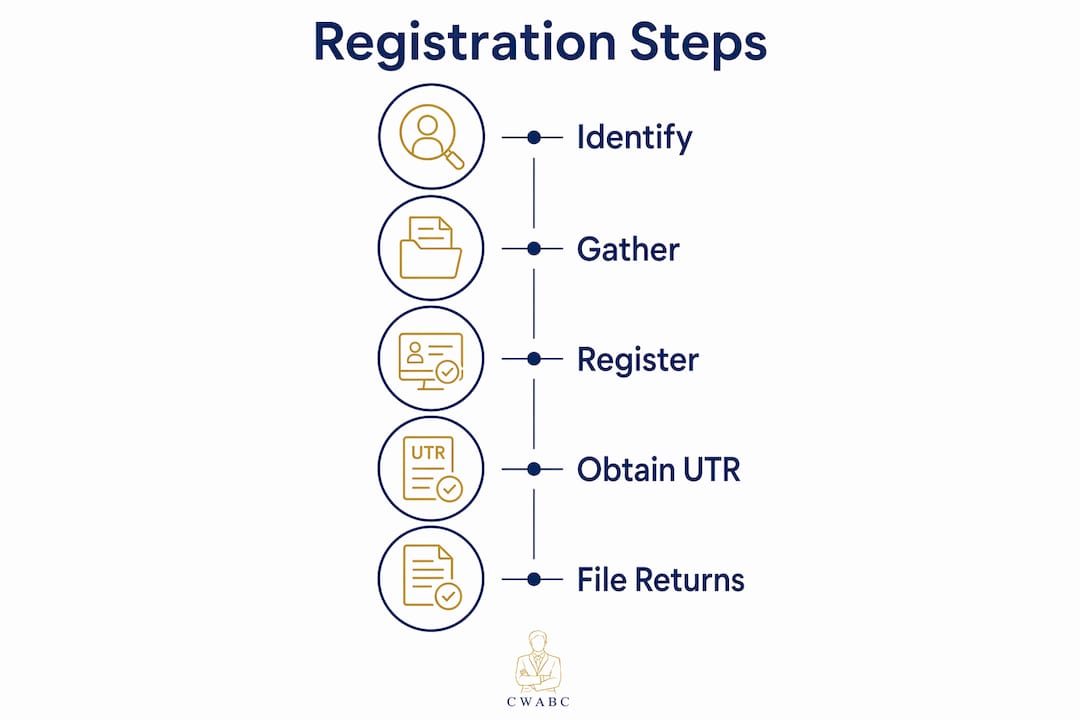
Go to GOV.UK and find the Self Assessment registration page. Search for “register for Self Assessment” on GOV.UK. You will be directed to the correct HMRC page for individuals who need to register as a new taxpayer.
-
Complete form SA1 online. The SA1 form asks for your reason for registering. Select “UK property income” as your reason. You will need your National Insurance number, your address, your date of birth, and the date you first started receiving rental income.
-
Submit your registration. Once submitted, HMRC processes your application. Your UTR arrives by post within approximately 10 working days. Keep this letter safe. You will need the UTR for every future interaction with HMRC regarding Self Assessment.
-
Set up your Government Gateway account. Once you have your UTR, you can create or log in to your Government Gateway account at GOV.UK. Your UTR is required to activate your Self Assessment account within the Gateway. Without completing this step, you cannot file your return online.
-
Enrol for Self Assessment within the Government Gateway. After logging in, select “Self Assessment” from the list of services and follow the enrolment steps. HMRC will send an activation code by post, which you enter to complete the setup.
-
Note your registration deadline. You must register by 5 October following the end of the tax year in which you first received rental income. For rental income received in the 2025/26 tax year (ending 5 april 2026), the deadline was 5 october 2026. Missing this date risks a penalty.
Pro Tip: Do not wait until october to register. If you received your first rental payment in, say, june 2025, register as soon as possible. The UTR takes up to 10 working days to arrive, and you will need it before you can do anything else. Starting early removes all the last-minute pressure.
For landlords who want a clear picture of what the annual filing process looks like, the 2026 landlord tax return guide from Cwabc covers the full timeline in plain English.
What happens after registration: filing returns and ongoing obligations
Once you are registered, you have a set of annual obligations to meet. Understanding the timeline keeps you organised and penalty-free.
The supplementary pages you need as a landlord are the SA105, which covers UK property income. These pages sit alongside your main SA100 Self Assessment return and are where you declare your rental income, allowable expenses, and any losses.
| Deadline | What it covers |
|---|---|
| 31 October (paper) | Deadline to file a paper Self Assessment return for the previous tax year |
| 31 January (online) | Deadline to file your online Self Assessment return for the previous tax year |
| 31 January | Balancing payment due: any remaining tax owed for the previous year |
| 31 July | Second payment on account due, if applicable |
Payments on account are advance payments toward your next year’s tax bill. HMRC requires them when your tax bill exceeds £1,000. Each payment on account is half your previous year’s bill, due in january and july respectively. New landlords are sometimes surprised by this, as it means you can face a large combined payment in your first january of filing.
Record keeping is an ongoing obligation, not a one-off task. HMRC requires you to keep rental income and expense records for at least five years after the 31 january filing deadline for the relevant tax year. That means receipts, bank statements, tenancy agreements, and invoices all need to be stored safely.
Registration can also affect your PAYE tax code if you have employment income. HMRC sometimes adjusts your tax code to collect small amounts of rental tax through your employer’s payroll. If this happens, check the adjustment carefully. Errors in tax code calculations do occur, and you remain responsible for ensuring the correct amount of tax is paid.
For practical guidance on preparing your rental accounts before filing, Cwabc has a clear step-by-step resource that walks you through the process.
Common pitfalls and best practices for landlord Self Assessment
Most problems with Self Assessment come down to a handful of avoidable mistakes. Knowing what they are puts you ahead of the majority of landlords.
Common mistakes to avoid:
- Missing the 5 October registration deadline. This is the most frequent error for new landlords. The deadline is firm, and HMRC does not routinely grant extensions.
- Confusing gross income with profit. The £1,000 registration threshold applies to gross receipts, not your net profit. Do not assume that because you made no money, you have nothing to declare.
- Forgetting to claim all allowable expenses. Many landlords claim only the obvious costs and miss others such as accountancy fees, advertising, and the replacement of domestic items relief.
- Ignoring changes in your rental situation. If you sell a property, change from residential to furnished holiday letting, or stop letting entirely, you must notify HMRC. Your Self Assessment obligations change with your circumstances.
- Leaving record keeping until january. Scrambling to find receipts from the previous april is stressful and increases the risk of errors or missed claims.
Best practices that make a real difference:
- Set up a separate bank account for rental income and expenses from day one
- Reconcile your rental accounts quarterly rather than annually
- Store digital copies of all receipts and invoices in a dedicated folder
- Diarise all HMRC deadlines at the start of each tax year
Pro Tip: If your rental income changes significantly, either up or down, review your payments on account. You can apply to reduce them if your income has fallen. Overpaying and waiting for a refund ties up cash unnecessarily.
Knowing when to bring in a professional is itself a best practice. If you own multiple properties, have overseas income, or are unsure about any aspect of your return, professional advice pays for itself many times over.
Key takeaways
Landlords must register for Self Assessment with HMRC by 5 October after their first tax year of rental income, claim all allowable expenses, and file accurate returns by 31 January each year to stay compliant and avoid penalties.
| Point | Details |
|---|---|
| Registration threshold | Gross rental income above £1,000 in a tax year triggers mandatory Self Assessment registration. |
| Registration deadline | Register by 5 October following the end of the tax year you first received rental income. |
| UTR is mandatory | HMRC issues your 10-digit UTR by post; you need it to file returns and access the Government Gateway. |
| Claim all allowable expenses | Repairs, agent fees, insurance, and domestic items relief all reduce your taxable rental profit. |
| Filing and payment deadlines | Online returns are due 31 January; payments on account may also fall due in January and July. |
What I have learned from working with landlords on Self Assessment
The landlords who come to me in a panic are almost always in that position for one reason: they waited. They received their first rental payment, assumed they would sort the tax side out later, and then found themselves in october with no UTR, no Government Gateway account, and a deadline bearing down on them.
The thing is, the process itself is not complicated. Registering online takes less than 30 minutes if you have your National Insurance number to hand. The complexity comes from not knowing what you do not know. Which expenses can you claim? How do payments on account work? What happens if you made a loss? These are the questions that trip people up, not the registration form itself.
What I find genuinely useful to tell landlords is this: the tax system is not designed to catch you out. It is designed to collect the right amount of tax. If you register on time, keep decent records, and claim what you are entitled to, the process is manageable. The landlords who struggle are those who treat it as something to deal with once a year in a rush, rather than something to maintain steadily throughout the year.
Looking ahead to the 2026 tax environment, Making Tax Digital for Income Tax is coming for landlords with income above £50,000 from april 2026. That means quarterly digital reporting will replace the annual return for many landlords. The landlords who have already built good record-keeping habits will find the transition straightforward. Those who have not will find it a significant adjustment. Registering for Self Assessment now, and doing it properly, is the foundation that makes everything else easier.
— Chris
How Cwabc supports landlords with Self Assessment
Cwabc works with landlords across Tonbridge and Kent to take the stress out of Self Assessment registration and filing.

Whether you are a first-time landlord unsure where to start or an experienced property owner who wants accurate, timely returns without the last-minute chaos, Cwabc offers clear, upfront support at every stage. From setting up your Government Gateway account to preparing your SA105 supplementary pages, the team handles the detail so you can focus on your property. Good bookkeeping for landlords is the foundation of a stress-free tax return, and Cwabc builds that foundation with you from day one. For expert local support, visit the Cwabc landlord tax return page or get in touch directly.
FAQ
Who must register for Self Assessment as a landlord?
Any UK landlord whose gross rental income exceeds £1,000 in a tax year must register for Self Assessment with HMRC, even if their expenses mean they made no profit.
What is the deadline to register for Self Assessment?
You must register by 5 October following the end of the tax year in which you first received rental income. For the 2025/26 tax year, that deadline was 5 october 2026.
What is a UTR and why do landlords need one?
A Unique Taxpayer Reference (UTR) is a 10-digit number issued by HMRC after you register. You need it to file your Self Assessment return online and to access your Government Gateway account.
What happens if a landlord does not register for Self Assessment?
Failure to register or file a return can result in an initial £100 penalty from HMRC, with further daily fines added if the return remains outstanding.
Does the Rent-a-Room Scheme exempt landlords from Self Assessment?
Income from letting a furnished room in your own home is exempt from Self Assessment if it falls within the Rent-a-Room Scheme limit of £7,500 per year. This exemption does not apply to buy-to-let properties.
Need help?
If you are unsure about your Self Assessment obligations or want to get registered correctly from the start, Cwabc offers a free, no-obligation conversation. Get in touch today and let us make the process straightforward for you.