A bookkeeping review is a careful, independent read of your company’s records to see whether they are complete, agree with outside evidence and are fit to produce accounts, VAT returns and a Corporation Tax return. I work through the bank, the sales and purchase ledgers, VAT, payroll, the director’s loan account, fixed assets, loans, opening balances, suspense accounts and the paperwork behind them. Then I give you a plain list of what is fine, what is missing and what needs your decision.
If the idea of someone looking over your books makes you nervous, that is normal. A review is not a telling-off. It is a calm way to find small problems while they are still small.
TL;DR
- A bookkeeping review checks that your records are complete, agree with bank statements and other third-party evidence, and are ready for year end.
- It is not a statutory audit and it is not the preparation of year-end accounts, though it makes both easier.
- I look at bank reconciliations, ledgers, the VAT control account, payroll liabilities, the director’s loan account, fixed assets, loans, opening balances, suspense and supporting documents.
- I never change figures just to make a difference disappear. Every adjustment needs evidence and your approval.
- The best time for a review is a few months before year end, while there is still time to fix things calmly.
Table of Contents
- What a bookkeeping review is, and what it is not
- Why your records need to stand up
- What I check, area by area
- How I find missing transactions, unreconciled balances and prior year errors
- Why adjustments need evidence and your approval
- Common findings in limited company books
- A practical checklist you can use before a review
- How long to keep the records
- Why an independent review before year end is worth it
- My perspective
- How I can help with your company’s review
- FAQ
- Need help?
- Sources
What a bookkeeping review is, and what it is not
People often use “review”, “audit” and “year-end accounts” as if they mean the same thing. They do not, and the difference matters when you decide what to ask for.
| Bookkeeping review | Statutory audit | Year-end accounts | |
|---|---|---|---|
| Purpose | Test whether the day-to-day records are complete and accurate | Independent opinion on whether the accounts give a true and fair view | Turn the records into the accounts and tax return you file |
| Who it is for | You, as director, to fix issues early | Shareholders and other users, where the law or the company’s own rules require one | Companies House and HMRC |
| Output | Findings list, proposed adjustments, questions for you | Formal audit report | Accounts, Corporation Tax computation and return |
| Timing | Any time, ideally before year end | After year end | After year end |
A review is about the quality of the bookkeeping. I am not giving an audit opinion, and I am not signing off accounts when I review. If your company needs an audit, that is a separate engagement. Many small companies are not required to have one, but a clean set of records makes the whole process quicker if you ever are.
A review also is not the same as the clean-up work in my bookkeeping cleanup checklist. That checklist is about tidying messy books, step by step. The review described here is a structured examination of a company’s records by someone who did not write them, with a findings report at the end. Where a review shows the books need real repair, the reconcile-first approach to cleaning up UK bookkeeping is where we would go next.
Why your records need to stand up
Under the Companies Act 2006, every company must keep accounting records that are sufficient to show and explain its transactions, disclose its financial position with reasonable accuracy at any time, and let the directors make sure the accounts comply with the Act. That is section 386 of the Companies Act 2006, and it is the yardstick I keep in mind throughout a review.
The responsibility sits with the directors. ICAEW’s guide to directors’ responsibilities explains that records must be open to the company’s officers at all times, and that failing to keep adequate records is a criminal offence. You can hire help, but the duty stays with you. That is one more reason an independent check is worth having.
GOV.UK is specific about what a limited company must hold: all money received and spent, details of assets, debts owed to and by the company, stock at the end of the financial year and, unless you are a retailer, details of goods bought and sold with the buyers and sellers. It also says you can be fined £3,000 by HMRC or be disqualified as a director if you do not keep records. The detail is on GOV.UK’s page on company and accounting records.
What I check, area by area
I work from the bank outwards, because the bank statement is the one record the company did not create itself. Everything else is tested against something outside the ledger wherever possible.
Bank and card reconciliations
I start with every bank account, credit card and any payment processor such as Stripe or PayPal. For each one I check that the closing balance in the books agrees with the statement for the same date, and that the reconciliation is complete month by month, not just at the end.
What I am looking for:
- Old uncleared items that should have cleared months ago.
- Transactions sitting in the bank feed but never coded.
- Transfers between company accounts recorded on one side only.
- Payments that went out of a personal account for the company, with no record.
- Gaps between one statement’s closing balance and the next one’s opening balance, which can signal a missing statement.
A reconciliation that “agrees” because someone entered a balancing figure is not a reconciliation. I look at how it agreed.
Sales ledger and income
I compare the list of what customers owe with the sales ledger, and sample invoices against bank receipts. I check for invoices raised but not recorded, duplicate invoices, customer payments received but not matched to an invoice, credit notes not applied, and negative customer balances. I also look at whether income is recorded in the right period, for example work invoiced in advance or delivered but not yet billed.
Old unpaid invoices are a particular point. Some will still be collectable and some will not. Deciding to write one off is a decision for you as director, not for me.
Purchase ledger and expenses
On the cost side I look at what the company owes suppliers, and compare to supplier statements where they exist. I check for duplicate bills, bills entered in the wrong period, supplier credits not used, payments allocated to the wrong supplier, and expenses that look personal rather than business. I also look at receipts: is there a document behind each material cost, and does it show the company’s name and the amount claimed?
VAT control account
If the company is VAT registered, the VAT control account should agree with what has been filed and paid. I reconcile the balance to the last VAT return, plus any VAT on transactions since then, and to the payment or repayment shown on the bank statement. I also check the VAT coding on a sample of entries: standard, reduced, zero-rated, exempt and outside the scope are easy to mix up.
If you want to see how this works in detail, I have written a guide to reconciling VAT returns to your bookkeeping records. Where a review turns up an error in a filed return, the next step is the VAT error checklist, and I can help with that through my VAT returns service.
Payroll liabilities
Where the company pays staff or directors through payroll, I agree the PAYE and National Insurance liability in the books to the payroll reports and to what was actually paid to HMRC. I check that pension contributions are recorded, that net pay in the ledger matches the payslips and bank payments, and that nothing is left sitting in a payroll liability account long after it should have been paid.
For construction companies I also look at whether Construction Industry Scheme deductions are recorded properly on both sides. If payroll or CIS is part of your business, my payroll and CIS support covers the monthly work.
Directors’ loan account
This is the account I find most often needs attention in small companies. I trace it back to the director’s own record of money put in and taken out. I check that personal spending paid from the company account is posted there, that company costs paid personally are recorded as owed to you, and that dividends and salary are not being mixed up with loans.
I also look at whether the account is overdrawn, how far, and for how long. An overdrawn balance can have tax consequences for the company and for you, including a charge if it is not repaid within nine months of the year end, and a benefit-in-kind question where larger sums are involved. The exact rates and thresholds change, so I confirm them against current HMRC guidance for your accounting period before advising on what a particular balance means. Dividends also need proper paperwork, such as board minutes and dividend vouchers, which I check exist.
Fixed assets and depreciation
I compare the fixed asset register to purchases of equipment, vehicles and computers in the ledger. I check that purchases above the company’s capitalisation level are on the register, that depreciation has been charged consistently, and that assets sold or scrapped have been removed. Items bought for the company but sitting in the expenses ledger, or small items wrongly capitalised, are both common.
Loans, hire purchase and leases
For each loan, hire purchase agreement or lease, I agree the balance in the books to the lender’s statement. I check that interest and capital repayments are split properly, so the full payment is not all treated as an expense, and that anything due within one year is separated from anything due later.
Opening balances
The opening balances should agree to the previous year’s signed accounts. If they do not, something has been changed after the accounts were filed, or the books were set up wrongly when the company moved to new software. I check this early, because an error in opening balances carries into every period after it.
Suspense and clearing accounts
A suspense account is a holding place for transactions nobody could code. It should be nil at year end. Any balance means money has come in or gone out that the books cannot explain. I list every item in it and work out where each belongs, or what I need from you to decide.
Supporting documents
Finally, I look at the evidence behind the numbers: sales invoices, supplier bills, receipts, contracts, loan agreements, payroll records, VAT returns, board minutes and dividend paperwork. I am not trying to see every document. I sample the largest and the oddest items and ask whether a stranger could follow the trail from the accounts down to the paper.
How I find missing transactions, unreconciled balances and prior year errors
I do not rely on one test. I use several that come at the books from different angles.
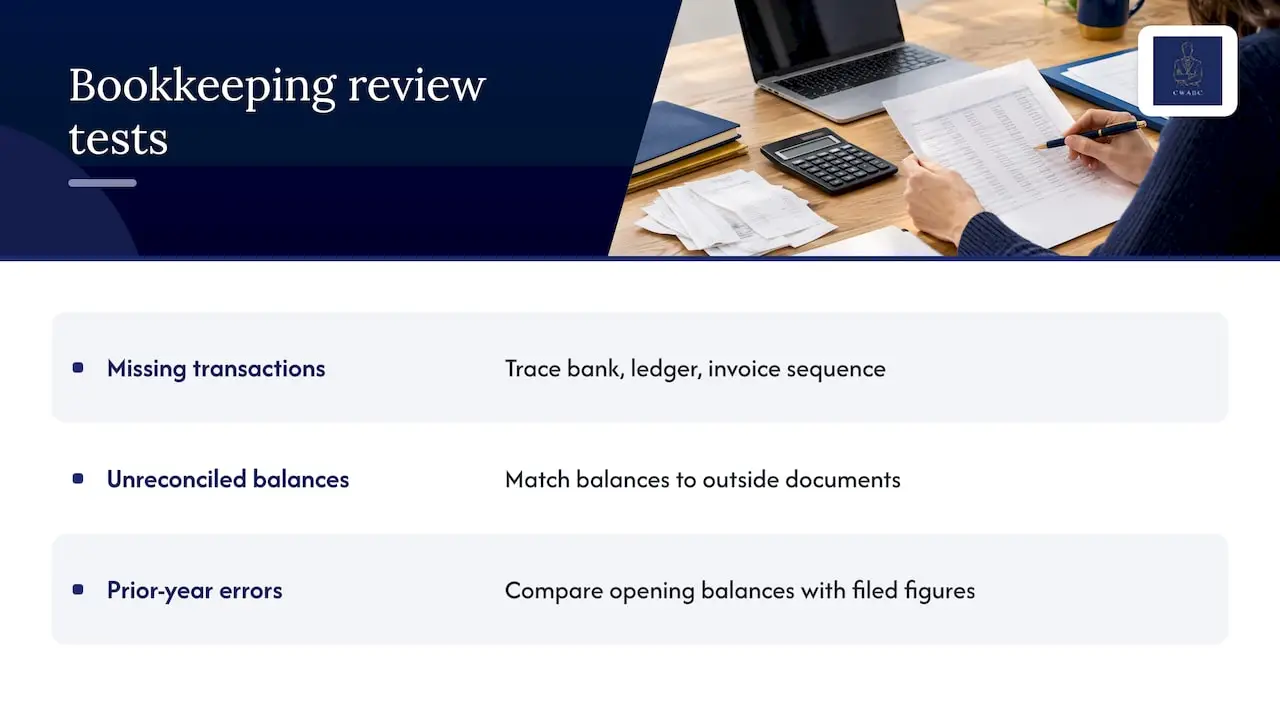
Missing transactions. I compare bank statements to the ledger line by line, check that invoice numbers run in sequence without unexplained gaps, look for regular payments that stopped or started (a monthly subscription that appears in only ten months of twelve, for example), and compare the bank feed to the statement for any days where the feed failed to import.
Unreconciled balances. For each balance sheet account I ask what outside document should agree with it. A difference is either explained, such as a payment in transit, or it is an error. I never treat a difference as too small to matter until I know what it is, because small differences can be two bigger mistakes cancelling each other out.
Possible prior year errors. Opening balances that do not match last year’s accounts, old items that sit in the ledgers year after year, and a director’s loan account that does not tie to the filed figures all point backwards. When I find one, I report it as a possibility with the evidence, not as a conclusion.
If an error is found after accounts have been filed, the options are limited. ICAEW’s guidance on defective accounts explains that directors will usually either correct it in the next set of financial statements as a prior period error, or revise the filed accounts, which is only allowed in certain circumstances under section 454 of the Companies Act 2006. Which route is right depends on how serious the error is and when the next accounts are due. That is a decision for you, and sometimes for a regulated adviser, once I have set out the facts.
Why adjustments need evidence and your approval
A review produces a list of proposed adjustments. I do not post them quietly and hope for the best, for three reasons.
- The books are yours. You are the director responsible for them. I can recommend a journal, but I cannot decide that a customer’s debt is bad or that a payment was personal.
- An adjustment without evidence is a guess. If a difference is simply forced to zero, the problem is hidden, not solved. For each proposed adjustment I record the amount, the period affected, what I checked, and what approval is needed.
- Someone may ask later. If HMRC or an accountant asks why a figure changed, there should be a clear trail: what was wrong, how we know, who agreed.
In practice, I take a read-only first pass. I list what I find without changing anything, then send you a single consolidated list of questions and missing documents. Once you have answered, I propose the adjustments with their evidence. Only after you approve do the corrections go in.
Common findings in limited company books
These are typical patterns that come up in reviews of small company records, not descriptions of any particular client.
- Unmatched receipts. Customer payments in the bank but not allocated to invoices, so the sales ledger shows old debts that were actually paid.
- Personal spending in expenses. Supermarket shops, personal subscriptions or family travel coded as business costs, which should sit in the director’s loan account instead.
- A growing overdrawn director’s loan. Regular withdrawals that were never declared as salary or dividends.
- VAT control account that does not agree. Often caused by a wrong tax code, a late-entered invoice, or a return filed from figures that were later changed.
- Payroll liability not cleared. PAYE paid to HMRC but coded to an expense account, so the liability looks unpaid forever.
- Suspense balances. Money received from a customer or payment platform that nobody has identified.
- Assets in expenses. A laptop, van or machinery posted as a repair or general cost.
- Loan repayments all treated as costs. The capital part should reduce the loan, not the profit.
- Opening balances that moved. The prior year closing figure in the new software does not match the filed accounts.
- Missing paperwork. Bills over a certain size with no document, or dividends with no minutes or vouchers.
Most of these are fixable once spotted. The point of a review is to spot them on a quiet afternoon, not in a rush the week before a deadline.
A practical checklist you can use before a review
You can gather most of this yourself before we start. It makes the review quicker and, for you, cheaper to run.
Bank and cash
- Statements for every business bank account, card and payment platform for the whole period.
- Confirmation that each account in the books has a reconciliation to the latest statement.
Sales and purchases
- Aged debtors and creditors lists.
- Supplier statements for your main suppliers.
- Any credit notes, and the invoices you believe will never be paid.
VAT and payroll
- Copies of filed VAT returns and payment records.
- Payroll summaries, HMRC payment records and pension statements.
Directors and ownership
- Your own record of money paid in and taken out of the company.
- Board minutes and dividend vouchers.
Assets and funding
- Fixed asset list and purchase invoices for larger items.
- Loan, hire purchase and lease statements and agreements.
Year-start position
- Last year’s signed accounts and the Corporation Tax return.
- A trial balance as it stands today.
If some of it is missing, do not worry. Telling me what you cannot find is useful. The missing-information list is part of the findings. If records have been lost, stolen or destroyed and cannot be replaced, GOV.UK says the company must do its best to recreate them, tell its Corporation Tax office straight away, and include this in its Company Tax Return.
How long to keep the records
People often ask whether they can throw old papers away. The answer has two layers. GOV.UK says a limited company must keep its accounting records for six years from the end of the last company financial year they relate to, and longer in some cases, for example where a transaction covers more than one accounting period, the company bought something expected to last more than six years, the Company Tax Return was late, or HMRC has started a compliance check. The Companies Act minimum for a private company is lower: three years from the date the records were made, under section 389. In practice the longer tax period is the one to follow. I explain this further in my guide to how long to keep tax records.
Why an independent review before year end is worth it
The person who keeps the books is the person least likely to see their own blind spots. Someone who did not write the entries asks different questions, and that is where the value lies.
Doing it before year end matters for practical reasons:
- You can still get documents. Asking a supplier for a statement in the middle of the year is easy. Asking eighteen months later is not.
- You can fix things in the right period. Corrections made while the period is open are cleaner than prior-year adjustments.
- Tax decisions stay open. If the director’s loan account looks high, there may still be time to decide how to deal with it properly.
- Fewer surprises. Your accounts and Corporation Tax return are prepared from records that already agree with the outside world. My Corporation Tax guide for limited companies shows where those figures end up.
- Better readiness for questions. If HMRC ever asks about your return, tidy, reconciled records and a clear trail of evidence make the conversation far easier.
A review does not replace regular monthly bookkeeping. It complements it. If you would like the ongoing habit as well, see my notes on staying HMRC ready each month as a limited company director and the benefits of monthly bookkeeping reviews.
My perspective
I have spent over 30 years in finance, and the pattern is the same whatever the size of the company. The numbers are rarely wrong because someone was careless. They are wrong because nobody has had time to stand back and ask whether the books agree with the real world.
That is what I do in a review. I do not arrive with a long list of criticisms. I arrive with a short list of questions, each tied to evidence, and I explain each one in plain English. If something is right, I say so. If something needs your decision, I set out the facts and leave the choice with you.
I work with you directly, which means the person who reviews your books is the person who explains the findings and helps you fix them. I use cloud software such as Xero, QuickBooks and FreeAgent, so the trail from the bank feed to the report is clear and easy to follow.
My aim is simple: you understand your numbers, your records are ready for HMRC, and year end is calm rather than a scramble.
Chris
How I can help with your company’s review
I am an AAT Licensed Accountant based in Hildenborough, near Tonbridge. I review the books of limited companies across Tonbridge, Sevenoaks and the rest of Kent, and remotely anywhere in the UK. You deal with me directly, and I explain what I find without jargon.
A review with me starts with a conversation about your company, your software and your year end. I then work through the areas above, send you the findings and questions, and, once you have approved the changes, help put the records right and keep them right. If you want ongoing support afterwards, my bookkeeping services cover the monthly work, and my accounting services cover year-end accounts and Corporation Tax. Pricing is agreed clearly upfront and depends on the size and condition of your records.
I cannot promise particular outcomes from a review, because it depends on what is in the records. What I can promise is a careful, honest look and a clear explanation of what I find.
FAQ
Is a bookkeeping review the same as an audit?
No. An audit is a formal, independent opinion on whether accounts give a true and fair view. A bookkeeping review tests whether your day-to-day records are complete and agree with outside evidence. It gives you a findings list rather than an audit report, and it helps you prepare for whatever comes next.
When should a limited company have its books reviewed?
The most useful time is a few months before year end, while documents are easy to get and corrections can still be made in the right period. It is also sensible after switching software, after a period of rapid growth, when a bookkeeper changes, or when you have not looked at the numbers for a while.
Will you change my figures without asking?
No. I first review without changing anything, then send you a list of findings and questions. Each proposed adjustment comes with its evidence, and I only post it once you have approved it. The books are the company’s, and the decisions are yours.
What records should I have ready?
Bank and card statements, aged debtors and creditors, VAT and payroll records, your director’s loan record, loan and asset documents, and last year’s signed accounts. If anything is missing, tell me. I will include it in the list of items to chase.
How long do I need to keep my company’s records?
GOV.UK says six years from the end of the last financial year they relate to, and longer in certain cases such as a late Company Tax Return or an HMRC compliance check. The Companies Act minimum for private companies is shorter, but the tax rule is the one most companies follow.
Need help?
If you would like me to review your limited company’s bookkeeping, or you just want to talk through where you stand before year end, get in touch through my contact page. I will reply as soon as I can, and I will tell you plainly what I can do and how it would be priced.
Sources
- Companies Act 2006, Part 15, Chapter 2: accounting records (legislation.gov.uk)
- ICAEW: directors’ responsibilities for corporate administration
- GOV.UK: running a limited company, company and accounting records
- ICAEW: defective accounts and reports
Recommended
- Stay HMRC Ready Monthly: Bookkeeping for UK Limited Company Directors
- Bookkeeping Cleanup Checklist for UK Sole Traders and Companies
- 7 benefits of monthly bookkeeping reviews for UK business owners
- Bookkeeping FAQs for Small Businesses 2025
This article provides general information based on UK tax and accounting rules at the time of publication. It is not a substitute for advice tailored to your individual circumstances. Tax legislation and HMRC guidance may change. If you need advice about your specific situation, please contact me at CW Licensed Bookkeeper & Accountant.