
Construction bookkeeping is ordinary bookkeeping with three extra jobs: tying every cost and payment to a specific project, handling the Construction Industry Scheme (CIS) correctly, and getting VAT right where the domestic reverse charge applies. If your records do those three things monthly, your tax returns, VAT returns and cash flow forecasts become far easier. If they don’t, you find out when HMRC writes to you or when the bank balance runs dry before a late payment arrives.
I’m Chris White, an AAT Licensed Accountant based in Hildenborough near Tonbridge. I work with builders, tradespeople and small contractors across Kent and remotely throughout the UK. This guide walks through what good construction bookkeeping looks like, where it usually goes wrong, and how I can help you keep it calm and accurate.
TL;DR
- Construction bookkeeping means recording every cost and payment against a job, not just against a supplier or a bank line.
- Contractors must record, deduct, report and pay CIS every month, including a nil return in months with no subcontractor payments from 6 April 2026.
- The VAT domestic reverse charge changes how you invoice and how you complete boxes 1 and 4 of your VAT return, so your software needs setting up for it.
- The biggest cash flow risk is late payment and retentions, so your books should show what is owed to you and when.
- I set up and run cloud bookkeeping for construction clients in Xero, QuickBooks or FreeAgent, so the records are ready for HMRC.
Table of Contents
- What construction bookkeeping actually involves
- Contractor or subcontractor: who does what
- CIS in your books: the monthly routine
- VAT and the domestic reverse charge
- Job costing: where construction records earn their keep
- Purchase invoices, receipts and paperwork
- Bank reconciliation and cash flow
- Common construction bookkeeping mistakes
- Software and Making Tax Digital
- How I help construction clients
- My perspective
- FAQ
- Need help with construction bookkeeping?
- Sources
What construction bookkeeping actually involves
Most small businesses can get by with one question: what came in and what went out? Construction needs a second question: which job was it for?
A bookkeeper working with contractors typically records:
- customer invoices and applications for payment, including interim payments, variations and final accounts
- supplier invoices for materials, plant hire and consumables
- payments to subcontractors, with any CIS deductions
- labour costs, whether employees through payroll or subcontractors
- bank transactions, matched to the right invoice and the right job
- VAT, including any reverse charge supplies
- retentions, the percentage of a payment held back until the work is signed off
That last point catches many small firms out. Retention commonly runs at 3% to 5% of contract value, with half released at practical completion and half at the end of a defects period, according to a 2026 industry guide. Until it is released, that money is earned but not in your bank. Your books should show it as a separate balance owed to you, not leave it buried in the sales figure.
Contractor or subcontractor: who does what
Under CIS, a contractor is a business that pays subcontractors for construction work. That includes many people who don’t think of themselves as contractors, such as a small builder who hires a plasterer. A subcontractor is the person or business doing the work and being paid. Plenty of firms are both, depending on the job.
HMRC’s CIS 340 guide sets out the duties. In plain terms:
| Contractor | Subcontractor | |
|---|---|---|
| Registers for CIS | Must register | Can choose to register |
| Verifies the other party | Checks each subcontractor with HMRC before first payment | Gives the contractor their details, such as UTR and company or trading details |
| Deducts tax | Deducts from the labour part of each payment (20% registered, 30% unregistered, 0% gross payment status) | Has deductions taken from payments |
| Gives statements | Gives each subcontractor a payment and deduction statement within 14 days of the tax month end | Keeps the statements for the tax return |
| Reports to HMRC | Files a monthly return and pays the deductions over | Files an annual return of profits, usually Self Assessment or Corporation Tax |
| Keeps records | At least 3 years after the end of the tax year | Invoices, contracts, expenses and statements |
If you are mainly a subcontractor, my guides to CIS for subcontractors and CIS registration for subcontractors cover registration and rates in more detail. This article focuses on the bookkeeping that sits around them.
CIS in your books: the monthly routine
CIS works best as a rhythm rather than a once-a-year scramble. The CIS tax month runs from the 6th of one month to the 5th of the next, and the return is due by the 19th.
1. Verify before you pay
Before a contractor pays a new subcontractor, they verify them with HMRC. HMRC then confirms which deduction rate applies. Record the outcome in your supplier or contact record, with the date. Paying someone on the wrong rate is one of the most common and most avoidable errors, because the unregistered rate is higher and the subcontractor will, quite reasonably, complain.
2. Work out the deduction on the right amount
CIS is not 20% of the whole invoice. The deduction applies to the labour element, after taking out VAT and the cost of materials the subcontractor paid for. HMRC’s guidance also excludes items such as consumable stores, plant hire and fuel not used for travelling. One industry guide points out that a job where the main contractor supplies most materials produces a bigger deduction than the headline rate suggests, simply because less of the payment is deductible materials, and more of it is labour.
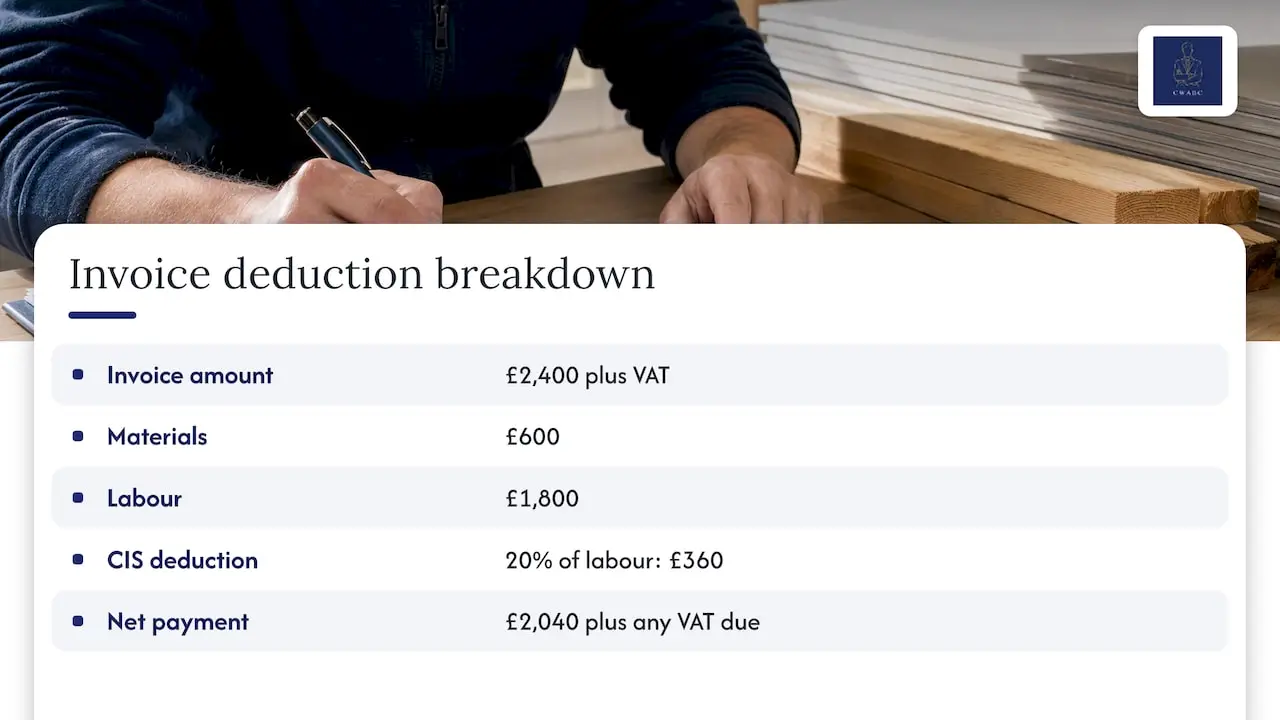
A simple example. A registered subcontractor invoices £2,400 plus VAT. £600 of that is materials they bought for the job. The labour element is £1,800, so the deduction is 20% of £1,800, which is £360. You pay £2,040 net of the deduction, plus any VAT due. Your books need to show the gross invoice, the materials, the deduction and the net payment as separate figures. A single “paid £2,040” bank line is not enough.
3. Record it on or before payment
HMRC requires contractors to record the gross payment (excluding VAT), the materials cost and the deduction for each payment. GOV.UK’s record-keeping page says these must be kept for at least 3 years after the end of the tax year, and that you can be fined up to £3,000 if you cannot show them. Keeping this in your accounting software as you go means you never have to rebuild it from emails.
4. Give statements and file the return
Each subcontractor needs a payment and deduction statement, and HMRC needs a complete monthly return. Both are due within 14 days of the tax month end, so by the 19th. GOV.UK’s penalty rules start at £100 for a return one day late and rise at 2, 6 and 12 months. A wrong employment status declaration on the return can also lead to a penalty of up to £3,000. My step-by-step CIS monthly returns guide covers the filing itself, so I won’t repeat it here.
5. Pay HMRC what you deducted
The deductions you took are not yours. HMRC’s guide says to pay them monthly, by the 22nd if you pay electronically (the 17th for cheque payments). I suggest keeping the deductions in a separate liability account in your books so they don’t get mistaken for spare cash.
What changed in April 2026
Two changes matter for your bookkeeping. First, ICAEW’s summary of the 2026/27 changes says that from 6 April 2026 contractors must file nil returns in months with no subcontractor payments, and payments to local authorities and certain public bodies fall outside CIS. Second, HMRC gained stronger anti-fraud powers over gross payment status, including immediate removal in certain cases and a longer bar on re-applying. If you hold gross payment status, keep your compliance record tidy and your returns on time.
VAT and the domestic reverse charge
The domestic reverse charge changes who accounts for VAT on certain construction services. HMRC’s guidance says it applies when all of these are true:
- you are VAT registered and your customer is VAT registered in the UK
- the payment is reported within CIS
- the services are standard or reduced rated
- you are not an employment business supplying workers
- your customer has not confirmed in writing that they are an end user or intermediary supplier
An end user, in HMRC’s terms, is a business that buys these services but doesn’t use them to make further supplies of construction services, as set out in HMRC’s manual on end users.
When it applies, the subcontractor invoices without adding VAT, and the invoice says the reverse charge applies. The contractor then accounts for the VAT themselves. HMRC’s manual explains that the customer shows it as output VAT in box 1 of their VAT return and, generally, reclaims it as input VAT in box 4, with no effect on boxes 6 and 7.
In bookkeeping terms, that means:
- Hold a note on every customer: VAT number, CIS status, and whether they have confirmed end user status in writing.
- Use a dedicated VAT code for reverse charge sales and another for reverse charge purchases.
- Check the VAT return boxes before you submit. Filling in only one of box 1 or box 4 is a classic slip, even when the net VAT looks right.
- Keep the reverse charge wording on your invoice templates.
If you want the detail, I’ve written separate guides on the four checks before coding reverse charge VAT and the five-step process with an invoice example. For reconciling the return to your records, see how to reconcile VAT returns to your bookkeeping.
Job costing: where construction records earn their keep
A profit and loss report for the whole business can look fine while one job quietly loses money. Job costing fixes that by giving every cost and every invoice a job reference.
A workable structure for a small contractor:
- Materials: code each supplier invoice to the job it was delivered for. If a delivery covers two sites, split it.
- Subcontractor labour: code the gross labour and materials separately, so the CIS deduction logic stays clean.
- Employees: allocate wages, employer’s National Insurance and pension costs to jobs using timesheets or a simple weekly split.
- Plant and tools hire: code to the job where possible.
- Overheads: keep van costs, insurance and office costs as overheads, then compare overall margin to see whether your job prices cover them.
Then compare each job’s actual costs against the quote. A job that came in at 18% margin when you priced for 30% teaches you something about your next quote. That is the practical value of the exercise, and it only works if the coding is consistent from the first invoice.
A worked example
Say you quote £18,000 plus VAT to refit a kitchen. Materials are £6,500, subcontracted labour £4,000, and your own time and a labourer cost £3,500. That is £14,000 of direct cost and £4,000 of margin, or about 22%. If the customer asks for extra work and you agree it verbally, the variation never reaches your sales ledger unless you record it. Log variations with a short note and the agreed amount as soon as they are agreed, so your final account matches reality.
Purchase invoices, receipts and paperwork
Construction produces a lot of paper: merchant invoices, delivery notes, fuel receipts, hire slips. A few habits help:
- Photograph receipts the day you get them, and attach them to the transaction in your software.
- Ask suppliers to put the job address or reference on the invoice.
- Match delivery notes to invoices before paying, so you only pay for what arrived.
- Keep subcontractor invoices separate from supplier invoices, because the CIS treatment differs.
Self-employed subcontractors should also keep copies of invoices, contracts, expenses and CIS statements, as HMRC’s Tax Confident guidance explains. Any CIS deducted can be credited against your tax bill, and if you’ve overpaid it is refunded after your Self Assessment return is processed.
Bank reconciliation and cash flow
Bank reconciliation means checking that your accounting records match your bank statement line by line. In construction, do it at least weekly if you pay subcontractors regularly. It catches duplicate payments, missing invoices and unrecorded cash withdrawals before they grow.
Cash flow is the larger worry. Late payment is a fact of life in the industry: Department for Business and Trade data reported by BCIS show large construction businesses paid 14% of invoices late in 2025, roughly one in seven. Even when you are paid on time, retention and CIS deductions mean your bank balance runs behind your sales.
To keep control, your books should let you see:
- invoices outstanding, by customer and by age
- retention held and its expected release date
- CIS deductions suffered and CIS deductions owed to HMRC
- VAT owed at the next quarter end
- wages and subcontractor payments due in the next four weeks
A simple rolling 13-week cash forecast built from these figures shows a squeeze weeks ahead. If you’d like help building one, my budgeting and forecasting support is designed for exactly this.
Common construction bookkeeping mistakes
- Treating the CIS deduction as 20% of the whole invoice. It applies to labour after materials and VAT are removed.
- Not verifying new subcontractors, then paying at the wrong rate.
- Forgetting the nil return. From April 2026 a month with no subcontractor payments still needs a nil return or a notification of inactivity.
- Mixing reverse charge and standard VAT sales under one VAT code.
- Leaving retention in the sales ledger as cash and overestimating what you can spend.
- Coding materials to the supplier but not the job, so you can’t see job margin.
- Using spreadsheets and bank statements only. For VAT-registered businesses, Making Tax Digital for VAT already needs digital records in compatible software.
- Catching up once a year. Twelve months of receipts is a miserable job, and errors are harder to trace.
If your books are already in a muddle, my bookkeeping clean-up checklist shows the order I’d tackle things, and five signs your bookkeeping needs professional help may help you decide whether it’s time.
Software and Making Tax Digital
Making Tax Digital (MTD) is HMRC’s programme requiring digital records and online submissions. MTD for VAT already applies to VAT-registered businesses. MTD for Income Tax started in April 2026 for sole traders and landlords with qualifying income over £50,000, according to ICAEW, who estimate about 864,000 people are affected. That includes many self-employed tradespeople. Quarterly updates are sent through compatible software, so your day-to-day bookkeeping becomes your tax record.
For current details on what applies to you, see my guides on MTD for Income Tax deadlines and the sole trader transition, or my MTD for Income Tax support page.
Whatever you use, the software should handle CIS deductions, reverse charge VAT codes, bank feeds, receipt capture and some form of job or project tracking, often through tracking categories or tags. I work with Xero, QuickBooks and FreeAgent, and which one suits you depends on your size and how you work.
How I help construction clients
I keep this practical and personal: you deal with me directly, not a call centre. For construction clients, that typically means:
- setting up your accounting software and training you to use it, so CIS, VAT codes and job tracking are in place from the start
- keeping your bookkeeping up to date on a regular schedule, with bank reconciliations
- handling CIS for contractors and subcontractors, and VAT returns including reverse charge
- preparing Self Assessment, limited company accounts and Corporation Tax
- explaining your numbers without jargon, so quotes and pricing improve
I work with clients around Tonbridge, Sevenoaks and across Kent, and remotely throughout the UK. Pricing is agreed clearly upfront and tailored to your business. For reference, my Self Assessment returns start from £250 one-off. You can see my bookkeeping services and my payroll and CIS services for more detail.

My perspective
Most of the construction clients I meet aren’t careless. They’re busy, on site at 7am, and the paperwork happens at the kitchen table at 9pm. The trouble is that CIS, reverse charge VAT and retentions all punish a catch-up approach.
My view is that construction bookkeeping should be set up once, properly, and then kept small. That means the right VAT codes, a sensible job structure and a monthly CIS routine, so nothing arrives as a surprise. Because I’m a sole practitioner, you speak to me, and I know your jobs and your software.
I’d rather you understood your numbers than simply handed them over. When you can see which jobs make money and what you owe HMRC, decisions about quoting, hiring and taking on a subcontractor get much easier.
Chris
FAQ
What does a bookkeeper do for a construction business?
A bookkeeper records your sales, purchases, wages and subcontractor payments, matches them to the bank and prepares figures for VAT and tax. In construction, that includes allocating costs to jobs, handling CIS deductions and returns, and coding reverse charge VAT correctly.
Do I need to file a CIS return if I paid no subcontractors?
From 6 April 2026, mainstream contractors must file a nil return or notify HMRC of inactivity in months with no subcontractor payments, according to ICAEW’s 2026/27 summary. Check HMRC’s current guidance for how to notify, and I can handle it for you if you are a client.
Can I do construction bookkeeping in a spreadsheet?
For a very small business with no VAT registration, a spreadsheet can record transactions. But if you are VAT registered, MTD for VAT requires digital records in compatible software. Cloud software also gives you bank feeds, receipt capture and CIS and reverse charge handling that a spreadsheet leaves to you.
How often should construction bookkeeping be done?
Monthly at a minimum, because CIS returns are monthly. If you pay subcontractors weekly or have several live jobs, weekly bank reconciliation keeps cash flow visible and errors small.
Need help with construction bookkeeping?
If you’d like your CIS, VAT and job records in order, I’d be glad to talk it through. I can set up your software, keep your books current and explain what the numbers mean for your business. Get in touch through my contact page and tell me a little about your work.
Sources
- Construction Industry Scheme: a guide for contractors and subcontractors (CIS 340), GOV.UK
- CIS contractor record keeping, GOV.UK
- CIS contractor monthly returns and penalties, GOV.UK
- How to use the VAT domestic reverse charge, GOV.UK
- VATREVCON31000, HMRC internal manual
- VATREVCON33100, HMRC internal manual
- How Tax Works for Construction Businesses, HMRC Tax Confident
- Prepare for 2026/27: Businesses, ICAEW
- Large construction firms paid one in seven invoices late in 2025, BCIS
- Invoice Finance for Construction: AfP, Retentions, CIS, Business Expert
Recommended
- Avoid bookkeeping errors: a practical guide for the self-employed
- Stay HMRC Ready Monthly: Bookkeeping for UK Limited Company Directors
- Accurate bookkeeping: save tax and avoid HMRC problems
- Clean Up UK Bookkeeping: Reconcile First, Flag Queries
This article provides general information based on UK tax and accounting rules at the time of publication. It is not a substitute for advice tailored to your individual circumstances. Tax legislation and HMRC guidance may change. If you need advice about your specific situation, please contact me at CW Licensed Bookkeeper & Accountant.