
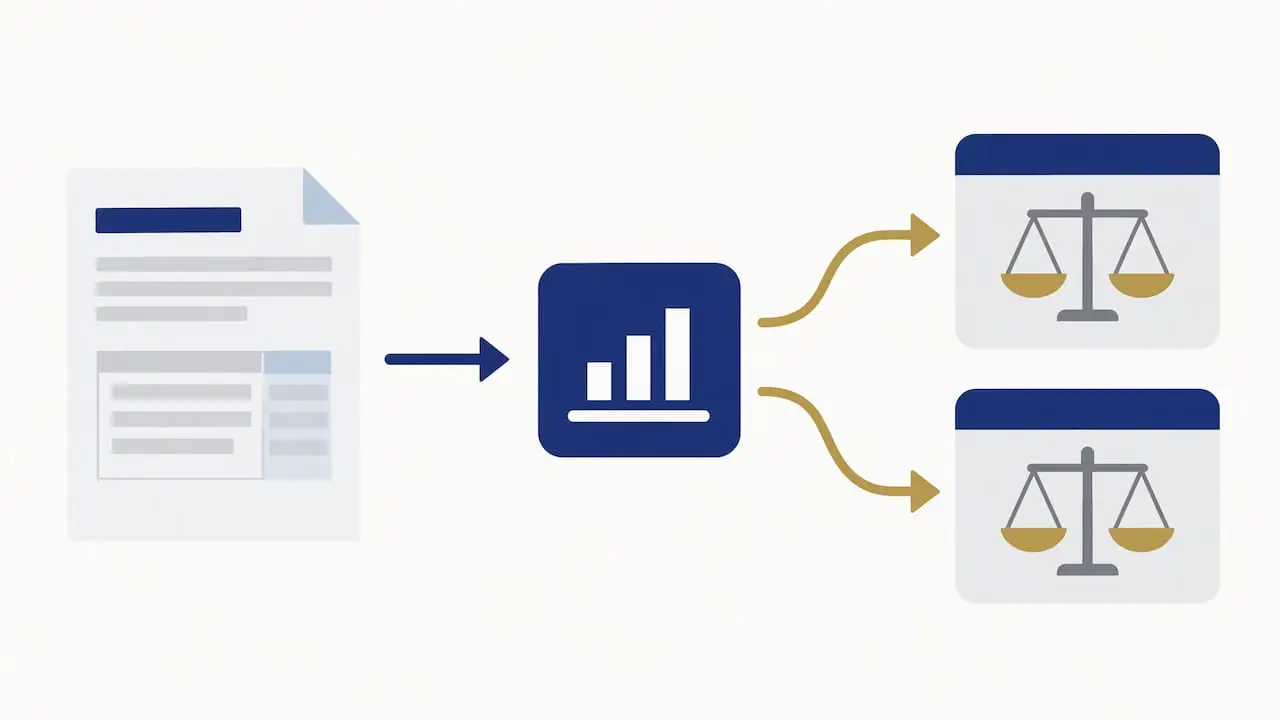
Under the domestic reverse charge, the customer (usually the contractor) accounts for the VAT, so the supplier invoices without charging it. The customer records both output and input VAT on their own return. It applies only where both parties are VAT-registered (or required to be), the work is reported under CIS, and the customer has not given written end-user or intermediary notification.
TL;DR:
- The charge applies only when both parties are VAT registered, the specified work is reported under CIS, and the supply is standard or reduced rated.
- Zero rated work and work not reported under CIS stay outside the charge; materials and the whole invoice follow it if any portion qualifies.
- A customer is not an end user merely because it is a homeowner or developer; normal VAT applies after written notice, which you must retain.
- On a £50,000 job at 20%, the contractor reports £10,000 in box 1, reclaims it in box 4, and leaves boxes 6 and 7 unchanged.
- Subcontractors no longer receive the VAT upfront, so they should adjust short term budgets and forecasts to account for lower cash balances.
Table of Contents
- Do these conditions apply to your job?
- Which construction services are covered?
- When the reverse charge does not apply: end users and intermediaries
- How to invoice when the reverse charge applies
- How to report it on the VAT return, with a worked example
- What it means for cash flow
- Setting up your software and checking for common errors
- My view: get the coding and records right first
- How I can help with VAT and CIS
- FAQ
- Sources
Do these conditions apply to your job?
Run each supply through four quick checks before you issue or code an invoice:
- Both supplier and customer are VAT-registered, or required to be.
- The work is a specified construction service, with payment reported under CIS.
- The customer has not given written notice that it is an end user or intermediary.
- The supply is standard- or reduced-rated, not zero-rated.
A “no” to any one of these usually means normal VAT rules apply. Whether you are paid gross or net under CIS does not matter. HMRC’s role guidance makes clear that the tests are VAT registration and CIS reporting. My CIS page on registration and deductions for subcontractors covers the CIS side in more detail.
Which construction services are covered?
HMRC’s list of specified supplies is wide, and the GOV.UK guidance on building and construction services covers most building trades. In practice, the following all count:
- Construction, alteration, repair and extension of buildings and structures
- Demolition and dismantling
- Installing heating, lighting, air-conditioning, drainage and sanitation systems
- Internal cleaning in the course of construction or refurbishment
- Painting and decorating
- Site clearance, foundations, scaffolding and landscaping as part of the works
Materials supplied alongside a specified service fall under the reverse charge too. One catch catches people out: if any part of a supply is covered, the whole invoice is treated under the reverse charge. You cannot split off the non-CIS elements. Zero-rated supplies, and supplies not reported under CIS, are outside the charge. HMRC’s scope manual sets out the full list of covered and excluded services.
When the reverse charge does not apply: end users and intermediaries
“End user” has a narrow legal meaning here. A large developer or a homeowner is not automatically one, so never assume. An end user is a customer who does not make onward supplies of the specified services, and HMRC’s end user guidance says this status must be evidenced in writing.
- End users: the customer tells you in writing that it is an end user, and normal VAT rules apply.
- Intermediary suppliers: a VAT- and CIS-registered business that resupplies to a linked end user without material alteration can be treated like an end user, provided written notices are exchanged.
- Evidence: notification can be paper, electronic or in the contract terms, and it must be kept with your VAT records.
Without written notice, you must apply the reverse charge.
How to invoice when the reverse charge applies
Do not charge VAT. Show the VAT-exclusive amount and state clearly that the reverse charge applies, so your customer knows to account for the VAT. GOV.UK’s summary of the rules confirms invoices must show the supplies are subject to the reverse charge.
- Show the net amount with no VAT line.
- Add wording such as “Reverse charge: customer to account to HMRC for the VAT”.
- Note the VAT rate that would otherwise apply, if you wish, but do not add it to the total.
- Keep the contract and CIS evidence, including any clause treating the customer as an end user or intermediary.
- If you are unsure, apply the reverse charge rather than charge VAT without authority.
Pro Tip: Build the reverse-charge wording into an invoice template so the correct text appears automatically on every qualifying job.
How to report it on the VAT return, with a worked example
Say a subcontractor supplies £50,000 of qualifying work to a contractor at 20% VAT. This is an illustration, not market data. The VAT that would normally apply is £10,000.
- The subcontractor invoices with no VAT and does not include the transaction in box 6. No output VAT is declared.
- The contractor records £10,000 as output VAT in box 1.
- The contractor reclaims the same £10,000 as input VAT in box 4, subject to normal recovery rules.
- The contractor does not include the transaction in box 7.
- The net effect on the contractor’s payment to HMRC for this transaction is nil.
HMRC confirms that on a reverse-charge transaction the customer accounts for the VAT in box 1 and may recover it in box 4, with no effect on box 6 or 7 totals. The reverse charge moves who reports the VAT, not how much tax is due.
What it means for cash flow
The reverse charge changes who holds the VAT money, and that matters for planning.
- Subcontractors no longer receive the VAT element up front, so short-term cash balances can drop, and any VAT you used to hold briefly is no longer there. Adjust your budgets and forecasts. My budgeting and forecasting support can help with this.
- Contractors must account for the VAT on the return even though they normally recover it as input tax, so check you have the right codes in place before you file.
Take a chain. Subcontractor A supplies qualifying work to Subcontractor B, who supplies the main contractor. The contractor then supplies an end user who has given written notification. A and B both invoice with no VAT. B and the contractor each account for the VAT on what they buy, and reclaim it. Only the final supply to the end user carries normal VAT.
Setting up your software and checking for common errors
Xero, QuickBooks and FreeAgent can all handle reverse-charge transactions. The key is a dedicated reverse-charge tax code, so amounts post to the right boxes and stay out of boxes 6 and 7 where required. Check invoice wording and VAT-exclusive totals before you code anything.
- Do not confuse CIS gross or net status with whether the reverse charge applies.
- Do not skip or lose end-user notifications.
- Do not post reverse-charge sales into output VAT by mistake.
- Follow HMRC’s procedure notice, which stresses correct treatment of these transactions.
Pro Tip: Run a monthly report on your reverse-charge tax code and compare it to your invoices. A mismatch usually shows a coding slip before it reaches the return.
If you want a hand setting this up, I cover accounting software setup in Kent. For a fuller walkthrough with invoice wording and journal entries, see my construction VAT reverse charge guide.
My view: get the coding and records right first
The reverse charge changes accounting practice, not the final tax liability, so the priorities are correct coding and tidy records. I check contracts, invoice wording and software codes for my clients, which cuts the risk of an HMRC query. If in doubt, keep written notifications and paperless records.
— Chris
How I can help with VAT and CIS
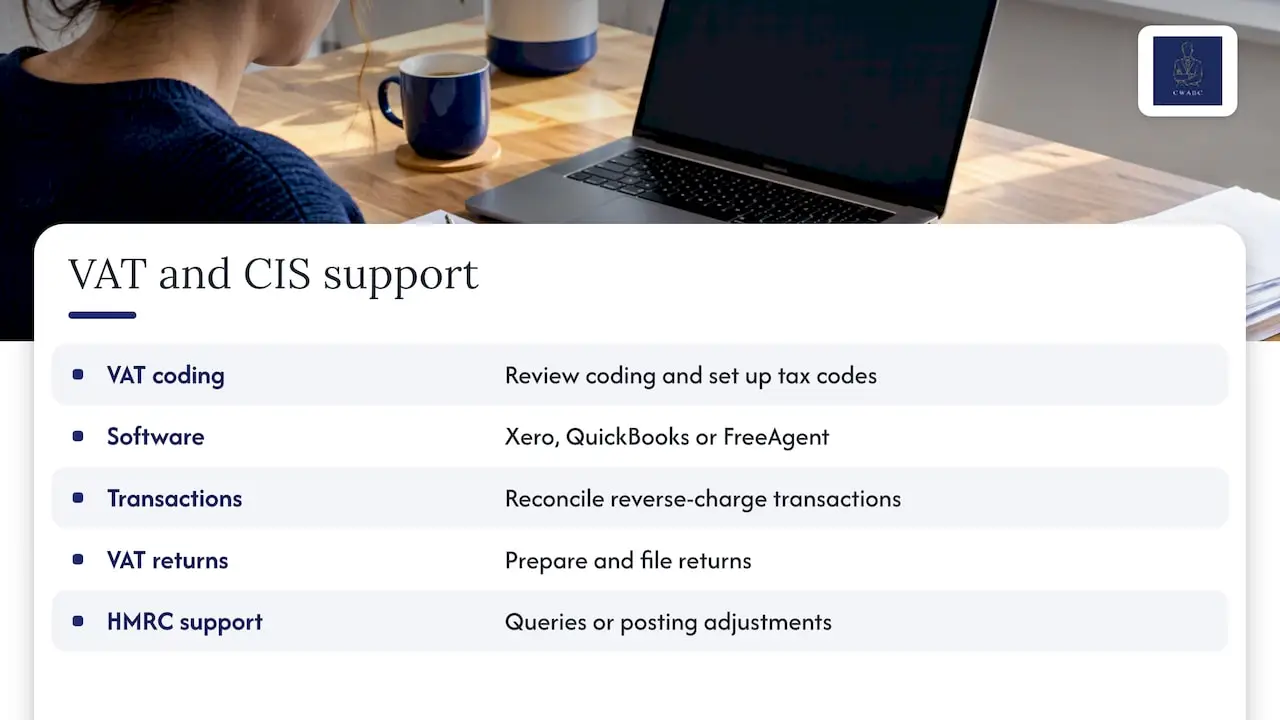
I work directly with contractors and subcontractors on VAT returns, CIS and payroll, and bookkeeping, and my wider accounting services in Tonbridge cover the rest. Where the reverse charge is concerned, I can review your VAT coding and set up the right reverse-charge tax codes in Xero, QuickBooks or FreeAgent. I can reconcile your reverse-charge transactions, prepare and file your VAT returns, and help with HMRC queries or adjustments if something has been posted wrongly.

I explain things in plain English and agree pricing clearly upfront, so you know where you stand. If you work in construction and want to be sure the reverse charge is handled properly, get in touch with me and tell me about your jobs. I will tell you what I would need to see and how I can help.
If you are also looking at marketing your trade business, this guide to contractor lead generation from TK Marketing is a useful read.
FAQ
Can builders reclaim VAT on materials?
Yes, if the builder is VAT-registered and the materials are used for taxable supplies, the VAT is normally recoverable as input tax. Under the reverse charge, the customer also reclaims the VAT it accounts for in box 4, subject to the usual recovery rules.
Where do I put the reverse charge on my VAT return?
The customer records the VAT as output tax in box 1 and reclaims it in box 4. Boxes 6 and 7 are not affected by the reverse charge, as HMRC’s manual explains.
When did the domestic reverse charge start?
It applies to specified supplies from 1 October 2019, and it is now in force as the standard rule for qualifying construction supplies.
What if my customer says it is an end user?
Ask for that in writing and keep the notice with your VAT records. Without written notification, you must apply the reverse charge.