The trading allowance lets you exempt up to £1,000 of gross trading or casual income each tax year. If your qualifying receipts are £1,000 or less, you usually do not need to declare them or pay tax. If they go over £1,000, you generally need to register for Self Assessment and then choose between the allowance and claiming your actual expenses.
TL;DR:
- Count gross receipts across all side activities, including commission and full CIS payments before deductions; income from connected parties follows normal expense rules.
- Compare £1,000 with allowable expenses and capital allowances; actual costs may give a larger deduction, while only that method can establish a loss.
- If gross qualifying receipts exceed £1,000, register for Self Assessment by October 5 after the tax year ends; existing filers report income on their return.
- The trading and property allowances have separate £1,000 limits, but neither can cover the other’s excess; voluntary registration may help protect State Pension and benefit entitlements.
Table of Contents
- Who can use the trading allowance, and what income counts?
- Should you claim the allowance or your actual expenses?
- When do you have to tell HMRC and register for Self Assessment?
- What do the allowance and expenses look like in real side-hustle examples?
- What records should you keep, and where does the allowance go on your return?
- How is the trading allowance different from the property allowance?
- What do I see most often in practice?
- How I can help with your trading allowance and Self Assessment
- FAQ
- Sources
Who can use the trading allowance, and what income counts?
The allowance covers money you receive from self-employment and casual work, including commission and one-off jobs. It does not cover pay from an employer. Think of it as a tax exemption on your gross receipts, meaning the money coming in before you take any costs off.
Here is what usually counts as qualifying income:
- Freelance fees, such as design, writing or bookkeeping jobs
- Takings from a small trade or a market stall
- Casual earnings and commission that do not come from employment
- Money from selling goods you made or bought to resell
The allowance applies per tax year, not per job. If you have several small activities, you can split it between them, but the total exemption cannot go above £1,000. The short tax return notes include examples of how that split works.
Some income is excluded because it comes from a connected party. That generally means your employer, a close company you are involved in, or certain partnership arrangements. The HMRC business income manual explains that this income must be reported and treated under normal expense rules.
If you work as a subcontractor under the Construction Industry Scheme, you count the full amount before any CIS deduction. The short self-employment notes make this clear.
Pro Tip: Add up gross receipts from every side activity before deciding anything. People often forget a small commission or a one-off sale, and it all counts towards the £1,000.
Should you claim the allowance or your actual expenses?
You cannot do both. If you claim the allowance, you cannot also deduct expenses or capital allowances against that income. The GOV.UK guidance is clear that you pick one method. HMRC’s capital allowances guidance adds that your capital allowance pools are unaffected and normal rules apply in later periods.
The decision is a simple comparison. Take your total allowable expenses and set them against £1,000. Whichever is bigger gives you the larger deduction and so the lower taxable profit. Here is how I work through it:
- Add up your gross receipts for the tax year.
- List your genuine allowable expenses, such as materials, software, travel for work and a share of phone costs.
- Include any equipment you would claim capital allowances on.
- Compare the total with £1,000.
- Choose the route that leaves the lower taxable profit, and keep your working notes.
HMRC says it is up to you to decide which route is most tax-efficient each year. If your actual costs are under £1,000, the allowance is often the better choice. If they are higher, calculating profit the traditional way usually wins.
Two more points matter. Claiming the allowance cannot create a loss, so if your costs are higher than your income, work out your profit in the traditional way to establish the loss. And because capital allowances are not available alongside the allowance, a big equipment purchase usually points towards claiming expenses. HS222 confirms this.
The tipping point is £1,000: once your allowable expenses and capital allowances are above that figure, claiming them instead of the allowance usually leaves you with the lower taxable profit.
For a fuller list of what you can deduct, see our guide to allowable expenses for sole traders.
When do you have to tell HMRC and register for Self Assessment?
If your gross qualifying receipts go over £1,000 in a tax year, you must register for Self Assessment. The registration deadline is 5 October following the end of that tax year. Once registered, you either claim the allowance or work out your profit using actual expenses.
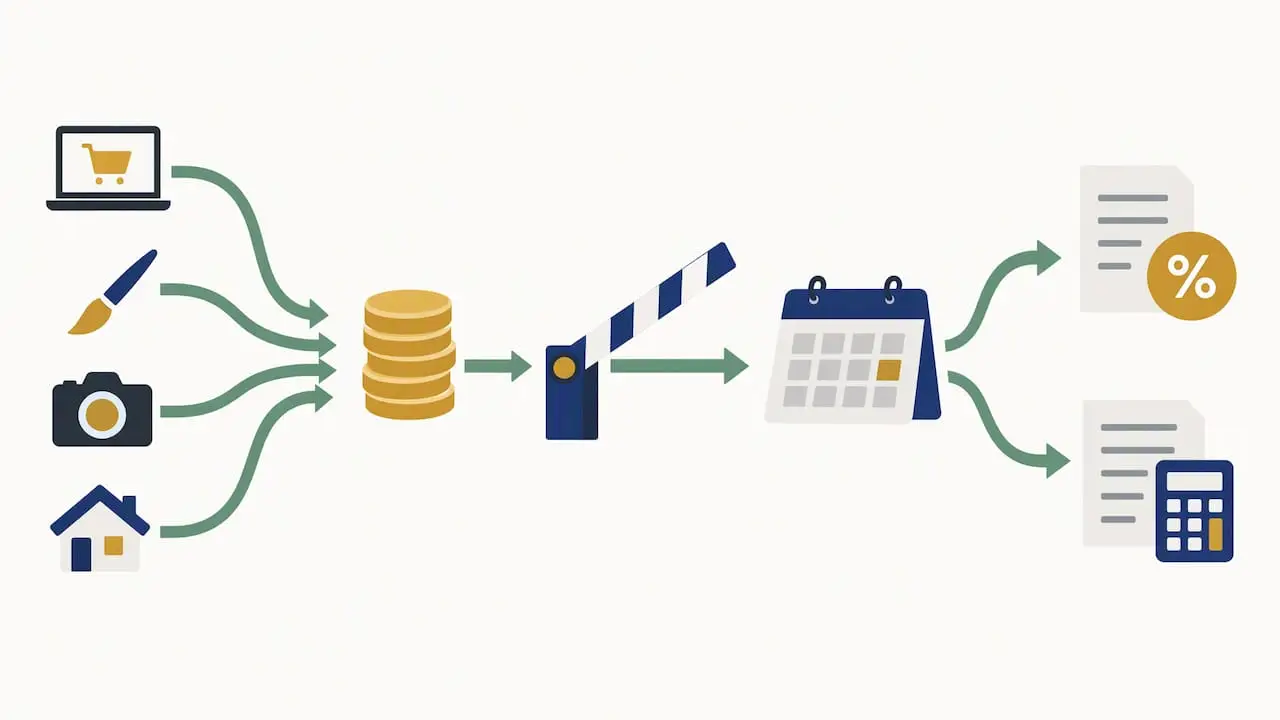
If you are already in Self Assessment, you simply include the income on your return. The guidance on registering as a sole trader confirms the £1,000 trigger.
Some people register even when they are under £1,000. A common reason is to pay voluntary Class 2 National Insurance, which can help protect State Pension and benefit entitlements. Whether that suits you depends on your wider position.
What to do next:
- Use the GOV.UK check tool to confirm whether you need to register
- Register for Self Assessment before the 5 October deadline
- Keep all receipts, invoices and bank records from day one
- Set money aside as you earn, so a tax bill never lands as a shock
- Ask for help early if your income is irregular
Payments on account can catch new traders out. HMRC can ask you to pay part of next year’s tax in advance, on top of the bill for the year just ended. In your first year that can feel like paying twice. I explain how it works in Self Assessment payments on account explained simply. If you are close to the deadline, my registration checklist may help. For wider background, read our sole trader tax guide.
Pro Tip: Put a percentage of every payment into a separate savings pot. It makes your first tax bill far less stressful.
What do the allowance and expenses look like in real side-hustle examples?
These are illustrative examples, with made-up figures, to show how the choice works.
- Gardening for neighbours. Say you earn a modest amount in the tax year and have no other trading income. If your total qualifying receipts are £1,000 or less, you generally do not need to declare them or pay tax.
- Tutoring plus craft sales. Say you earn money from tutoring and selling crafts, and your qualifying receipts total more than £1,000. You generally need to register for Self Assessment. If your expenses are small, you could claim the allowance, split it between the activities up to £1,000 in total, and not complete expense boxes for that income.
- A photographer with equipment costs. If your income is modest but your allowable costs for a new camera and lenses are substantial, the allowance would only deduct £1,000. Claiming actual expenses may give a bigger deduction and could let you establish a loss. Compare the figures before choosing.
If your situation looks like the third example, it is worth checking the maths before you commit to a method.
What records should you keep, and where does the allowance go on your return?
HMRC expects you to keep clear evidence of what came in, whether or not you claim the allowance. At a minimum, I suggest you keep:
- Sales receipts and invoices
- Bank statements showing the income
- CIS statements, if you work as a subcontractor
- Notes of any expenses you considered, so you can show why you chose a method
On the return, the self-employment notes show where to enter the trading allowance and how to split it across activities. Claiming it means you do not complete the expense boxes for that income. The short tax return notes give the same steer for simpler returns.
A few habits make this easier. Tag side income in your cloud accounting software so it is never mixed up with other money. Use a separate bank account, or at least a clear label, for your side activity. And keep your records for the period HMRC requires. If you need a hand setting this up, my guide to a sole trader bookkeeping system is a good place to start.
Failing to register when you should can lead to penalties, so it pays to check early.
How is the trading allowance different from the property allowance?
They are two separate £1,000 reliefs. The trading allowance covers self-employment and casual income. The property allowance covers property receipts, such as occasional rental income. GOV.UK confirms that if you have both types of income, you may be eligible for an allowance for each.
- Each allowance has its own limit and is claimed separately
- Connected-party rules apply to both, so income from some related parties is excluded
- Each sits in its own section of the tax return
- You cannot use one to absorb the other’s excess
Say you earn £700 from freelance work and £900 from letting a spare room. You could use each allowance in the same year, and neither alone would trigger a declaration.
What do I see most often in practice?
A first payment on account can come as a surprise to new traders. A new trader finishes their return, pays the bill, and then finds a second demand for next year’s tax. It strains cashflow, and it is avoidable if you plan ahead. Common mistakes include choosing the allowance without checking expenses, not recording receipts as they come in, and overlooking the connected-party rules. A short review early in the year costs far less than fixing mistakes later.
— Chris
How I can help with your trading allowance and Self Assessment
If you are unsure whether the allowance suits you, I can look at your numbers and give you a clear, plain-English answer. I work with you directly, so you know who is handling your tax affairs. Here is what I do:
- Review your records and work out whether you must report the income
- Model the tax result of claiming the allowance against claiming expenses
- Prepare and file your Self Assessment tax return, from £250 one-off
- Set up bookkeeping and cloud software so your records stay tidy
- Help you plan for payments on account
- Set up Making Tax Digital for Income Tax where it applies to you
My aim is to remove the guesswork, so you can get on with your work. If you would like a review, get in touch through my contact page and I can arrange a time to talk.
FAQ
How much can I trade in the UK before paying tax?
You can receive up to £1,000 in gross trading or casual income in a tax year without declaring it or paying tax, under the trading allowance. Above that, you generally need to register for Self Assessment. Connected-party income is treated differently.
Is the trading allowance still £1,000?
Yes. The GOV.UK guidance sets it at £1,000 per tax year, and the 2026 helpsheets repeat that figure. It applies to your gross receipts, not your profit.
What is a trade allowance and how does it work?
It is a flat exemption on your gross trading and casual income. If your receipts are £1,000 or less, you usually have nothing to report. Over that, you choose between deducting the allowance or deducting your actual expenses, but not both.
Do I need to tell HMRC when I start trading?
Not necessarily. If your gross receipts stay at £1,000 or less, you generally do not need to tell HMRC. If they go over, you must register for Self Assessment by 5 October after the tax year ends. You may also register voluntarily, for example to pay Class 2 National Insurance.