
Trading income for a UK small business is the total profit arising from its trade, calculated by deducting allowable business expenses from gross trading receipts, in line with HMRC guidance and generally accepted accounting practice (GAAP). Get this classification right and you unlock the correct tax treatment, the right reliefs, and a clean compliance record. Get it wrong and you risk denied allowances, unexpected tax bills, and penalties.
Table of Contents
- What qualifies as trading income under UK tax rules?
- How active, dormant, and non-trading status affects Corporation Tax
- How does HMRC decide whether your income is trading income?
- The UK trading allowance and when it applies to you
- How to calculate and report your trading income for tax
- Common misunderstandings about trading income
- How trading income classification affects your reliefs and allowances
- Cwabc helps you get trading income right from the start
- Key takeaways
- Need help?
What qualifies as trading income under UK tax rules?
Trading income covers the full amount of profits from a trade, profession, or vocation, as charged under the Income Tax (Trading and Other Income) Act 2005 and the Corporation Tax Act 2009. In plain terms, it is the money your business earns through its core commercial activity, after deducting the costs of earning it.
Income types that count as trading income:
- Sales of goods or products
- Fees for services provided to clients or customers
- Commissions earned through referrals or agency arrangements
- Online income from selling goods, digital products, or services
- Grants received in connection with trading activity (where they are revenue in nature, not capital)
- Rental of business equipment as part of a trade
- Casual income from services such as gardening or babysitting (where carried on as a trade)
Income types that do not count as trading income:
- Dividends from shares (these are investment income)
- Most interest received, unless it is integral to trading operations or arises on business current account balances within normal banking requirements
- Capital receipts from selling business assets
- Non-transferable rewards or benefits that cannot be converted to cash
A useful way to think about the capital versus income divide is HMRC’s own “tree and fruit” analogy: the business asset is the tree, and the trading receipts are the fruit. You pay tax on the fruit, not the tree itself.
Pro Tip: Keep a simple spreadsheet that separates each income stream by type from day one. Labelling receipts as “trading” or “non-trading” as they arrive takes seconds and saves hours at tax time.
How active, dormant, and non-trading status affects Corporation Tax
Your company’s status determines whether it has a Corporation Tax obligation and whether trading income needs to be recognised at all. HMRC distinguishes three categories.
Active company: Carries on trading or business activities, receives income, or incurs expenses in connection with trade. Corporation Tax returns are required, and trading income must be reported.

Dormant company: Has no significant accounting transactions during the period. HMRC accepts that a dormant company has no trading income to report, though Companies House filing obligations still apply.
Non-trading company: Sits between the two. It may hold assets, receive investment income such as dividends or interest, or exist between periods of trading. It is not dormant, but it is not generating trading income either.
Key characteristics at a glance:
- Active: trading receipts, allowable expenses, Corporation Tax due on profits
- Dormant: no significant transactions, no trading income, reduced filing burden
- Non-trading: investment income possible, no trade profits, specific tax rules apply to non-trading loan relationships
If your company moves between these statuses during a year, you must notify HMRC promptly. Misreporting your status is one of the more common causes of incorrect Corporation Tax filings for small limited companies.
How does HMRC decide whether your income is trading income?
HMRC does not simply count transactions. Instead, it applies the “badges of trade,” a set of factors drawn from case law that together paint a picture of whether an activity amounts to a trade. No single badge is decisive; the overall commercial context is what matters.
The badges of trade:
- Profit motive: Was the transaction entered into with the intention of making a profit?
- Frequency and number of transactions: Repeated similar transactions suggest trading, though frequency alone is not enough.
- Nature of the asset: Assets that yield income (such as shares paying dividends) point toward investment rather than trade.
- Existence of similar trading transactions: Does the activity resemble what a recognised trader in that field would do?
- Method of acquisition: Assets acquired by gift or inheritance are less likely to be trading stock.
- Supplementary work: Did you process, improve, or market the asset before sale? That points toward trade.
- Circumstances of the sale: Was the sale forced, or was it a deliberate commercial decision?
- Motive: The taxpayer’s stated intention at the time of acquisition carries weight.
“The number and frequency of transactions, and the short-term nature of the holdings alone did not establish trading. Other factors taken into account were the time spent on the activity, the fact that the individual did not entirely rely on their own expertise, and that the activities were not characteristic of established dealers.” — HMRC Business Income Manual, BIM20250
This matters in practice. A sole trader who buys and sells second-hand tools regularly, markets them online, and prices them to generate a margin is almost certainly trading. Someone who sells a personal collection of antiques once is probably not. The facts of your specific situation are what HMRC will examine, not a simple checklist.
The UK trading allowance and when it applies to you
The £1,000 trading allowance is a tax-free threshold available to individuals with trading income from self-employment, casual services, or hiring out personal equipment. It has applied since 6 April 2017.
Key rules:
- If your gross trading income is £1,000 or less in a tax year, you generally do not need to notify HMRC or register for Self Assessment (though exceptions apply).
- If your gross trading income exceeds £1,000, you must register for Self Assessment by 5 October in the following tax year.
- You can choose between the allowance and deducting your actual expenses, but you cannot claim both.
- The allowance does not apply to income from a partnership.
- The allowance cannot create a loss; it can only reduce taxable income to nil.
“If your annual gross trading income is £1,000 or less, from one or more trades you may not have to tell HMRC, however there are circumstances when you must register for Self Assessment and declare your income on a tax return.” — GOV.UK, Tax-free allowances on property and trading income
Example: You earn £1,800 from selling handmade goods online. You have £300 of actual costs. Using the trading allowance gives you taxable profit of £800 (£1,800 minus £1,000). Using actual expenses gives you taxable profit of £1,500 (£1,800 minus £300). The allowance wins here. But if your costs were £1,200, actual expenses would produce a lower taxable profit of £600. Always run both calculations before deciding.
Choosing the wrong method is one of the most common reasons small business owners overpay tax in their first year of trading. Good bookkeeping practices from the start make that comparison straightforward.
How to calculate and report your trading income for tax
Trading profits must be calculated in accordance with GAAP, with any adjustments required by tax law applied on top. For eligible small businesses, the cash basis is an alternative that simplifies record-keeping by recognising income when received and expenses when paid, rather than when invoiced.
“The profits of a trade must be calculated in accordance with generally accepted accounting practice, subject to any adjustment required or authorised by law.” — S25(1) Income (Trading and Other Income) Act 2005
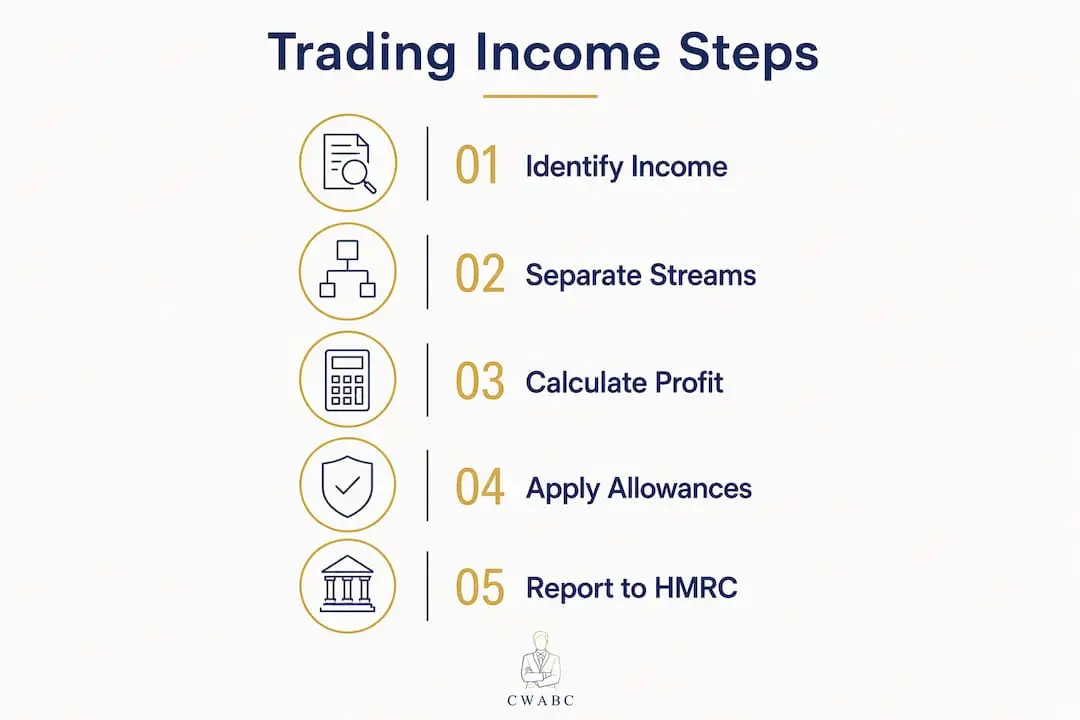
The basic calculation:
Gross trading receipts, minus allowable business expenses, equals trading profit. Allowable expenses include costs wholly and exclusively incurred for the trade: stock, materials, business travel, professional fees, and relevant software subscriptions, among others.
Mixed income streams require apportionment. If you run a buy-to-let property alongside a freelance design business, the rental income is property income, not trading income. Each stream is reported separately on your Self Assessment return. Mixing them together is a common error that can distort both your tax liability and your VAT position.
VAT implications: If your taxable turnover (which broadly follows trading income) exceeds the VAT registration threshold, you must register for VAT. Misclassifying non-trading income as trading income can push you over the threshold unnecessarily, or vice versa.
Record-keeping: Keep invoices, receipts, bank statements, and a clear record of income by source. HMRC can request records going back several years, and clear documentation is your best defence in any enquiry. Understanding your small business tax obligations from the outset helps you build the right habits early.
Common misunderstandings about trading income
A few misconceptions come up repeatedly, and they can be costly.
Common mistakes to avoid:
- Treating all income as trading income: Dividends paid to you as a company director are not trading income. They are investment income taxed differently.
- Assuming the trading allowance always wins: As the example above shows, actual expenses sometimes produce a better result. Never assume; always calculate.
- Thinking grants are always excluded: Revenue grants linked to trading activity are generally trading income. Capital grants for buying assets are treated differently.
- Believing high transaction frequency proves trading: HMRC’s own case law confirms that frequency alone does not establish a trade. Commercial organisation, customers, and profit motive all matter.
- Overlooking the “money or money’s worth” rule: A receipt must be convertible to cash to count as taxable trading income. A non-transferable reward or benefit that cannot be sold or exchanged is not taxable trading profit.
- Mixing personal and business income: Personal income from selling your own possessions is not trading income unless the badges of trade indicate otherwise.
Misclassification has real consequences. HMRC can deny loss relief, disallow allowances, and charge penalties where income has been reported under the wrong head of charge. If your income streams are mixed or unusual, professional tax planning is worth the investment.
How trading income classification affects your reliefs and allowances
Getting the classification right is not just about compliance. It directly affects which reliefs and allowances you can access.
Small Profits Rate and Corporation Tax: Only companies with trading profits qualify for the Small Profits Rate of Corporation Tax. A company with only investment income does not benefit from this rate.
Trading losses: You can only offset a trading loss against other income or carry it forward if the loss arises from a genuine trade. Misclassify investment activity as trading and HMRC will deny the loss relief, as illustrated in the Wannell v Rothwell case referenced in HMRC’s own manuals.
Annual Investment Allowance (AIA): The AIA applies to capital expenditure incurred for the purposes of a trade. If your activity is not classified as trading, you cannot claim it.
Research and Development (R&D) relief: Available only to companies carrying on a qualifying trade. Non-trading companies are excluded.
Making Tax Digital (MTD): From April 2026, MTD for Income Tax applies to sole traders and landlords with qualifying income above the threshold. Trading income is central to calculating whether you are in scope. Knowing exactly what counts as trading income helps you prepare for MTD without last-minute chaos.
Sole traders should also be aware that registering with HMRC correctly from the start, and declaring the right income type, sets the foundation for accessing the reliefs you are entitled to. A small error at registration can create complications that take years to untangle.
Cwabc helps you get trading income right from the start
Sorting out what counts as trading income sounds straightforward until you are staring at three different income streams, a grant payment, and a question about whether your interest counts. That is exactly where Cwabc comes in.
Based in Tonbridge, Cwabc works with sole traders, landlords, and small limited companies across Kent who want clear, jargon-free accounting support without the guesswork. The focus is on getting your income classified correctly from day one, so your tax returns are accurate, your reliefs are claimed in full, and you are not caught out by Making Tax Digital when it arrives.
There are no vague quotes and no surprise bills. Cwabc offers clear, upfront pricing and the kind of personal support that means you always know where you stand. Whether you need help with your Self Assessment, Corporation Tax, or simply want someone to review how you are recording your income streams, the team is ready to help.
Get in touch with Cwabc to arrange a free, no-obligation conversation about your trading income and tax position.
Key takeaways
Trading income classification determines your tax liability, your eligibility for reliefs, and your VAT obligations, making accurate categorisation one of the most consequential decisions a small business owner makes.
| Point | Details |
|---|---|
| Core definition | Trading income is gross receipts from your trade minus allowable expenses, calculated under GAAP or cash basis. |
| What is excluded | Dividends, most interest, capital receipts, and non-transferable benefits do not count as trading income. |
| Trading allowance | The trading allowance applies to individuals only; partnerships cannot claim it, and actual expenses sometimes produce a better result. |
| Badges of trade | HMRC assesses trading status on the full commercial context, not any single factor such as transaction frequency. |
| Cwabc | Cwabc helps sole traders and small companies in Kent classify income correctly, claim the right reliefs, and file accurately. |
Need help?
If you are unsure how to classify your income streams or want to make sure your tax returns reflect the correct trading income position, Cwabc is here to help. Book a free, no-obligation conversation with the team at cwabc.co.uk/contact-us and get straightforward answers without the jargon.