Sole trader tax is defined as the annual process of paying Income Tax and National Insurance Contributions (NICs) on your business profits through HMRC’s Self Assessment system. As a sole trader, you are personally responsible for calculating and paying these taxes. You must register with HMRC once your gross self-employment income exceeds £1,000 in a tax year. Your taxable profit is your income minus allowable expenses, and the Personal Allowance of £12,570 means you pay no Income Tax below that threshold. Getting sole trader tax explained clearly from the start saves you from penalties, missed deductions, and last-minute filing chaos.
What does sole trader tax explained mean in practice?
Sole trader tax covers three core obligations: Income Tax on profits, Class 4 National Insurance, and the annual Self Assessment tax return filed with HMRC. Unlike employees, no employer deducts tax at source for you. You calculate what you owe, report it yourself, and pay it directly. The main regulatory body overseeing this process is HMRC, and the key document is your Self Assessment tax return, submitted once a year. Understanding these obligations early puts you in control of your finances rather than scrambling at deadline time.

How and when do you register as a sole trader with HMRC?
Registration is not optional once your income crosses the threshold. Gross income over £1,000 in a tax year triggers the legal requirement to register with HMRC for Self Assessment. Missing this step leads to automatic penalties, not just a gentle reminder.
The registration process follows a clear sequence:
- Check the threshold. If your gross self-employment income exceeds £1,000 in any tax year, you must register.
- Meet the deadline. You must register by 5 October following the end of the tax year in which you started trading. For example, if you started trading in the 2025/26 tax year, your deadline is 5 October 2026.
- Register online. Use HMRC’s online portal to create a Government Gateway account and complete the self-employment registration form.
- Receive your UTR. HMRC issues a Unique Taxpayer Reference within 10 working days of registration. You need this number to file your tax return.
- Check VAT obligations. If your taxable turnover exceeds £90,000 in a rolling 12-month period, you must also register for VAT separately.
- Consider employer registration. If you take on staff, you will need to register as an employer with HMRC and operate PAYE.
Pro Tip: Register as soon as your income exceeds £1,000, even if your business is small. Early registration prevents unnecessary penalties and gives you time to set up good record-keeping habits from day one.
Registering early also means you receive your UTR in good time before the January filing deadline. Leaving registration late is one of the most common and avoidable mistakes sole traders make.
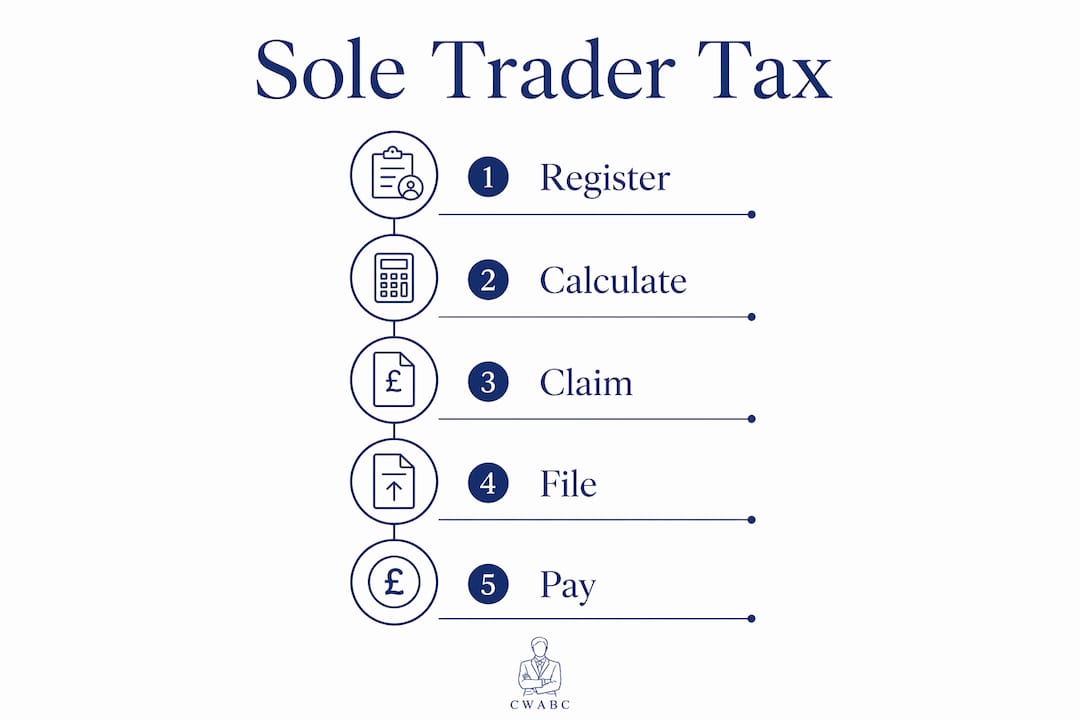
How is Income Tax and National Insurance calculated for sole traders?
Your taxable profit is your total business income minus your allowable expenses. Once you have that figure, HMRC applies Income Tax and National Insurance rates to calculate what you owe. The Personal Allowance of £12,570 is frozen until at least 2028, meaning the first £12,570 of profit is tax-free.
Income Tax rates for 2026/27
UK Income Tax rates for sole traders in 2026/27 are as follows:
| Profit band | Income Tax rate |
|---|---|
| Up to £12,570 | 0% (Personal Allowance) |
| £12,571 to £50,270 | 20% (basic rate) |
| Above £50,270 | 40% (higher rate) |
These rates apply to your taxable profit after expenses, not your total turnover. That distinction matters enormously when you are planning your tax bill.
National Insurance Contributions for sole traders
Class 4 National Insurance is charged at 6% on profits between £12,570 and £50,270, and 2% on profits above that. Class 2 NI is now collected through Self Assessment if your profits exceed £12,570. If your profits fall below that threshold, Class 2 contributions become voluntary. Paying them voluntarily protects your entitlement to the State Pension and certain benefits.
A practical example
Suppose your taxable profit for 2026/27 is £35,000.
- Income Tax: 20% on £22,430 (£35,000 minus £12,570) = £4,486
- Class 4 NI: 6% on £22,430 = £1,345.80
- Total tax and NI: approximately £5,831.80
That figure does not include any payments on account, which are covered in the filing section below.
Pro Tip: Check your National Insurance record on your HMRC personal tax account at least once a year. Voluntary Class 2 NI helps maintain your State Pension entitlement if your profits fall below the threshold. Gaps in your record are expensive to fill later.
What expenses can reduce your sole trader tax bill?
Allowable expenses are costs you deduct from your income before calculating taxable profit. Every pound of legitimate expenses reduces the profit HMRC taxes. HMRC requires expenses to be wholly and exclusively for business use. That single rule governs every claim you make.
Common allowable expense categories
- Equipment and tools used solely for your business (laptops, machinery, specialist tools)
- Business travel including mileage, train fares, parking at client sites, and overnight accommodation on business trips
- Home office costs apportioned by the number of rooms used and hours worked
- Professional fees such as accountancy, legal advice, and professional memberships
- Marketing costs including website hosting, advertising, and printed materials
- Software subscriptions used for business purposes
- Stock and materials purchased for resale or use in your work
What you cannot claim
Client entertaining costs are explicitly disallowed by HMRC for sole traders. Personal clothing (unless it is a uniform or protective gear), fines, and the personal portion of any mixed-use expense are also disallowed. Claiming these is a common trigger for HMRC enquiries.
Mixed-use items and apportionment
Many sole traders use a phone or vehicle for both business and personal purposes. Mixed-use assets require you to split the cost between business and personal use, using a consistent and documented methodology. For example, if you use your mobile phone 60% for business, you can claim 60% of the bill. You must record how you reached that split and apply it consistently.
Simplified expenses vs actual costs
HMRC offers flat-rate simplified expenses for vehicles, home working, and living on business premises. The mileage rate for cars is 45p per mile up to 10,000 miles, then 25p per mile thereafter. The alternative is the actual cost method, which requires detailed records of every expense. Simplified expenses are easier to administer; the actual cost method sometimes produces a higher deduction for high-mileage drivers.
| Method | Best suited to | Record-keeping burden |
|---|---|---|
| Simplified (flat rate) | Lower mileage, home workers | Low |
| Actual cost | High mileage, significant vehicle costs | High |
Pro Tip: The Annual Investment Allowance (AIA) lets you deduct 100% of qualifying capital equipment costs up to £1 million in the year of purchase. If you buy a significant piece of equipment, claim AIA rather than spreading the cost over several years.
From april 2026, Making Tax Digital for Income Tax (MTD ITSA) requires sole traders with income over £50,000 to keep digital records and submit quarterly updates to HMRC. This changes how you store receipts and record transactions, not just how you file at year end. Setting up a digital record-keeping system now avoids a disruptive scramble later.
How do you file your Self Assessment tax return and meet deadlines?
Self Assessment is the annual process of reporting your income, expenses, and tax liability to HMRC. You file one return per tax year, covering the period from 6 april to 5 april. The process is straightforward once your records are in order throughout the year.
Key deadlines every sole trader must know
- 5 October after the end of the tax year: deadline to register for Self Assessment if you are new to self-employment.
- 31 October (paper returns): deadline to submit a paper Self Assessment tax return.
- 31 January (online returns): deadline to submit your online Self Assessment return and pay any tax owed.
- 31 July: deadline for your second payment on account.
Late filing triggers an immediate £100 penalty, even if you owe no tax. Penalties escalate after three months, six months, and twelve months. Missing the payment deadline adds interest charges on top. These are entirely avoidable costs.
Understanding payments on account
Payments on account are advance payments toward your next year’s tax bill. HMRC calculates them automatically based on your previous year’s liability. Payments on account are due on 31 January and 31 July each year. Each payment equals 50% of your prior year’s tax bill. If your income drops significantly, you can apply to reduce them, but you must do so before the payment date.
For example, if your 2025/26 tax bill is £5,000, HMRC will ask for £2,500 on 31 January 2027 and another £2,500 on 31 July 2027 as payments on account for 2026/27. This catches many new sole traders off guard in their second year of trading.
Pro Tip: Submit your Self Assessment return as early as possible after 6 april. Early submission gives you months to budget for the payment due in January, rather than scrambling in the last week. It also reduces the risk of technical errors under deadline pressure.
For sole traders with income over £50,000, MTD ITSA quarterly updates replace the annual-only filing routine with four digital submissions per year plus a final declaration. This is a significant shift in how you manage your tax records throughout the year.
Sole trader vs limited company: how does the tax differ?
The core distinction is legal status. A sole trader and their business are the same legal entity. A limited company is a separate legal entity from its owner. That difference drives everything else, including how tax is calculated and paid.
Sole traders pay Income Tax and Class 4 National Insurance on their profits through Self Assessment. Limited companies pay Corporation Tax on their profits, and directors or shareholders pay Income Tax on salaries and Dividend Tax on dividends they draw from the company. The overall tax burden depends on profit levels, how money is extracted, and personal circumstances.
| Factor | Sole trader | Limited company |
|---|---|---|
| Legal status | No separation from owner | Separate legal entity |
| Tax on profits | Income Tax + NI via Self Assessment | Corporation Tax |
| Tax on owner’s income | Included in profit tax | Salary (PAYE) + dividends |
| Accounting complexity | Lower | Higher |
| Personal liability | Unlimited | Limited to share capital |
| Privacy | Lower | Accounts filed at Companies House |
Neither structure is universally better. The right choice depends on your profit level, your appetite for administrative complexity, and your plans for the business. This comparison is informational. Changing your business structure has legal and tax consequences that require professional advice before you act.
Pro Tip: If you are considering moving from sole trader to limited company, speak to a qualified accountant before making any changes. The tax savings at higher profit levels can be real, but the additional compliance costs and responsibilities must be weighed carefully.
Key takeaways
Sole trader tax requires HMRC registration, accurate profit calculation, and timely Self Assessment filing to stay compliant and avoid penalties.
| Point | Details |
|---|---|
| Register by 5 October | Register with HMRC by 5 October after the tax year you started trading to avoid automatic penalties. |
| Know your tax rates | Income Tax starts at 20% above £12,570; Class 4 NI is 6% up to £50,270 and 2% above. |
| Claim all allowable expenses | Deduct wholly and exclusively business costs to reduce your taxable profit and lower your tax bill. |
| Plan for payments on account | Budget for two advance payments due 31 January and 31 July, each equal to 50% of your prior year’s bill. |
| Prepare for MTD ITSA | Sole traders earning over £50,000 must keep digital records and submit quarterly updates from april 2026. |
What I have learned from years of working with sole traders
Working with sole traders in and around Tonbridge, I see the same patterns repeat year after year. The ones who struggle most are not the ones with complicated finances. They are the ones who left registration too late, kept no records through the year, and then faced a January deadline with a shoebox of receipts.
The single biggest misconception I encounter is around National Insurance. Many sole traders treat NI as an afterthought, something to pay and forget. The reality is that your Class 2 and Class 4 contributions directly affect your State Pension entitlement. Paying voluntarily when your profits fall below the threshold is not a bureaucratic formality. It is an investment in your future income. I have seen clients reach retirement age with gaps in their NI record that cost them dearly, simply because nobody told them to check.
The second pattern I see constantly is the undervaluing of allowable expenses. Sole traders routinely miss legitimate claims because they are not sure what counts. The “wholly and exclusively” rule sounds strict, but it covers a wide range of genuine business costs. A good set of records throughout the year makes the difference between a rushed, incomplete return and one that accurately reflects your real tax position.
Making Tax Digital is changing the rhythm of tax management for sole traders. Quarterly digital submissions feel like more work at first. In practice, they force a discipline that most sole traders benefit from. When you update your records every quarter, your January return becomes a formality rather than a crisis.
My honest advice is this: do not wait until October to think about your tax position. Set aside time each month to update your records, check your expenses, and review your income. If your situation is growing more complex, the role of an accountant shifts from a luxury to a practical necessity.
— Chris
How Cwabc supports sole traders with their tax
Cwabc works with sole traders across Tonbridge and the surrounding area to take the stress out of tax compliance. Whether you need help with your first Self Assessment return, want to make sure you are claiming every legitimate expense, or need to prepare for Making Tax Digital, Cwabc provides clear, jargon-free support at every stage.
From setting up digital record-keeping systems to submitting accurate returns on time, Cwabc handles the detail so you can focus on running your business. Clients benefit from upfront pricing, no surprises, and a local expert who understands the pressures sole traders face. If you are unsure whether your bookkeeping is working for you, or you want to check you are not missing any deductions, start with a free, no-obligation conversation. Visit the Cwabc contact page to get in touch today.
FAQ
What is the registration threshold for sole traders?
You must register with HMRC for Self Assessment if your gross self-employment income exceeds £1,000 in a tax year. The registration deadline is 5 October after the end of that tax year.
How do sole traders pay National Insurance?
Sole traders pay Class 4 National Insurance through their Self Assessment return. Class 4 is charged at 6% on profits between £12,570 and £50,270, and 2% above that. Class 2 NI is also collected through Self Assessment if profits exceed £12,570.
What expenses can a sole trader claim?
Sole traders can claim expenses that are wholly and exclusively for business use. Common claims include equipment, business travel, home office costs, professional fees, and software subscriptions. Client entertaining and personal clothing are not allowable.
What happens if you miss the Self Assessment deadline?
A late Self Assessment return triggers an immediate £100 penalty, even if no tax is owed. Penalties increase after three months, six months, and twelve months, with interest added to any unpaid tax.
What is Making Tax Digital for sole traders?
Making Tax Digital for Income Tax (MTD ITSA) requires sole traders with income over £50,000 to keep digital records and submit quarterly updates to HMRC from april 2026. It replaces the previous annual-only filing routine with four digital submissions per year plus a final declaration.
Need help?
Managing sole trader tax does not have to be complicated. Cwabc offers a free, no-obligation conversation to help you understand your obligations and get your records in order. Contact Cwabc today and take the first step toward stress-free tax management.