
UK residential landlords must declare rental income to HMRC, pay tax on profits after allowable expenses, and meet specific reporting deadlines — the quick checklist and worked example below show exactly how.
Your rental profit is simply your total rental income minus your allowable expenses. That profit is added to your other income and taxed at your marginal rate. The property allowance lets you exempt the first £1,000 of gross property income each year, but if your expenses exceed that figure, claiming actual costs will almost always save you more.
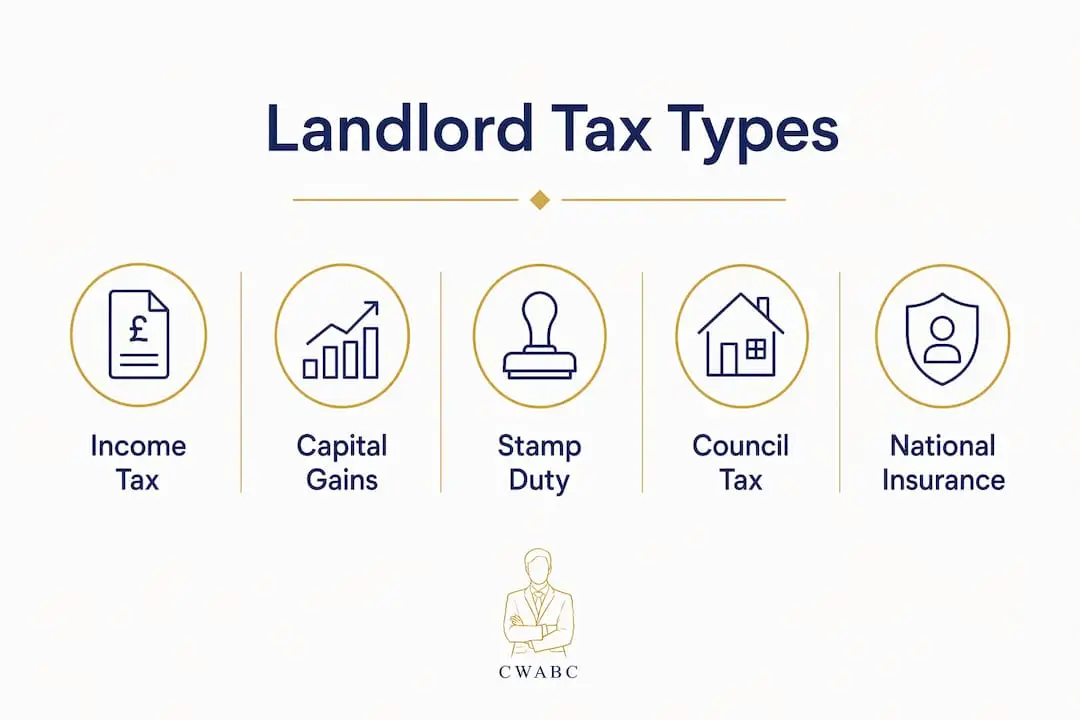
Taxes you should expect as a residential landlord:
- Income tax on rental profits (after allowable expenses and Section 24 adjustments)
- Capital Gains Tax (CGT) when you sell a let property
- Stamp Duty Land Tax (SDLT) in England and Northern Ireland, Land Transaction Tax (LTT) in Wales, or Land and Buildings Transaction Tax (LBTT) in Scotland, payable on purchase
- National Insurance in rare cases where letting activity is treated as a trade
Your immediate action list:
- Register for Self Assessment with HMRC by 5 October following the tax year you first received rental income.
- Choose your accounting basis: cash basis (available if total property income is below a specified turnover threshold) or traditional accruals accounting.
- Start digital record-keeping now — Making Tax Digital for Income Tax is coming and early systems prevent last-minute chaos.
- Preserve all invoices, tenancy agreements, bank statements, and evidence of capital improvements.
- Check whether any special scheme applies to you: Non-resident Landlord Scheme, rent-a-room relief, or company ownership.
The single most important habit: treat your rental property as a business from day one. Landlords who keep tidy, categorised records throughout the year spend far less time and money at filing time — and face far fewer HMRC queries.
Pro Tip: If your gross rental income is below the property allowance threshold in a tax year, you have nothing to declare. Above that threshold, register and report — even if your profit after expenses is small or nil.
Table of Contents
- What taxes do residential landlords actually pay?
- What counts as taxable rental income?
- Which costs can you deduct, and what counts as capital?
- How does Section 24 affect your mortgage interest relief?
- Making Tax Digital and Self Assessment: what you must do and when
- Capital Gains Tax when you sell a let property
- Purchase taxes across the UK: SDLT, LTT, and LBTT
- Special situations: non-resident landlords, rent-a-room, and company ownership
- Worked example: calculating taxable rental profit and tax due
- How Section 24 has affected landlords in practice
- Landlord tax checklist: registrations, records, and deadlines
- Key takeaways
- Why landlords who act early sleep better at night
- Cwabc: landlord tax and bookkeeping support in Tonbridge
- Useful sources and further reading
- Need help?
What taxes do residential landlords actually pay?
Understanding your full tax picture from the outset saves surprises later. Here is a concise overview of every tax a residential landlord may face.
Income tax on rental profits
Rental profit (income minus allowable expenses) is added to your other income and taxed at your marginal rate: 20% basic rate, 40% higher rate, or 45% additional rate. From 6 April 2027, separate property rates will apply: 22% basic, 42% higher, and 47% additional, with finance cost relief provided at the new 22% basic property rate. (Note: Until 6 April 2027, finance cost relief is a 20% basic-rate tax credit; after that, relief is at the 22% basic property rate.) That is a material change worth planning for now.

Capital Gains Tax on disposal
When you sell a let property, any gain above your annual CGT exempt amount is taxable. The rates for residential property are 18% (basic-rate taxpayer) and 24% (higher or additional rate taxpayer) on gains above the threshold.
Purchase transaction taxes
- SDLT applies in England and Northern Ireland on residential purchases above the nil-rate threshold, with a 3% surcharge on additional residential properties.
- LTT applies in Wales, with its own rates and an additional 4% surcharge on second homes.
- LBTT applies in Scotland, with an Additional Dwelling Supplement (ADS) of 8% on additional residential properties.
Council tax and business rates
Residential lets are generally subject to council tax, paid by the tenant. Where a landlord pays council tax on a void property, that cost is an allowable expense. Short-term holiday lets may attract business rates instead.
National Insurance
Most residential landlords pay no National Insurance on rental income because letting is treated as investment activity, not a trade. The exception arises where HMRC determines the activity constitutes a property trade, which is uncommon for standard residential lets.
Non-resident landlords
If you live outside the UK, the Non-resident Landlord Scheme (NRLS) normally requires your letting agent or tenant to deduct basic-rate tax at source before paying rent to you. You can register with HMRC to receive rents gross and settle your UK tax liability through Self Assessment instead.
What counts as taxable rental income?
Rental income is broader than the monthly cheque from your tenant. HMRC’s property income rules treat all receipts from the exploitation of land or property as taxable, and several categories catch landlords off guard.
What you must include:
- Cash rent received from tenants
- Payments in kind (for example, a tenant who decorates in lieu of rent)
- Service charges you collect and pass on, where you retain any surplus
- Insurance recoveries under rent-guarantee policies
- Premiums received on the grant of a lease (subject to part-capital, part-income apportionment rules)
- Reverse premiums and inducements above £1,000
- Income from allowing a film crew to use your property
Items landlords commonly forget:
- Deposits retained at the end of a tenancy, where they are treated as compensation for unpaid rent rather than returned
- Letting agent fees charged back to you and then reimbursed by the tenant
- Utility contributions from tenants that pass through your hands
What is not rental income:
- The capital element of a premium on a long lease (only the income portion is taxable as property income)
- Grants and reimbursements that relate to capital expenditure rather than revenue costs
- Proceeds from selling the property itself (those are subject to CGT, not income tax)
For a full breakdown of which receipts are taxable, the Cwabc guide on taxable landlord income covers the edge cases in detail.
Joint ownership
Where a property is jointly owned, each owner reports their share of the income and expenses. Married couples and civil partners are generally taxed 50/50 unless they make a Form 17 election to reflect unequal beneficial ownership.
Pro Tip: If your tenant pays for repairs directly and deducts the cost from rent, include the full rent in your income and claim the repair cost as an expense. Netting the two off is a common error that understates both figures and can trigger HMRC queries.
Which costs can you deduct, and what counts as capital?
Allowable expenses reduce your taxable rental profit. The key rule is that a cost must be wholly and exclusively for the purposes of your letting business. Capital expenditure is not deductible against income, though it may reduce a CGT liability when you sell.
Common allowable (revenue) expenses:
- Letting agent and management fees
- Buildings and contents insurance premiums
- Repairs and maintenance (like-for-like, not improvements)
- Accountant’s fees and professional charges
- Council tax, water rates, gas and electricity where you pay them
- Legal fees for tenancy agreements of one year or less
- Advertising costs for new tenants
- Ground rents and service charges you pay as landlord
- Replacement of domestic items relief (for replacing furniture, white goods, and similar items on a like-for-like basis in residential lets, from 6 April 2016)
The capital vs revenue boundary
A cost is capital if it adds value, extends the useful life of the property, or brings it to a significantly better condition than when you acquired it. A repair that restores something to its original working state is revenue. The distinction matters because capital costs are not deductible against rental income.
| Typical revenue expense (allowable) | Typical capital spend (not allowable against income) |
|---|---|
| Repainting walls between tenancies | Adding a new extension or conservatory |
| Replacing a broken boiler with an equivalent model | Installing central heating for the first time |
| Repairing a leaking roof | Replacing a roof with a superior specification |
| Mending a broken fence | Erecting a new boundary wall |
| Replacing worn carpets on a like-for-like basis | Fitting a new kitchen that substantially upgrades the property |
Capital costs are not wasted, however. Keep records of every capital improvement because they reduce your CGT gain when you eventually sell.
Pro Tip: Under Making Tax Digital, you will need to categorise transactions as capital or revenue from the outset. Set up two separate categories in your digital records from day one — “capital improvements” and “repairs and maintenance” — and never mix them. Reclassifying a year’s worth of transactions at filing time is exactly the kind of last-minute mess that leads to errors.
How does Section 24 affect your mortgage interest relief?
Section 24 of the Finance Act 2015 is the single biggest tax change for individual residential landlords in a generation. Before April 2020, you could deduct mortgage interest in full from rental income before calculating tax. That deduction no longer exists for individuals letting residential property.

How it works now
Finance costs (mortgage interest, loan arrangement fees, and similar charges) are no longer deductible from rental income. Instead, you receive a basic-rate tax credit equal to 20% of the lower of:
- Your finance costs for the year
- Your property profits before finance costs
- Your total income above the personal allowance
That credit is applied after your tax is calculated on the full rental profit. Any unused finance costs can be carried forward to future years, but they do not reduce your immediate tax bill.
Who is in scope?
- Individual UK-resident landlords letting residential properties
- Individual non-UK-resident landlords letting UK residential properties
- Individuals letting in partnership
- Trustees and beneficiaries of trusts with residential property income
Limited companies and commercial property landlords are outside the scope of Section 24. A company can still deduct mortgage interest in full as a business expense.
The practical impact: a comparison
| Scenario | Before Section 24 | Under Section 24 |
|---|---|---|
| Gross rent | £18,000 | £18,000 |
| Allowable expenses (excl. mortgage interest) | £3,000 | £3,000 |
| Mortgage interest | £9,000 | £9,000 |
| Taxable property profit | £6,000 | £15,000 |
| Tax at 40% (higher-rate taxpayer) | — | £6,000 |
| Less 20% tax credit on finance costs | — | £1,800 |
| Tax due | — | — |
For a basic-rate taxpayer the credit broadly replicates the old deduction. For a higher-rate taxpayer, the difference is stark: the same property with the same mortgage now generates £1,800 more tax per year in this example.
Practical responses
- Review your portfolio gearing: properties with low mortgage balances relative to rent are less affected.
- Consider whether limited company ownership makes sense for new purchases (not necessarily for existing properties, given SDLT and CGT transfer costs).
- Work through the numbers carefully before any incorporation decision — the role of an accountant for landlords is particularly valuable here.
- Plan ahead for the separate property rates arriving in April 2027, which will change the credit calculation again.
Pro Tip: Excess finance costs that cannot be relieved in the current year are carried forward. Keep a running total of your unrelieved finance costs in your records — they are easy to lose track of and can reduce future tax bills.
Making Tax Digital and Self Assessment: what you must do and when
Self Assessment is how most landlords report rental income to HMRC. Making Tax Digital for Income Tax (MTD for IT) will change how that reporting works for many landlords in the coming years.
Self Assessment basics
You must register for Self Assessment if your rental income exceeds £1,000 in a tax year. Register by 5 October following the end of the tax year in which you first received rental income. The online filing deadline is 31 January following the end of the tax year; the paper deadline is 31 October. Payment of any tax due is also required by 31 January, with a second payment on account due by 31 July.
Making Tax Digital for Income Tax
MTD for IT requires digital records and quarterly updates submitted to HMRC, followed by a final declaration at the year end. The main challenge is not the software — it is keeping timely, categorised digital records throughout the year.
The rollout timetable is:
- From April 2026: landlords and self-employed individuals with qualifying income above £50,000 must comply.
- From April 2027: the threshold drops to £30,000.
- From April 2028: the threshold drops further to £20,000.
Qualifying income means your combined gross income from self-employment and property before expenses.
Digital records checklist for MTD
- Use MTD-compatible software (such as Xero, FreeAgent, or QuickBooks) from the start of the tax year.
- Record every rental receipt and expense digitally as it occurs, not in a batch at year end.
- Categorise capital and revenue transactions separately from day one.
- Submit quarterly updates to HMRC by the deadlines: 5 August, 5 November, 5 February, and 5 May.
- Submit your final declaration by 31 January following the tax year end.
The Cwabc MTD requirements checklist walks through each step in plain language.
Cash basis vs traditional accounting
Cash basis is available to landlords with total property income up to £150,000. It is simpler: you record income when received and expenses when paid. Traditional (accruals) accounting matches income and costs to the period they relate to. If you switch between the two, transitional adjustments are required in the year of change — plan the timing carefully to avoid an unexpected tax spike.
Penalties for late filing and payment
HMRC charges automatic penalties for late Self Assessment returns: £100 immediately, rising after three months, six months, and twelve months. Interest accrues on late payments. The best way to avoid penalties is to file early and set aside tax as you go.
Pro Tip: Set a calendar reminder for 5 October each year to check whether your rental income has crossed the Self Assessment threshold. Missing the registration deadline is one of the most common — and most avoidable — landlord tax errors.
Capital Gains Tax when you sell a let property
Selling a residential let property triggers a CGT liability if the sale proceeds exceed your allowable costs. The rules are specific, and the reporting window is tight.
How to calculate your gain
Your chargeable gain is broadly:
- Sale proceeds (or market value if not at arm’s length)
- Less: original purchase price
- Less: buying and selling costs (solicitor’s fees, estate agent’s fees, SDLT paid on purchase)
- Less: capital improvements made during ownership (keep every invoice)
- Equals: chargeable gain
The annual CGT exempt amount is a specified non-trivial allowance. Gains above that threshold are taxed at 18% (basic-rate taxpayer) or 24% (higher or additional rate taxpayer) for residential property.
The 60-day reporting rule
Where you make a gain on a UK residential property and you are a UK resident, you must report and pay any CGT due within 60 days of completion. This is done through HMRC’s online “Report and pay CGT on UK property” service, separate from your Self Assessment return. Missing this deadline triggers automatic penalties.
Principal private residence relief
If the property was your main home for part of your ownership, principal private residence (PPR) relief exempts the proportion of the gain relating to that period, plus the final nine months of ownership in all cases. Keep records of when you lived there.
Lettings relief
Lettings relief was significantly restricted from April 2020. It now applies only where the owner was in shared occupancy with the tenant — that is, you lived in the property at the same time as letting part of it. For most buy-to-let landlords, lettings relief no longer applies.
Pro Tip: Keep a dedicated folder for every capital improvement invoice from the day you buy a property. These costs directly reduce your CGT bill when you sell, but HMRC will not accept estimates — you need the receipts.
Purchase taxes across the UK: SDLT, LTT, and LBTT
The tax you pay when buying a residential property depends on where in the UK it is located. For landlords buying additional properties, surcharges apply on top of the standard rates.
England and Northern Ireland: SDLT
Stamp Duty Land Tax applies to residential purchases in England and Northern Ireland. A 3% surcharge applies on top of standard residential rates for additional residential properties (broadly, any purchase where you will own more than one residential property at the end of the transaction day). The surcharge applies to the whole purchase price, not just the portion above a threshold.
Wales: LTT
Land Transaction Tax applies in Wales, administered by the Welsh Revenue Authority. A 4% higher rates surcharge applies to additional residential properties in Wales.
Scotland: LBTT
Land and Buildings Transaction Tax applies in Scotland, administered by Revenue Scotland. The Additional Dwelling Supplement (ADS) is currently 8% of the total purchase price for additional residential properties.
Incorporation and portfolio transfers
Moving existing properties into a limited company triggers SDLT (or LTT/LBTT) on the market value of each property transferred, as well as a potential CGT charge on any gain. These costs can be substantial and often outweigh the Section 24 benefit of company ownership for existing portfolios. For larger portfolios or those with significant mortgage debt, the calculation is more nuanced, and specialist property advisory input is worth seeking before committing.
Pro Tip: Model your stamp taxes before any incorporation or portfolio restructure decision — not after. SDLT on a portfolio transfer can run to tens of thousands of pounds and is not recoverable. The numbers need to work before you proceed, not as an afterthought.
Special situations: non-resident landlords, rent-a-room, and company ownership
Several special regimes sit alongside the standard residential landlord rules. A short check against each one can save significant tax or prevent a compliance gap.
Non-resident Landlord Scheme
If you live outside the UK, your letting agent or tenant is normally required to deduct basic-rate income tax from your rent before paying it to you. You can apply to HMRC to receive rents gross by registering under the Non-resident Landlord Scheme. You then report your UK rental income through Self Assessment and pay any tax due in the normal way. If tax has been deducted at source, you claim credit for it on your return.
Rent-a-room relief
If you let a furnished room in your own home, rent-a-room relief exempts up to £7,500 of gross rental income per year (£3,750 if you share the income with a partner). You do not need to claim it formally if your income is below the threshold — it applies automatically. Above the threshold, you choose between paying tax on the excess or opting out and using the standard property income rules instead.
Furnished holiday lettings: post-April 2025
The FHL tax regime was abolished from 5 April 2025. Income from short-term holiday lets is now treated as ordinary property income. This means:
- Finance cost relief is now restricted by Section 24 in the same way as standard residential lets.
- Capital allowances for furniture and fixtures are no longer available (replacement of domestic items relief applies instead).
- CGT reliefs previously available to FHL owners (business asset disposal relief, rollover relief) no longer apply.
If you previously operated under the FHL regime, review your tax position for 2025/26 carefully.
Properties held in companies
A limited company can deduct mortgage interest in full as a business expense, which is the primary tax advantage over individual ownership under Section 24. Corporation Tax is currently 25% for profits above £250,000 (19% for profits up to £50,000, with marginal relief between). However, extracting profits from a company as salary or dividends creates additional tax layers. For larger portfolios or new purchases with significant financing, tax advisory services can model the full picture before you commit to a structure.
Quick compliance checks
- Are you UK-resident for tax purposes? If not, register under the NRLS.
- Are you letting a room in your own home? Check rent-a-room eligibility.
- Did you previously have FHL properties? Confirm your 2025/26 treatment has been updated.
- Do you own property through a company? Confirm Corporation Tax registration and filing obligations with Companies House.
Pro Tip: The rent-a-room threshold of £7,500 is per property, not per person. If two people jointly own and live in the property, each person’s threshold is £3,750 — a common misunderstanding that leads to under-reporting.
Worked example: calculating taxable rental profit and tax due
This step-by-step example uses realistic figures to show how rental profit is calculated and how Section 24 affects the final tax bill. Use it as a template to plug in your own numbers.
Facts for the example
- Gross annual rent: £18,000
- Allowable expenses (agent fees, insurance, repairs): £3,000
- Mortgage interest paid: £9,000
- Other income (employment): £35,000
- Personal allowance: £12,570
Step-by-step calculation
- Gross rental income: £18,000
- Less allowable expenses (excluding mortgage interest): £3,000
- Property profit before finance costs: £15,000
- Add to employment income: £35,000 + £15,000 = £50,000 total income
- Less personal allowance: £50,000 − £12,570 = £37,430 taxable income
- Income tax on £37,430 (all within basic rate band at 20%): £7,486
- Section 24 tax credit: 20% × lower of (a) finance costs £9,000, (b) property profit £15,000, © income above personal allowance £37,430 = 20% × £9,000 = £1,800
- Tax due after credit: £7,486 − £1,800 = £5,686
How the outcome changes for a higher-rate taxpayer
| Basic-rate landlord (total income £50,000) | Higher-rate landlord | |
|---|---|---|
| Property profit (before finance costs) | £15,000 | £15,000 |
| Total taxable income | £37,430 | — |
| Income tax before credit | £7,486 | — |
| Section 24 credit (20% × £9,000) | £1,800 | £1,800 |
| Tax due | £5,686 | — |
The higher-rate landlord in this example pays more in tax than the net rental profit after mortgage interest (£6,000). That is the cash-flow squeeze Section 24 creates for heavily geared individual landlords.
Pro Tip: Use this worked example as a starting template and discuss it with an accountant before filing. The Section 24 three-test cap means the credit can be lower than you expect when income is close to the personal allowance — always run the numbers rather than estimating.
How Section 24 has affected landlords in practice
The policy intent behind Section 24 was to remove a tax advantage that higher-rate taxpayers enjoyed over owner-occupiers and to reduce tax-driven mortgage gearing in the buy-to-let market. The practical effect has been more concentrated than the policy designers may have anticipated.
Industry research from Propertymark confirms that heavily mortgaged individual landlords have been most affected, with financial stress prompting behavioural responses including portfolio reduction and incorporation. Landlords with low mortgage balances relative to rental income are largely unaffected; those with high gearing often find their effective tax rate on net rental profit exceeds 100%, as the worked example above illustrates.
The incorporation route is not automatically beneficial. Transfer costs (SDLT on market value, CGT on any gain, legal fees, and ongoing company compliance costs) can take years to recoup through the interest deductibility advantage. Practitioners consistently advise that portfolio structure matters more than ownership structure: a landlord with modest gearing and strong rental yields may be better served by reducing borrowing than by incorporating.
Looking ahead to April 2027, the separate property rates (22% basic, 42% higher, 47% additional) will change the Section 24 credit calculation again. The credit will be calculated at the new 22% basic property rate rather than the current 20%, which provides a modest improvement for basic-rate landlords but does not fundamentally alter the position for higher-rate taxpayers.
Pro Tip: If you are considering incorporation, model the full five-year cash position including transfer costs, not just the annual tax saving. Many landlords who incorporated early have found the break-even point is longer than they expected.
Landlord tax checklist: registrations, records, and deadlines
Use this checklist to confirm you have covered the key compliance bases. Tick each item off at the start of each tax year and again before filing.
Registrations
- Register for Self Assessment by 5 October following your first year of rental income.
- Register under the Non-resident Landlord Scheme if you live outside the UK.
- Enrol for MTD for Income Tax before your mandation date (April 2026 if income exceeds £50,000; April 2027 if above £30,000; April 2028 if above £20,000).
- Register for Corporation Tax with Companies House if you hold property through a limited company.
Records to keep (minimum five years from the 31 January filing deadline)
- Tenancy agreements and renewal documents
- Rent receipts and bank statements showing rental income
- All expense invoices: agent fees, insurance, repairs, professional fees
- Evidence of capital improvements (invoices, planning permissions, contractor contracts)
- Deposit records and any deductions made at end of tenancy
- Mortgage statements showing interest paid each year
- Records of any periods of personal use (relevant for PPR relief on sale)
Key deadlines
- 5 October: register for Self Assessment (new landlords).
- 31 October: paper Self Assessment filing deadline.
- 31 January: online Self Assessment filing deadline and payment of tax due.
- 31 July: second payment on account.
- 60 days from completion: report and pay CGT on UK residential property disposal.
- MTD quarterly deadlines: 5 August, 5 November, 5 February, 5 May.
For a step-by-step guide to completing your return, the Cwabc annual tax return guide for landlords covers common pitfalls and how to avoid them. The landlord bookkeeping guide sets out the record-keeping systems that make filing straightforward.
Key takeaways
UK residential landlords pay income tax on rental profits, CGT on disposal, and transaction taxes on purchase — and Section 24 means mortgage interest is no longer deductible for individuals, replaced by a 20% basic-rate tax credit that hits higher-rate landlords hardest (rising to a 22% credit from April 2027 under the separate property rates).
| Point | Details |
|---|---|
| Declare all rental income | Report gross rent to HMRC via Self Assessment; the property allowance exempts the first £1,000 of gross income. |
| Section 24 changes your tax bill | Mortgage interest is not deductible; you receive a 20% basic-rate credit instead, which can push effective tax rates above 100% for heavily geared higher-rate landlords. |
| MTD is coming — act now | Landlords with qualifying income above £50,000 must comply with Making Tax Digital from April 2026; digital records and quarterly updates are required. |
| Keep capital records separately | Capital improvement costs are not allowable against income but reduce your CGT gain on sale — keep every invoice from day one. |
| Cwabc supports landlords in Tonbridge | Cwabc handles Self Assessment, MTD setup, and landlord bookkeeping, helping landlords stay compliant without the last-minute scramble. |
Why landlords who act early sleep better at night
The landlords who struggle most at tax time are not the ones with complicated portfolios. They are the ones who left their records in a drawer for eleven months and tried to reconstruct everything in January. That pattern is entirely avoidable, and it is the thing I see most often in practice.
Section 24 genuinely changed the economics of residential letting for higher-rate taxpayers with significant mortgage debt. But the landlords who are navigating it well are not necessarily the ones who incorporated — they are the ones who modelled their position early, understood the numbers, and made deliberate decisions about gearing and portfolio structure. The ones who are struggling are those who discovered the impact only when their tax bill arrived.
MTD is the next inflection point. The requirement for quarterly digital updates is not just an administrative change — it forces a discipline that most landlords would benefit from anyway. Knowing your rental profit position every quarter, rather than once a year, gives you time to plan payments, adjust spending, and avoid surprises. The landlords who treat MTD as a burden are the ones who have not yet experienced the alternative: knowing exactly where they stand at all times.
The practical advice is straightforward. Get your records in order now. Understand your Section 24 position. Know your deadlines. And if the numbers are getting complicated, talk to someone who works with landlords regularly — not as a one-off panic measure, but as an ongoing relationship that keeps you ahead of the rules rather than catching up with them.
Cwabc: landlord tax and bookkeeping support in Tonbridge
Sorting your landlord tax does not have to mean hours of paperwork and a last-minute scramble every January. Cwabc works with residential landlords across Tonbridge and the surrounding area, handling the detail so you can focus on your property.

The service covers everything from initial Self Assessment registration and choosing the right accounting basis, through to MTD enrolment, quarterly digital record-keeping, and annual return submission. If Section 24 has changed your tax position and you are not sure whether your current structure still makes sense, that is exactly the kind of conversation worth having early. Clear, upfront pricing means no surprises on the bill — and no jargon in the explanation.
Whether you are a first-time landlord with a single property or managing a small portfolio, the landlord bookkeeping service gives you the organised, compliant records HMRC expects, without the stress of doing it alone. If you are already wondering whether your bookkeeping needs a professional eye, the 5 signs your bookkeeping needs help page is a useful starting point.
Ready to get your landlord tax sorted? Get in touch with Cwabc for a free, no-obligation conversation.
Useful sources and further reading
The rules around residential landlord tax change regularly. Always verify current rates, thresholds, and transitional provisions on GOV.UK before acting on any figures in this article.
Primary HMRC and GOV.UK sources:
- Work out your rental income when you let property — GOV.UK
- UK property notes 2026 — HMRC
- Changes to tax rates for property, savings and dividend income — GOV.UK
- Non-resident Landlord Scheme guidance — GOV.UK
- SDLT residential property rates — GOV.UK
- Check if you need to send a Self Assessment tax return — GOV.UK
- PIM1051 — HMRC Property Income Manual
Industry and practitioner sources:
- Section 24 mortgage interest restriction — TaxKiln
- Property income — Low Incomes Tax Reform Group (LITRG)
- Making Tax Digital for landlords — LITRG
- Impact of Section 24 on buy-to-let landlords — Propertymark (August 2024)
Cwabc guidance pages:
- Landlord bookkeeping: your practical 2026 guide
- Making Tax Digital for landlords: 2026 guide
- Annual tax return for landlords: your 2026 guide
- Property income tax return: UK landlord’s 2026 guide
- The role of accountant for landlords explained
This article is general information for UK residential landlords and does not constitute professional tax advice. Tax rules change, and your individual circumstances will affect the outcome. Confirm current rates and thresholds on GOV.UK or speak with a qualified accountant before making decisions based on this guidance.
Need help?
If you have questions about your landlord tax obligations, want help setting up MTD-compliant records, or simply want someone to check your Self Assessment before you file, Cwabc is here for a free, no-obligation conversation. Contact Cwabc today and get the clarity you need.