
An accountant for landlords is a financial specialist who manages bookkeeping, tax compliance, and reporting for rental property businesses. This role goes well beyond filing a Self Assessment return once a year. A specialist property accountant, as the industry term goes, handles everything from classifying rental income and expenses to advising on portfolio structuring, Making Tax Digital (MTD) obligations, and capital gains tax (CGT) planning. Tools like Xero, FreeAgent, and QuickBooks sit at the centre of modern landlord accounting, and knowing how to use them correctly makes a real difference to your compliance and your bottom line.
What are the key responsibilities of an accountant for landlords?
The day-to-day work of a property accountant covers a wider range of tasks than most landlords expect. Accountants handle month-end reconciliations, classify rental income and expenses, and prepare financial report packages that give you a clear picture of each property’s performance. This is not just tidy paperwork. Accurate records are your first line of defence if HMRC ever questions a deduction.
Here is what a thorough accountant typically handles for landlords:
- Bookkeeping and rent-roll reviews. Every rental payment, repair bill, and letting agent fee is recorded and categorised correctly. Rent-roll reviews confirm that income matches what tenants owe, catching discrepancies before they become problems.
- Bank reconciliation. Monthly reconciliation matches your bank statements to your accounting records. This catches errors, duplicate entries, and missing transactions before they distort your tax position.
- Financial statement preparation. Profit and loss reports, balance sheets, and cash flow summaries give you and your lender a reliable view of your portfolio’s health.
- Tax return support. Your accountant compiles the figures for your Self Assessment return, identifies allowable deductions, and submits on time to avoid HMRC penalties.
- Trust account management. Trust accounts must be kept separate from operating accounts. Commingling funds is illegal and can result in severe penalties, so proper oversight here is non-negotiable.
- Budgeting and cash flow forecasting. A good accountant helps you plan for void periods, maintenance costs, and tax bills so you are never caught short.
Pro Tip: Keep property-level accounts rather than one combined ledger. Lenders want to see the performance of individual properties when you apply for a mortgage or refinance, and HMRC expects you to be able to defend deductions at property level if challenged.
Experienced accountants build accounts throughout the year rather than reconstructing everything in January. This approach supports tax defence, speeds up lender applications, and removes the last-minute scramble that causes so many landlords unnecessary stress.

How does a specialist landlord accountant differ from a general accountant?
A general accountant can file your tax return. A specialist property accountant understands why Section 24, CGT deadlines, and MTD quarterly reporting change the way you structure your finances. These complex tax rules have radically reshaped landlord accounting since 2017, and they demand a level of knowledge that a generalist rarely maintains.
The practical differences are significant. A specialist accountant engages with you throughout the year, not just at Self Assessment time. They model the tax impact of selling a property, advise on whether a limited company structure makes sense for your portfolio, and flag inheritance tax exposure before it becomes a problem. A general accountant typically responds to what has already happened. A specialist helps you plan what happens next.
The table below sets out the key differences clearly.
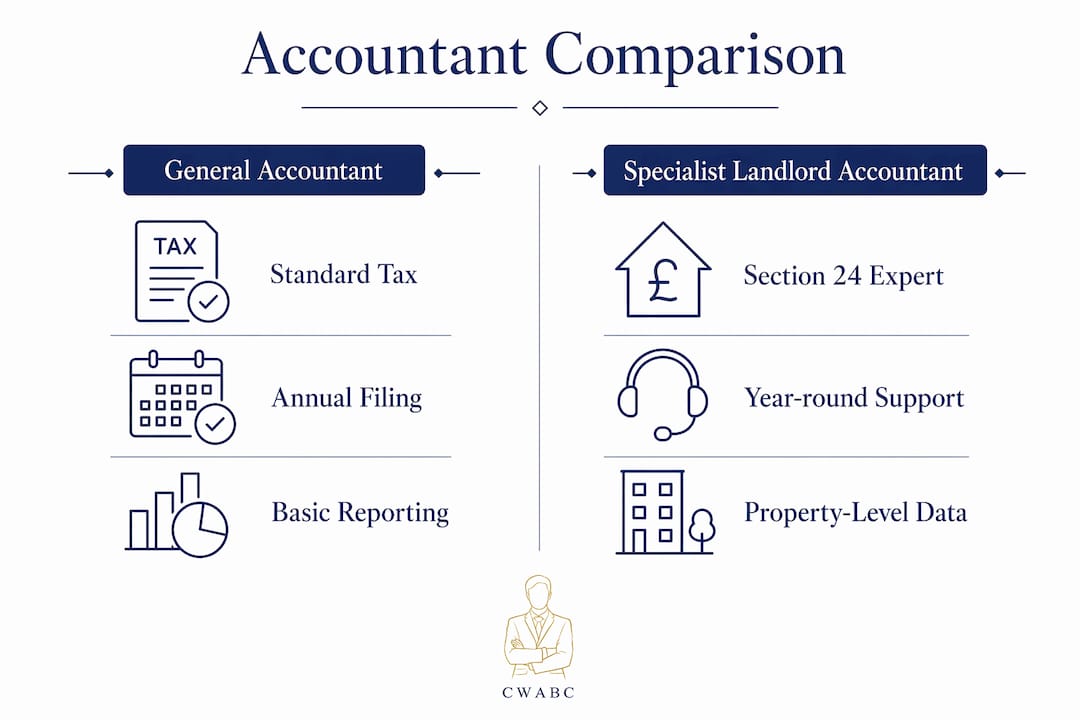
| Area | General accountant | Specialist landlord accountant |
|---|---|---|
| Tax knowledge | Standard income tax and VAT | Section 24, CGT, MTD, inheritance tax for landlords |
| Engagement frequency | Mainly year-end | Ongoing, quarterly or monthly dialogue |
| Reporting | Annual accounts | Property-level schedules and management accounts |
| Software | General tools | HMRC-approved MTD software: Xero, FreeAgent, QuickBooks |
| Portfolio advice | Limited | Disposal timing, refinancing, and restructuring guidance |
Specialist accountants provide decision-ready reporting throughout the year, which is particularly valuable when you are speaking to a mortgage broker or considering a disposal. A general accountant produces a year-end snapshot. A specialist gives you a live financial picture you can act on.
The software question matters more than many landlords realise. Approved tools like LandlordOS, QuickBooks, FreeAgent, and Xero are required for MTD compliance, and a specialist accountant will set these up correctly from the start rather than leaving you to figure it out alone. Cwabc offers accounting software setup support for landlords in Kent who need to get MTD-ready without the technical headache.
How do accountants help landlords with tax compliance and relief?
Tax compliance for landlords is more complex than it is for most sole traders. Section 24 restricts mortgage interest relief to a 20% tax credit rather than a full deduction, which catches many landlords off guard. An accountant calculates the precise impact on your tax bill and identifies every legitimate deduction available to reduce it.
Allowable expenses include accountant fees and legal costs, but some purchase costs are excluded. Getting this distinction wrong leads to either an inflated tax bill or an incorrect return that HMRC may challenge. Your accountant draws that line correctly every time.
Common tax deductions and reliefs your accountant will manage include:
- Mortgage interest tax credit under Section 24, calculated at 20% of finance costs.
- Repairs and maintenance costs that are revenue in nature, such as fixing a boiler or repainting a flat.
- Letting agent fees, management charges, and advertising costs.
- Accountancy and professional fees directly related to the rental business.
- Buildings insurance and landlord-specific cover premiums.
- Ground rent and service charges on leasehold properties.
- CGT annual exempt amount on disposal, plus any available reliefs such as Private Residence Relief where applicable.
MTD for Income Tax Self Assessment (ITSA) requires landlords with qualifying income to submit quarterly digital updates to HMRC using approved software. Your accountant manages this process, sets up the correct software, and submits updates on time. You can read more about MTD ITSA for landlords and what it means for your filing obligations.
CGT reporting is another area where errors are costly. When you sell a residential property, you have 60 days from completion to report and pay any CGT owed to HMRC. Miss that deadline and penalties apply immediately. An accountant tracks disposal dates, calculates the gain accurately, and submits the report on time.
What financial management support do accountants provide to optimise landlord portfolios?
Compliance is the floor, not the ceiling. The most valuable work a property accountant does sits above compliance, in the area of financial management and strategic planning. Effective landlord accounting shifts from compliance-only to proactive financial decision support throughout the year, and that shift is where real portfolio performance improvements happen.
Management accounts are a practical example. Rather than waiting until April to understand how your portfolio performed, your accountant prepares monthly or quarterly profit and loss reports per property. You can see which properties are generating strong returns and which are underperforming before the situation becomes a problem.
Cash flow forecasting is equally useful. Rental income is rarely perfectly smooth. Void periods, large maintenance bills, and tax payments can all create cash pressure in the same month. A good accountant builds a 12-month cash flow model that shows you where the pinch points are and helps you plan around them. This is particularly relevant for landlords managing multiple properties or carrying significant mortgage debt.
Pro Tip: Ask your accountant to prepare a portfolio schedule that shows each property’s net yield, outstanding mortgage balance, and estimated equity. This document is exactly what a mortgage broker or lender needs, and having it ready saves weeks of back-and-forth during a refinancing application.
Disposal timing is another area where accountant input pays for itself. Selling a property in the wrong tax year can push you into a higher CGT band or reduce the benefit of your annual exempt amount. Your accountant models the tax outcome of selling in different years and sequences disposals to minimise the overall liability. Ongoing conversations with a specialist accountant significantly improve portfolio performance and tax optimisation over time. This is not something a once-a-year relationship delivers.
Lender confidence is a practical benefit that landlords often overlook. When you apply for a buy-to-let mortgage or remortgage, lenders want up-to-date, professionally prepared accounts. Property-level books maintained year-round support lender communications and strategic decisions without last-minute reconstructions. An accountant who keeps your records current throughout the year makes that process straightforward rather than stressful.
You can also benefit from a mid-year financial review to catch any issues early and adjust your plans before the tax year closes.
Key takeaways
A specialist property accountant delivers far more than tax filing. The combination of year-round bookkeeping, proactive tax planning, and portfolio-level financial management is what separates landlords who stay compliant from those who build genuinely profitable rental businesses.
| Point | Details |
|---|---|
| Year-round bookkeeping | Monthly reconciliation and property-level records prevent last-minute chaos and support lender applications. |
| Specialist tax knowledge | Section 24, CGT deadlines, and MTD compliance require expertise that a general accountant rarely holds. |
| MTD readiness | Approved software like Xero, FreeAgent, or QuickBooks is required from April 2026 for qualifying landlords. |
| Proactive financial management | Cash flow forecasting and disposal modelling improve portfolio performance beyond basic compliance. |
| Trust account compliance | Keeping tenant funds separate from operating accounts is a legal requirement, not optional best practice. |
Why proactive accounting is the real differentiator in 2026
I have worked with landlords at very different stages of their property journey, from someone with a single buy-to-let flat to clients managing portfolios of ten or more properties. The pattern I see most often is this: landlords who treat accounting as a once-a-year task consistently face the same problems. A surprise tax bill in January. A mortgage application delayed because the accounts are not ready. A property sold at the wrong time because nobody modelled the CGT impact in advance.
The landlords who avoid those problems are not necessarily more experienced. They simply have an accountant who stays engaged throughout the year rather than appearing in January and disappearing in February.
What has changed significantly since 2017 is the complexity of the tax environment. Section 24 alone altered the profitability calculation for thousands of landlords who had not modelled the impact. MTD is now adding a quarterly reporting obligation on top of that. These are not minor administrative changes. They require a different kind of accounting relationship, one built on regular dialogue rather than annual compliance.
My honest view is that many landlords underestimate what inadequate accounting actually costs them. Not just in penalties or missed deductions, but in poor decisions made without good financial information. Buying a property without understanding the CGT exit cost. Refinancing without current accounts to show the lender. Holding a loss-making property because nobody has modelled the numbers clearly.
A specialist accountant is not an overhead. They are the person who helps you see your portfolio clearly and make better decisions with confidence. That is worth considerably more than the fee.
— Chris
How Cwabc supports landlords with accounting and tax compliance
If you are a landlord looking for calm, clear support with your rental finances, Cwabc is here to help. Based in Tonbridge and working with landlords across Kent, Cwabc provides tailored bookkeeping services and specialist landlord accounting without the jargon. Whether you need help getting MTD-ready, filing your Self Assessment, or keeping your property accounts organised throughout the year, the team at Cwabc offers clear, upfront pricing and the kind of personal support that makes a real difference.

From MTD ITSA compliance to year-round bookkeeping and financial reporting, Cwabc takes the complexity out of landlord accounting so you can focus on your portfolio. Get in touch to find out how straightforward managing your rental finances can be with the right support in place.
FAQ
What does an accountant do for a landlord?
An accountant for a landlord handles bookkeeping, tax return preparation, MTD quarterly filings, and financial reporting at property level. They also advise on allowable expenses, CGT planning, and portfolio structuring to improve tax efficiency.
Do landlords need a specialist accountant or will a general one do?
A specialist property accountant understands Section 24, CGT deadlines, and MTD requirements in a way that a general accountant typically does not. For landlords with more than one property or complex tax positions, specialist knowledge pays for itself quickly.
What is Making Tax Digital and how does it affect landlords?
Making Tax Digital for Income Tax Self Assessment (MTD ITSA) requires landlords with qualifying rental income to submit quarterly digital updates to HMRC using approved software such as Xero, FreeAgent, or QuickBooks. An accountant manages this process and keeps you compliant.
What expenses can a landlord claim through their accountant?
Allowable expenses include mortgage interest tax credits under Section 24, letting agent fees, repairs and maintenance, insurance, accountancy fees, and ground rent. Your accountant identifies every legitimate deduction and records them correctly to reduce your tax bill.
How often should a landlord meet with their accountant?
Quarterly contact is the minimum recommended for landlords under MTD obligations, but monthly reviews are better for those managing larger portfolios. Regular financial reviews throughout the year prevent surprises and support better decision-making.