
For the 2026 to 2027 tax year, HMRC will not apply penalty points for late quarterly updates, so a missed quarterly submission alone will not trigger a points-based penalty. Quarterly updates are still required, though, and late annual tax returns, late payment penalties and interest all remain fully in force. This guide walks through exactly what applies, who needs to act, and how to stay clear of penalties without stress.
TL;DR:
- For the 2026-27 tax year, missed quarterly updates will not incur penalty points, but late annual tax returns and late payments will still be penalized.
- The threshold for income to require MTD drops from over £50,000 in 2026 to over £30,000 in 2027, then to over £20,000 in 2028, with some exemptions available.
- The points system counts each missed deadline toward a threshold of four points, after which a £200 penalty applies, but points are removed after 24 months of compliance.
- Late payment penalties are separate from points, applying after 15 days in subsequent years, with a 3% charge at day 15 and day 31 if unpaid.
- From 2027-28, the transitional easement ends, and missed quarterly updates will fully count toward points, with thresholds and penalties returning to pre-2026 rules.
Table of Contents
- Who must use Making Tax Digital for Income Tax
- What changed for 2026-27: penalty reform and the first-year easement
- Late submission penalties: points, thresholds and financial penalties explained
- Late payment penalties and interest: how the timelines and percentages work in 2026-27
- Exemptions and temporary easements for the 2026-27 tax year
- Appeals and reasonable excuse: how to challenge a penalty or get a point cancelled
- Practical checklist to avoid MTD penalties
- Practitioner guidance: how I help clients avoid penalties
- How penalty points interact with your wider HMRC obligations
- Data errors in quarterly updates: what actually triggers a penalty
- What happens from 2027-28 once the easement ends
- How penalties apply across self-employment and property income
- A calmer way to look at the 2026-27 changes
- How I can help: services and how to get started
- Sources
- FAQ
- Need help?
Who must use Making Tax Digital for Income Tax
Making Tax Digital for Income Tax is being rolled out in stages based on your qualifying income, which broadly means your total gross income from self-employment and property before expenses. HMRC checks your qualifying income from an earlier tax year to work out when you need to join, and if you meet the threshold, you will get a letter confirming your start date.
The phased thresholds are:
- From April 2026: qualifying income over £50,000 brings you into MTD for Income Tax.
- From April 2027: the threshold drops to qualifying income over £30,000.
- From April 2028: the threshold drops again to qualifying income over £20,000.
Not everyone is caught by these rules. Some taxpayers qualify for an exemption, covered in more detail further down. If you are unsure whether you fall into scope, my MTD for Income Tax guide explains the phased rollout in plain terms.
What changed for 2026-27: penalty reform and the first-year easement
Making Tax Digital for Income Tax brings a new penalty framework, replacing the old Self Assessment late-filing and late-payment rules for anyone now required to use MTD. Instead of a single fixed penalty for missing your tax return, HMRC now uses a points-based system for submissions and a graduated, proportionate system for late payments.
For the 2026-27 tax year specifically, HMRC is taking a lighter approach:
- No penalty points for a late quarterly update during 2026-27, even though the update is still required.
- Points continue to apply for a late annual Self Assessment return.
- Late payment penalties and interest are unaffected by this easement.
HMRC’s own guidance confirms this directly: penalty points will not be applied for missed quarterly updates in 2026-27, though the update must still be sent before you can submit your final return. This matters because if you skip updates altogether, you cannot complete your annual return properly, which can create a scramble in January. The easement is a grace period for the submission mechanic, not a reason to ignore it. If you have chosen to join MTD voluntarily before you are required to, similar transitional treatment applies, though your obligations under the annual return remain identical to those of a mandated taxpayer.
Late submission penalties: points, thresholds and financial penalties explained
The points-based system is designed to avoid punishing an isolated, one-off slip while still discouraging a pattern of late filing. Here is how it works in practice for the 2026-27 tax year:
- You get one point for each missed deadline that still attracts points, which for 2026-27 means a late annual tax return rather than a late quarterly update.
- The threshold for taxpayers required to use MTD is 4 points. Once you reach that threshold, HMRC applies a £200 penalty.
- Each further missed deadline after the threshold brings another £200 penalty, so repeated lateness becomes increasingly expensive.
- Points are removed automatically after 24 months of compliant filing, provided you have not reached the penalty threshold in that period.
- Volunteers who join MTD early face a lower 2-point threshold for annual returns rather than 4, reflecting the smaller number of obligations they carry.
The 24-month reset is worth understanding properly. It does not mean points vanish the moment two years pass from when they were issued. Instead, HMRC looks at your compliance record over a rolling period and clears points once you have filed on time consistently enough to satisfy the reset condition. This gives you a genuine route back to a clean record if a difficult year throws you off track, rather than a permanent black mark.
Late payment penalties and interest: how the timelines and percentages work in 2026-27
Late payment penalties sit entirely separately from the points system, and they apply regardless of whether your late quarterly update attracted a point. If you owe tax and do not pay it, or do not set up a payment plan, the clock starts running from your payment deadline.
For 2026-27, HMRC is giving taxpayers new to the regime a longer initial window:
- In your first year under the new rules, you have 30 days to pay in full or agree a Time to Pay arrangement before a penalty applies.
- After the first year, this shortens to 15 days.
- A 3% penalty applies if tax remains unpaid at day 15 (or day 30, in year one), with a further 3% charge if the balance is still outstanding at day 31.
- Interest is charged from day 1 of late payment, calculated daily until the balance is cleared.
The key figure to hold onto: a 3% charge applies at day 15 and again at day 31 for 2026-27, with annual interest running from day 31 alongside daily interest from the outset. These percentages are separate from the points system entirely, so a taxpayer could have no points at all and still face a payment penalty simply because the tax bill was not settled on time. Quarterly updates report your income and expenses to HMRC. They are not quarterly tax payments, and sending an update does not itself trigger a bill. Your tax liability is still calculated and paid annually through your Self Assessment return, in the same way it always has been.
Exemptions and temporary easements for the 2026-27 tax year
Not everyone with qualifying income above the threshold has to comply with MTD for Income Tax. Some exemptions are automatic, while others need to be applied for.
- Automatic exemptions cover certain categories of taxpayer and some types of Self Assessment supplementary pages, some of which run only until April 2027 while others are permanent.
- Digital exclusion is a common reason for an applied-for exemption, covering people who cannot reasonably use software or the internet because of age, disability, location or another genuine barrier.
- Applications go through HMRC directly, and you will usually need to explain why digital record-keeping is not practical for your circumstances.
If your exemption is granted, you are not simply left with no obligations. You remain on the current Self Assessment penalty regime rather than the new MTD points system, meaning the old late-filing and late-payment rules continue to apply to you as they always have.
Appeals and reasonable excuse: how to challenge a penalty or get a point cancelled
If you think a penalty or point has been issued unfairly, you have the right to appeal. HMRC’s appeals guidance sets out the process clearly.
- Write to HMRC within the time limit shown on your penalty notice, explaining exactly what happened and why you believe the penalty should not apply.
- Give a genuine reasonable excuse. Accepted examples include a serious illness, a family bereavement close to the deadline, a system failure at HMRC, or unavoidable circumstances outside your control such as a fire or flood affecting your records.
- Note that insolvency or exceptional personal circumstances are also considered on their own facts, so it is worth explaining your situation in full rather than assuming it will not count.
- If HMRC agrees, the point or penalty is cancelled and does not count towards your total, giving you a route back to a clean compliance record without waiting out the full 24 months.
Practical checklist to avoid MTD penalties
Staying on top of MTD for Income Tax is mostly about routine rather than complexity. A few habits make the difference between a calm quarter and a last-minute mess.
- Keep digital records as you go in MTD-compatible software such as Xero, QuickBooks or FreeAgent, and back up your data regularly.
- Calendar your quarterly update dates, which fall on 7 August, 7 November, 7 February and 7 May, alongside the annual Self Assessment deadline of 31 January.
- Set reminders two weeks before each deadline rather than relying on memory during a busy trading period.
- Consider authorising an agent or accountant to handle your updates and return; this simply means giving them permission through HMRC’s online agent authorisation process to act on your behalf.
- Use HMRC’s ‘check if you need to use MTD’ tool to confirm your position, and apply early for an exemption if you think you qualify.
Pro Tip: Set your quarterly update reminders on the 1st of the deadline month, not the day before, so a software glitch or a busy week does not catch you out.
My quarterly reporting guide sets out exactly what to include in each update if you want to go through the detail before your first submission.
Practitioner guidance: how I help clients avoid penalties
I set clients up on cloud software, build their quarterly submission schedule and handle reconciliations so nothing gets missed. Most penalty problems I see are caused by disorganised records rather than a lack of understanding, which is why the process matters as much as the software.
- MTD setup: getting your software connected and your categories right from day one.
- Scheduled quarterly updates: built around your bookkeeping cycle rather than a last-minute scramble.
- Monthly reconciliation: catching errors before they compound into a bigger problem at year end.
- Self Assessment filing: bringing everything together for your annual return once all four quarters are in.
If you want support with any part of this, my MTD for Income Tax service page explains what is included.
How penalty points interact with your wider HMRC obligations
MTD penalties do not exist in isolation from the rest of your tax affairs. Your points total for quarterly and annual submissions sits alongside, rather than instead of, your other Self Assessment obligations, including registering for Self Assessment, paying any payments on account, and reporting other income sources correctly.
If you are also VAT registered, it is worth being clear that MTD for VAT runs on its own separate set of rules, deadlines and penalty regime. A late VAT return does not affect your Income Tax points total, and vice versa, because they are administered as distinct obligations even though both sit under the broader Making Tax Digital programme.
Where things can genuinely overlap is your overall compliance history. HMRC’s systems track your record across obligations, so a pattern of lateness across different taxes can affect how sympathetically an officer views a reasonable excuse claim, even though the formal points and thresholds are calculated separately for each regime. Keeping your VAT, PAYE and Income Tax submissions consistently on time protects your standing across the board, not just within one system.
If you are unsure how your various obligations fit together, particularly once you are running payroll or CIS deductions alongside MTD for Income Tax, it is worth having someone check the full picture rather than treating each deadline as a separate task.
Data errors in quarterly updates: what actually triggers a penalty
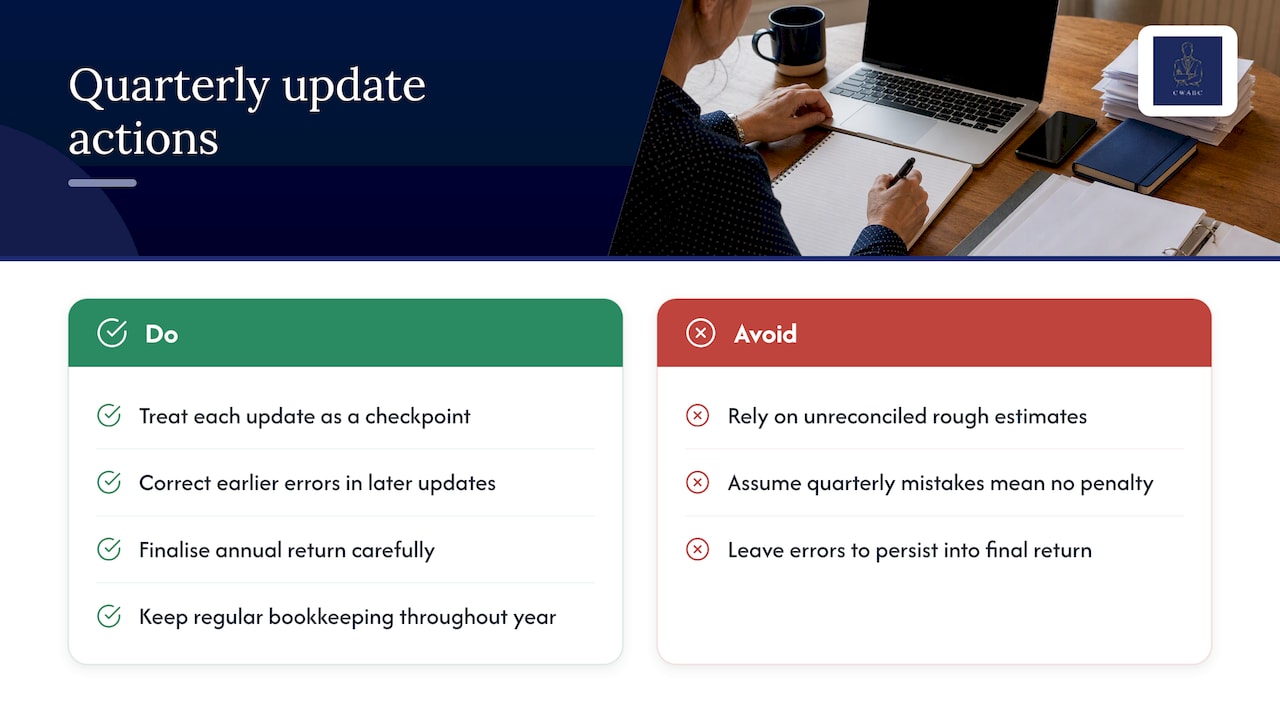
A genuine mistake in a quarterly update, such as a miscategorised expense or a transaction entered under the wrong period, does not by itself attract a penalty under the 2026-27 rules. The points system for 2026-27 is concerned with whether an update was sent, not with whether every figure inside it was perfect. HMRC expects updates to be a reasonable summary of your income and expenses for the quarter, refined and finalised when you complete your annual return.
That said, errors are not consequence-free. If inaccuracies carry through into your final Self Assessment return and understate your tax liability, that can trigger the separate penalty regime for inaccurate returns, which is assessed on the annual figures rather than the quarterly ones. The quarterly update itself is a stepping stone towards an accurate final return, not a final, binding submission in its own right.
The practical lesson is to treat quarterly updates as genuinely useful checkpoints rather than a box-ticking exercise. If you spot an error in an earlier quarter, you can generally correct it in a later update or when you finalise your return, but leaving a string of rough estimates unreconciled increases the chance that something significant is missed by January. Regular bookkeeping through the year, rather than a single annual catch-up, is the simplest way to keep your quarterly figures close enough to accurate that year-end corrections are minor rather than dramatic.
What happens from 2027-28 once the easement ends
The 2026-27 treatment of quarterly updates is explicitly transitional. From the 2027-28 tax year, the points-based system is expected to apply in full to quarterly updates as well as annual returns, meaning a missed quarterly deadline will start counting towards your points total in the same way a late annual return does now.
This also lines up with the next threshold change: from April 2027, taxpayers with qualifying income over £30,000 join MTD for Income Tax, bringing a wider group of sole traders and landlords into scope at the same time the quarterly easement is due to end. If you are already filing under MTD in 2026-27, it is worth treating the current lighter-touch year as practice for a routine you will need to run properly from 2027-28 onward, rather than as a reason to leave things loose.
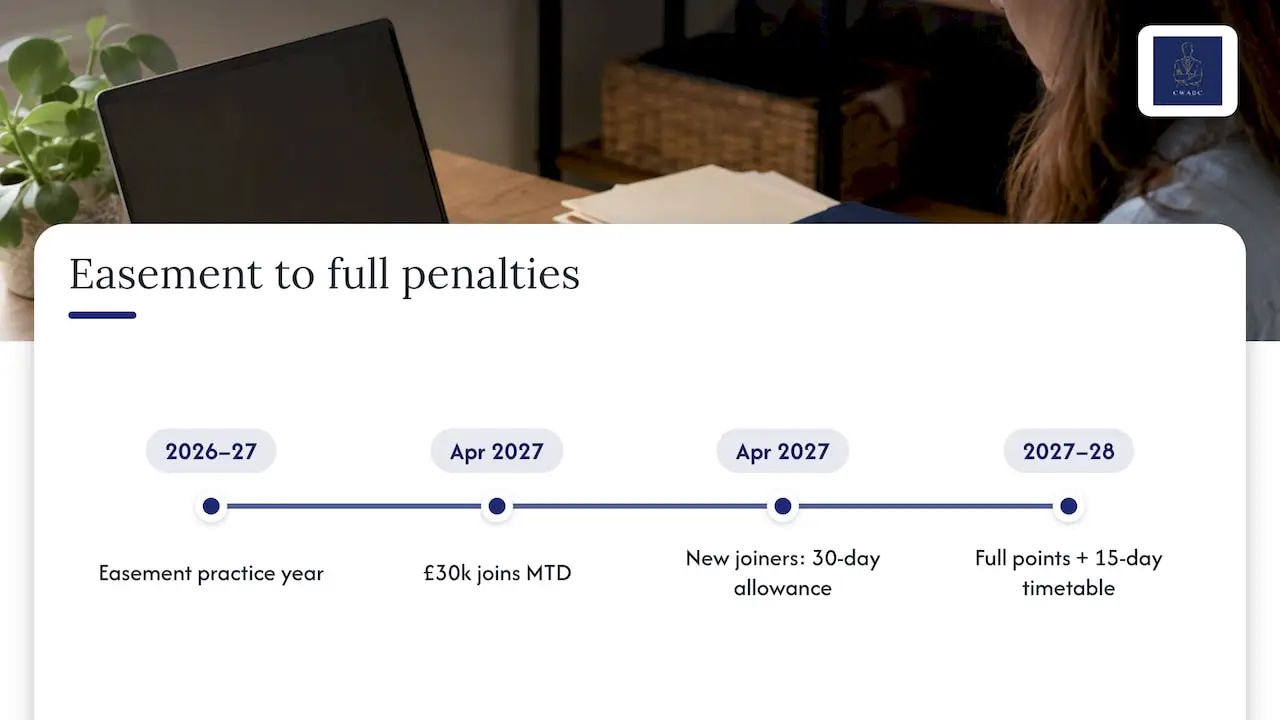
The late payment penalty percentages and the 15-day standard timetable described earlier are expected to continue applying from 2027-28, since the first-year 30-day allowance is specifically a one-off concession for taxpayers new to the regime. Anyone moving into MTD for Income Tax from April 2027 would get their own first-year allowance at that point, on the same terms current 2026-27 joiners received.
How penalties apply across self-employment and property income
If you have both self-employment and property income, MTD for Income Tax treats them as part of one combined qualifying income figure for deciding whether you are in scope, but you still need to keep digital records and send quarterly updates for each source separately. A missed update for your property income counts the same as a missed update for your self-employment income when it comes to the requirement to submit before your final return, even though neither currently attracts a point in 2026-27.
Landlords with multiple properties sometimes assume each property needs its own update, but the requirement is for one quarterly update per income source, covering all properties together, not one per property. Sole traders running more than one self-employment业务 similarly report each business as its own income source within the same overall submission structure.
Where this matters most is at the annual return stage, since your final Self Assessment return draws together the finalised figures from every income source into a single tax calculation. If one source has been poorly tracked through the year, whether that is a rental property with missing invoices or a side business with patchy records, it is that source, and ultimately your overall return, that carries the risk of an inaccurate figure and the standard penalties that follow. Keeping each income stream’s bookkeeping current through the year, rather than only at deadline time, is the simplest way to avoid this becoming a January problem regardless of how many sources you have.
A calmer way to look at the 2026-27 changes
The 2026-27 easement is a genuine reduction in immediate risk, not a loophole and not a reason to relax. It exists because HMRC recognises that a new digital process needs a settling-in period, and one missed quarterly update in your first year should not define your compliance record.
What I would encourage is treating the year as your chance to build a routine while the stakes are lower, so that when the full points system applies from 2027-28, sending an update on time is already second nature. If you are unsure where you stand, get in touch and I can talk it through with you.
— Chris
How I can help: services and how to get started
Getting MTD for Income Tax right from the start saves you far more time than sorting out a backlog later. Support is available for sole traders and landlords across Tonbridge, Sevenoaks, Kent and remote locations for this kind of setup.

- MTD setup and software configuration, so your quarterly updates are straightforward from your very first submission.
- Ongoing quarterly update support, keeping your figures accurate and your deadlines met without you having to track four separate dates yourself.
- Self Assessment filing, bringing your quarterly data together into your annual return, starting from £250 one-off for Self Assessment Tax Returns.
If you would like a straightforward review of what MTD means for your situation, visit my Making Tax Digital for Income Tax support page or get in touch and I will talk you through the next steps.
Sources
The rules above come directly from HMRC’s penalty guidance for MTD for Income Tax, the phased rollout policy paper, the quarterly update requirements, and the exemptions guidance. For older Self Assessment penalty rules, see my self assessment penalties guide.
- Penalties for Making Tax Digital for Income Tax
FAQ
What are the exemptions for Making Tax Digital for Income Tax?
Some exemptions are automatic, covering specific Self Assessment categories, and some run only until April 2027, while others are permanent. You can also apply for an exemption on grounds such as digital exclusion, and if granted, you stay on the current Self Assessment penalty regime rather than the new points system.
Will HMRC tell me if I need to go digital?
Yes. HMRC checks your qualifying income from an earlier tax year and writes to confirm your mandatory start date once you meet the relevant threshold. You can also check your own position using HMRC’s online tool rather than waiting for the letter.
What are the penalties for missing the MTD deadline?
For 2026-27, missing a quarterly update does not currently attract a penalty point, but a late annual return does, and reaching 4 points triggers a £200 financial penalty.
What are the new rules for Making Tax Digital?
MTD for Income Tax requires digital record-keeping and quarterly updates instead of a single annual submission, phased in from April 2026 for qualifying income over £50,000. The old fixed Self Assessment penalties are being replaced by a points-based system for submissions and proportionate percentage penalties for late payment.
Need help?
If any of this feels like more than you want to manage alone, I offer straightforward, jargon-free support with MTD setup, quarterly updates and Self Assessment filing. Get in touch and I will help you find the simplest way through it.