
The Non-Resident Landlord Scheme (NRLS) means UK letting agents or tenants must deduct basic-rate tax from your rental income whenever your usual home is outside the UK. If you want your rent paid without that deduction, you apply to HMRC using form NRL1, NRL2 or NRL3. Either way, you still have to report the income and settle your actual tax bill through Self Assessment.
TL;DR:
- Applying for gross payment approval via HMRC allows non-resident landlords to receive rent without deductions, but it does not exempt them from filing Self Assessment returns.
- Each joint owner must apply separately and keep accurate records of income, expenses, and tax deducted to avoid compliance issues and penalties.
- Letting agents and anyone collecting rent must operate the scheme unless HMRC explicitly approves gross payment for that landlord, regardless of rent amount or involvement level.
- The tax deducted at source is at the basic rate on net rent after allowable expenses, but the final tax liability depends on the landlord’s overall income and allowances reported through Self Assessment.
- Deadlines such as the quarterly NRLS reports and the July 5 Self Assessment submission are critical, and failure to meet these can lead to penalties, especially if gross approval is withdrawn.
Table of Contents
- What is the Non-Resident Landlord Scheme?
- Who counts as a non-resident landlord?
- How do you apply to receive rent gross?
- What must letting agents and tenants do?
- How is the tax worked out, and what can you claim?
- Joint ownership, agent chains and other edge cases
- Keeping your gross approval and avoiding HMRC penalties
- Practical checklist for overseas landlords
- How I help non-resident landlords stay compliant
- Why the standard advice on this scheme misses the point
- Getting your NRLS compliance sorted with CWABC
- Sources
- FAQ
- Need help?
What is the Non-Resident Landlord Scheme?
The Non-Resident Landlords Scheme exists so HMRC collects tax on UK rental income at source, before it ever leaves the country. Rather than chasing landlords scattered across dozens of jurisdictions, HMRC puts the job onto whoever is already handling the rent here: the letting agent or, in some cases, the tenant.
The trigger isn’t your nationality or where the property sits. It’s your “usual place of abode.” HMRC’s own guidance treats this as broadly equivalent to living abroad for more than six months of the year, even if you own a home in the UK and pop back regularly. That’s a different test from full UK tax residence, which follows the Statutory Residence Test and affects far more than just your rental income. You can have a UK usual place of abode outside the country under NRLS while your wider residence status is worked out completely separately. Mixing the two up is one of the most common, and costly, misunderstandings I see among overseas landlords.
Who counts as a non-resident landlord?
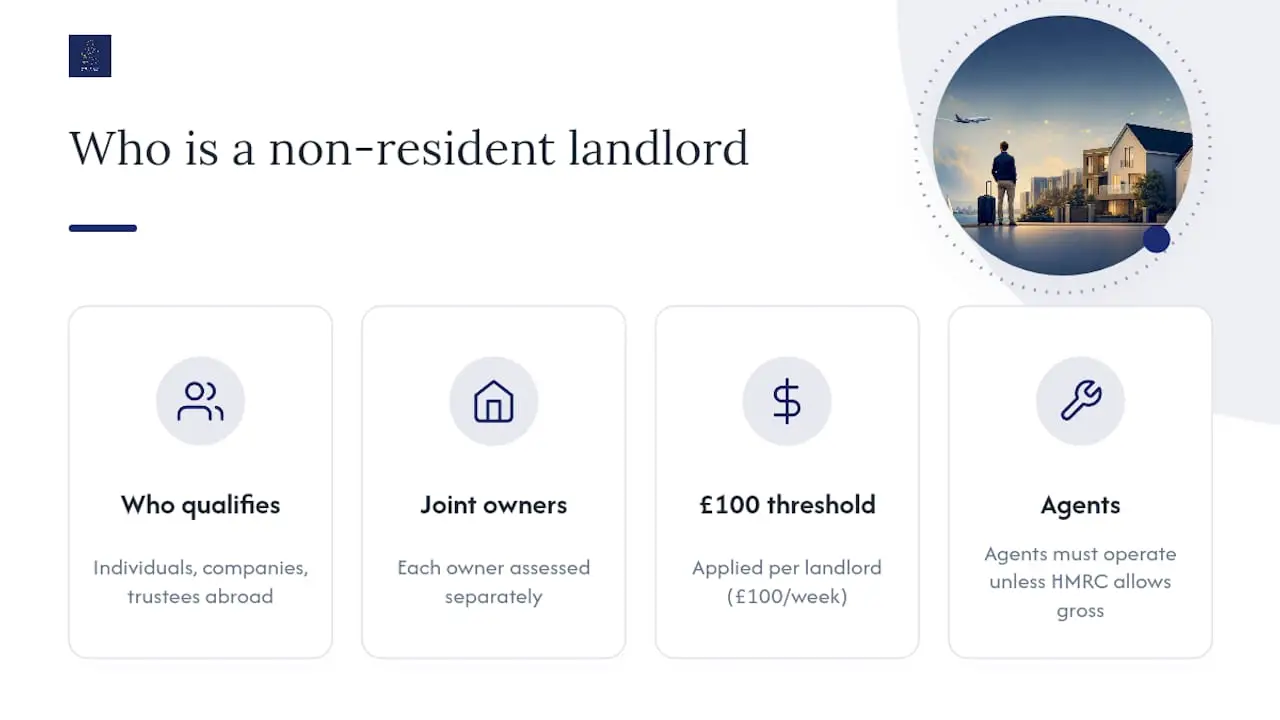
NRLS applies to individuals, companies and trustees whose usual place of abode is outside the UK, regardless of whether the property is held personally, through a company, or in trust. A company incorporated overseas that owns UK buy-to-let property falls squarely within scope, as does a trustee living abroad managing a UK rental for beneficiaries.
Joint ownership doesn’t let anyone off the hook. Each owner is assessed separately, and the threshold that decides whether a tenant must personally operate the scheme, paying more than £100 a week directly to the landlord, is applied per landlord, not per property. So if a married couple co-own a flat and the tenant pays a certain amount weekly split evenly, each owner’s share sits under the threshold, and the tenant’s obligations shift accordingly. Get the maths wrong on this and you can end up either over-withholding needlessly or under-withholding and creating a compliance gap that lands back on the tenant or agent.
Letting agents, by contrast, must operate the scheme regardless of rent amount unless HMRC has already authorised gross payment. There’s no £100 threshold escape route once an agent is involved.
How do you apply to receive rent gross?
If you’d rather receive rent without deduction and manage the tax yourself, you apply to HMRC for approval. Which form you use depends on how you hold the property:
- NRL1 for individual landlords
- NRL2 for companies
- NRL3 for trustees
Applications can be submitted online or by post, and each joint owner needs to apply separately for their own share of the property, even where the ownership split is straightforward. HMRC’s guidance confirms the online form can’t be saved partway through, so it helps to have your National Insurance number, UK property details and overseas address ready before you start.
HMRC checks each application and can ask for further evidence before approving it, particularly where your compliance history is thin or your circumstances look unusual. Approval isn’t automatic and isn’t permanent either. Crucially, and this is the point that trips people up most, approval only stops the withholding at source. It does not make your rental income tax-free, and it does not remove your obligation to file a Self Assessment return each year. Practitioners tend to see gross approval as a cash-flow tool rather than a tax break. It helps where your deductible expenses are high and basic-rate withholding would otherwise leave you overpaid until you reclaim it, but it raises the bar on keeping your own filing discipline sharp.
What must letting agents and tenants do?
Anyone acting as a letting agent for a non-resident landlord must operate NRLS, full stop, unless HMRC has confirmed gross payment approval for that landlord. The definition of “letting agent” is wider than most people assume. HMRC’s guidance on paying tax on rent for landlords abroad confirms it can capture a friend, relative or informal UK contact who collects rent or manages the property, not just professional agencies. If you’ve asked a family member to handle things while you’re overseas, check whether that arrangement inadvertently makes them a letting agent for these purposes.
Tenants only need to operate the scheme themselves when they pay more than £100 a week directly to a landlord with no agent involved.
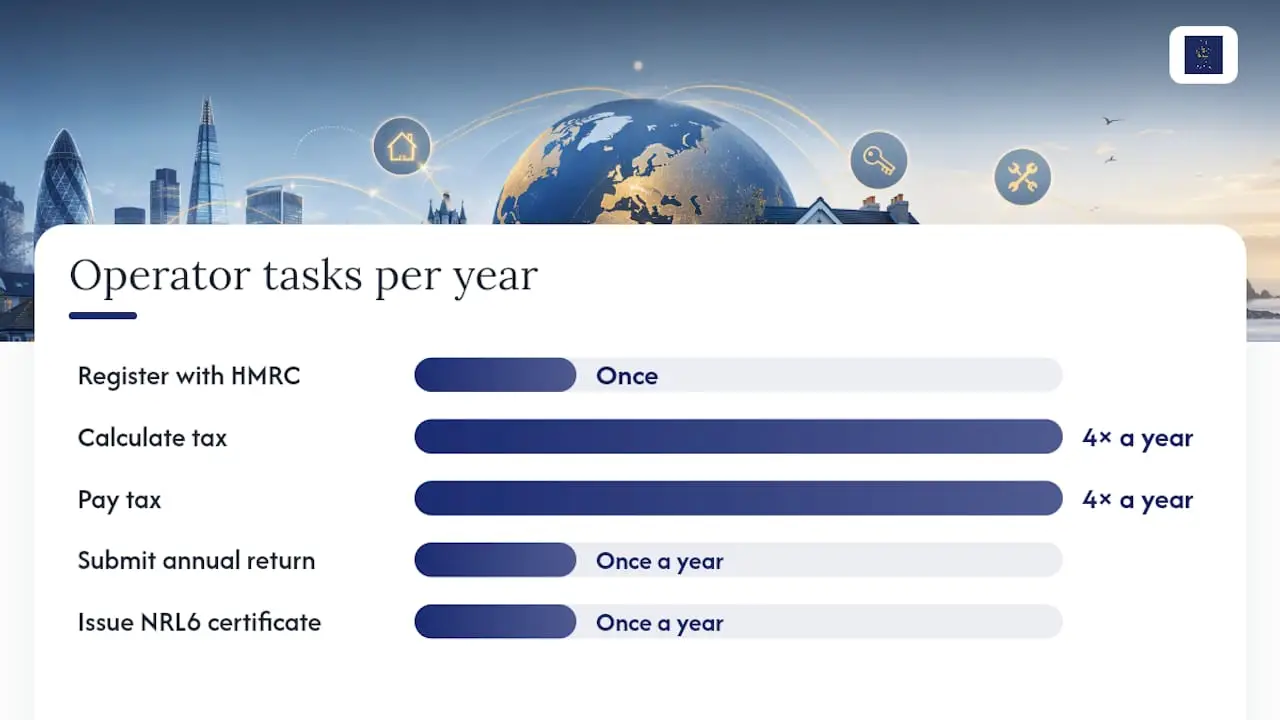
Where the scheme does apply, here’s what the operator (agent or tenant) must do:
- Register with HMRC as an operator of the scheme before making any payments.
- Calculate the tax due each quarter on rent received, after deducting allowable expenses the landlord has told them about.
- Pay the tax quarterly using form NRLQ, within 30 days of each quarter end (30 June, 30 September, 31 December and 31 March).
- Submit an annual information return, form NRLY, by 5 July following the tax year.
- Issue the landlord a certificate, form NRL6, confirming how much tax was deducted over the year.
- Keep records of rent received, expenses allowed and tax deducted in case HMRC queries the figures later.
Miss these deadlines and the consequences fall on the operator, not just the landlord, which is exactly why I always recommend a written agreement setting out who is responsible for what before the tenancy starts.
How is the tax worked out, and what can you claim?
The operator deducts tax at the basic rate on the net rent, meaning rent received minus any expenses the landlord has notified them of in writing before payment. This isn’t the same as your final tax liability. Basic-rate withholding on net rent is a rough proxy, and Self Assessment is where it gets reconciled against what you actually owe based on your total income and any personal allowance you’re entitled to.
Typical deductible expenses include:
- Letting agent fees and management commission
- Landlord insurance premiums
- Repairs and maintenance (not improvements)
- Ground rent and service charges
- Mortgage interest, restricted to a basic-rate tax credit rather than a full deduction
Costs that improve the property beyond its original condition, personal travel unrelated to the letting, or your own accommodation costs don’t qualify. Once the tax year ends, you report the rental income and expenses on the SA105 property pages of your Self Assessment return. If the tax withheld under NRLS turns out higher than your actual liability, once your personal allowance and any other reliefs are factored in, you claim the difference back through that same return. Making Tax Digital for Income Tax doesn’t currently change the NRLS mechanics themselves, but it will eventually affect how some landlords keep and submit records, so it’s worth keeping an eye on MTD requirements for landlords as thresholds are phased in.
Joint ownership, agent chains and other edge cases
Joint ownership splits the £100 weekly tenant threshold by each owner’s share, not the total rent. Where three siblings jointly own a property and the rent is £280 a week, each owner’s notional share sits below £100, which can change whether the tenant needs to operate the scheme personally.
Agent chains cause more confusion than almost anything else in this area. Where rent passes through several agents before reaching the landlord, responsibility usually falls to the last agent in the chain, the one who actually pays the landlord, unless the agents make a joint election otherwise. This detail gets overlooked constantly until a compliance issue surfaces and nobody can agree who was supposed to be withholding tax.
A handful of situations sit outside the standard rules entirely: certain sovereign immune entities, some pension funds, and specific trustee arrangements can have different treatment. If your ownership structure is anything other than straightforward personal ownership, it’s worth checking your specific position rather than assuming the general rules apply unchanged.
Keeping your gross approval and avoiding HMRC penalties
Gross payment approval isn’t a one-off badge you keep forever. HMRC can withdraw it if it decides you’re not meeting your filing or payment obligations, and once withdrawn, withholding starts again on future rent. Operators who fail to register, deduct or file correctly face penalties and interest, and HMRC does pursue these actively rather than treating NRLS as a minor administrative sideline.
Pro Tip: Set a recurring calendar reminder for your Self Assessment deadline the moment your NRL1, NRL2 or NRL3 approval comes through. Landlords who lose gross approval almost always do so because a tax return was late, not because the tax itself was wrong.
Simple controls go a long way here: a written agent agreement clarifying who does what, quarterly reconciliations against your NRLQ statements, and filing your Self Assessment return well before the January deadline rather than racing it.
Practical checklist for overseas landlords
If you’re bringing your UK rental reporting up to scratch, work through these steps in order:
- Confirm whether you need to register for Self Assessment as a landlord with UK rental income.
- Decide whether gross payment approval suits your situation, and apply using NRL1, NRL2 or NRL3 if so.
- Gather and keep tenancy agreements, bank statements, agent statements and expense invoices, ideally digitally.
- Confirm in writing with your letting agent or tenant exactly who is operating the scheme and what they’ll deduct.
- Diarise the NRLQ quarterly deadlines (30 June, 30 September, 31 December, 31 March) and the 5 July deadline for NRLY and NRL6.
That 5 July date catches out more landlords than almost any other deadline in this scheme, largely because it falls outside the usual Self Assessment rhythm most people have in their heads.
How I help non-resident landlords stay compliant
As an AAT-licensed accountant working remotely across the UK from Hildenborough near Tonbridge, I support overseas landlords through Self Assessment, rental bookkeeping and Making Tax Digital preparation using Xero, QuickBooks and FreeAgent. The error I see most often is landlords assuming gross approval means the income is tax-free. I help clients set up cloud records early, liaise directly with letting agents on NRLS paperwork, and keep filing on track from wherever they’re based.
Why the standard advice on this scheme misses the point
Most guidance on the Non-Resident Landlord Scheme stops at “get gross approval and you’re sorted.” That’s the bit that sounds like good news, so it’s the bit that sticks. It’s also the bit that causes the most damage down the line, because gross approval solves a cash-flow problem, not a tax problem. Your liability doesn’t change; only the timing and mechanism of collection does.
The advice I’d push back on hardest is treating NRLS status as a proxy for residence. It isn’t. I’ve seen landlords assume that because HMRC classes them as non-resident for scheme purposes, their wider tax position is settled too. It isn’t remotely the same test, and conflating the two leads people to miss reliefs they’re entitled to or, worse, misjudge their Statutory Residence Test position entirely.
If you take one thing from this, prioritise the paperwork discipline over the withholding decision. A landlord who lets tax get deducted at source but files an accurate, timely Self Assessment return every year is in a far stronger position than one who secured gross approval and then let record keeping slide.
— Chris
Getting your NRLS compliance sorted with CWABC
CWABC gives overseas landlords a direct route to compliance without the back-and-forth of a large agency, working through everything by email and cloud software so nothing depends on you being in the country. I handle Self Assessment filing, rental bookkeeping, MTD-ITSA setup and the practical liaison with your letting agent to confirm who’s operating the scheme and what they should be deducting.

Every engagement starts with a clear, fixed-fee estimate agreed upfront before any work begins, using Xero, FreeAgent or QuickBooks depending on what suits your situation. If you’re an overseas landlord who needs your rental income properly reported, my Self Assessment Tax Returns service starts from £250 one-off. Get in touch through my contact page to talk through your NRLS position and get a quote.
FAQ
What is the HMRC guidance for non-resident landlords?
HMRC’s core guidance sits across the Non-Resident Landlords Scheme publication and the Property Income Manual references PIM4820 and PIM4860, which cover agent duties, landlord obligations and the gross-payment application process respectively.
What is the 5 year rule for non-residents in the UK?
This isn’t part of NRLS. It relates to the Statutory Residence Test and Temporary Non-Residence rules, which can tax certain gains or income if someone returns to the UK within five years of leaving. NRLS and wider residence status are separate tests, and your NRLS approval doesn’t determine your position under either.
Can I complete the NRL1 form online?
Yes, individuals can apply online or by post using form NRL1, though the online version can’t be saved partway through, so it’s worth having your details ready before starting.
What is the tax rate for non-resident landlords in the UK on rental income?
Letting agents and tenants who operate the scheme deduct tax at the basic rate from net rent. Your actual liability is then worked out through Self Assessment based on your total income and allowances, which may differ from the amount withheld.
Need help?
If you’re an overseas landlord trying to work out your NRLS position, get your forms right, or catch up on Self Assessment, I’d be glad to help. Get in touch through my contact page and we can talk through what applies to your situation.