Most small business cash flow problems are not caused by a lack of profit. They come from timing: money leaves your bank account before your customers’ money arrives, and tax bills land on dates you did not plan for. The good news is that timing problems can be seen coming, and with tidy bookkeeping and a simple forecast you can deal with them calmly rather than in a last-minute scramble. I’m Chris, an AAT licensed accountant and bookkeeper near Tonbridge, and this guide sets out what causes the problem, how to spot it early and what to do about it.
TL;DR
- Cash flow is the money actually moving in and out of your bank account. Profit is what your books say you earned. The two can be very far apart.
- The usual culprits are late customer payments, weak debtor control, seasonal income, unplanned tax bills, stock purchases, heavy drawings and no forecast.
- Fixes are practical: invoice promptly, shorten payment terms, review costs monthly, set tax aside as you go and hold a cash reserve.
- A rolling forecast of the next 13 weeks, built on up-to-date bookkeeping, shows a shortfall while you still have time to act.
- If you are already short, contact HMRC early about Time to Pay rather than waiting for a deadline to pass.
Table of Contents
- What a cash flow problem actually is
- The most common causes of cash flow problems
- Why profit does not mean cash in the bank: a worked example
- Early warning signs to watch for
- Practical steps to improve cash flow
- Use a 13-week forecast to see problems early
- How cash flow problems look for different businesses
- How I use bookkeeping and forecasts to help owners decide
- Perspective
- Getting help with your cash flow
- Need help?
- FAQ
- Sources
What a cash flow problem actually is
Cash flow is the movement of money in and out of your business over a period. If more comes in than goes out, cash flow is positive. If more goes out than comes in, even for a few weeks, it is negative, and that is the point where suppliers, wages and VAT stop being patient.
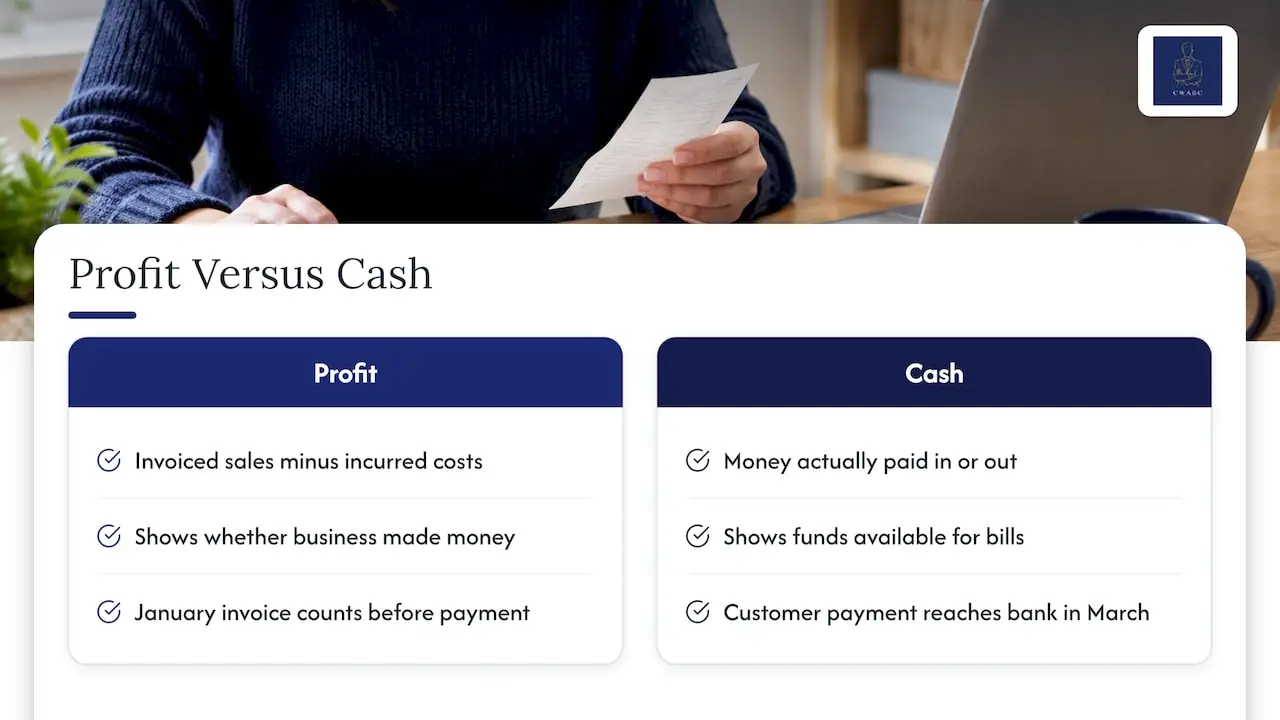
The confusing part is that a business can be profitable and still be short of cash. Profit is calculated from sales you have invoiced less the costs you have incurred. Cash is what has really been paid. If you invoice in January and the customer pays in March, January shows a profit and your bank balance shows nothing. Insolvency advisers make the same point: a company can look profitable on paper and still be unable to meet a VAT bill, supplier payment or wages on the day they fall due.
That is why I always ask owners two questions, not one: “Did we make money?” and “Where is the money now?” The second question is the one that keeps the lights on.
The most common causes of cash flow problems
These are the causes I would expect to find first in a UK small business. Most businesses have two or three of them at once.
1. Late customer payments
This is the big one. You have done the work, paid for the materials and covered the wages, but the invoice sits unpaid. Government data cited by a credit insurer suggests a typical UK small business is owed around £22,000 in late payments, which is a sum that could easily cover a quarter’s rent, wages and VAT for a small firm.
People often assume customers who pay late are being deliberately awkward. Often they are not. Invoices go to the wrong person, a purchase order number is missing, or the invoice is simply forgotten in an inbox. Which brings us to the next cause.
2. Poor debtor control
Debtors are the customers who owe you money. Debtor control means knowing exactly who owes what, how overdue it is and who has chased it. Without it, the same three invoices stay unpaid for months because nobody has a list in front of them.
A basic aged debtors report, produced from your bookkeeping software, groups unpaid invoices into current, 30 days, 60 days and 90 days or more. If you have never looked at one, it is usually the most revealing page in your accounts.
3. Seasonal income
Gardeners, caterers, wedding suppliers, builders and many retailers earn most of their money in a few months and still pay rent, insurance and software all year. The risk is spending as if every month were the busy one. A forecast that shows the quiet months in advance lets you build a reserve in summer to cover the winter.
4. Unexpected tax liabilities
Tax is rarely unexpected to an accountant, but it often is to the business owner. Typical shocks:
- A Self Assessment bill that includes payments on account, which are advance payments towards next year’s tax. I explain how they work in Self Assessment payments on account explained simply.
- A quarterly VAT payment that is far larger than the owner remembered, because VAT collected from customers is not your money.
- Corporation tax falling due nine months after the end of a company’s accounting period. My small business corporation tax guide covers the detail.
- PAYE and National Insurance for employees, or CIS deductions for construction businesses.
If you keep the dates in front of you, none of these are surprises. My small business tax deadline calendar is a good place to start.
5. Stock purchases
Stock is cash turned into shelves. Buy too much and money sits there doing nothing. The ICAEW, the professional body for chartered accountants, warns that excess stock can tie up cash that could have covered operating costs and may become obsolete or go out of date, which matters for food, chemicals or fashion lines. A bulk discount is only a saving if you can afford to pay for it and sell it in good time.
6. Excessive drawings
Sole traders and directors sometimes take money out based on how the month feels rather than what the business can afford. When drawings run ahead of profit, the shortfall is usually plugged by the money that should have gone to HMRC. A fixed monthly drawing or salary, reviewed quarterly, is far safer than dipping into the account whenever you need something.
7. Weak forecasting
Many owners know their bank balance today and have a rough feel for next week. Very few can say what it will be in ten weeks. Without a forecast, a gap that could have been fixed with a quiet word to a customer or a supplier arrives as a sudden crisis.
Other causes crop up too: growth that pushes up wages and overheads faster than income arrives, expensive borrowing, and a fall in sales or margins. Growth is an interesting one. Winning a big contract usually means paying for materials and staff before the first payment arrives, so a business can run short of cash precisely because it is doing well.
Why profit does not mean cash in the bank: a worked example
Here is a simple, made-up example to show how it happens. Imagine a small building and maintenance firm, not VAT registered to keep the numbers clear.
January
- Opening bank balance: £2,000
- It completes a job and invoices the customer £12,000 on 30-day terms.
- It pays out £4,500 for materials, £3,000 for subcontractors and £1,000 for van costs, insurance and software. That is £8,500 in total.
What the profit and loss report says
Sales £12,000 less costs £8,500 gives a profit of £3,500. It looks like a good month.
What the bank says
The customer has not paid. Money in: £0. Money out: £8,500. The bank balance moves from £2,000 to minus £6,500, which means an overdraft the firm may not have.
Suppose the customer takes 60 days instead of 30. The owner now has to find another month’s costs while waiting. If a second job is started in February, the gap deepens. Nothing in the profit figure has gone wrong. The business is making money, but the timing is hurting it.
Now add tax. If this business were VAT registered on the standard scheme, it would normally owe the VAT on that £12,000 invoice to HMRC for the quarter even though the customer has not paid. I cover this in my VAT return explained guide. The profit is not touched, but the cash gap grows by £2,400.
This is exactly the situation a forecast is built to show. Seen in January, it can be fixed by asking for a deposit, invoicing in stages or agreeing a later payment date with the supplier. Seen in March, it is a call to the bank.
Early warning signs to watch for
Cash flow trouble usually shows itself before it becomes serious. Watch for these:
- Your bank balance is lower at the end of each month than the month before.
- You are paying suppliers later than agreed.
- You are using an overdraft or credit card to pay regular bills.
- You are not sure you could pay your next tax bill.
- Customers are taking longer to pay and you are not sure who owes what.
- You are waiting on one or two large payments before you can move forward.
- You are taking on work mainly to cover a short-term gap.
- You are delaying your own pay.
The Federation of Master Builders lists several similar signs for the construction trade, including not knowing what payments are due in the next fortnight and invoicing falling behind the work on site. They apply well beyond builders.
One or two of these is a prompt to look closer, not a reason to panic. Several together are a clear signal to put a forecast together this week.
Practical steps to improve cash flow
Below are the fixes I would work through, roughly in the order they make a difference.
Invoice faster and make invoices easy to pay
Invoice the day the work is done, or sooner if you can bill in stages. Put the due date, your bank details and any purchase order number on the invoice. Send it to the person who actually pays it. The Bank of Scotland recommends issuing invoices promptly with correct information, and it is one of the cheapest improvements you can make.
For longer jobs, the Federation of Master Builders suggests milestone stage payments, fortnightly rather than monthly invoicing where possible, and clear invoices that are easy to check. Landlords with regular rent can use standing orders and keep arrears under review in the same way.
Shorten payment terms and agree them in writing
Thirty days is a habit, not a rule. Seven or fourteen days is realistic for many small jobs, and deposits on new work take the pressure off at the start. Put your terms on quotes and invoices so the customer agrees to them before work begins.
It also helps to know that statutory interest exists. Under the Late Payment of Commercial Debts (Interest) Act 1998, the rate of statutory interest is 8 per cent over the official dealing rate per annum, which is the Bank of England’s base rate. That applies to business-to-business debts where the contract does not provide its own reasonable remedy. Most small firms prefer to keep customers rather than charge interest, but stating your late payment terms upfront encourages prompt payment.
Chase consistently, longest debts first
Make chasing routine rather than personal. A friendly reminder a few days before the due date, another on the day and a phone call a week later is far easier than an awkward conversation three months on. Chase the oldest debts first, since the older an invoice gets, the harder it is to collect. Credit-check new customers before taking on large jobs if the amounts are significant.
Review your costs every month
Once a month, go through your bank feed and look for subscriptions you no longer use, suppliers whose prices have crept up, and spending that could wait a quarter. Ask whether each large cost is bringing in income. Also check your prices. If costs have risen and your prices have not, no amount of chasing will fix the underlying gap.
Set tax aside as you earn
The simplest protection against a nasty tax bill is a separate savings account for tax. The Federation of Master Builders suggests moving a percentage of each payment into separate pots for VAT, corporation tax and a general reserve. The same idea works for sole traders and landlords: when a payment arrives, a share goes into the tax pot straight away. VAT you have collected goes into its own pot too, since it is owed to HMRC.
Your accountant can tell you what percentage suits your situation, because it depends on your profit, your other income and whether you pay payments on account. If you need help with the Self Assessment side, my Self Assessment tax return service starts from £250 as a one-off fee.
Build a cash reserve gradually
A reserve is what lets you absorb a late payer or a quiet month without borrowing. A common aim is a cushion of one month of essential outgoings, working up to three. It does not need to happen overnight. Moving a small fixed percentage of income into savings each month builds the habit, and you can raise it when trading is strong.
Control drawings and stock
Set a regular drawing or salary that the business can afford in a quiet month, not a good one. For stock, order what you expect to sell in the near term and be wary of buying more simply because the unit price is lower.
Talk to HMRC early if you are already short
If you cannot pay a tax bill on time, contact HMRC before the due date. HMRC can sometimes agree to a Time to Pay arrangement, which spreads a tax debt over instalments. It is an agreement made case by case, so it is worth having your figures ready, and a clear forecast makes that conversation far easier. For anything involving company insolvency, a director should take advice from a licensed insolvency practitioner.
Use a 13-week forecast to see problems early
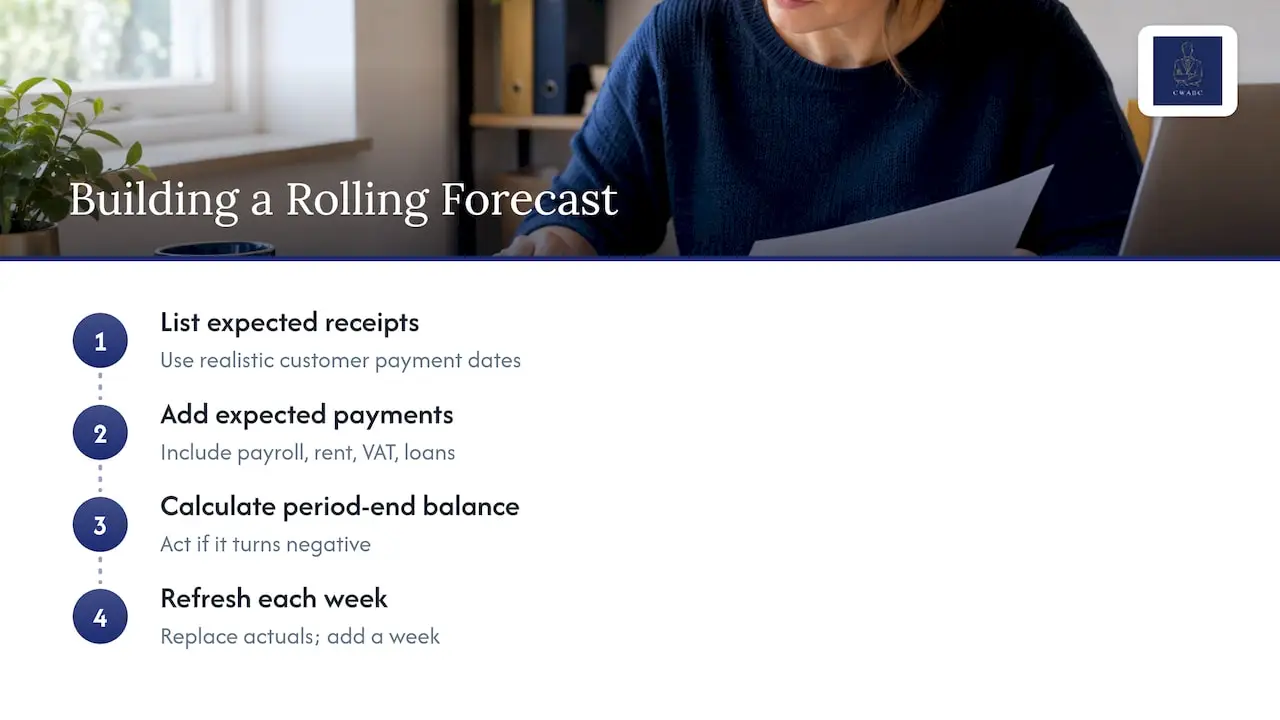
A cash flow forecast does not need to be complicated. The Bank of Scotland suggests a weekly or monthly forecast covering at least the next three months. You list the cash you expect to receive and when, add the payments you expect to make, and work out the balance at the end of each period. If the balance turns negative, you act before the bills become harder to pay.
Many accountants favour a rolling 13-week forecast, because 13 weeks is a quarter and covers most of the cycles that matter: customer payment dates, payroll, rent and VAT. Each week you replace the forecast with what really happened and add a new week at the end. A shortfall spotted in week ten still leaves around ten weeks to fix it.
The ICAEW says a good forecast should reflect forecast turnover by month, cost of sales, how long customers and suppliers actually take to pay, stock levels, rent due dates, capital spending, and PAYE, National Insurance, VAT and loan repayments. One tip I give all my clients: put customer payments in the week you realistically expect them, not the week the terms say. If a customer always takes 45 days, forecast 45.
If you want to build one yourself, my business cash flow forecast worked example goes through it line by line. Startups may prefer my startup cash flow forecasting plan, and sole traders can read sole trader cash flow management.
Why forecasts depend on good bookkeeping
A forecast is only as reliable as the records behind it. If invoices are not recorded, bank transactions are months behind or you cannot say who owes you what, the forecast is guesswork. Up-to-date bookkeeping gives you the three things a forecast needs: what customers owe and when, what you owe suppliers and when, and what has actually gone through the bank. The Bank of Scotland makes the same point: keep your bookkeeping up to date to forecast accurately.
How cash flow problems look for different businesses
The causes are the same, but the pinch point differs depending on how you trade.
| Type of business | Where cash usually gets tight | A sensible first step |
|---|---|---|
| Sole trader | Self Assessment bill and payments on account arriving in January and July | Set aside a share of every payment into a tax pot |
| Landlord | Void periods, repairs and the tax bill on rental profit | Keep a reserve for repairs and track rent received against rent due |
| Startup or side hustle | Spending on equipment and software before sales build | Forecast the first 12 months, week by week for the first quarter |
| Limited company | Corporation tax, VAT and directors’ dividends or salary | Diarise tax dates and agree a regular director’s pay |
| Small employer | Payroll, PAYE and National Insurance falling due each month | Forecast wages and HMRC payments together |
| Construction business | Waiting for stage payments while paying subcontractors, plus CIS deductions | Agree stage payments and track CIS deductions monthly |
How I use bookkeeping and forecasts to help owners decide
I treat the books as a decision tool, not just a record for HMRC. When a client’s bookkeeping is up to date in software such as Xero, QuickBooks or FreeAgent, I can see sales, bills, who owes what and what has cleared the bank. That is the raw material for a forecast.
From there, the conversations become practical:
- Can I afford to take on a member of staff? The forecast shows whether wages, employer’s National Insurance and pension costs fit in the weeks ahead.
- Can I buy that van or equipment? We look at the lowest point your bank balance reaches, not just whether you have enough today.
- Should I register for VAT? The cash effect of charging VAT, and when you must pay it over, can be modelled before you decide. My guide to VAT registration for small businesses explains the threshold.
- How much should I put aside for tax? Up-to-date profit figures let me give a realistic tax estimate through the year instead of one big surprise.
My Budgeting & Forecasting Support is built around this kind of planning, and I run bookkeeping services so that the information feeding it is accurate. If your records are behind, my article on five signs your bookkeeping needs professional help is a good place to check. For year-round planning, see my tax preparation tips.
Perspective
The cash flow conversations I find hardest are the ones that start too late. An owner arrives with a bank balance that has been falling for three months and a tax bill on the way, and they are worried and, quite often, embarrassed. There is nothing to be embarrassed about. Cash flow is a skill nobody teaches you when you start a business.
What I try to do is make the numbers calm. I keep the bookkeeping tidy and up to date, so we both know what has been paid and what has not. Then I build a simple forecast on top, so that the next ten or twelve weeks are written down in front of you, rather than sitting in your head at 2am.
I work directly with every client, explain things without jargon, and agree pricing clearly upfront. My aim is for you to understand your own numbers well enough to make decisions with confidence, and to meet your obligations on time.
Chris
Getting help with your cash flow
If you want a second pair of eyes on your cash position, I can help with the groundwork: setting up or tidying your cloud accounting, keeping your bookkeeping current, preparing VAT, payroll, CIS, Self Assessment or corporation tax, and building a forecast you can actually use. I support sole traders, landlords, startups, limited companies, CICs and small employers around Tonbridge, Hildenborough, Sevenoaks and across Kent, and remotely anywhere in the UK. Pricing is tailored to your situation and agreed clearly upfront. You can see the full range on my accounting services page.
If you are a landlord, I can also help with rental reporting and bookkeeping so rent received, repairs and tax are tracked through the year. You can find that on my main site.
Need help?
If late payments, tax bills or an unclear bank balance are keeping you up at night, get in touch and tell me about your business. I will look at where you are and what would help most. You can reach me through my contact page.
FAQ
How do I track cash flow in a small business?
Record every sale, bill and bank transaction in cloud accounting software, and check your bank feed and unpaid invoices weekly. Then add a forecast of the next 13 weeks, showing expected receipts and payments and the closing balance for each week. Update it with actual figures regularly.
What causes a business to have cash flow problems?
The most common causes are late customer payments, poor chasing of debts, seasonal income, tax bills that were not planned for, too much stock, taking out more drawings than the business can afford and having no forecast. Fast growth can also cause it, because costs rise before income does.
Is it true that 82% of small businesses fail because of cash flow problems?
That figure is repeated widely online, but it is hard to trace to a primary source, so I would not rely on it. What is safe to say is that running out of cash is a serious risk for any small business, and that late payments and poor planning are common reasons why. The practical answer is to forecast and keep a reserve.
Can a business be profitable and still run out of cash?
Yes. Profit counts sales when you invoice them, while cash counts money when it is received. If you pay for materials and wages before a customer pays, the business can be profitable on paper and overdrawn in the bank, as the worked example above shows.
What should I do if I cannot pay my tax bill on time?
Contact HMRC before the deadline and explain the situation, as HMRC can sometimes agree a Time to Pay arrangement to spread the payment. Have your figures and a realistic forecast ready. If you are a director worried about the company’s solvency, speak to a licensed insolvency practitioner.
Sources
- Atradius: help with late payments
- ICAEW: cash flow forecasts and inventory
- Federation of Master Builders: why builders run into cashflow trouble
- Bank of Scotland: 9 ways to manage cash flow
- legislation.gov.uk: Late Payment of Commercial Debts (Rate of Interest) (No. 2) Order 1998
Recommended
- Sole trader cash flow management: 2026 guide
- Cash flow forecasting for startups: a founder’s step-by-step plan
- How to Build a Business Cash Flow Forecast: A Worked Example
- Small business tax payment budget plan: 2026 guide
This article provides general information based on UK tax and accounting rules at the time of publication. It is not a substitute for advice tailored to your individual circumstances. Tax legislation and HMRC guidance may change. If you need advice about your specific situation, please contact me at CW Licensed Bookkeeper & Accountant.