
Corporation Tax is a UK tax paid by limited companies on their annual profits. If you run a limited company, this tax applies to your trading profits, investment income, and any chargeable gains. The current rates range from 19% to 25% depending on how much profit your company makes. Understanding small business corporation tax explained clearly is the difference between paying what you owe and paying more than you should. This guide walks you through the rates, how taxable profits are calculated, your filing obligations, and practical ways to reduce your bill legally.
What are the current corporation tax rates for small UK businesses?
Corporation Tax rates are tiered by profit size: 19% for profits up to £50,000, 25% for profits above £250,000, and a Marginal Relief band in between. This structure means most small businesses will pay the lower rate, but growth can push you into more expensive territory quickly.

Here is a clear breakdown of how the rates apply:
| Profit band | Rate | Notes |
|---|---|---|
| Up to £50,000 | 19% (small profits rate) | Full small profits rate applies |
| £50,001 to £250,000 | Approx. 26.5% effective | Marginal Relief applies |
| Above £250,000 | 25% (main rate) | Full main rate applies |
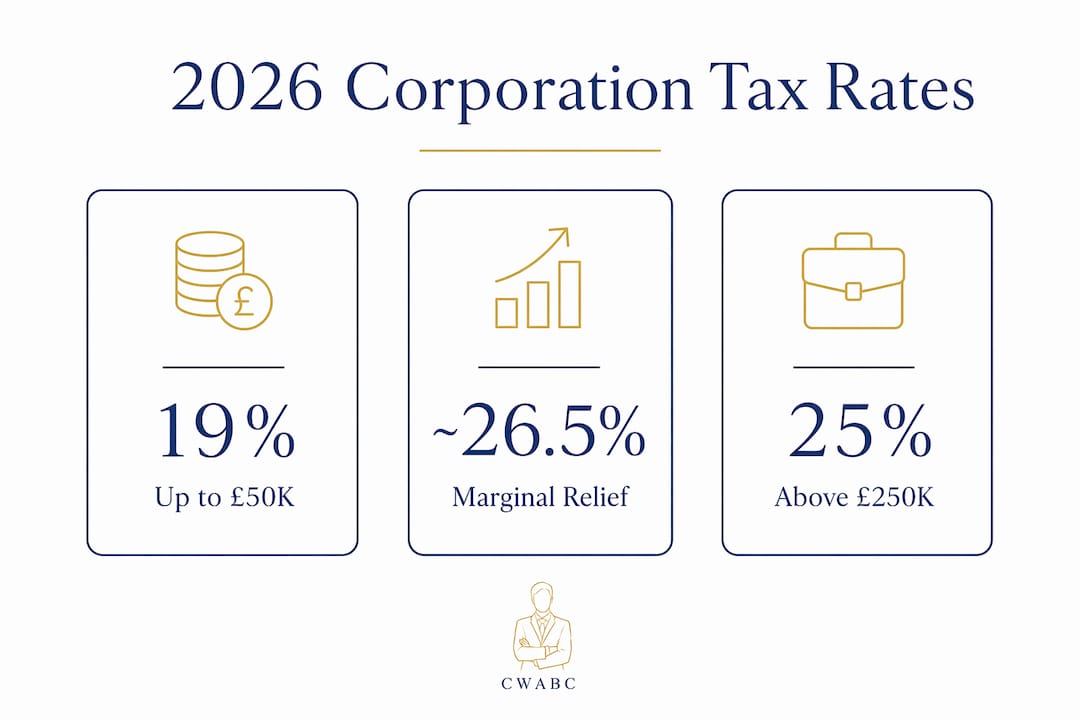
The Marginal Relief band creates an effective rate of approximately 26.5% on profits between £50,001 and £250,000. That is actually higher than the main rate of 25%. This counterintuitive result happens because Marginal Relief tapers the benefit of the lower rate as profits rise, meaning each additional pound of profit in this band costs more in tax than a pound earned above £250,000.
This has a real impact on tax planning. If your profits are approaching £50,000, a modest increase could push you into the Marginal Relief band and trigger a disproportionately higher tax charge on those extra pounds. Knowing where you sit in this structure lets you plan purchases, expenses, and salary decisions more deliberately.
Pro Tip: If your profits are close to the £50,000 threshold, consider whether bringing forward a planned equipment purchase into the current financial year could keep you below it and preserve the 19% rate.
How do UK limited companies calculate their taxable profits?
Corporation Tax is payable on trading profits, investment income, and chargeable gains. Taxable profit is not simply your bank balance or turnover. It is what remains after you subtract all allowable business expenses from your total income.
Allowable expenses are costs that are wholly and exclusively for business purposes. Limited companies can claim expenses including:
- Rent and utilities for business premises
- Staff salaries and employer National Insurance contributions
- Business insurance premiums
- Office supplies and equipment
- Professional fees such as accountancy and legal costs
- Business travel and mileage
- Marketing and advertising costs
One point that catches many small business owners out: companies have no personal allowance. Every pound of profit is taxable. This is fundamentally different from Income Tax, where sole traders benefit from a personal allowance before tax kicks in. For a limited company, precise deduction of every legitimate expense is not optional. It is the primary way you reduce your bill.
Small business owners also frequently confuse the director’s personal income with company profit. Your salary as a director is an allowable business expense and reduces the company’s taxable profit. Dividends, however, are paid from post-tax profits and do not reduce the Corporation Tax bill. Keeping these two streams clearly separated in your records prevents costly errors at year-end.
Pro Tip: Keep a dedicated business bank account and never mix personal and business transactions. This single habit makes expense tracking accurate and saves hours of untangling at year-end.
For a practical walkthrough of preparing your company accounts, Cwabc has a step-by-step guide that removes the guesswork.
What are the filing and payment deadlines for corporation tax?
Every limited company must file a CT600 tax return with HMRC annually and pay Corporation Tax nine months and one day after the end of its accounting period. These are two separate deadlines, and missing either one triggers penalties.
Here is the sequence you need to follow each year:
- Know your accounting period. Your Corporation Tax obligations are tied to your company’s accounting period, which is usually 12 months and aligns with your financial year-end registered with Companies House.
- Pay your Corporation Tax. Payment is due nine months and one day after your accounting period ends. For a company with a 31 march year-end, that means payment by 1 january the following year.
- File your CT600. The company tax return must be filed online with HMRC within 12 months of the accounting period end. This is a separate deadline from payment.
- Submit your annual accounts. Companies House requires annual accounts within nine months of the year-end for private limited companies. These accounts inform your CT600 figures.
- Keep records for six years. HMRC can investigate past returns, so retain all supporting records for at least six years from the end of the accounting period.
Late filing or late payment results in penalties and interest charges. A day late on your CT600 triggers an automatic £100 fine. Longer delays escalate quickly, with additional penalties at three months, six months, and twelve months. Interest accrues on unpaid tax from the payment due date.
Filing online through HMRC or compatible accounting software is the required method. Tools such as Xero, FreeAgent, and QuickBooks can produce CT600-compatible data and connect directly to HMRC’s systems. Early payment can even earn interest repayments from HMRC if you overpay, so there is a genuine financial benefit to getting ahead of the deadline.
How can small business owners legally reduce their corporation tax bill?
Reducing Corporation Tax legally comes down to claiming every expense you are entitled to and planning the timing of income and expenditure thoughtfully. There is no need for complex schemes. The most effective strategies are straightforward.
Here are the main approaches worth knowing:
- Balance salary and dividends. Director remuneration split between salary and dividends is one of the most effective tools available. Salary is a deductible business expense that reduces Corporation Tax. Dividends are not deductible but are taxed at lower personal rates. The optimal split depends on current thresholds and your personal tax position.
- Use the Annual Investment Allowance (AIA). Capital allowances including up to £1 million AIA allow you to deduct the full cost of qualifying plant and machinery in the year of purchase. This can significantly reduce taxable profits in years when you invest in equipment, vehicles, or technology.
- Claim Full Expensing where eligible. Full Expensing provides 100% relief in the first year for qualifying assets. This accelerates tax relief and improves cash flow compared to spreading deductions over several years.
- Claim all legitimate business expenses. Rent, utilities, insurance, professional fees, and staff costs all reduce your taxable profit. Review your expense categories regularly to confirm nothing is being missed.
- Understand Marginal Relief timing. If your profits sit in the £50,001 to £250,000 band, the effective 26.5% rate means that utilising the Annual Investment Allowance to bring profits below £50,000 can produce a larger tax saving than the headline numbers suggest.
- Maintain clean bookkeeping throughout the year. Structured bookkeeping enhances profit visibility and makes tax planning decisions more accurate. You cannot plan around figures you cannot see clearly.
Pro Tip: If you are planning to buy a significant asset such as a computer, van, or piece of machinery, consider whether purchasing it before your financial year-end rather than after could bring your taxable profits down this year rather than next.
What are the best practices for corporation tax compliance?
Compliance is not a once-a-year task. Ongoing organisation and record maintenance throughout the financial year is what separates businesses that file calmly from those that scramble at the last minute.
The habits that make the biggest difference are:
- Reconcile your accounts monthly. Waiting until year-end to sort your records creates errors and missed deductions. A monthly review keeps your figures accurate and your stress levels low.
- Separate business and personal finances completely. A dedicated business bank account and business credit card make expense tracking straightforward and audit-proof.
- Use HMRC-compatible accounting software. Xero, FreeAgent, and QuickBooks all connect to HMRC’s systems and produce the data needed for CT600 filing. Setting these up correctly from the start saves significant time later.
- Prepare annual accounts early. Do not wait until the filing deadline approaches. Early preparation gives you time to spot errors, plan tax-saving moves, and avoid the cost of rushed professional fees.
- Engage an accountant when complexity arises. If your profits are growing, you have investment income, or you are considering a significant asset purchase, professional advice pays for itself. Knowing when to bring in an accountant is itself a practical skill.
- Review your financial position quarterly. A quarterly review of profit, expenses, and projected tax liability lets you make adjustments before the year-end, not after it.
The difference between LLC and corporation taxes and other business structures is worth understanding if you are considering changing how your business is set up. The tax implications vary considerably, and the right structure depends on your profit level and personal circumstances.
Key takeaways
Corporation Tax for UK limited companies is a tiered system where the rate you pay depends directly on your profit level, and the Marginal Relief band between £50,000 and £250,000 carries the highest effective rate of all.
| Point | Details |
|---|---|
| Rates are tiered by profit | Pay 19% up to £50,000, approx. 26.5% in the Marginal Relief band, and 25% above £250,000. |
| No personal allowance applies | Every pound of company profit is taxable, so claiming all allowable expenses is critical. |
| Two separate deadlines | Pay Corporation Tax nine months and one day after year-end; file CT600 within 12 months. |
| AIA reduces taxable profits | Up to £1 million Annual Investment Allowance can be claimed on qualifying plant and machinery. |
| Year-round records matter | Monthly bookkeeping prevents last-minute errors and supports accurate tax planning decisions. |
Why corporation tax caught me off guard in my first year of practice
When I started working with small limited companies, I assumed most owners understood the basics of Corporation Tax. What I found was the opposite. The most common issue was not wilful avoidance or complex schemes. It was simply that owners had no idea the Marginal Relief band existed, and they were making decisions about salary, dividends, and equipment purchases without any awareness of where their profits sat in the rate structure.
One client came to me after their accountant had filed a return showing profits of £62,000. They had paid tax at the effective Marginal Relief rate on those profits above £50,000 without ever considering that a £15,000 equipment purchase they had been putting off would have brought them back below the threshold. That decision cost them more in tax than the equipment would have cost outright. It was a painful lesson, but a preventable one.
What I tell every small business owner now is this: Corporation Tax planning is not a year-end exercise. It is something you build into how you run the business month by month. Knowing your profit position in october or november gives you time to act. Knowing it in march, after the year has closed, gives you nothing but a bill.
The salary and dividend balance is another area where I see real money left on the table. Many directors take a high salary because it feels safer or more familiar. But salary above the optimal threshold costs both the company and the director more in combined tax and National Insurance than a dividend would. Getting this right requires knowing the current thresholds, your personal tax position, and your company’s profit forecast. It is not complicated once you have the numbers in front of you.
My honest advice: treat your bookkeeping as a management tool, not a compliance chore. The businesses that manage Corporation Tax well are not the ones with the cleverest schemes. They are the ones that know their numbers every single month.
— Chris
How Cwabc helps small businesses stay on top of corporation tax
Managing Corporation Tax does not have to feel like a constant source of stress. Cwabc provides bookkeeping services for small businesses that keep your records accurate, your expenses properly categorised, and your profit position visible throughout the year.

From CT600 preparation to advice on salary and dividend structuring, Cwabc offers clear, jargon-free support tailored to limited companies and sole traders across the UK. If you want to understand your tax position before the year-end, not after it, explore Cwabc’s bookkeeping FAQs or get in touch to discuss your specific situation. Clear pricing, no surprises, and practical guidance from a licensed bookkeeper who understands small business finances.
FAQ
What is corporation tax and who pays it?
Corporation Tax is a direct tax on the net profits of UK limited companies. Only limited companies pay Corporation Tax; sole traders and partnerships pay Income Tax through Self-Assessment instead.
What is the corporation tax rate for small businesses in 2026?
The small profits rate is 19% for companies with profits up to £50,000. Profits above £250,000 are taxed at 25%, with Marginal Relief applying to profits in between.
When do I need to pay and file my corporation tax return?
Payment is due nine months and one day after your accounting period ends. Your CT600 tax return must be filed online with HMRC within 12 months of the same period end.
Can I reduce my corporation tax bill legally?
Yes. Claiming all allowable expenses, using the Annual Investment Allowance on qualifying assets, and balancing director salary against dividends are all legitimate ways to reduce your liability.
What happens if I file my corporation tax return late?
An automatic £100 penalty applies from day one of a late CT600 filing. Additional penalties and interest on unpaid tax accumulate the longer the return and payment remain outstanding.