
A cash flow forecast is a simple table of the money you expect to receive and pay out, month by month, with a running bank balance at the bottom. To build one, start with the cash actually in your business bank account, add receipts in the month they will arrive, take off payments in the month they will leave, and carry each closing balance forward. I will walk you through that process below, using a fictional three-month example you can copy.
If forecasting feels like one more job on a long list, that is normal. It is far less daunting once you see it laid out in plain figures. I am Chris White, and I help UK sole traders and limited companies set these up calmly, so that a quiet month or a tax bill is something you have planned for rather than a nasty surprise.
TL;DR
- A forecast shows when cash will arrive and leave your bank account, not just what you have earned or spent on paper.
- Start from your real bank balance, put customer receipts in the month you expect to be paid, and put costs in the month you will pay them.
- Include payroll, VAT, tax and loan repayments, and plan for seasonal highs and lows.
- Three months, updated regularly, is a perfectly good place to start.
- Set a minimum cash level, and use the forecast to spot any month that dips below it while you still have time to act.
Table of Contents
- What a cash flow forecast is (and what it is not)
- Cash flow versus accounting profit
- What you need before you start
- How to build the forecast, step by step
- A fictional three-month example
- Covering the items that catch people out
- Keeping the forecast reliable
- How I help you build and use a forecast
- My view: a forecast should make you calmer, not busier
- Get help with your forecast
- Need help?
- FAQ
- Sources
What a cash flow forecast is (and what it is not)
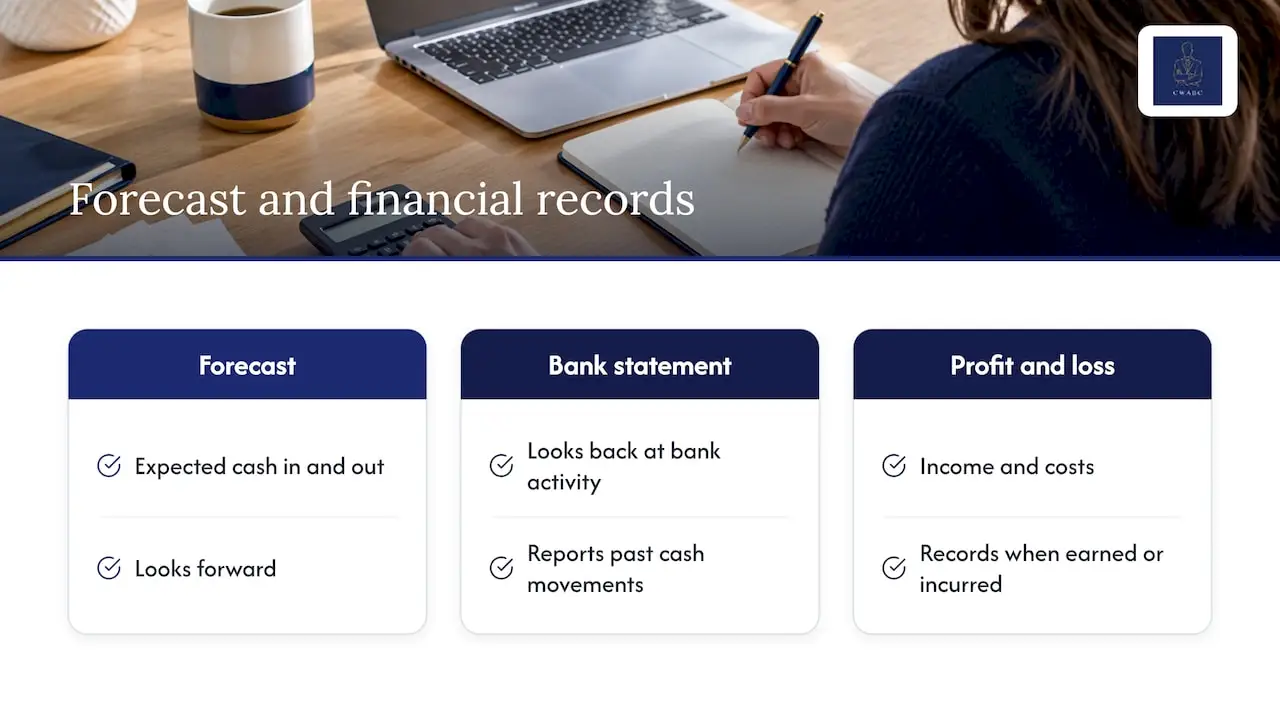
A cash flow forecast records the cash you expect to come into the business and leave it. Business Wales describes it as usually monthly and commonly covering 12 months, though it can be shorter or longer. It looks forward. That makes it different from a bank statement, which looks back, and different from a profit and loss account, which records income and costs when they are earned or incurred rather than when money moves.
It is also worth separating it from a cash flow statement. A statement reports what has already happened. A forecast is your best estimate of what is about to happen, so you can make decisions before the money runs short.
The forecast does not need to be perfect. It needs to be realistic, written down and reviewed. ICAEW’s practical guidance says a simple three-month view of revenue, overheads and cost of sales is better than having no forecasting system at all.
Cash flow versus accounting profit
This is the point that trips up most business owners, so it is worth taking slowly. Business Wales puts it simply: cash is money flowing in and out, while profit is what the business earns after costs are taken out of income received. A business can be profitable on paper and still be unable to pay its bills on Friday.
Here are the usual reasons the two numbers drift apart:
- Late-paying customers. You count a sale when you invoice it. Your bank counts it when the money lands.
- VAT. If you are VAT-registered, the VAT you collect is not your income, and the VAT bill is a cash payment that never appears as a cost in your profit.
- Equipment. A new van or mower leaves your bank in one go, but in your accounts the cost is usually spread over several years.
- Loan repayments. The capital part of a repayment reduces your bank balance but is not a business expense.
- Tax. Income Tax, Corporation Tax and payroll liabilities are paid on a schedule that rarely matches when you earned the money.
- Stock and seasonal buying. Buying ahead for a busy season takes cash out long before the sales arrive.
In the worked example below, the business ends the three months with £1,250 less in the bank than it started with, even though it is trading well. Nothing has gone wrong. The cash simply moved in a different pattern to the sales.
What you need before you start
Gather these before opening a spreadsheet. ICAEW lists the inputs worth considering as forecast turnover, cost of sales, supplier and customer payment times, rent, capital expenditure, PAYE and NI, VAT and loan repayments. In practice, I ask for:
- Your current business bank balance. Not expected profit, the real balance. Enterprise Nation’s UK template guidance also says to begin with the actual bank balance.
- Your sales ledger. Who owes you money, how much and when they usually pay, not when the terms say they should.
- Your supplier bills and regular direct debits. Rent, insurance, software, phone, vehicle costs and subscriptions.
- Payroll details. Wages, employer National Insurance, pension contributions and the dates PAYE is paid to HMRC.
- VAT and tax dates. Your VAT return quarters, Corporation Tax or Self Assessment dates, and any payments on account.
- Loans, finance agreements and planned purchases. Anything with a repayment, plus one-off costs you already know are coming.
- Non-sales money. The British Business Bank suggests listing other receipts such as tax refunds, grants or owner investment in the period the cash is expected to reach the bank.
If your records are behind, a forecast built on guesses will mislead you. This is where tidy bookkeeping pays for itself. If you suspect yours needs attention first, these five signs are a good checklist.
How to build the forecast, step by step
Step 1: Choose your period and columns
For most small businesses I suggest monthly columns over three to six months to begin with. The Federation of Small Businesses says many businesses keep a rolling three-to-six-month forecast and update it as new information arrives. If you are seeking funding, a 12-month view is more usual. If cash is tight, Enterprise Nation suggests a 13-week view gives closer control.
The British Business Bank says the forecast should cover at least as far ahead as your cash-flow cycle. If you buy materials in October and are paid in January, three months will not show the whole picture.
Step 2: Enter the opening balance
This is your bank balance on the first day of the first month. Every later opening balance is the previous month’s closing balance, so you only type this one in.
Step 3: List customer receipts by the month they will be paid
Business Wales is clear that credit sales belong in the month payment is expected, not the month you issue the invoice. If a customer on 30-day terms usually takes 45 days, use 45. Clear, prompt invoicing helps here, and my guide to invoicing best practices for sole traders covers the habits that shorten the wait.
Step 4: List every payment by the month it leaves
Costs go in the month you pay them, not when the bill arrives. Annual and instalment payments go in the months they are actually paid. Include payroll, PAYE and NI, VAT, tax, loan repayments, equipment and the small direct debits that add up.
Step 5: Work out net cash flow and the closing balance
For each month, take total payments away from total receipts. The British Business Bank describes keeping a running total to show cash flow over time. In a spreadsheet:
- Net cash flow = total receipts minus total payments
- Closing balance = opening balance plus net cash flow
- Next month’s opening balance = this month’s closing balance
Business Wales notes that a spreadsheet can reduce calculation errors and help you test changed figures. ICAEW adds that for a less complex business a simple diary or Excel sheet may be enough, and that the quality of the information matters more than the software.
Step 6: Set a minimum cash level
Decide the lowest balance you are comfortable with, perhaps enough to cover a few weeks of wages, rent and loan repayments. Enterprise Nation suggests checking the closing balance against the minimum cash level you want to keep. Any month that falls below it is a month to act on.
A fictional three-month example
Let me show you how this looks with real-feeling numbers. The business below is made up for illustration. It is a small limited company in Kent running garden maintenance, with one part-time employee, a yard, a van and a bank loan. It is VAT-registered, so the figures include VAT where relevant. The forecast covers January to March, and the business wants to keep at least £5,000 in the bank.
| £ | January | February | March |
|---|---|---|---|
| Opening balance | 6,000 | 7,100 | 4,700 |
| Receipts | |||
| Customer payments | 7,800 | 6,200 | 9,400 |
| Total receipts | 7,800 | 6,200 | 9,400 |
| Payments | |||
| Materials and suppliers | 1,900 | 1,500 | 2,600 |
| Van, fuel and maintenance | 650 | 600 | 800 |
| Wages (net pay) | 2,400 | 2,400 | 2,400 |
| PAYE and NI | 520 | 520 | 520 |
| Yard rent, insurance, software | 780 | 780 | 780 |
| VAT payment | 0 | 2,350 | 0 |
| Loan repayment | 450 | 450 | 450 |
| New equipment | 0 | 0 | 1,800 |
| Total payments | 6,700 | 8,600 | 9,350 |
| Net cash flow | 1,100 | (2,400) | 50 |
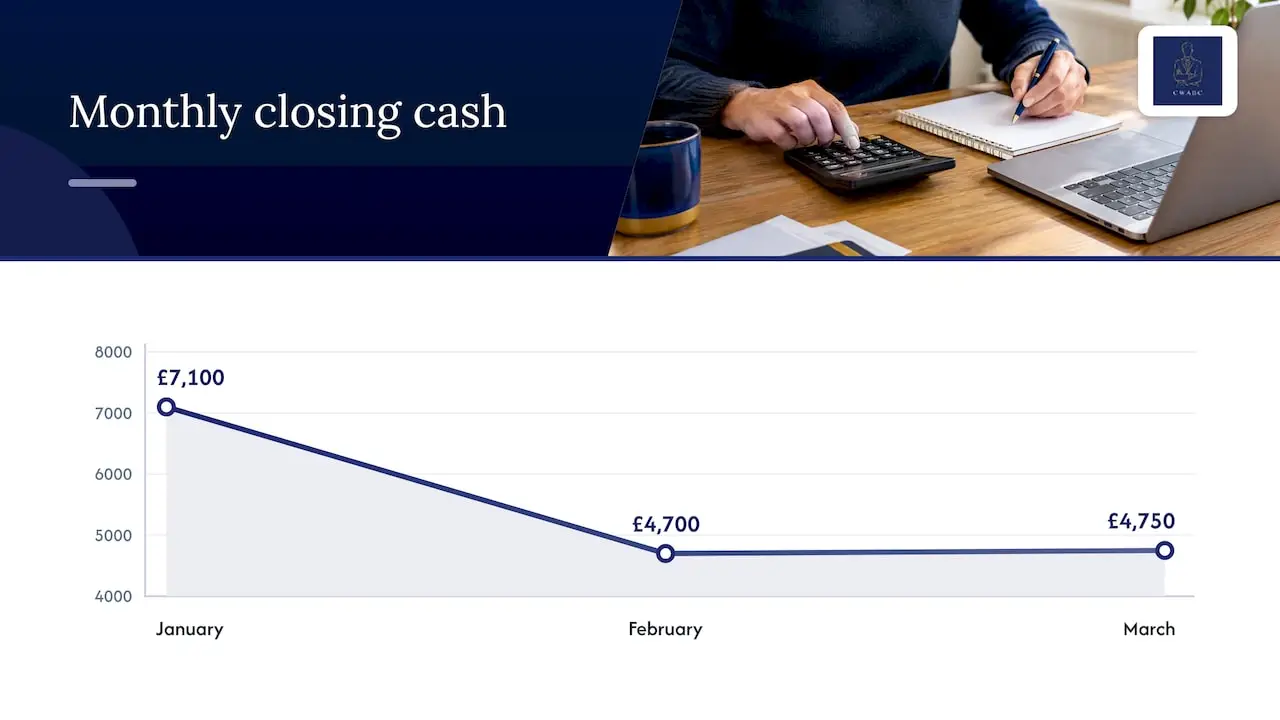
| Closing balance | 7,100 | 4,700 | 4,750 |
What this forecast tells you
January looks comfortable. The business closes the month with £7,100, and it would be easy to relax.
February is where the forecast earns its keep. Customer receipts dip because it is the quiet end of winter, and the quarterly VAT payment of £2,350 falls due. Net cash flow is minus £2,400 and the balance drops to £4,700, which is below the £5,000 minimum.
March is busier, with receipts of £9,400, but the business also buys a £1,800 mower ahead of the growing season and stocks up on materials. The month ends at £4,750, still below the minimum even though trading is strong.
None of this would show on a profit and loss account. On paper, the business is doing well. In the bank, it is running thin for two months.
Testing what happens if a customer pays late
Now try a simple scenario. Suppose a £2,000 customer payment expected in February arrives in March instead. February receipts fall to £4,200, net cash flow becomes minus £4,400 and the February closing balance falls to £2,700. March receipts rise to £11,400, so March still closes at £4,750.
The three-month result is the same, but February is now a real squeeze, with the business holding about half its minimum cash level. Sage Advice UK shows the same effect in its own example, where a £1,200 payment delayed by 30 days cuts that month’s closing balance noticeably. It is a small change in timing that makes a large difference to what is in the bank.
What the business could do about it
Because the forecast shows the dip in January, there is time to choose. Realistic options include:
- Invoicing winter work promptly and chasing the oldest invoices before the VAT date.
- Asking larger customers to pay a deposit or stage payment before the spring rush.
- Timing the mower purchase for April, or spreading the cost, once the March receipts are in.
- Agreeing slightly longer terms with a key supplier for February.
- Talking to the lender early if a repayment looks tight, rather than after it is missed.
- Setting money aside from January’s surplus towards the February VAT bill.
An upcoming tax bill just outside the window matters too. If this company has a £3,100 Corporation Tax payment due at the start of April, the March closing balance of £4,750 would fall to £1,650 straight after. That is exactly the kind of thing a longer forecast reveals. My guide to a small business tax payment budget plan shows how to set money aside for it month by month.
Covering the items that catch people out
Customer receipts
Be honest about how your customers really pay. Look at your last six to twelve months of invoices and note the average number of days to payment, then forecast on that rather than your terms. If you rely on a handful of large customers, forecast them individually.
Supplier payments
List regular suppliers by the date the money leaves your account. If you pay by card or direct debit, use that date. If you pay suppliers in a batch once a month, put them all in that month.
Payroll
If you employ anyone, include net pay, employer National Insurance, PAYE and any workplace pension contributions. PAYE is usually paid to HMRC after the pay month, so the cash leaves a little later than the wages. Subcontractors who work under the Construction Industry Scheme should also allow for deductions and monthly returns. I support both through my payroll and CIS services.
VAT
Business Wales says VAT should be included in sales and cost figures where you qualify for VAT. That means your forecast receipts include the VAT you charge, your costs include the VAT you pay, and the net payment to HMRC appears in the month it leaves your account. My guide to the VAT return explained for small businesses covers how the figure is made up, and if you are approaching the registration limit, this VAT registration guide is worth a read.
Tax
Sole traders should remember Self Assessment, including payments on account, which are two instalments that can arrive alongside a balancing payment. I explain how they work in Self Assessment payments on account explained. Limited company directors should include Corporation Tax; my guide on how to pay Corporation Tax correctly helps with timing. Many people find tax is the single largest cash payment of the year, so giving it its own row is worth the effort.
Loans and finance
The Federation of Small Businesses lists financing activity, interest and debt repayments among the items a forecast should include. Put in every repayment on its due date, and any new borrowing when the money is expected to arrive, not when you apply.
Seasonal changes
Most businesses have a quiet stretch and a busy one. Retail often builds stock before Christmas. Tradespeople and gardeners may see winter dips. Holiday lets peak in summer. Enter your seasonal pattern using last year’s bank statements if you have them, and treat the pre-season buying as a cash cost that arrives early.
One-off costs
Enterprise Nation recommends including planned equipment, websites, stock, training and professional fees, as well as any expected finance or grants. If you know about it, it belongs in the forecast.
Keeping the forecast reliable
A forecast is only useful while it is reasonably current. A few habits keep it that way:
- Use realistic estimates. Business Wales advises using realistic figures and testing changed figures such as lower sales.
- Add an actuals column. Put the real figure beside each forecast month and note the difference. Business Wales suggests this, and adjusting the rest of the year when differences are significant.
- Write down your assumptions. Enterprise Nation recommends recording assumptions and tracking variances, so you can see why results differ.
- Update on a sensible rhythm. Sage Advice UK suggests weekly updates where cash is tight, income is irregular or the business is new, and says monthly is enough for most small businesses. Business Wales advises reviewing cash flow at least weekly.
- Roll it forward. Each month, drop the month just finished and add a new one at the end, so you always look three to six months ahead.
Sharing the sheet with your accountant helps as well. I can compare it against your bookkeeping, point out items you may have missed and flag tax dates well before they arrive. Software can help here too. If your records are in cloud accounting, much of the data already exists, and I set up and train clients on accounting software so the numbers you need are always to hand.
How I help you build and use a forecast
Some clients want a forecast built for them. Others want to do it themselves with a second pair of eyes. Both are fine. Here is how I can help:
- Pulling the figures together. I work from your bookkeeping, bank feeds and invoices so the starting numbers are accurate.
- Mapping your tax and VAT dates. I put them in the months they fall so they never arrive unannounced.
- Testing scenarios. I can show what a late payer, a lost customer or a new hire does to your balance.
- Spotting shortfalls early. I flag any month that dips below your minimum so we can talk through options calmly, before a bill is due.
- Keeping it simple. You get a layout you understand, in plain English, that you can keep updating.
I do not promise outcomes, and a forecast is always an estimate. What it gives you is time and clarity to make decisions. For sole traders there is more in my sole trader cash flow management guide, and if you are just starting out, see cash flow forecasting for startups.
My view: a forecast should make you calmer, not busier
Most people who come to me worried about cash are not bad with money. They are short of a clear picture. The bank balance tells them where they are today, the accounts tell them how last year went, and nobody has shown them what the next three months look like.
That is why I like starting with three months and a simple sheet. It is quick to build and quick to update, and it answers the questions that actually keep owners awake: can I cover payroll, can I pay the VAT, can I afford that purchase.
I work directly with every client, so I look at your real figures, your customers’ real payment habits and your real tax dates. I use cloud accounting and secure digital workflows so the data is current, and I explain each line in plain English. If a squeeze is coming, I would much rather we see it in the forecast now than discover it on the day the payment is due.
Chris
Chris
Get help with your forecast
If you would like a forecast built around your own business, my budgeting and forecasting support is designed to do exactly that. I work with sole traders, landlords, startups and limited companies in Tonbridge, Hildenborough, Sevenoaks and across Kent, and remotely anywhere in the UK. I can set up your forecast alongside your bookkeeping so it stays up to date with minimal effort from you.
Pricing is tailored to the work involved and agreed clearly upfront, so you know where you stand before we begin.
Need help?
If you would like a calm, practical conversation about your cash flow, tax dates or bookkeeping, please get in touch with me. I will explain your options in plain English and tell you how I can help.
FAQ
How far ahead should a small business forecast cash flow?
Three months is a sound starting point, and ICAEW says it is better than having no system at all. Many businesses keep a rolling three-to-six-month view, while a 12-month forecast is common when seeking funding or planning for the year. Choose a period that at least covers your full cycle from paying suppliers to being paid by customers.
Can I build a cash flow forecast in Excel?
Yes. A spreadsheet works well for most small businesses, provided the assumptions behind it are sound. Set up a row for each receipt and payment type, a column for each month, and formulas that carry each closing balance into the next opening balance. Add an actuals column beside each month so you can compare as you go.
How often should I update my forecast?
Monthly is enough for many small businesses. If cash is tight, your income is irregular or you have only recently started trading, weekly updates are safer. Each time, replace forecast figures with actuals and adjust the months ahead if anything has changed significantly.
What should I do if my forecast shows a shortfall?
Act early while you have options. You could chase overdue invoices, ask for deposits, adjust the timing of purchases, discuss payment terms with suppliers or speak to your lender before a repayment is due. If the shortfall involves tax or VAT, talk to your accountant about the dates and what is possible.
Is cash flow the same as profit?
No. Profit is what the business earns after costs, while cash flow is the actual movement of money in and out of your bank account. Late payments, VAT, equipment purchases, loan repayments and tax can all mean a profitable business still has a tight bank balance.
Sources
- Cashflow forecast, Business Wales
- How to create a cash flow forecast in 4 steps, British Business Bank
- Cash flow forecasts and inventory, ICAEW
- How to keep your cash flow up to date, FSB
- Cash flow forecast template for small businesses, Enterprise Nation
- Cash flow forecast template, Sage Advice UK
Recommended
- Cash flow forecasting for startups: a founder’s step-by-step plan
- Sole trader cash flow management: 2026 guide
- Small business tax payment budget plan: 2026 guide
- Break-even analysis: a practical guide for UK small businesses
This article provides general information based on UK tax and accounting rules at the time of publication. It is not a substitute for advice tailored to your individual circumstances. Tax legislation and HMRC guidance may change. If you need advice about your specific situation, please contact me at CW Licensed Bookkeeper & Accountant.