
A UK limited company can only pay dividends out of profits available for distribution. If you pay more than that, the dividend is unlawful, even when the money was sitting in the company bank account. Usually the overpayment is treated as a director’s loan that has to be repaid, and it can bring extra tax and, if the company later fails, personal exposure.
If you have just realised you may have taken too much, please don’t panic. This is common in small companies, and in most cases it can be tidied up calmly if you deal with it early. I’m Chris, the sole practitioner behind CWABC, and this guide explains how distributable profits work, how to check them before you pay yourself, and what to do if you have already overpaid.
TL;DR
- Dividends must come from accumulated, realised profits, after deducting accumulated losses. Cash in the bank is not the test.
- Check your latest accounts, then think about what has happened since. Record the decision in minutes and issue dividend vouchers.
- A dividend paid without enough profits is generally treated as a director’s loan and must be repaid. A tax charge may arise if it stays unpaid.
- An unlawful dividend can’t simply be relabelled afterwards, so fix it properly, with the right paperwork and advice.
- I can help you check profits before you declare a dividend, and tidy up if you have already overpaid.
Table of Contents
- Why money in the bank is not the same as profit
- What the law says: distributable profits
- How to check whether you have enough profit
- A quick checklist before you declare a dividend
- A fictional example: when the bank balance misleads
- What counts as an unlawful dividend
- Consequences for directors and shareholders
- Tax on dividends: the shareholder’s side
- How an overpaid dividend can be corrected
- Perspective: why I check profits before the dividend, not after
- How I can help
- Common mistakes to avoid
- FAQ
- Need help?
- Sources
Why money in the bank is not the same as profit
Most directors look at the bank balance and think, “There’s £30,000 in there, so I can take £20,000.” It is a natural assumption, but the law looks at a different number.
Cash can be in the company for many reasons that have nothing to do with profit:
- Customers paid you in advance for work you haven’t done yet.
- You collected VAT that belongs to HMRC.
- You haven’t yet paid a Corporation Tax bill, supplier invoices or payroll liabilities.
- You borrowed money, or the shareholders put in capital.
- A director put money in as a loan, which the company still owes back.
None of those make the company richer in the way that matters for dividends. A licensed insolvency practitioner makes the same point with a simple example: a company can have £50,000 in the bank and still have no lawful ability to pay a £50,000 dividend, as Paul Brindley explains.
The reverse also happens. A company can be profitable on paper while cash is tight, because customers are slow to pay. Profit and cash are two different measures, and a dividend depends on the first.
What the law says: distributable profits
The rule sits in the Companies Act 2006. Section 830 says a company may only make a distribution out of profits available for the purpose. Those profits are its accumulated, realised profits not already used up by earlier distributions or capitalisation, less its accumulated, realised losses not already written off through a proper capital reduction.
In plain English, think of three ideas:
- Accumulated. It is the running total since the company began, not just this year’s result.
- Realised. Profits that have actually been earned in a way the law recognises, not a paper gain such as a property revaluation.
- Net of losses. Past losses come off the total before you can take anything.
GOV.UK gives the same message in its guidance for directors: your company must not pay out more in dividends than its available profits from current and previous financial years.
Retained earnings and accumulated losses
On your balance sheet, the profit and loss reserve (often called retained earnings) is the starting point. If it is a positive figure, there may be profits available. If it is negative, you have accumulated losses, and those need to be cleared before a dividend is possible.
The ICAEW is clear that if a company has accumulated losses, it cannot pay dividends, and that this applies even where a wider group is profitable. Profits available for distribution are worked out for each individual company.
This catches directors out in a few typical ways:
- A startup makes a loss in year one, a small profit in year two, and the director pays a dividend equal to the year-two profit. The company is still in deficit overall, so nothing is distributable.
- A director with two companies assumes profit in one company can support a dividend from the other. It can’t.
- A company has a strong first half of the year and a poor second half, and dividends taken in the strong months are no longer covered by the year-end position.
Realised and unrealised profits
The face of the accounts doesn’t always separate realised from unrealised reserves. The ICAEW notes that items such as property revaluations may sit within reserves without being realised. If your company holds investment property or has revalued assets, please ask before treating the whole reserve as available.
How to check whether you have enough profit
Here is the routine I would follow before any dividend is declared.
Step 1: Start with the right accounts
Under section 836 of the Companies Act 2006, whether a distribution is allowed is normally judged by the company’s last annual accounts. If those accounts don’t show enough profit, the distribution can be justified by interim accounts instead. In the first accounting period, initial accounts can be used. Those accounts must meet the relevant requirements, or they can’t be relied on.
The ICAEW’s helpsheet on illegal dividends in a private company adds an important practical point. You also need to consider whether losses since the relevant accounts have reduced the realised profits available. Last year’s good result doesn’t protect a dividend if this year has gone badly.
Step 2: Bring the numbers up to date
This is where good bookkeeping matters most. If your records are weeks or months behind, you are guessing. With up-to-date records in cloud software, I can usually give you a clear view of the year-to-date profit and the liabilities heading your way, so you declare a dividend based on facts. If you want to get into that habit, my monthly bookkeeping for limited company directors guide explains what I keep on top of.
Step 3: Allow for what is coming
Think about the Corporation Tax the company will owe on this year’s profit, any VAT and PAYE due, and any known bills. Directors sometimes feel safe because cash flow looks healthy. However, a future liability such as Corporation Tax can change the picture, as BTG Begbies Traynor notes. My guides on Corporation Tax for UK limited companies and paying Corporation Tax correctly show how to estimate what you will owe.
Step 4: Decide and document
GOV.UK says that to pay a dividend the company must hold a directors’ meeting to declare it and keep minutes, even with a single director. Each dividend needs a voucher showing the date, company name, the shareholders being paid and the amount. The same page says dividends are generally paid to all shareholders of the same class in proportion to their holdings, so check your share structure before you pay one owner and not another.
A good set of minutes records that the directors looked at the available profits and were satisfied the dividend could be paid. If the dividend is questioned later, those minutes show you took the decision seriously.
A quick checklist before you declare a dividend
- Is the profit and loss reserve positive after any past losses?
- Are my records up to date, with bank reconciled?
- Have I allowed for Corporation Tax, VAT, PAYE and other bills?
- Are any reserves unrealised, such as revaluations?
- Have I recorded the decision in minutes and prepared vouchers?
- Is the dividend in line with each shareholder’s rights?
A fictional example: when the bank balance misleads
This example is made up to show the mechanics. It isn’t a real client.
Priya is the sole director and shareholder of Oakfield Design Ltd, a fictional company. Here is the position after two years.
| Item | Amount |
|---|---|
| Retained profit at the end of last year’s accounts | £8,000 |
| Trading loss this year, to date | (£12,000) |
| Accumulated position now | (£4,000) |
| Bank balance | £30,000 |
The £30,000 in the bank looks generous, but £18,000 of it is a customer deposit for a project that hasn’t started, and £6,000 is VAT due to HMRC. Priya looks at the cash and pays herself a £20,000 dividend.
On last year’s accounts alone, she might think £8,000 was available. But the current-year loss has wiped that out. After allowing for it, there is a £4,000 deficit, so the company has no distributable profit. The whole £20,000 is an unlawful distribution, not just the £12,000 she might have guessed was “too much”.
What happens next to Priya
- The dividend is treated as a loan. Where a dividend isn’t supported by enough profits, GOV.UK’s director information hub says it will usually be treated as a director’s loan and must be repaid. In the books, it moves to Priya’s director’s loan account as an amount she owes the company.
- There is a possible tax charge. If a close company makes a loan to a participator, section 455 of the Corporation Tax Act 2010 can create a charge based on the dividend upper rate for the tax year of the loan, due nine months and one day after the end of the accounting period. For 2026 to 2027, the upper dividend rate is 35.75%. On £20,000, that is £7,150, if the loan were still outstanding when the charge falls due. Whether and how it applies depends on the facts, so it needs checking against the real figures.
- There may be benefit-in-kind issues. If Priya is also an employee, a loan to her can bring reporting and tax questions of its own, so it needs a proper review.
- The dividend stays unlawful. Law firm Osborne Clarke points out that an unlawful dividend always remains unlawful and can’t be made lawful after the event. What can be done is to deal with the consequences properly.
If you would like to understand how a loan balance behaves and how it is cleared, my guide to an overdrawn director’s loan account covers it step by step.
What counts as an unlawful dividend
GOV.UK says a dividend is considered illegal when a company pays out more than its available profits or doesn’t follow the correct procedures. That gives two ways to get it wrong:
- Substance: there weren’t enough distributable profits when the dividend was paid.
- Process: the paperwork was missing, such as minutes or dividend vouchers.
Timing matters too. The Court of Appeal decision in Global Corporate v Hale, summarised by Keystone Law, confirmed that the company needs sufficient profits at the time the dividend is paid. The same summary notes that a liability to repay isn’t wiped out by later deciding to relabel the payment as salary.
So I would be wary of any suggestion that you can “just reclassify it at year end”. Salary has its own PAYE and National Insurance rules. If you want to see how a sensible mix works, my director salary tax examples are a good place to start.
Consequences for directors and shareholders
For most small companies that are trading healthily, an overpaid dividend is a repayment and tidy-up problem. The risks grow if the company later runs into difficulty.
Repayment by shareholders
Under section 847 of the Companies Act 2006, a shareholder who received a distribution knowing, or having reasonable grounds to know, that it was unlawful is liable to repay it. The ICAEW helpsheet on illegal dividends sets this out. It also says that if profitability falls later in the year after interim dividends were paid, repayment wouldn’t normally arise provided the directors had properly supported the interim dividend at the time.
In an owner-managed company, the director and the shareholder are usually the same person, so it is hard to argue you had no reason to know. That’s why record-keeping at the time matters.
Director duties and insolvency
Osborne Clarke explains that directors who authorise an unlawful dividend may be in breach of their duties and can be personally liable to repay the amount. Keystone Law adds that a director may also face a misfeasance claim under section 212 of the Insolvency Act 1986 and disqualification proceedings.
GOV.UK summarises the position for insolvent companies: consequences can include repaying dividends, personal liability for the company’s losses and director disqualification. Those outcomes arise where the company fails. If your company is struggling to pay its debts, please speak to a licensed insolvency practitioner before paying any further dividends.
Tax on dividends: the shareholder’s side
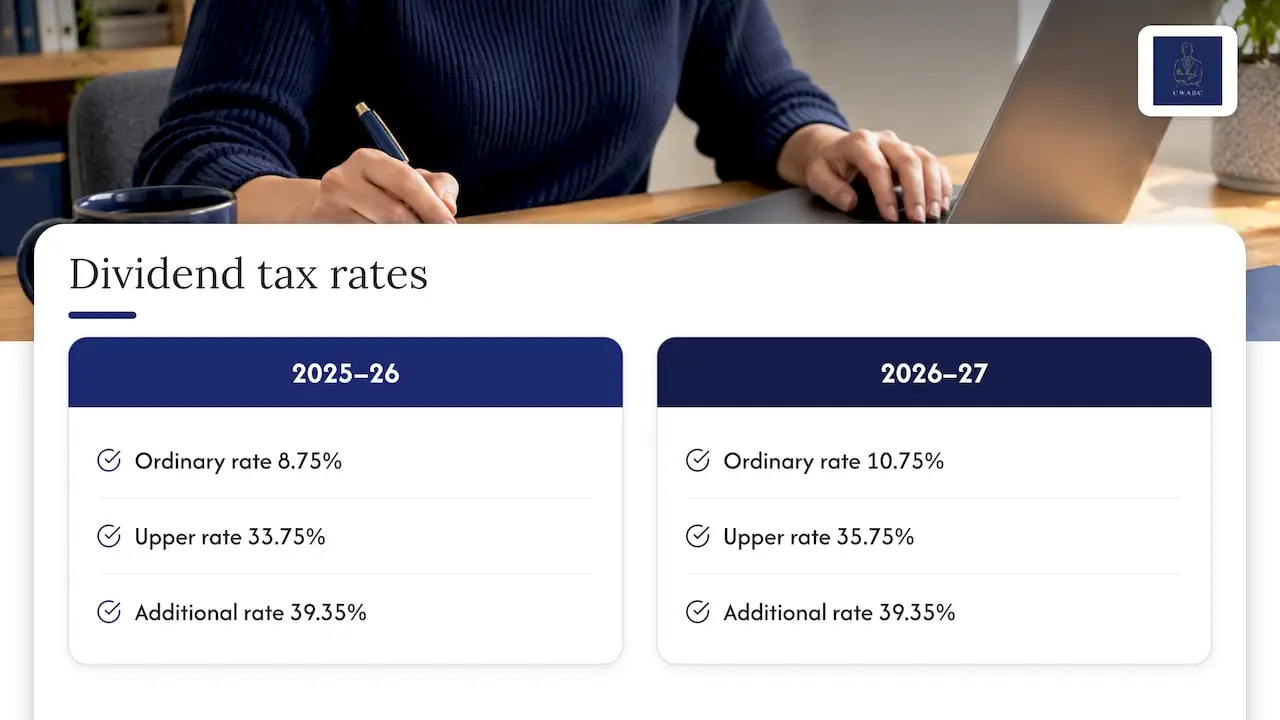
A properly paid dividend isn’t a company expense, and the company doesn’t pay tax on it. The shareholder may owe Income Tax if dividends go over the £500 allowance, according to GOV.UK. For 2025 to 2026 and 2026 to 2027, the dividend ordinary rate is 8.75%, the upper rate is 33.75% for 2025 to 2026 and 35.75% for 2026 to 2027, and the additional rate is 39.35%, as set out in GOV.UK’s rates and allowances. The ordinary rate rises to 10.75% in 2026 to 2027.
Dividends over the allowance are reported on a Self Assessment return. If you need help with that, see my Self Assessment service.
HMRC’s own internal manual adds a technical point. Where a dividend is ultra vires and the shareholder knew, or had reasonable grounds to believe, it was unlawful, as would normally be the case for a shareholder-director, the shareholder holds it as constructive trustee for the company and it doesn’t form part of their income for tax purposes. That manual is dated guidance, so any tax correction of a past year’s return needs professional review rather than guesswork.
How an overpaid dividend can be corrected
The right fix depends on the facts: how much, how long ago, whether the company is solvent, and whether other shareholders are involved. Common routes include:
- Repay it. Put the money back into the company, clearing the director’s loan account.
- Correct the books. HMRC’s manual says an unlawful dividend may be rectified by reducing or extinguishing it and drawing up approved accounts showing only dividends covered by distributable profits, with matching adjustments to directors’ loan accounts.
- Use profits now available. Osborne Clarke lists appropriating distributable profits to the payment by special resolution, provided the accounts now show enough, along with deeds of release and correction of accounts. A deed of release for shareholders is itself a distribution, so it needs distributable reserves too.
- Disclose and commit. The ICAEW says that if reserves are in deficit, directors should make full disclosure in the notes to the accounts and undertake to make no further distributions until reserves are available. Without proper paperwork, payments to shareholders are treated as loans shown as a debtor.
These steps can have legal, tax and accounting effects, and some of them may need a solicitor or insolvency practitioner. I can help with the accounting and tax side, and with working out what the figures show, but I don’t give legal advice.
Perspective: why I check profits before the dividend, not after
Most of the dividend problems I see aren’t about bad intentions. They come from a bank balance that looked healthy, and records that were a few months behind.
My view is simple. A dividend should be the end of a short routine, not the start of a guess. Update the books, look at the profit and loss reserve, allow for the tax that is coming, then write the decision down. It takes a short time when the bookkeeping is current, and it saves a great deal of stress later.
I work directly with every client, so the person who looks at your numbers is the person who explains them to you in plain English. I use cloud software such as Xero, QuickBooks and FreeAgent so the figures are there when you need them. If you have already overpaid, I would rather you told me early. Most clean-ups are far easier when nothing has been left for years.
Chris
How I can help
I help limited company directors work out what they can safely take, record it properly and keep it tidy for HMRC. That can include:
- bringing your bookkeeping up to date so you can see the profit and loss reserve clearly;
- preparing year-end accounts and Corporation Tax calculations;
- setting up dividend minutes and vouchers as a repeatable routine;
- reviewing your director’s loan account and explaining what a balance means;
- preparing your Self Assessment return where dividends are involved, from £250 one-off.

If you want regular support, my bookkeeping services keep your records current, and my wider accounting services cover accounts and Corporation Tax. I work with directors in Tonbridge, Sevenoaks and across Kent, and remotely throughout the UK. I can’t promise a particular outcome, because each company’s position is different, but I can help you understand it clearly.
Common mistakes to avoid
- Treating the bank balance as profit. It is the single most common error.
- Using last year’s profit only. Losses since the last accounts still count.
- Forgetting Corporation Tax. Set it aside as you earn, so it isn’t a surprise.
- Skipping the paperwork. Minutes and vouchers are required, even for a one-person company.
- Paying “regular” dividends regardless of results. A monthly top-up can be fine only when profits support it.
- Waiting. The longer a loan stays on the books, the more questions it raises. My article on Corporation Tax filing mistakes covers related traps.
FAQ
Can a company pay dividends without making a profit?
Only if it has enough retained, realised profits from current and previous years. A loss in the current year doesn’t automatically stop a dividend, but accumulated losses must be cleared first. GOV.UK says dividends can only be taken from retained company profits.
Can a company pay a dividend with negative retained earnings?
No. Negative retained earnings means accumulated losses, and the ICAEW says a company with accumulated losses can’t pay dividends. You would need to build up enough profit to clear the deficit before distributing anything.
What makes a dividend unlawful?
Paying out more than the available profits, or not following the right procedures, such as missing minutes or vouchers. Both are covered in GOV.UK’s guidance for directors. The test is applied at the date the dividend is paid.
What happens if I take too much in dividends?
The excess is usually treated as a director’s loan that must be repaid. A Corporation Tax charge under section 455 may arise if it isn’t cleared in time. If the company later becomes insolvent, a liquidator may pursue repayment, so it is best to correct it early.
How do I know how much I can safely pay myself?
Look at the profit and loss reserve in your latest accounts, update it with this year’s results, and allow for tax and other bills. If you are unsure, ask your accountant to run the figures before you pay. I’m happy to do this for you.
Need help?
If you think you may have taken more in dividends than your company can support, or you want a clear process for the future, I’m here to help. Get in touch with me and we can look at your figures calmly, in plain English.
Sources
- Director information hub: Dividends, GOV.UK
- Running a limited company: taking money out, GOV.UK
- Annex A: rates and allowances, GOV.UK
- Companies Act 2006, section 830
- Companies Act 2006, section 836
- Corporation Tax Act 2010, section 455
- HMRC Company Taxation Manual CTM20090
- Paying dividends the essentials, ICAEW
- Illegal dividends in a private company, ICAEW helpsheet
- Consequences and remedies for unlawful dividends, Osborne Clarke
- The dangers of unlawful dividends, Keystone Law
- What are unlawful dividends, BTG Begbies Traynor
- Dividends, drawings and director pay when cash is tight
Recommended
- Small business director salary tax examples: 2026 guide
- How to pay corporation tax correctly: UK director’s guide
- Corporation tax for UK limited companies: 2026 guide
- Ten corporation tax filing mistakes small company directors make
This article provides general information based on UK tax and accounting rules at the time of publication. It is not a substitute for advice tailored to your individual circumstances. Tax legislation and HMRC guidance may change. If you need advice about your specific situation, please contact me at CW Licensed Bookkeeper & Accountant.