Your balance sheet is a snapshot of what your company owns and owes on one day, usually the last day of your financial year. Once you can read its main lines (fixed assets, current assets, creditors, loans, the director’s loan account, share capital and retained earnings), you can see why a profitable company can still run short of cash. You can also spot a missing liability before you sign. As a sole practitioner, I help limited company directors do exactly this, so that approving the accounts feels like a decision rather than a leap of faith.
TL;DR
- A balance sheet shows assets, liabilities and equity at one date. It does not show how the year went, which is the job of the profit and loss account.
- Profit and cash are different things. Money can be tied up in unpaid invoices, stock, loan repayments, tax or dividends.
- A liability left out of the accounts, such as VAT, PAYE or corporation tax, makes the company look stronger than it is.
- The director’s loan account needs a clear explanation: does the company owe you, or do you owe the company?
- Before you approve the accounts, check the bank, debtors, creditors, tax balances, loans and the director’s loan account against real records.
Table of Contents
- What a company balance sheet actually shows
- A simple fictional balance sheet
- Walking through each section
- Why a profitable company can still run short of cash
- Why a missing liability distorts the picture
- What to check before you approve the annual accounts
- My point of view
- How I can help with your balance sheet
- Balance sheet, profit and loss, and cash flow: how they differ
- FAQ
- Need help?
- Sources
What a company balance sheet actually shows
The FSB describes the balance sheet as a statement of the assets, liabilities and equity of a business at a particular point in time. The ICAEW adds that this is normally the end of the financial year.
Think of it as a photograph, not a film. It tells you where the company stood on, say, 31 March. It cannot tell you how busy the year was or whether the next quarter will be easier.
Three words do most of the work:
- Assets are things the company owns or controls that can bring in money or other benefits: equipment, stock, money customers owe you, cash in the bank.
- Liabilities are what the company owes: suppliers, tax authorities, lenders.
- Equity is what is left when you take liabilities away from assets. It belongs to the shareholders.
The FSB explains equity as assets minus liabilities. Rearranged, that gives the rule every balance sheet follows: assets equal liabilities plus equity. Both sides always agree, which is why it is called a balance sheet.
Why directors have to care
Under the Companies Act, directors must prepare a balance sheet as at the last day of each financial year, and it must give a true and fair view of the company’s affairs. The FSB notes that limited companies have to produce financial statements when they file their accounts. A sole trader has no such duty to file with a public body.
That legal duty sits with you personally as a director, even when an accountant prepares the figures. So the aim is not to become an accountant. The aim is to understand the page you are approving.
If you are still weighing up whether a company suits you, my guide on sole trader vs limited company covers the trade-offs.
Smaller companies and simpler formats
Very small companies can file less detail. The 2008 regulations allow a company that qualifies as a micro-entity to show only the items listed in the prescribed balance sheet formats. The FRS 102 accounting standard also gives small entities some exemptions. Whatever goes on the public record, I would still want you to see the fuller picture in your own management figures. That is what you actually run the business on.
A simple fictional balance sheet
Here is a made-up company, Harbour Lane Design Ltd, so you can see how the pieces fit. It is not a real client and the figures are only there to teach. Its year end is 31 March 2026.
| Harbour Lane Design Ltd, 31 March 2026 | £ |
|---|---|
| Fixed assets | |
| Equipment and van (net book value) | 18,000 |
| Current assets | |
| Stock | 4,000 |
| Debtors (customers who owe money) | 21,000 |
| Cash at bank | 9,000 |
| Total current assets | 34,000 |
| Creditors: due within one year | |
| Trade creditors (suppliers) | 8,500 |
| VAT | 6,200 |
| PAYE and National Insurance | 2,300 |
| Corporation tax | 7,000 |
| Director’s loan account (owed to director) | 3,000 |
| Bank loan, next 12 months | 4,000 |
| Total due within one year | 31,000 |
| Net current assets | 3,000 |
| Total assets less current liabilities | 21,000 |
| Creditors: due after more than one year | |
| Bank loan, remaining balance | 11,000 |
| Net assets | 10,000 |
| Capital and reserves | |
| Share capital | 100 |
| Retained earnings | 9,900 |
| Total equity | 10,000 |
Check the logic: assets of 52,000 (18,000 plus 34,000) less liabilities of 42,000 (31,000 plus 11,000) gives net assets of 10,000. That matches the equity at the bottom. If those two numbers ever disagree, something is wrong with the books.
Walking through each section
Fixed assets
The ICAEW describes fixed assets as items used to support the business, such as land and buildings, equipment and machinery, motor vehicles, and fixtures, fittings and furniture, normally owned for more than a year. In the example, the van and equipment appear at 18,000.
That figure is the net book value: the cost less depreciation, which spreads the cost over the years you use the asset. It is not what you could sell the van for tomorrow. Two things are worth asking. Is everything listed still in the business? And has anything bought during the year been recorded here, rather than treated as an everyday expense?
Current assets
The ICAEW explains current assets as the trading items that are bought or made and sold: stock, debtors and cash. They are listed roughly in order of how quickly they turn into cash.
In Harbour Lane, debtors are 21,000. That is much bigger than the 9,000 in the bank. On paper those customers are an asset. In practice, they are only useful once they pay. So two questions matter: how old are those invoices, and is any of it unlikely to be paid?
Creditors
Creditors are the amounts the company owes. The balance sheet splits them into those due within one year and those due after more than one year. The split matters because short-term bills need cash soon.
In the example, the 31,000 due within a year includes suppliers, VAT, payroll taxes and corporation tax. These are easy to forget because they are not bills you paid during the year. They are bills the year has created. If your VAT or PAYE balance looks oddly low or missing, ask why.
Bank loans
A bank loan is split into the part you must repay in the next 12 months and the part after that. Harbour Lane owes 15,000 in total: 4,000 within a year and 11,000 later. Look at the first figure when you plan your cash. It is a real payment leaving the bank, but it never appears in the profit and loss account as an expense. Only the interest does, so a loan repayment can drain cash without touching profit.
Business support bodies look at this through gearing, which compares borrowing with total financing. Guidance from nibusinessinfo.co.uk says a lower figure indicates a stronger business, and that lenders may become cautious at higher levels. You do not need to calculate it every month. You need to know whether your borrowing is growing faster than the business behind it.
The director’s loan account
This is the line that causes the most confusion for owner-managed companies. The director’s loan account records money moving between you and the company outside salary, dividends and expense claims. It can sit in one of two places:
- Credit balance (the company owes you). You put money in, or paid a company cost personally and have not been repaid. It appears under creditors, as in the example, where the company owes the director 3,000.
- Debit balance (you owe the company). You took out more than you were owed. It appears as a debtor, and an overdrawn balance at the year end can bring tax consequences for the company and for you. Please read the current GOV.UK guidance or speak to me before the year end if that is your position.
Either way, the balance should agree with a clear record of every transaction. A vague “director’s loan” figure that nobody can explain is the first thing I would want to sort out.
Share capital
Share capital is the amount shareholders paid in for their shares, often just £100 or less in a small company. It is a fixed historic figure. It does not show what the company is worth. A small number here is normal and not a sign of weakness.
The Sage Publishing text on balance sheets explains that sole traders and partners normally have unlimited liability for their firm’s debts, while limited company shareholders are not required to contribute beyond what they paid for their shares. That limit is why the share capital line, and the whole structure, exists.
Retained earnings
Retained earnings are the total profits the company has made since it began, after tax, less any dividends paid out. Harbour Lane shows 9,900.
A common surprise: you may have made £42,000 profit this year and still see a modest retained earnings figure. That happens when dividends, earlier losses or tax take a share. It also explains why you cannot pay unlimited dividends: they come from retained profits, so a balance sheet that shows low reserves should make you think twice before declaring one.
Why a profitable company can still run short of cash
The ICAEW makes the point that a company might have lots of profit, but if it does not have enough cash, it will struggle to pay its creditors. The balance sheet is where you can see why.
Here is how Harbour Lane could report a decent profit and still feel tight:
- Customers have not paid. Work is billed and counted as income, but 21,000 is sitting in debtors rather than in the bank.
- Stock was bought and not yet sold. Cash left the bank, but the cost only becomes an expense when the goods are sold.
- Loan capital was repaid. The 4,000 due this year leaves the bank without reducing profit.
- Equipment was bought. The cash went out at once, while the profit and loss account only picks up a share each year through depreciation.
- Tax bills fall due. The VAT, PAYE and corporation tax in the creditors section all need paying from cash, at fixed times.
- Dividends or drawings were taken. These reduce cash and reserves but are not business costs.
So profit tells you whether the business model works, and the balance sheet tells you whether the company can pay its bills this quarter. You need both.
A quick liquidity check
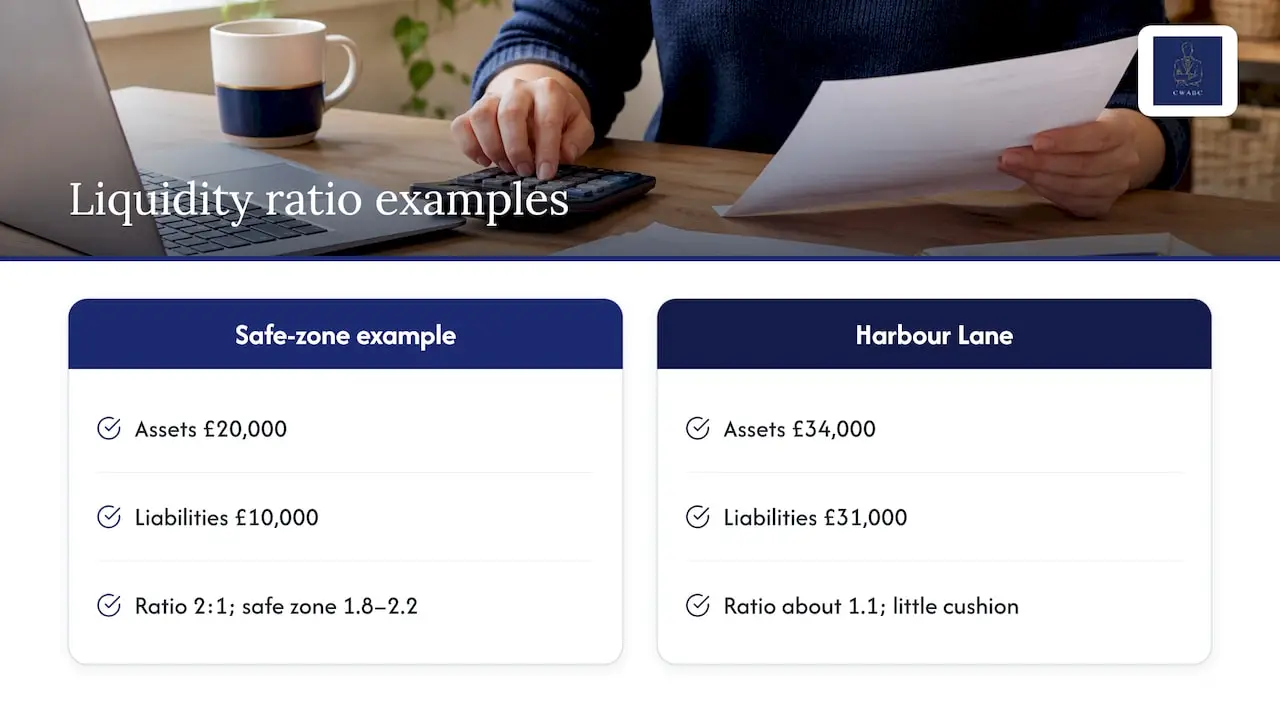
Business Wales explains the liquidity ratio as current assets divided by current liabilities, and treats a ratio between 1.8 and 2.2 as a safe zone. Its example is £20,000 of current assets against £10,000 of current liabilities, a 2:1 ratio.
Harbour Lane’s figure is 34,000 divided by 31,000, or about 1.1. That does not mean disaster. It means there is little cushion, and that the speed at which customers pay matters a great deal. Ratios are prompts for questions, not verdicts. They work best when you compare your own figures year on year.
Why a missing liability distorts the picture
A balance sheet only balances if everything is in it. If a liability is left out, assets look larger relative to what is owed, and equity looks healthier than it is.
Let us say Harbour Lane’s bookkeeping missed the VAT (6,200) and the corporation tax (7,000). That removes 13,200 from creditors. Net assets would then read 23,200 instead of 10,000. The company would appear more than twice as strong, even though the cash needed for those bills is exactly the same.
The usual suspects are:
- VAT owed for the final quarter before the year end
- PAYE and National Insurance for the last pay run
- Corporation tax for the year just ended
- Supplier invoices dated before the year end but received afterwards
- Loan interest, accrued but unpaid
- Money owed to you as a director, or to HMRC after a late return
These gaps usually come from untidy records, not dishonesty. Keeping VAT and payroll reconciled to your bookkeeping throughout the year makes them far less likely. My guides on reconciling VAT returns to your records and what I check in a bookkeeping review explain how.
What to check before you approve the annual accounts
A private company’s annual accounts are normally due at Companies House within nine months of the year end, so you have time to review them properly. Use this list:
- Cash at bank. Does the figure agree with your bank statement on the year-end date? A tiny difference with an explanation is fine. An unexplained one is not.
- Debtors. Do you recognise every name? Are any invoices old enough that you doubt they will be paid?
- Stock. If you hold stock, was it counted or estimated, and is the value sensible?
- Fixed assets. Is everything you bought this year listed, and is anything sold or scrapped still there?
- Trade creditors. Are all supplier bills up to the year end included, including ones arriving in April?
- VAT, PAYE and corporation tax. Do the balances match your latest returns and what you expect to pay?
- Bank and other loans. Does the split between short-term and long-term match the lender’s statement?
- Director’s loan account. Is the balance supported by a transaction list, and do you agree with the direction, owed to you or owed by you?
- Share capital. Does it match what was issued, and does your shareholder record agree?
- Retained earnings. Do last year’s closing figure, this year’s profit and any dividends add up to this year’s balance?
- Comparison. Do the figures make sense against last year? A big jump or drop should have a reason you can state.
- The signature. Do you understand what you are signing? Ask for anything you do not understand to be explained, in plain English, before the approval, not after.
If you can answer yes to each, you can approve with real confidence. If any answer is no, that is simply a question to put to whoever prepared the accounts.
My point of view
Most directors I meet are not afraid of numbers. They are afraid of signing something they only half understand.
My view is that a balance sheet should never arrive as a surprise. If I keep your bookkeeping tidy through the year, with the bank reconciled, VAT and payroll balances agreeing to the returns and the director’s loan account explained, the year-end figures are simply a summary of things you already know.
I work directly with you, with no hand-offs, and I explain each line in everyday language. I use cloud software such as Xero, QuickBooks and FreeAgent, so you can look at the same figures I do. When the accounts are ready, I would rather spend the time walking you through the debtors, the creditors and the director’s loan account than hurry you to a signature.
I do not give personalised tax or legal advice in a general guide like this, and no article replaces looking at your own figures. But understanding your balance sheet is one of the most practical steps you can take to feel in control of your company.
Chris
How I can help with your balance sheet
I am an AAT Licensed Accountant based in Hildenborough, near Tonbridge, working with limited company directors across Kent and remotely throughout the UK. For balance sheet confidence, I can help in three ways:
- Keeping your records accurate through the year with my bookkeeping services, so there are fewer surprises at the year end.
- Preparing your company accounts and corporation tax, then explaining the balance sheet to you before you approve it. You can see the range on my accounting services page.
- Setting up or tidying your cloud software, so the figures you see are the figures I work from.
My fees are tailored to each client and agreed clearly upfront, so you know what to expect before we start. My ongoing guide to bookkeeping for limited company directors shows the monthly routine that keeps the balance sheet in good shape. If you want to plan for next year’s cash as well, my budgeting and forecasting support is a natural next step. Corporation tax is a big creditor line for many companies, so my corporation tax guide for UK limited companies is worth reading too.
Balance sheet, profit and loss, and cash flow: how they differ
The three statements answer different questions:
| Statement | Question it answers | Covers |
|---|---|---|
| Balance sheet | What does the company own and owe? | One date |
| Profit and loss account | Did the company make a profit? | A period, usually a year |
| Cash flow statement | Where did the cash come from and go? | A period, usually a year |
The balance sheet cannot tell you how the year unfolded. Two companies could show the same net assets, one after a steady year and one after a wild one. It also records many assets at cost less depreciation, not market value, and it only reflects the position on the day. A big customer payment received the day after the year end will not be there.
Small companies are not always required to produce a cash flow statement. FRS 102 says a small entity applying its small-entity section need not comply with the statement of cash flows. That is one more reason to look at monthly cash and the balance sheet together, rather than waiting for the annual accounts. If you want help reading them side by side, the Companies House filing side of my work is covered on my accounting page.
A note for sole traders
If you trade as a sole trader, you do not file a balance sheet with a public body, as the FSB notes. Your records matter just as much for Self Assessment, though, and my guide to sole trader annual accounts explains what you need.
FAQ
What is the difference between current assets and fixed assets?
Fixed assets are things the company keeps to use over a longer period, such as equipment or a van, normally for more than a year. Current assets are items that turn over in trading, such as stock, debtors and cash. The difference matters because only current assets can quickly pay short-term bills.
Why is my balance sheet showing less money than my profit?
Profit is not cash. Unpaid customer invoices, stock, loan repayments, equipment purchases, tax bills and dividends can all take money out of the bank without reducing profit. Your balance sheet shows where the money went, and a conversation about your debtors and creditors usually explains most of the gap.
Does a small limited company still need a balance sheet?
Yes. Directors must prepare a balance sheet as at the last day of each financial year, and it must give a true and fair view. Very small companies may file a simplified version on the public record, but the duty to prepare the accounts properly remains.
What should I do if my director’s loan account is overdrawn?
Do not wait for the year end. An overdrawn balance can have tax consequences for you and the company, so check the current GOV.UK guidance and speak to an accountant about your own figures. I can look at the transactions with you and explain your options in plain English.
Need help?
If you would like someone to explain your company balance sheet line by line before you approve it, I would be glad to help. You can contact me here to talk through your situation.
Sources
- FSB: Beginner’s guide to financial statements
- ICAEW: About a business
- Business Wales: Balance sheet and ratios
- Companies Act 1989, section 4 (legislation.gov.uk)
- The Small Companies and Groups (Accounts and Directors’ Report) Regulations 2008 (legislation.gov.uk)
Recommended
- Overdrawn Directors Loan Account: What Happens Next
- Stay HMRC Ready Monthly: Bookkeeping for UK Limited Company Directors
- Confirmation statement filing: what every director must check
- How to pay corporation tax correctly: UK director’s guide
This article provides general information based on UK tax and accounting rules at the time of publication. It is not a substitute for advice tailored to your individual circumstances. Tax legislation and HMRC guidance may change. If you need advice about your specific situation, please contact me at CW Licensed Bookkeeper & Accountant.