If you run your own business as a sole trader, you have probably wondered what “sole trader annual accounts explained” actually means for you in practice. Here is a common misconception worth clearing up straight away: sole traders do not file formal annual accounts with Companies House. That obligation belongs to limited companies. What you do instead is prepare a set of accounts, typically called sole trader financial statements, to calculate your taxable profit and complete your HMRC Self Assessment tax return. Getting this right matters more than ever, with Making Tax Digital changes arriving from April 2026.
Table of Contents
- Key takeaways
- What sole trader annual accounts actually are
- Understanding the sole trader financial year
- How to prepare your accounts for Self Assessment
- Record keeping and Making Tax Digital in 2026
- Common mistakes and how to avoid them
- My honest take on sole trader accounts
- How Cwabc supports sole trader accounts and tax compliance
- FAQ
Key takeaways
| Point | Details |
|---|---|
| No Companies House filing | Sole traders prepare accounts for HMRC Self Assessment, not for Companies House. |
| SAI is your accounts framework | The Standard Accounts Information form translates your accounts into the Self Assessment figures HMRC needs. |
| Accounting period choice matters | Aligning your accounting period to the tax year simplifies profit calculations and reduces errors. |
| Five-year record keeping rule | HMRC requires you to keep supporting records for at least five years after the filing deadline. |
| MTD arrives April 2026 | Sole traders earning over £50,000 must keep digital records and submit quarterly updates from April 2026. |
What sole trader annual accounts actually are
The term “annual accounts” sounds formal and a little daunting. For sole traders, though, it refers to a summary of your business income and expenses over a 12-month period, showing your net profit or loss. Unlike limited companies, there is no legal requirement to submit these accounts to Companies House or to have them audited.
What you do need is sufficient financial information to complete your Self Assessment tax return accurately. HMRC uses a specific section called the Standard Accounts Information, or SAI, to capture this. HMRC’s HS229 guidance describes the SAI as providing “a comprehensive summary of your trading profit/loss and balance sheet” along with adjustments needed to arrive at your taxable profit.
Here is how sole trader accounts differ from limited company accounts at a glance:
| Feature | Sole trader | Limited company |
|---|---|---|
| Filed with Companies House | No | Yes |
| Audit requirement | No | Sometimes |
| Tax return type | Self Assessment (SA100) | Corporation Tax return |
| Balance sheet required | Optional | Yes |
| Accounts format | Flexible | Statutory format |
For many sole traders, the accounts themselves consist of three things:
- An income and expenditure summary (turnover minus allowable expenses)
- A calculation of net profit or taxable profit after adjustments
- Optionally, a balance sheet showing assets and liabilities
The key insight here is that sole trader accounts are not merely a bookkeeping exercise. They form the direct basis for your SAI and show the adjustments needed to reach your taxable profits. That distinction matters when you sit down to fill in your tax return.
Understanding the sole trader financial year
Your accounting period is the block of time your accounts cover. For most sole traders, this is 12 months. If you are not a new business, the accounting period starts the day after your previous period ended. So if your last accounts ran to 5 April 2025, your new period begins on 6 April 2025.
The tax year always runs from 6 April to 5 April. This matters because HMRC calculates your tax liability on the profits arising within each tax year. If your accounting period does not match the tax year, your profits may need to be apportioned across two tax years.
There is a practical exception worth knowing. Apportionment is not required if your accounting period ends on 31 March or on any date between 1 and 4 April. HMRC treats these as equivalent to the tax year end.
Common accounting date choices and their implications:
- 5 April or 31 March – aligns neatly with the tax year, no apportionment needed
- 31 January – popular with some trades but creates apportionment calculations
- 30 April – means accounts straddle two tax years significantly
Pro Tip: Choosing 31 March or 5 April as your accounting date is the simplest option for most sole traders. It removes the need to apportion profits and keeps your tax computations clean and straightforward.
Your accounting date is a tax decision, not just an accounting convenience. Plan it deliberately.
How to prepare your accounts for Self Assessment
This is where sole trader end-of-year accounts prep gets practical. The SAI section of your Self Assessment return contains specific boxes on the Self-Employment (Full) pages. Note that sole traders with turnover over £90,000 must complete the full Self-Employment pages, which include the SAI.
Here is a structured approach to preparing your submission:
-
Gather your income figures. Start with total turnover: all money received from customers before deducting any expenses. Include any other business income separately.
-
List your allowable expenses. Group these into the SAI categories: cost of goods sold, wages, premises costs, repairs, general admin, motor expenses, travel, advertising, legal and financial charges, and depreciation adjustments.
-
Create a reconciliation sheet. Mark each line item in your accounts as “placed” and note which SAI box it goes into. This single step prevents double counting and omissions, which are the most common SAI errors.
-
Use a two-pass method. Fill in the obvious, straightforward figures first. Leave ambiguous items, such as mixed-use expenses or unusual income, for a second pass. HMRC’s HS229 guidance recommends exactly this approach to avoid forcing items into the wrong boxes prematurely.
-
Handle the balance sheet section carefully. If your accounts do not include a balance sheet, do not complete boxes 83 to 99 on the SEF 5 form. Leaving them blank is correct. Filling them with estimated figures can distort your taxable profit calculation.
-
Review for year-on-year consistency. HMRC advises that you should map figures to the same SAI boxes each year. Changing your mapping without good reason can raise questions and create reconciliation problems.
Pro Tip: Do not submit your return until all your final figures are confirmed. Entering provisional amounts and amending later adds unnecessary admin and can attract HMRC attention.
If you want to start planning well ahead of the deadline, the guide on preparing ahead of the filing deadline at Cwabc is a useful starting point.
Record keeping and Making Tax Digital in 2026
Good records are the foundation of accurate accounts. HMRC’s rules are clear: keep records for at least five years after the 31 January filing deadline. That means if you file your 2025 to 2026 return by January 2027, you keep those records until at least January 2032.
What records do you need?
- Sales invoices and receipts for all income
- Purchase receipts and supplier invoices for expenses
- Bank statements for your business account
- Mileage logs if you claim vehicle expenses
- Payroll records if you employ anyone
- Records of any capital items bought or sold
Keeping a dedicated business bank account makes this significantly easier. Mixing personal and business transactions is one of the fastest ways to create confusion at year end.
Now for the change that affects many sole traders from April 2026. Making Tax Digital for Income Tax Self Assessment (MTD ITSA) requires sole traders with income over £50,000 to keep digital records and submit quarterly updates to HMRC using compatible software. This is not optional. You will need to use software that links directly to HMRC’s systems.
Pro Tip: Start using MTD-compatible software now, even if you are not yet required to. Building the habit early means you avoid a last-minute scramble when the deadline arrives. Your year-end process also becomes much faster when records are already digital and categorised.
For a full breakdown of what MTD ITSA means for sole traders, the MTD ITSA guide for self-employed on the Cwabc website covers everything in plain language.
Common mistakes and how to avoid them
Many of the problems Cwabc sees with sole trader accounts come down to a small number of avoidable habits. Here is what to watch for as part of your sole trader year-end accounts checklist:
- Misclassifying expenses. Putting personal costs through the business, or claiming expenses that are not wholly and exclusively for business use, is a frequent trigger for HMRC enquiries.
- Incomplete records. Missing receipts or undocumented income create gaps that can only be filled by estimates. Estimates invite scrutiny.
- Late filing. The 31 January deadline carries an automatic £100 penalty for missing it. Further daily penalties follow after three months.
- Ignoring apportionment. If your accounting period does not match the tax year and you skip the apportionment calculation, your taxable profit figure will be wrong.
- Inconsistent SAI mapping. Changing which box you put figures into year after year makes it harder to spot trends and easier to make errors.
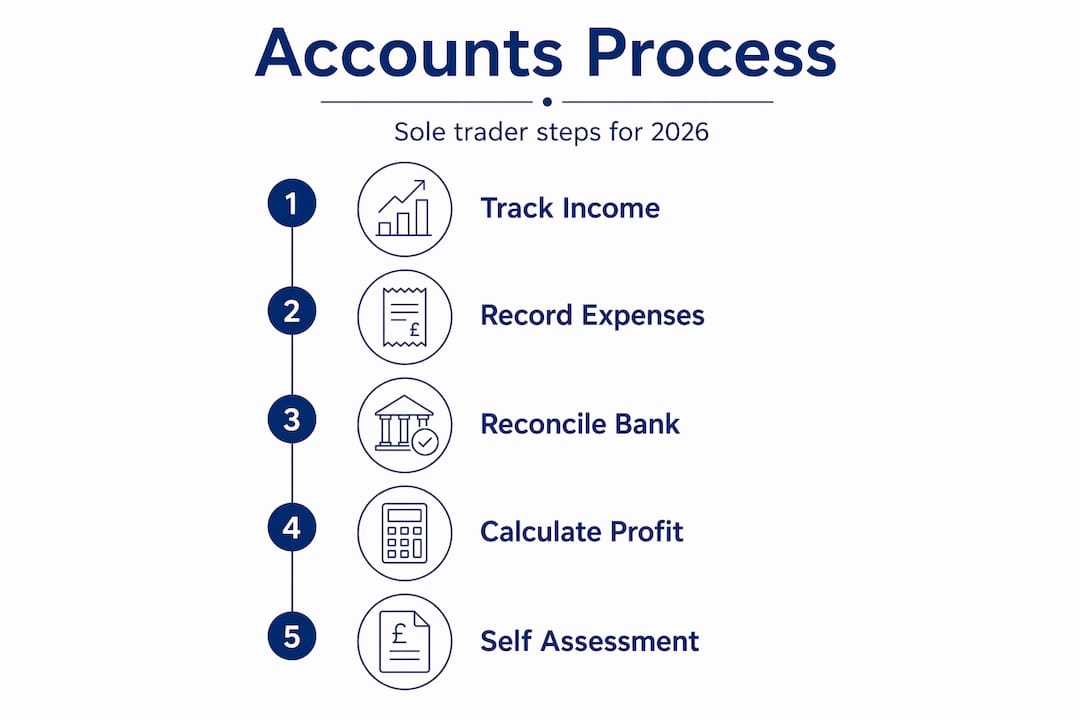
A useful way to think about the sole trader year end process is as a series of monthly habits rather than a single annual task. Reconcile your bank account monthly. Categorise your expenses as you go. Keep a running total of your income. When January approaches, you have a tidy set of records to work from rather than a pile of unsorted paperwork.
Here is a simple year-end process summary:
| Step | Action |
|---|---|
| Review accounting period | Confirm start and end dates, check for apportionment need |
| Reconcile bank statements | Match all transactions to receipts and invoices |
| Categorise all expenses | Use SAI categories consistently from last year |
| Calculate net profit | Income minus allowable expenses, plus adjustments |
| Complete SAI boxes | Use two-pass method, leave balance sheet blank if none |
| Check record retention | Confirm all documents stored securely for five years |
The hidden costs of poor records go beyond penalties. They can mean paying more tax than you owe, or less, both of which carry risks.
My honest take on sole trader accounts
In my experience, the biggest mistake sole traders make is treating their accounts as a once-a-year task rather than an ongoing picture of their business. I’ve seen people arrive at year end with a year’s worth of bank transactions to sort through, no clear record of which expenses are allowable, and genuine uncertainty about their profit. That creates stress, takes far longer than it needs to, and often results in errors.
What I’ve also noticed is that most sole traders underestimate how much the SAI structure matters. It is not just a form. It reflects your accounting decisions and directly determines your tax liability. Getting the mapping wrong, even with good intentions, can lead to incorrect returns.
My honest view is this: the sole trader financial year explained properly is less about the paperwork itself and more about the habits that support it. Consistent categorisation, a dedicated business account, monthly reconciliation, and a basic understanding of your accounting period will make your year-end process calm and straightforward. Without those habits, even simple accounts become complicated.
— Chris
How Cwabc supports sole trader accounts and tax compliance
Managing your sole trader accounts does not have to feel like a burden. At Cwabc, we work with sole traders across Tonbridge and Kent to make this process simple, organised, and stress-free.
Whether you need help preparing your annual accounts, completing your Self Assessment, or getting ready for Making Tax Digital, our team offers clear, upfront support without the jargon. We help you set up the right systems from the start, so compliance becomes routine rather than last-minute chaos.
Our bookkeeping services in Tonbridge keep your records accurate throughout the year, while our accounting services cover everything from year-end preparation to Self Assessment filing. If you have questions about MTD software or record keeping, our bookkeeping FAQs are a great place to start.
FAQ
Do sole traders have to file accounts with Companies House?
No. Sole traders have no obligation to file accounts with Companies House. That requirement applies only to limited companies. Sole traders prepare accounts to complete their HMRC Self Assessment tax return.
What is the SAI in a sole trader tax return?
The Standard Accounts Information (SAI) is the section of the Self-Employment (Full) Self Assessment pages where you enter your accounts figures. It covers turnover, expenses, profit, and optionally a balance sheet.
When does sole trader accounting period start and end?
Your accounting period typically covers 12 months. If you are an established business, it starts the day after your previous period ended. Choosing 31 March or 5 April as your year end avoids the need to apportion profits across two tax years.
What records must a sole trader keep and for how long?
You must keep records supporting your Self Assessment for at least five years after the filing deadline. These include invoices, receipts, bank statements, mileage logs, and any other documents that support your income and expense figures.
Who needs to comply with Making Tax Digital from April 2026?
Sole traders with total business or property income above £50,000 from April 2026 must keep digital records and submit quarterly updates to HMRC using MTD-compatible software. The threshold drops to £30,000 in April 2027.