
UK income tax bands are the system HMRC uses to divide your taxable income into portions, each taxed at a different rate. For 2026/27 in England, Wales, and Northern Ireland, the Personal Allowance sits at £12,570, meaning the first £12,570 of your income is tax-free. Above that, income is taxed progressively at 20%, 40%, and 45%. Crucially, these thresholds are frozen until at least 2031, which means more people are gradually pulled into higher bands as wages rise. Whether you are an employee, sole trader, or company director, understanding how these bands work is the first step to knowing exactly what you owe.
What are the UK income tax bands and rates for 2026/27?

UK income tax bands explained simply: you do not pay a single flat rate on all your income. Instead, each slice of income is taxed only at the rate for that slice. This is called progressive taxation, and it is how the income tax system in the UK has worked for decades.
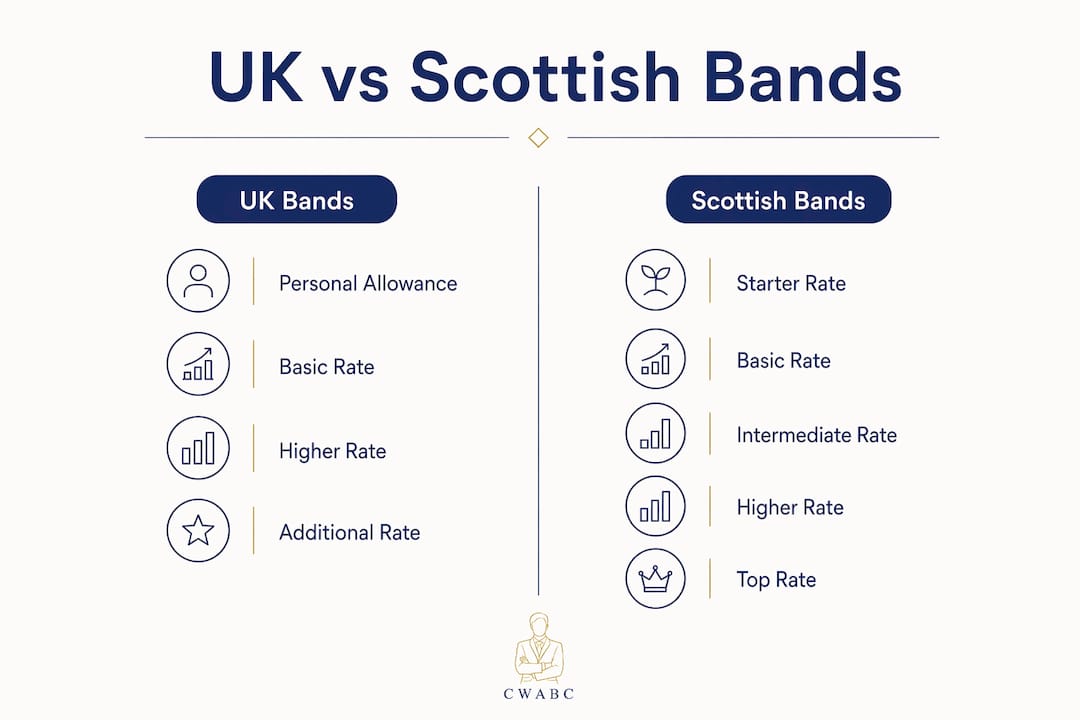
For 2026/27 in England, Wales, and Northern Ireland, the bands are as follows:
| Band | Taxable income | Rate |
|---|---|---|
| Personal Allowance | Up to £12,570 | 0% |
| Basic rate | £12,571 to £50,270 | 20% |
| Higher rate | £50,271 to £125,140 | 40% |
| Additional rate | Above £125,140 | 45% |
The Personal Allowance is the amount you can earn before paying any income tax at all. Once your income exceeds £12,570, you pay 20% only on the portion above that figure, not on your entire income.
This point catches many people out. If you earn £55,000, you are not paying 40% on all £55,000. You pay 0% on the first £12,570, 20% on the next £37,700 (from £12,571 to £50,270), and 40% only on the remaining £4,730 above £50,270. Your actual tax bill is far lower than a flat 40% would suggest.
The threshold freeze until 2031 is a significant issue for anyone whose income rises with inflation. Because the bands are not moving upwards, a pay rise can push you into a higher band even if your real purchasing power has not changed. HMRC calls this fiscal drag, and it is quietly increasing tax receipts without any formal rate rise.
How is UK income tax calculated for employees, sole traders, and company directors?
The calculation method differs slightly depending on how you earn your income, but the underlying band structure is the same for all three groups.
Worked example: employee earning £60,000
Here is a step-by-step calculation for an employee on a £60,000 salary:
- Start with gross income: £60,000
- Deduct the Personal Allowance: £60,000 minus £12,570 = £47,430 taxable income
- Apply the basic rate (20%) to income from £12,571 to £50,270. That is £37,700 taxed at 20% = £7,540
- Apply the higher rate (40%) to income from £50,271 to £60,000. That is £9,730 taxed at 40% = £3,892
- Total income tax: £7,540 plus £3,892 = £11,432
The effective tax rate on £60,000 is roughly 19%, not 40%. Knowing this distinction matters when you are budgeting or negotiating salary.
Worked example: sole trader with £45,000 profit
Sole traders pay income tax on their profits, not their turnover. Allowable business expenses reduce the taxable profit figure, which is why accurate expense records are so valuable. For a sole trader with £45,000 profit after expenses:
- Taxable profit: £45,000
- Deduct Personal Allowance: £45,000 minus £12,570 = £32,430 taxable
- Basic rate (20%) on £32,430 = £6,486 income tax
- Class 4 National Insurance (6%) on £32,430 = £1,946
- Total liability: approximately £8,432
The Class 4 NI rates for sole traders are 6% on profits between £12,570 and £50,270, and 2% on profits above £50,270. Class 2 NI was abolished in april 2024, simplifying the picture for self-employed people.
Worked example: company director on salary and dividends
Company directors often take a low salary alongside dividends to manage their overall tax position. The salary is taxed through the standard income tax bands. Dividends, however, use a separate set of rates and a dividend allowance, and they do not attract National Insurance. This combination can result in a lower overall tax burden compared to taking the same amount entirely as salary. A director taking £12,570 in salary and £30,000 in dividends will pay no income tax on the salary and dividend tax only on the portion of dividends above the dividend allowance.
What is the Personal Allowance taper and the 60% tax trap?
The Personal Allowance taper is one of the least understood features of the UK tax system. Once your income exceeds £100,000, your Personal Allowance reduces by £1 for every £2 you earn above that threshold.
The practical effect is stark:
- At £100,000 income, your full £12,570 Personal Allowance applies.
- At £112,570 income, your Personal Allowance has reduced by £6,285.
- At £125,140 income, your Personal Allowance disappears entirely.
This creates what tax professionals call the “60% tax trap.” Between £100,000 and £125,140, every extra £2 you earn is taxed at 40%, and you also lose £1 of tax-free allowance. That lost allowance would have sheltered income from 40% tax. Combined, the effective marginal rate in this range reaches 60%.
This is different from the 45% additional rate that applies above £125,140. The 60% zone is actually more punishing than the top rate of tax.
Why does this matter for small business owners? A sole trader or director whose adjusted net income creeps above £100,000 can find themselves paying 60p in tax for every additional £1 earned. That is a powerful reason to plan ahead.
Strategies to reduce adjusted net income and avoid this trap include:
- Making personal pension contributions, which reduce your adjusted net income pound for pound.
- Deferring income into a later tax year where possible.
- Maximising allowable business expenses to reduce taxable profit.
- Making Gift Aid donations, which extend your basic rate band.
Pro Tip: If your income is approaching £100,000, speak to a bookkeeper or accountant before the tax year ends. A pension contribution made before 5 april can pull your adjusted net income back below the threshold and recover your full Personal Allowance.
The 60% effective rate arises because each £2 earned above £100,000 triggers both 40% tax and the loss of £1 of Personal Allowance, which itself would have been worth 40p in tax savings. Planning to stay below £100,000 adjusted net income is one of the most valuable tax moves available to higher earners.
How do National Insurance contributions relate to UK income tax bands?
National Insurance (NI) is a separate charge from income tax, but it runs alongside it and adds significantly to your overall tax burden. Understanding both together gives you the true cost of earning.
Key points for employees (Class 1 NI):
- Employees pay 12% NI on earnings between £12,570 and the Upper Earnings Limit.
- Above the Upper Earnings Limit, the rate drops to 2%.
- Employers also pay NI on top of this, which is a cost to the business rather than the employee directly.
Key points for sole traders (Class 4 NI):
- Sole traders pay 6% Class 4 NI on profits between £12,570 and £50,270.
- Above £50,270, the rate drops to 2%.
- Class 2 NI was abolished from april 2024, removing the flat weekly charge that previously applied.
The NI threshold aligns with the Personal Allowance at £12,570, which means both income tax and NI kick in at the same point. For a sole trader earning £45,000 profit, the combined income tax and Class 4 NI burden is noticeably higher than the income tax figure alone suggests. Good tax payment budgeting accounts for both charges together.
One practical issue for new sole traders is the payments on account system. If your Self Assessment tax bill exceeds £1,000, HMRC requires advance payments in january and july each year. These are estimated payments based on the previous year’s liability. Many new sole traders are caught off guard by the first payment on account, which arrives on top of the balancing payment for the previous year. Planning for this from the start avoids a cash flow shock.
For a fuller breakdown of how NI works alongside income tax for self-employed people, the sole trader NI guide covers the current rates and thresholds in detail.
How do Scottish income tax bands differ from the rest of the UK?
Scotland operates its own income tax rates and bands, set by the Scottish Parliament. The Personal Allowance remains £12,570, but the bands above it are different and more numerous than those in England, Wales, and Northern Ireland.
For 2026/27, Scottish income tax bands are:
| Band | Rate |
|---|---|
| Starter rate | 19% |
| Basic rate | 20% |
| Intermediate rate | 21% |
| Higher rate | 42% |
| Advanced rate | 45% |
| Top rate | 48% |
The Scottish rates range from 19% to 48%, with the higher rate starting at a lower threshold than in the rest of the UK. This means a Scottish taxpayer earning the same salary as someone in England will typically pay more income tax. The top rate of 48% is the highest rate of income tax in the UK.
One important point: dividends and savings income still use UK-wide rates, not Scottish rates. This is relevant for company directors and landlords in Scotland who receive income from these sources. If you are based in Scotland, using the correct rates in your Self Assessment return is not optional. HMRC uses your address to determine which rates apply, and errors can result in underpayment penalties. Cwabc’s bookkeeping services in Scotland are tailored to the Scottish tax bands and can help you get this right.
Key takeaways
UK income tax bands work progressively, meaning each portion of your income is taxed only at the rate for that slice, not at a single flat rate across all earnings.
| Point | Details |
|---|---|
| Personal Allowance is £12,570 | The first £12,570 of income is tax-free for most people in 2026/27. |
| Bands are frozen until 2031 | Threshold freezes cause fiscal drag, pushing more earners into higher bands over time. |
| The 60% tax trap is real | Income between £100,000 and £125,140 carries a 60% effective marginal rate due to the Personal Allowance taper. |
| NI adds to your total burden | Sole traders pay Class 4 NI at 6% and 2% on profits, on top of income tax. |
| Scotland has six bands | Scottish taxpayers face rates from 19% to 48%, with a higher rate starting earlier than in England. |
A practical view on tax bands and where people go wrong
One thing I see regularly with sole traders and small business owners is the assumption that understanding UK tax brackets means knowing the headline rates. It does not. The headline rates tell you very little about your actual tax bill.
The most common mistake I encounter is someone who has just crossed £50,270 in profit and believes they are now a “40% taxpayer.” They are not. They are paying 40% only on the slice above £50,270. Their effective rate on total income is much lower. This misunderstanding leads to over-caution about taking on more work, which is the wrong response entirely.
The second mistake is ignoring National Insurance when estimating tax. A sole trader who budgets only for income tax will face a nasty surprise when the Class 4 NI charge arrives. The two charges together are what you actually owe, and planning for both from day one avoids the cash flow scramble that catches so many new traders out.
The third, and most costly, mistake is drifting above £100,000 without realising the Personal Allowance taper is active. I have seen clients pay thousands more than necessary simply because they did not make a pension contribution before the tax year ended. The 60% effective rate in that band is avoidable with the right timing. If your income is heading toward £100,000, that is the moment to get proper advice, not after the tax year closes.
Good record keeping, early planning, and understanding what you actually owe are the three things that separate confident business owners from those who dread the january deadline. None of it requires a degree in tax law. It requires clear information and a system that works.
— Chris
Tax band complexity made manageable with Cwabc
Getting the income tax bands right matters, but applying them correctly to your specific situation is where things get detailed. Sole traders, landlords, and company directors each have different calculations, allowances, and deadlines to manage.

Cwabc specialises in bookkeeping and tax support for sole traders and landlords in Tonbridge and beyond. From Self Assessment filing to tax planning around the Personal Allowance taper, the team works through the numbers with you in plain English. If you are not sure whether your records are ready for your next tax return, the small business tax return guide is a practical starting point. For a free, no-obligation conversation about your tax position, get in touch with Cwabc today.
FAQ
What is the Personal Allowance for 2026/27?
The Personal Allowance is £12,570 for 2026/27 in England, Wales, and Northern Ireland. This is the amount of income you can earn before paying any income tax.
Do I pay 40% tax on all my income if I earn over £50,270?
No. You pay 40% only on the portion of income above £50,270, up to £125,140. Income below £50,270 is taxed at 20%, and the first £12,570 is tax-free.
How is UK income tax calculated for sole traders?
Sole traders pay income tax on their profits after allowable expenses, using the same income tax bands as employees. They also pay Class 4 National Insurance at 6% on profits between £12,570 and £50,270, and 2% above that.
What is the 60% tax trap?
The 60% tax trap occurs between £100,000 and £125,140, where the Personal Allowance tapers away at £1 for every £2 earned above £100,000. Combined with the 40% higher rate, the effective marginal rate in this range reaches 60%.
Are Scottish income tax rates different?
Yes. Scotland has six income tax bands with rates from 19% to 48%, set by the Scottish Parliament. The higher rate in Scotland starts at a lower threshold than in England, Wales, and Northern Ireland, meaning Scottish taxpayers on the same income often pay more.
Need help?
Tax bands are straightforward once you know the rules, but applying them to your own income, expenses, and business structure is where it gets personal. Cwabc offers a free, no-obligation conversation to help you understand exactly where you stand. Contact Cwabc and let’s make your next tax return the least stressful one yet.