
Why accurate bookkeeping saves tax and prevents HMRC problems
Getting your bookkeeping right is one of the most practical things you can do to protect your business. Accurate financial records mean your tax returns reflect reality, your VAT submissions are correct, and HMRC has no reason to come knocking. Poor records, on the other hand, can trigger penalties, investigations, and unexpected tax bills that could have been avoided entirely.
Here is why it matters so much:
- Correct records produce correct tax returns, reducing the risk of underpaying or overpaying tax
- Accurate expense tracking means you claim every allowable deduction and reduce your tax bill legally
- Clear income records prevent accidental omissions that HMRC treats as careless or deliberate inaccuracies
- Up-to-date books give you a real picture of cash flow, so you can plan ahead with confidence
- Good records demonstrate reasonable care to HMRC, which can eliminate penalties even when an honest mistake occurs
- Digital records support compliance with Making Tax Digital (MTD), which applies to sole traders and landlords from April 2026
Think of accurate bookkeeping as your financial safety net. It catches errors before they become problems.
Why precise records matter for UK small businesses and sole traders
HMRC requires every self-employed person and landlord to keep records of all business income and expenses. These records underpin your Self Assessment tax return, your VAT submissions, and any PAYE obligations you have as an employer. Without them, you are guessing, and guesses cost money.

From the 2024 to 2025 tax year, cash basis accounting became the default method for most small businesses. Under cash basis, you record income when you receive it and expenses when you pay them, which keeps your books closely aligned with your actual bank activity. That alignment makes reconciliation faster and errors easier to spot.
Precise records also give you genuine visibility over your cash flow. You can see what you are owed, what you owe, and whether your business is actually profitable after tax. That clarity makes decisions, such as whether to take on a new contract or invest in equipment, far less stressful.
Benefits specific to UK small businesses and sole traders:
- Timely and accurate Self Assessment filings, avoiding late-filing penalties
- Correct VAT returns, reducing the risk of surcharges or VAT investigations
- Clear separation of business and personal finances, which HMRC expects
- Evidence of allowable expenses, reducing your taxable profits legitimately
- Audit-ready records that hold up to scrutiny if HMRC opens a compliance check
Common bookkeeping mistakes that cause tax errors and HMRC trouble
Most HMRC problems do not start with deliberate fraud. They start with poor record keeping: missed sales, mixed-up expenses, and receipts that were never saved. These mistakes are easy to make and surprisingly costly to fix.
The most common errors include:
- Missing income records. Forgetting to log a cash payment or an online transfer means your turnover is understated. HMRC can treat this as a careless inaccuracy, which carries a penalty up to a significant percentage of the tax underpaid.
- Mixing personal and business spending. Paying a personal bill from your business account, or vice versa, distorts your profit figure and can trigger questions during a compliance check.
- Misclassifying expenses. Claiming a personal cost as a business expense, even accidentally, is an inaccuracy. HMRC does not always accept “I didn’t realise” as a defence.
- Lost or missing receipts. Without supporting evidence, HMRC can disallow an expense claim entirely.
- Leaving reconciliation too long. The longer you leave it, the harder it is to remember what a transaction was for, and the more likely errors are to compound.
- Ignoring bank interest and other income. Landlords in particular sometimes overlook rental deposits, interest, or service charges that are taxable.
Pro Tip: Set a recurring reminder every week to log transactions and match them to your bank statement. Fifteen minutes a week prevents hours of panic in january.
Best practices and tools to keep your records accurate and compliant
Cloud-based accounting software is the most practical way to maintain accurate records. Tools such as Xero, FreeAgent, and QuickBooks connect directly to your bank account, categorise transactions automatically, and create a clear audit trail. They also support Making Tax Digital requirements, which is no longer optional for many sole traders and landlords.

From April 2026, MTD for Income Tax applies to sole traders and landlords with total income over £50,000. The threshold drops in the following years from april 2027 and april 2028 respectively. Compatible software is mandatory under these rules; a spreadsheet alone will not meet the requirement.
Best practices to maintain accuracy:
- Reconcile your bank account at least monthly
- Keep digital copies of all receipts and invoices
- Separate your business and personal bank accounts from day one
- Review your VAT position each quarter before the submission deadline
- Store records securely for the required retention period (see section 11 below)
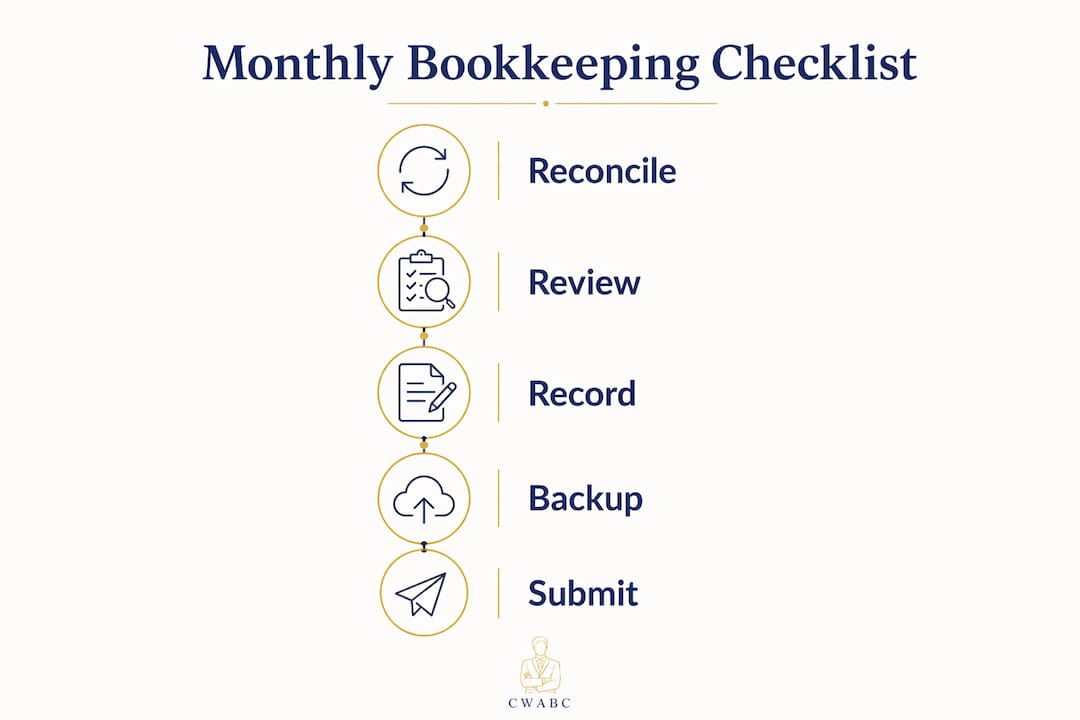
Monthly bookkeeping checklist
| Task | Why it matters |
|---|---|
| Reconcile bank and credit card statements | Catches errors and missing transactions before they accumulate |
| Log all sales invoices and income received | Keeps turnover accurate for tax and VAT purposes |
| Record all business expenses with receipts | Supports allowable deductions and protects against disallowance |
| Review outstanding invoices (debtors) | Maintains cash flow awareness and prompts chasing overdue payments |
| Check VAT records if VAT-registered | Prevents errors on quarterly VAT returns |
| Back up digital records securely | Protects against data loss and supports audit readiness |
How professional bookkeeping support helps you avoid HMRC penalties
A professional bookkeeper or accountant does more than organise your numbers. They verify that your records meet HMRC’s legal standards, flag potential issues before they become penalties, and prepare submissions that are accurate and on time. That combination of accuracy and timeliness is exactly what HMRC expects from every taxpayer.
Professional support brings several concrete benefits:
- Maximising allowable deductions. A professional knows which expenses are genuinely deductible and which are not, so you pay the right amount of tax, not more than you owe.
- Timely filings. Late Self Assessment returns attract an automatic £100 penalty, with further daily charges after three months. A professional keeps you ahead of every deadline.
- Audit defence. If HMRC opens a compliance check, well-maintained records and a professional adviser give you the strongest possible position.
- Tax planning. Good bookkeeping reveals opportunities to manage your tax position legally, from timing income and expenses to making pension contributions.
- Peace of mind. Knowing your records are in order removes the anxiety that builds up when you know things are not quite right.
Cwabc works with sole traders, landlords, and small business owners across Kent, providing bookkeeping and compliance support that keeps records accurate and submissions on time.
Digital bookkeeping, reasonable care, and HMRC penalties in 2026
HMRC calculates penalties as a percentage of the “potential lost revenue” (PLR), which is the additional tax due as a result of correcting an inaccuracy. The percentage applied depends entirely on the behaviour behind the error.
Keeping accurate records and demonstrating reasonable care can prevent HMRC penalties entirely, even when an honest mistake occurs. HMRC’s own compliance factsheet confirms this: if you took reasonable care but your return was still wrong, no penalty applies.
HMRC penalty rates by behaviour type
| Behaviour | Maximum penalty (% of PLR) | Minimum with unprompted disclosure |
|---|---|---|
| Reasonable care taken | 0% | 0% |
| Careless inaccuracy | 30% | 0% |
| Deliberate inaccuracy | 70% | 20% |
| Deliberate and concealed | 100% | — |
Demonstrating reasonable care means keeping enough records to file an accurate return, storing those records safely, and seeking advice when you are unsure. Digital record keeping under MTD creates exactly this kind of audit trail. If HMRC does find an error, prompt disclosure and full cooperation reduce the penalty further. The quality of your disclosure, including telling HMRC about the error, helping calculate the tax due, and giving access to check figures, all affect the final amount. Protecting your business from email fraud is also worth considering; DMARC for accountants explains how professional advisers can help prevent impersonation that could compromise your digital records.
UK tax regulations you need to know as a small business owner or landlord
UK tax obligations for small businesses and landlords cover several distinct areas, and missing any one of them can create compliance problems.
Self Assessment. If you are self-employed or receive rental income, you must register for Self Assessment and file a tax return each year. The deadline for online returns is 31 january following the end of the tax year.
VAT. You must register for VAT once your taxable turnover exceeds £90,000 in any rolling 12-month period. Once registered, you file VAT returns (usually quarterly) and pay any VAT owed to HMRC. Making Tax Digital for VAT already applies to all VAT-registered businesses.
PAYE. If you employ staff, you operate PAYE to deduct Income Tax and National Insurance from wages. Real Time Information (RTI) requires you to report payroll to HMRC on or before each payday.
Landlord income. Rental income is taxable. Allowable expenses include mortgage interest (subject to the finance cost restriction for residential landlords), letting agent fees, repairs, and insurance. From april 2026, landlords with income over £50,000 must also comply with MTD for Income Tax.
How accurate bookkeeping simplifies your VAT and PAYE filings
VAT returns and PAYE submissions are only as accurate as the records behind them. If your sales figures are incomplete or your expense categories are wrong, your VAT return will be wrong too, and HMRC will notice.
Accurate bookkeeping simplifies VAT by keeping a running total of your output tax (VAT charged on sales) and input tax (VAT paid on purchases). When the quarter ends, the figures are ready. There is no last-minute scramble to find invoices or work out which purchases were VAT-rated.
For PAYE, accurate payroll records mean you deduct the right amount of tax and National Insurance from each employee’s pay. RTI submissions go out on time, and your year-end P60s are correct. Errors in PAYE can trigger HMRC interest charges and penalties, so getting the underlying records right from the start saves considerable trouble.
What HMRC penalties actually look like in practice
HMRC penalties for inaccurate returns are calculated under Schedule 24 of the Finance Act 2007. The penalty is a percentage of the potential lost revenue, which is the extra tax HMRC is owed because of the error.
HMRC penalties depend on the nature of the error, with careless mistakes attracting proportionally lower penalties, deliberate inaccuracies higher penalties, and deliberate and concealed inaccuracies potentially incurring penalties up to the full amount of tax underpaid.
Late filing carries its own charges, including fixed penalties and escalating daily charges, which accumulate quickly but can be avoided with organised records and a clear filing calendar.
Real-world examples of HMRC problems caused by poor records
These scenarios are common and illustrative of the kinds of issues poor bookkeeping creates.
The sole trader who forgot cash income. A self-employed tradesperson received several cash payments over the year and simply forgot to record them. When HMRC cross-referenced bank deposits with declared income, the discrepancy triggered a compliance check. The undeclared income was treated as a careless inaccuracy, resulting in additional tax plus a penalty.
The landlord with mixed expenses. A landlord claimed mortgage interest on a property that was partly used personally. Because the records did not clearly separate personal and rental use, HMRC disallowed a portion of the claim and charged interest on the underpaid tax.
The VAT-registered business with missing invoices. A small retailer could not produce purchase invoices for a quarter’s input VAT claims. HMRC disallowed the claims, resulting in a VAT assessment and a surcharge. The invoices existed but had not been saved digitally or filed properly.
Each of these situations shares one root cause: records that were incomplete, disorganised, or simply not kept at all.
How long must you keep your records?
HMRC sets clear record retention requirements depending on your business type.
- Self-employed individuals: keep records for at least five years after the 31 january submission deadline for the relevant tax year. For example, records for the 2024 to 2025 tax year (filed by 31 january 2026) must be kept until at least 31 january 2031.
- Companies: keep accounting records for at least six years from the end of the accounting period.
- VAT records: keep for at least six years.
- PAYE records: keep for at least three years after the end of the tax year they relate to.
If HMRC opens an investigation, you may need to produce records going back further. Storing everything digitally makes retrieval straightforward and removes the risk of paper records being lost or damaged.
What to do if you spot a discrepancy or HMRC contacts you
Discovering an error in your records or receiving a letter from HMRC can feel alarming. The good news is that acting promptly and transparently almost always leads to a better outcome.
- Do not ignore it. Whether you find an error yourself or HMRC contacts you, respond quickly. Delay makes things worse and can increase penalties.
- Gather your records. Pull together all relevant invoices, bank statements, and receipts. The more organised your evidence, the faster the issue can be resolved.
- Make a voluntary disclosure. If you have spotted an error before HMRC has, telling them yourself (an unprompted disclosure) attracts the lowest possible penalty rate.
- Seek professional advice. An accountant or bookkeeper can help you calculate the correct tax position, communicate with HMRC on your behalf, and present your case clearly.
- Cooperate fully. Helping HMRC calculate the tax due and giving access to your records reduces penalties further.
The worst outcome is almost always the result of doing nothing. A calm, organised response, backed by good records, gives you the best chance of resolving the matter quickly and with the lowest possible cost.
Key takeaways
Accurate bookkeeping is the single most effective way to reduce your tax bill, avoid HMRC penalties, and keep your business finances under control.
| Point | Details |
|---|---|
| Reasonable care eliminates penalties | HMRC will not charge a penalty if you took reasonable care, even when an honest error occurs. |
| MTD applies from april 2026 | Sole traders and landlords with income over £50,000 must use compatible digital software from april 2026. |
| Penalty rates reach up to 100% of PLR | Deliberate and concealed inaccuracies can attract a penalty up to 100% of the tax underpaid. |
| Records must be kept for up to six years | Self-employed individuals must retain records for five years after the relevant filing deadline. |
| Monthly reconciliation prevents most errors | Checking your records against your bank statement each month catches mistakes before they compound. |
Ready to get your bookkeeping sorted?

If your records feel disorganised, your tax deadlines feel stressful, or you are not sure whether you are ready for Making Tax Digital, Cwabc can help. Based in Tonbridge, we work with sole traders, landlords, and small business owners across Kent to set up clear, compliant bookkeeping systems that take the worry out of tax.
Whether you need help setting up cloud accounting software or want to understand whether your current records are good enough, we offer straightforward, jargon-free support with clear, upfront pricing.
Not sure where to start? Read our guide on signs your bookkeeping needs help to find out whether it is time to get some support.
Need help?
Get in touch with Cwabc for a free, no-obligation conversation about your bookkeeping and tax compliance. We will listen, give you honest advice, and help you put the right systems in place before problems arise.
Contact Cwabc today and take the stress out of your finances.