
If you sell a rental property and make a profit, Capital Gains Tax is very likely due, and if it is, you must report the sale and pay the tax within 60 days of completion. This applies to UK resident individual landlords, trustees and personal representatives dealing with an estate; non-residents face similar but stricter timing rules, so check separately if this applies to you.
Miss the deadline and HMRC can charge penalties and interest on top of the tax owed. Here is what triggers the obligation, who it catches, and what happens next:
- You’ve sold or given away a UK residential property that was not your only home throughout ownership
- The gain, after deducting costs and reliefs, exceeds your annual tax-free allowance
- You must report via HMRC’s CGT on UK Property service and pay an estimated amount on account, then reconcile it through Self Assessment later
60 days is the figure to remember. It starts from the completion date, not the exchange date, and it catches people out more often than any other part of this process.
Key Takeaways
Landlords selling a UK rental property must calculate the gain accurately, apply the correct reliefs, and report and pay any Capital Gains Tax due within 60 days of completion.
| Point | Details |
|---|---|
| 60-day deadline is strict | Report and pay via the CGT on UK Property service within 60 days of completion, not exchange. |
| Gain is proceeds minus costs | Deduct purchase price, incidental costs and genuine capital enhancements, not routine repairs. |
| Reliefs need careful checking | Private Residence Relief and the restricted post-2020 Lettings Relief rarely cover a gain fully. |
| Rate depends on your income | From 6 April 2026, gains are taxed at 18% within your basic rate band and 24% above it. |
| CWABC handles the whole process | CWABC calculates the gain, checks reliefs, and submits your 60-day return and Self Assessment reconciliation. |
Table of Contents
- Landlord capital gains tax considerations: which sales are chargeable?
- How do you calculate the gain on a rental property?
- What costs can you deduct, and what doesn’t count?
- Which reliefs can reduce a landlord’s CGT bill?
- How does your income affect the CGT rate you pay?
- What are the reporting deadlines and how do you pay?
- Can you legally reduce or manage your CGT bill?
- My practical approach as an accountant when a landlord plans to sell
- Prefer to hand the CGT return to someone else?
- Need help?
- Sources
Landlord capital gains tax considerations: which sales are chargeable?
Not every property sale creates a CGT liability, so the first job is working out whether yours does. A residential property disposal for the 60-day rule includes any sale, gift or transfer of a UK dwelling (or part of one) where you’re not fully covered by Private Residence Relief. That covers a straightforward buy-to-let you’ve never lived in, an inherited rental property you’ve since sold, and mixed-use buildings with a residential element.
Some disposals fall outside the reporting requirement entirely:
- Your only or main home, where full Private Residence Relief applies throughout your ownership
- Transfers between spouses or civil partners, which happen on a “no gain, no loss” basis
- Disposals where reliefs and losses fully cover the gain, leaving nothing chargeable
Three quick examples help you self-screen. Sell a buy-to-let flat you’ve always let out, and you’ll almost certainly need to report and pay. Sell a house you lived in for years before renting it out, and Private Residence Relief will likely reduce the gain, though probably not eliminate it. Sell an inherited rental property, and the gain is calculated from probate value, not the original purchase price, which can produce a smaller (or larger) liability than you expect.
How do you calculate the gain on a rental property?
The calculation itself follows a formula: sale proceeds minus allowable costs equals your gain, then subtract your annual exempt amount and any allowable losses to reach the taxable figure. Getting each element right matters, because HMRC’s 60-day window doesn’t leave much room to gather paperwork after the event.
Allowable acquisition costs start with what you paid for the property, plus incidental costs like Stamp Duty Land Tax and legal fees at purchase. Disposal costs work the same way in reverse: estate agent commission, solicitor’s fees, and even advertising costs for the sale. HMRC’s own manual confirms these incidental costs of acquisition and disposal are deductible where they were wholly and exclusively incurred for that purpose.
Capital enhancement expenditure is where landlords most often go wrong. An extension, a loft conversion, a new kitchen fitted where there wasn’t one before, these typically qualify because they change the asset’s state permanently. A replacement boiler, redecorating, or fixing a leaking roof are running repairs, not enhancements, and HMRC won’t allow them against the gain even though they felt like a big outlay at the time.
Here’s a simplified illustration, using plausible figures only, to show the mechanics:
This is illustrative only — for detailed insight on handling specialised rental scenarios and ensuring compliance, see our guide on short term rental compliance. Your own figures, ownership history and available reliefs will change the outcome, sometimes significantly, so don’t treat this table as a template for your own return.
Before you can prepare the actual 60-day return, gather:
- The completion date from your conveyancing solicitor
- Final sale proceeds and the original purchase price
- Invoices for stamp duty and legal fees at both ends
- Receipts for any capital improvements, ideally with before-and-after evidence
- Estate agent invoices and any advertising costs for the sale
Pro Tip: When you’re estimating your taxable income for the 60-day payment-on-account calculation, be realistic rather than optimistic. Underestimate your income and you could pick the wrong CGT rate band, leaving a top-up bill waiting for you at Self Assessment. Check your rental income tax position for the year before you submit.
What costs can you deduct, and what doesn’t count?
The line between an allowable cost and a disallowed one trips up more landlords than any other part of the calculation. Get this wrong on the 60-day return and you’ll either overpay, or underpay and risk a correction later.
Costs that generally qualify under TCGA92/S38 include:
- Stamp Duty Land Tax paid on purchase
- Legal and conveyancing fees on both purchase and sale
- Surveyor or valuer fees where reasonably incurred
- Estate agent fees and reasonable advertising costs for the sale
- Capital improvements that permanently enhance the property
HMRC’s own test is specific. Enhancement expenditure must be wholly and exclusively for the purpose of enhancing the asset, and that enhancement must still be reflected in the property’s state at the point you sell it.
Enhancement expenditure is allowable only where it was wholly and exclusively for the purpose of enhancing the asset, and that enhancement is reflected in the state or nature of the asset at disposal. Spend on something that’s since been removed, replaced or worn away doesn’t qualify.
That last point matters more than it looks. Fit a conservatory, then knock it down five years later to build something bigger, and the original conservatory cost is gone from your calculation because it no longer exists at disposal.
What definitely doesn’t count: routine repairs, mortgage interest, letting agent management fees, insurance, and general maintenance. These are revenue costs that belong against your rental income each year, not against the capital gain. If your case involves unusual enhancement work or a disputed cost, the HMRC manual is worth consulting directly, or ask an accountant to check before you submit.
Which reliefs can reduce a landlord’s CGT bill?
Reliefs are where a genuinely large tax bill can shrink into something manageable, but landlords often assume reliefs apply more generously than they actually do.
Private Residence Relief (PRR) is the big one if you ever lived in the property. It exempts gains for periods you occupied it as your only or main home, plus an automatic final nine months of ownership regardless of whether you were living there at the end. If you lived in the property for 3 years out of a 10-year ownership period, you’d typically get relief for roughly 3 years and 9 months out of 10, with the remaining period taxable.
Lettings Relief has been far more restricted since April 2020. It now only applies where you were living in the property and shared occupation with a tenant at the same time, so most landlords who moved out and then let the whole property no longer qualify. This trips people up constantly, because older guidance and forum posts still describe the more generous pre-2020 version.
Other reliefs worth knowing about, briefly:
- Spouse or civil partner transfers happen on a no gain, no loss basis, useful for balancing which partner uses their annual exemption
- Business Asset Disposal Relief rarely applies to ordinary residential lettings, since it’s aimed at trading businesses
- Hold-over relief is a specialist area, generally irrelevant to standard buy-to-let disposals
Red flags that mean you should get advice before relying on any relief: partial occupation where the timeline is unclear, a large garden or grounds that might exceed the permitted area for PRR, or part of the dwelling used for business purposes throughout ownership.
Pro Tip: Don’t assume Lettings Relief applies just because you once lived in the property. Check the shared-occupation condition carefully, it’s the detail that catches out the most landlords.
How does your income affect the CGT rate you pay?
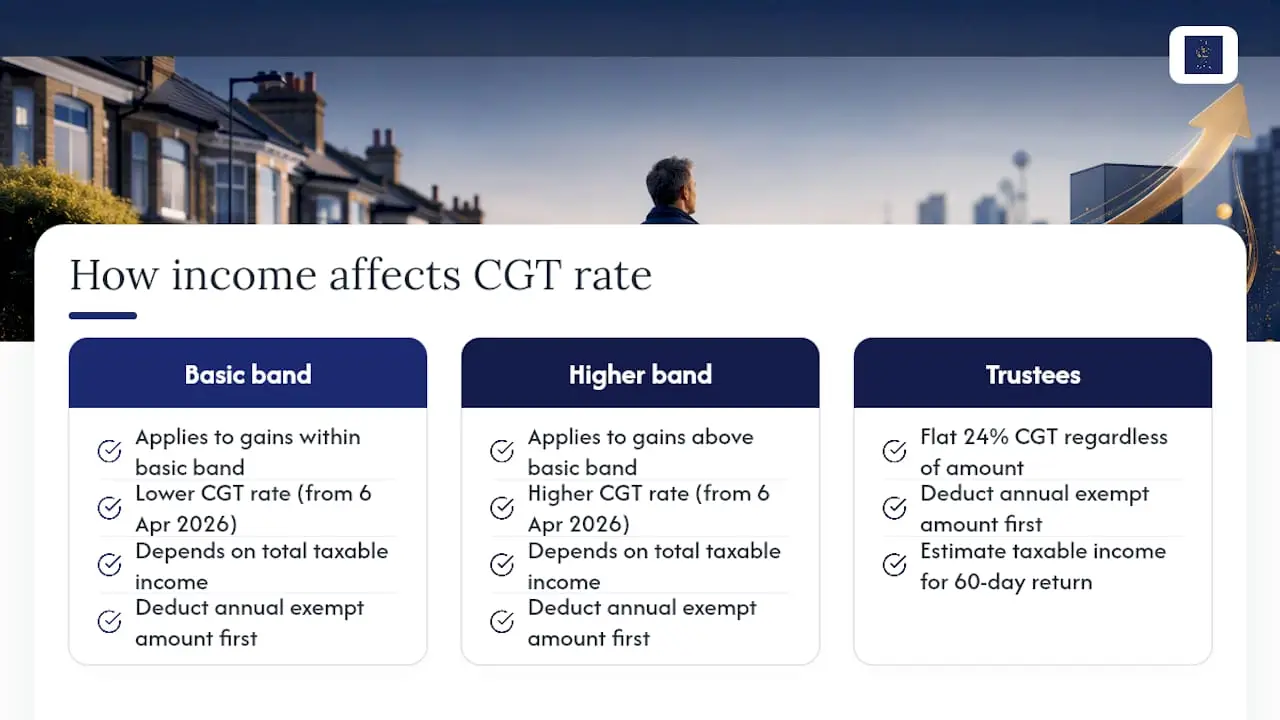
Your CGT rate on a residential property gain depends on your total taxable income for the year, not just the gain itself. From 6 April 2026, gains are taxed at lower and higher rates depending on your income tax band, with basic rate band gains taxed at a lower rate and gains above that band taxed at a higher rate. Trustees pay a flat 24% regardless of the amount.
This means the same gain can cost two landlords very different amounts, purely because of their other income. A higher earner will likely see most or all of it taxed at 24%.
Before working anything out, deduct your annual exempt amount, the tax-free allowance available before CGT applies at all. This figure has changed substantially in recent years, so always verify the current amount on GOV.UK’s CGT rates page at the time you’re actually selling, rather than relying on a figure from an old article or forum thread.
When you’re completing the 60-day return, you’ll need to estimate your total taxable income for the year, since the tax year won’t have finished yet. Checking your income tax bands beforehand helps you land on a sensible estimate. Get it wrong and you’ll either be due a refund or owe more, both settled through Self Assessment once your actual income is known.
What are the reporting deadlines and how do you pay?
For completions on or after 27 October 2021, you have a 60-day period from the completion date to report the disposal and pay any CGT due. An earlier 30-day rule applied to completions between April 2020 and October 2021, so it’s rarely relevant now, but worth knowing if you’re dealing with an old estate matter.
In practice, this means:
- Set up a Capital Gains Tax on UK Property account through GOV.UK as soon as you know a sale is proceeding
- Submit your return online, which generates an immediate 14-digit payment reference, far more reliable than a paper return
- Pay the estimated tax on account using that reference before the 60 days elapse
- Reconcile everything through Self Assessment once you know your full-year income, correcting any over- or under-payment
The CGT on UK Property service is the recommended route, and practitioner guidance strongly favours it over paper submissions because of the speed and certainty of that payment reference. HMRC does charge penalties for late filing, plus interest on unpaid tax, so this isn’t a deadline to treat casually. My full breakdown of the 60-day CGT return covers the process step by step if you want more detail before you get started.
At completion, your checklist should include:
- Confirming the exact completion date with your solicitor
- Estimating your taxable income for the year
- Having your gain calculation ready in advance
- Submitting the return and paying within the 60-day window
Can you legally reduce or manage your CGT bill?
A handful of straightforward, entirely legitimate steps can reduce what you owe, without straying anywhere near tax avoidance territory.
- Use your annual exempt amount in full each year, splitting a disposal across two tax years where genuinely possible
- Crystallise capital losses from other investments in the same tax year to offset against the gain
- Consider a transfer to a spouse or civil partner before sale, so both annual exemptions and rate bands are used efficiently
Be cautious with large improvement spending shortly before a sale purely to inflate your cost base. HMRC can and does query enhancement claims that look timed for tax purposes rather than genuine property improvement. Two situations where you should get specialist advice before proceeding: property development activity that might be treated as trading rather than a capital disposal, and any case involving mixed personal and business use of the same dwelling.
Pro Tip: If you’re weighing up a sale near the end of a tax year, a delay of a few weeks either side of 5 April could shift your entire gain into a different tax year, and potentially a different rate band. It’s worth the calculation before you exchange contracts.
My practical approach as an accountant when a landlord plans to sell
I’m AAT-licensed, and when a landlord tells me they’re planning a sale, I follow the same sequence every time: review the purchase and improvement documents, calculate the gain, check every relief that might genuinely apply, then handle the 60-day return and reconcile it through Self Assessment.
Most of this can happen in the weeks before completion if you get in touch early. Bring your original completion statement, any improvement invoices, and a rough idea of your income for the year, and we can usually move quickly from there.
Prefer to hand the CGT return to someone else?
CWABC gives you a fixed, upfront-priced alternative to wrestling with HMRC’s property account and the 60-day clock yourself, with none of the guesswork over what counts as an allowable cost. I handle the gain calculation, the reliefs check, the 60-day return submission, and the year-end reconciliation through Self Assessment, all built on accurate, HMRC-ready records rather than a shoebox of receipts pulled together at the last minute.

Landlords across Tonbridge and Sevenoaks work with me in person, and I support clients remotely right across the UK using the same paperless, cloud-based systems either way. If your bookkeeping needs tidying up before a sale, my landlord bookkeeping guide explains what good records look like. Otherwise, get in touch through my contact page and tell me your completion date, and I’ll let you know what I need and how quickly we can turn it around.
Need help?
If you’re planning to sell a rental property and want the CGT calculation, the 60-day return and your Self Assessment reconciliation handled properly, get in touch with CWABC before you exchange contracts.
This article is general information, not a substitute for advice from a qualified financial advisor. Consult a qualified financial professional about your own circumstances before acting on anything here.
Sources
- Report and pay your Capital Gains Tax if you sold a property in the UK on or after 6 April 2020