
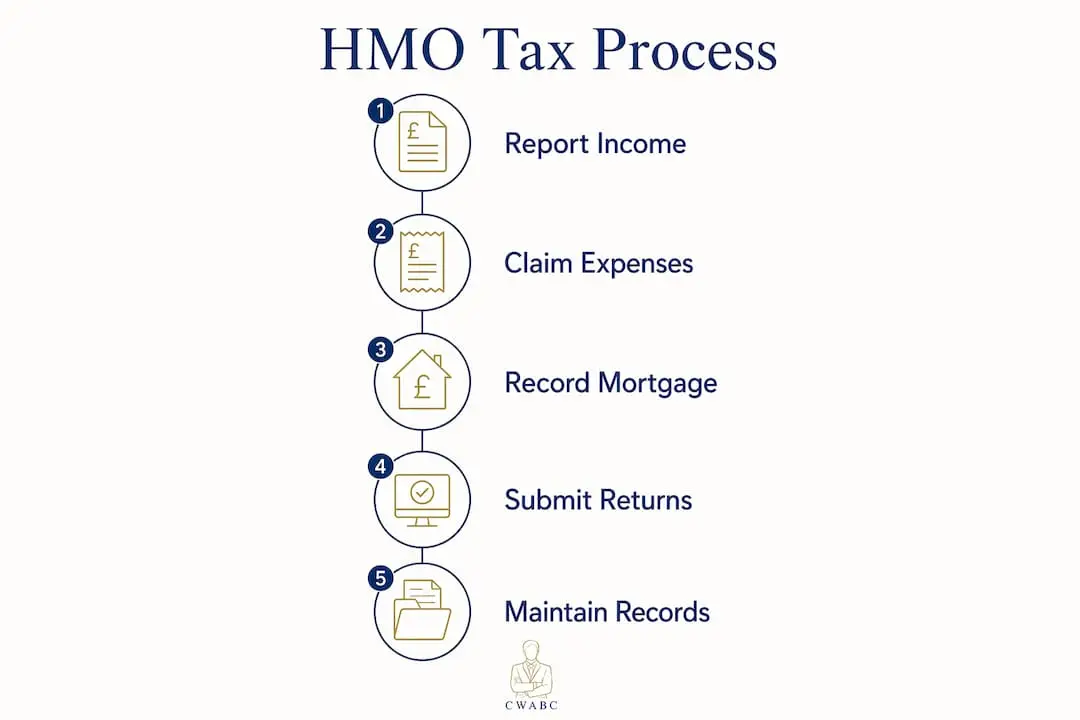
HMO landlords must treat all rental receipts as UK property income, keep digital records of every HMO-specific cost, claim allowable revenue expenses including licence and safety fees, apply the mortgage interest tax credit rules correctly, and report through Self Assessment and Making Tax Digital where required.
Your immediate action checklist:
- Register for Self Assessment with HMRC if you have not already done so
- Set up digital record-keeping software before your first quarterly MTD update
- Categorise mortgage interest and other finance costs as a separate line item from day one
- Log every HMO licence fee, gas safety certificate, and EICR in a dedicated expenses folder
- Check whether your gross property income triggers MTD obligations
Table of Contents
- What counts as taxable income from your HMO?
- Allowable expenses every HMO landlord should be claiming
- How mortgage interest relief actually works for HMO landlords
- Record keeping and filing: what you must do and when
- Making Tax Digital for income tax: what HMO landlords need to do
- Incorporation, VAT, CGT, and SDLT: the bigger decisions
- Common mistakes and how to avoid them
- A worked example: from gross rent to tax payable
- Key takeaways
- Why disciplined bookkeeping is the real tax strategy
- How Cwabc helps HMO landlords stay on top of their tax
- Useful sources
- Need help?
What counts as taxable income from your HMO?
Every pound your HMO generates is taxable rental income unless a specific exemption applies. That includes more than just the monthly rent.
HMRC’s guidance confirms that rental income covers all payments for the use of the property, including service charges, fees retained from deposits where the money is not returned, and utility bills you pay on behalf of tenants and then recover. If you charge tenants separately for communal broadband or pay the council tax yourself and recoup it through the rent, both amounts are income.
There is no separate HMO tax category. Your HMO profits are pooled with any other UK property income you have and taxed at your marginal income tax rate, whether that is 20%, 40%, or 45%. One practical consequence: a loss on one property offsets a profit on another within the same UK property business.
Allowable expenses every HMO landlord should be claiming
HMOs carry compliance costs that many landlords underestimate. Properly recorded, those costs reduce your taxable profit and build an audit trail for both council licensing and HMRC enquiries.
Fully deductible revenue expenses for HMOs include:
- HMO licence fees, which typically vary depending on your council and property size
- Gas safety certificates and annual boiler servicing
- Electrical Installation Condition Reports (EICRs)
- Fire alarm servicing, emergency lighting checks, and fire-door maintenance
- Communal utilities: electricity, water, broadband, and council tax where you pay as landlord
- Cleaning of communal areas and gardens
- Letting agent and management fees
- Buildings and contents insurance
- Accountant’s fees
Capital works are different. Adding en-suites or installing fire doors to bring a property up to HMO licence standard are capital improvements, not revenue expenses. They are not deductible against rental income, but you should record them carefully because they increase the property’s cost base for Capital Gains Tax purposes.
For furnishings and white goods, Replacement of Domestic Items Relief lets you claim the cost of a like-for-like replacement, minus any proceeds from disposing of the old item. The relief does not cover the initial purchase when you first let the property.
Pro Tip: Create a dedicated HMO expenses folder, physical or digital, with a subfolder for each compliance category. Photograph safety certificates on the day of renewal and store supplier invoices alongside them. This doubles as your audit trail for both the council and HMRC.

How mortgage interest relief actually works for HMO landlords
Since 6 April 2020, finance costs for residential landlords are no longer deducted from rental profits. Instead, you receive a basic rate tax credit equal to 20% of your finance costs, applied against your income tax liability.
Here is what that means in practice:
- Calculate your rental profit without deducting mortgage interest.
- Add that profit to your other income and work out your income tax liability in the normal way.
- Deduct a tax credit of 20% of your total finance costs from the tax you owe.
A basic-rate taxpayer ends up in roughly the same position as before. A higher-rate taxpayer, however, pays tax at 40% on the profit but only recovers 20% via the credit, creating a real additional cost. Finance costs include mortgage interest, loan arrangement fees, and interest on loans taken out to buy furnishings.
Pro Tip: Record mortgage interest as a completely separate line in your accounts, labelled “residential finance costs”. Good cloud software will have this category built in. Keeping it separate from revenue expenses prevents misclassification and makes your MTD quarterly updates straightforward.
Record keeping and filing: what you must do and when
Good records are not optional. HMRC requires you to keep them for at least five years after the 31 January filing deadline for each tax year.
- Register for Self Assessment by 5 October following the first tax year in which you received rental income.
- File your Self Assessment return by 31 January online (or 31 October on paper) for the previous tax year ending 5 April.
- Pay any tax owed by 31 January, with a payment on account due 31 July if your bill exceeds £1,000.
Your property income tax return uses the UK property pages (SA105 for paper filers). All UK property income and expenses are pooled into a single figure; you do not file a separate return per property.
Records to retain:
- Tenancy agreements and renewal correspondence
- Rent receipts and bank statements showing rental credits
- All expense invoices, receipts, and supplier contracts
- HMO licence documents and renewal notices
- Safety certificates (gas, EICR, fire alarm)
- Deposit protection records and any deduction correspondence
- Mortgage statements showing the interest element separately
If you own property jointly, you report only your share of income and expenses. Spouses are taxed on equal shares unless you complete Form 17 to declare a different beneficial interest.
Making Tax Digital for income tax: what HMO landlords need to do
Making Tax Digital for Income Tax Self Assessment (MTD ITSA) requires landlords whose qualifying gross property income exceeds the relevant threshold to keep digital records, submit quarterly updates to HMRC, and file an end-of-year return through MTD-compatible software.
What you need to record digitally:
- Gross rent received, broken down by property
- Each category of allowable expense
- Residential finance costs as a separate category, not mixed with other expenses
- Agent statements reconciled to your own records each quarter
For jointly owned properties, HMRC allows an easement under which joint owners can report only gross rental income in quarterly updates and provide full expense detail at year-end.
Implementation steps:
- Choose MTD-compatible software (cloud accounting packages that connect directly to HMRC)
- Map your HMO expense categories in the software before your first quarter begins
- Schedule a monthly or quarterly bookkeeping session to reconcile agent statements and bank feeds
- Submit each quarterly update within one month of the quarter end
Cwabc’s MTD ITSA guide for landlords walks through the practical setup steps in plain English.
Pro Tip: Choose software that has a dedicated “residential finance costs” tag. Mixing mortgage interest into general expenses is one of the most common MTD errors and can overstate your deductible costs.
Incorporation, VAT, CGT, and SDLT: the bigger decisions
Incorporation. Inside a limited company, mortgage interest remains fully deductible against profits, and corporation tax rates currently apply. The trade-off is the tax cost of extracting profits as salary or dividends, plus the administrative overhead of running a company. This is a decision worth modelling carefully with an accountant before acting.
VAT. Most residential HMO lettings are exempt from VAT, so you neither charge VAT to tenants nor reclaim it on costs. Where you provide significant additional services, or where an HMO has six or more lettable rooms and may be assessed for business rates by the Valuation Office Agency, the VAT and rates position can become more complex.
Capital Gains Tax on disposal. When you sell an HMO, you must report and pay CGT within 60 days of completion using HMRC’s residential property disposal return. CGT rates for residential property depend on your income tax band, with lower and higher rates applied accordingly. Allowable deductions include the original purchase price, buying and selling costs, and capital improvements you have recorded over the years.
SDLT on purchase. Buying an HMO attracts the standard residential Stamp Duty Land Tax rates plus the additional-dwelling surcharge. Multiple Dwellings Relief (MDR) was abolished for transactions completing on or after 1 June 2024, so it is no longer available to reduce SDLT on HMO purchases.
Capital allowances may apply to qualifying fixtures and safety equipment such as fire-safety systems and boilers, with the Annual Investment Allowance potentially giving 100% relief in the year of purchase up to the annual limit.
Common mistakes and how to avoid them
HMO landlords face more compliance touchpoints than standard buy-to-let landlords. These are the errors that cause the most problems:
- Claiming capital works as revenue expenses. Fitting fire doors or adding en-suites are capital costs, not repairs. Misclassifying them inflates your deductions and creates HMRC risk.
- Mixing tenant deposits with income. Deposits held in a protection scheme are not income. Only amounts you retain at the end of a tenancy, and do not return, become taxable.
- Failing to record finance costs separately. Lumping mortgage interest in with general expenses makes MTD submissions inaccurate and complicates year-end adjustments.
- Missing licence renewal dates. An expired licence means you cannot legally let the property and you lose the deduction for the period the licence lapses.
- Ignoring communal utility costs. These are deductible but only if you have invoices to evidence them.
Pro Tip: Prepare a single compliance pack each year containing your HMO licence, all safety certificates, deposit protection confirmations, and a log of capital works. It satisfies council inspection requirements and doubles as your HMRC audit trail. Keeping it in one place saves hours when questions arise.
A worked example: from gross rent to tax payable
The figures below are illustrative. Substitute your own numbers to see the effect on your position.
| Item | Amount |
|---|---|
| Mortgage interest (finance cost, not deducted) | |
| Tax at basic rate on net rental profit | |
| Less: mortgage interest tax credit at the basic rate | |
| Tax at higher rate on net rental profit | |
| Less: mortgage interest tax credit at the basic rate |
Assumptions: no other property income; personal allowance already used against employment income; finance costs fully eligible for the 20% credit.
Key takeaways
HMO landlords must report all rental receipts as UK property income, claim every allowable HMO-specific expense, apply the 20% mortgage interest tax credit correctly, and keep digital records ready for MTD ITSA.
| Point | Details |
|---|---|
| Report all HMO receipts | Rent, service charges, retained deposits, and recovered utilities are all taxable income. |
| Claim HMO-specific expenses | Licence fees, safety certificates, communal utilities, and agent fees are fully deductible. |
| Apply the finance cost credit | Mortgage interest is not deducted from profit; a 20% tax credit is applied to your tax liability instead. |
| Keep digital records now | MTD ITSA requires quarterly digital updates; set up compatible software and tag finance costs separately. |
| Cwabc can help | Cwabc provides landlord bookkeeping, MTD setup, and Self Assessment support from Tonbridge, Kent. |
Why disciplined bookkeeping is the real tax strategy
The landlords who pay the least tax are rarely the ones who find clever loopholes. They are the ones whose records are so clean that every deductible cost is captured, every licence fee is logged, and every finance cost is correctly tagged. The tax saving is simply the result of doing the basics well.
What I see most often with HMO landlords is not deliberate error but drift. A licence renewal gets paid from a personal account and never makes it into the accounts. A safety certificate sits in an email inbox rather than a named folder. Six months later, at year-end, those costs are either missing entirely or require hours of reconstruction. That reconstruction is expensive and stressful, and it is entirely avoidable.
The landlords who find MTD least disruptive are those who already treat their property as a business, with monthly reconciliations and a clear separation between personal and rental finances. MTD simply formalises what good practice already looks like. If you are not there yet, the best time to set up the right system is now, before your first quarterly update is due.
How Cwabc helps HMO landlords stay on top of their tax
Getting your HMO tax right is straightforward when you have the right system in place. Cwabc, based in Tonbridge and serving landlords across Kent, offers clear, fixed-fee support covering landlord bookkeeping, MTD ITSA setup, Self Assessment preparation, and capital gains planning for disposals.

You will not get jargon or vague advice. You get a structured system built around your HMO portfolio, with finance costs tagged correctly from the start and quarterly updates handled calmly and on time. If you are unsure whether your current records are MTD-ready, or if you want someone to check your expense categorisation before you file, the role of an accountant for landlords is exactly this kind of practical, ongoing support.
Useful sources
- Work out your rental income when you let property — GOV.UK: covers taxable receipts, allowable expenses, pooling rules, and record-keeping requirements
- Restricting finance cost relief for individual landlords — GOV.UK: the full Section 24 restriction and how the basic rate tax credit is calculated
- Tax relief for residential landlords: how it’s worked out — GOV.UK: worked case studies on the finance cost credit
- Renting out your property: Houses in Multiple Occupation — GOV.UK: HMO definition, licensing thresholds, and HHSRS obligations
- Making Tax Digital for landlords — Low Incomes Tax Reform Group (LITRG): MTD thresholds, quarterly update requirements, and joint-owner easements
- UK property notes 2026 — HMRC: official SA105 guidance for completing the UK property pages
- Landlord bookkeeping: your practical 2026 guide — Cwabc: step-by-step bookkeeping and MTD setup for landlords
- The role of accountant for landlords explained — Cwabc: how professional support covers Self Assessment, CGT planning, and MTD compliance
Need help?
If you would like a free, no-obligation conversation about your HMO tax position, MTD readiness, or Self Assessment, get in touch with Cwabc today. There is no pressure and no jargon — just practical, local support from a licensed bookkeeper and accountant who understands what HMO landlords in Tonbridge and Kent actually need.
This article provides general information only and does not constitute professional tax advice. Tax rules can change and your individual circumstances will affect the outcome. Please verify current HMRC guidance at GOV.UK or speak with a qualified accountant before making decisions about your own tax position.