
Management accounts are the monthly or quarterly reports you run your business on. They show your profit, what you own and owe, and where your cash is going, while there is still time to act. Your annual accounts tell you how the year went. Management accounts tell you how this month is going, and what to do about it.
If that sounds like something only larger firms bother with, it is not. A sole trader with a few regular customers, a landlord with several properties and a limited company with one employee can all benefit from a simple, regular set of figures. You do not need a finance department. You need tidy bookkeeping, a sensible layout and someone to talk the numbers through with you calmly.
TL;DR
- Management accounts are internal reports (profit and loss, balance sheet, cash flow, plus a few useful extras) that help you make decisions. They are not filed with anyone.
- Annual statutory accounts look backwards and are prepared for outsiders such as Companies House and HMRC. Management accounts look at the present and the near future.
- The most useful questions they answer: Are my margins healthy? Who owes me money? When will cash run short? Am I on budget?
- Good bookkeeping in cloud software makes them quick to produce, and it also puts you in a stronger position for Making Tax Digital.
- I can prepare them for you and, just as importantly, explain what the figures mean in plain English.
Table of Contents
- What management accounts actually are
- Management accounts versus annual statutory accounts
- What goes into a set of management accounts
- A worked example: how the figures drive decisions
- Why your bank balance is not enough
- Which numbers to look at each month
- How landlords, sole traders and directors use them differently
- How cloud software makes this simpler
- Where Making Tax Digital fits in
- My perspective: numbers should give you confidence, not stress
- How I can help with management accounts
- Common mistakes to avoid
- Getting started this month
- Need help?
- FAQ
- Sources
What management accounts actually are
Management accounts are reports prepared for the people running the business, which usually means you. There is no fixed legal format. You choose what goes in, how often you produce them and how much detail you need.
That is the key difference from the accounts a company files. ICAEW describes management accounting as focused on internal decision-making, budgeting, forecasting and monitoring key performance indicators, while financial accounting records what has already happened for external readers such as HMRC, lenders and investors.
Think of it this way:
- Annual accounts are the photograph you hand to other people once a year.
- Management accounts are the dashboard you glance at while you are driving.
Most small businesses produce them monthly. Some quarterly is enough, especially for a simple sole trader or a small portfolio of rental properties. Weekly cash checks suit businesses with tight cash flow, such as those with large materials bills or slow-paying customers.
Management accounts versus annual statutory accounts
The two sets of accounts are built from the same bookkeeping records, but they do different jobs. Here is a side-by-side view.
| Management accounts | Annual statutory accounts | |
|---|---|---|
| Who they are for | You, your business partner or co-directors, sometimes your bank | Companies House, HMRC, shareholders, lenders |
| Frequency | Monthly, quarterly or whenever you need them | Once a year |
| Format | Flexible, set up to suit your business | Set by law and accounting standards |
| Looks at | Recent results, current position and the months ahead | The year that has already ended |
| Must be filed | No | Yes, for limited companies |
| Typical content | P&L, balance sheet, cash flow, budget comparison, debtors and creditors, KPIs | Formal accounts, notes, and the figures that feed the tax computation |
A private limited company must prepare full statutory annual accounts and a Company Tax Return after the end of each financial year. GOV.UK sets out what you must send and when, so check the deadlines that apply to your company’s year end.
Sole traders and landlords do not file statutory accounts in the same way. They report income and expenses through Self Assessment. That does not mean management accounts are irrelevant to them. If anything, a sole trader who only looks at the numbers when the tax return is due is the person who gets the nastiest surprises.
One more point worth saying clearly: management accounts are not a substitute for your statutory accounts or your tax return, and they are not audited. They are a working tool. Their value depends on the quality of the bookkeeping behind them.
What goes into a set of management accounts
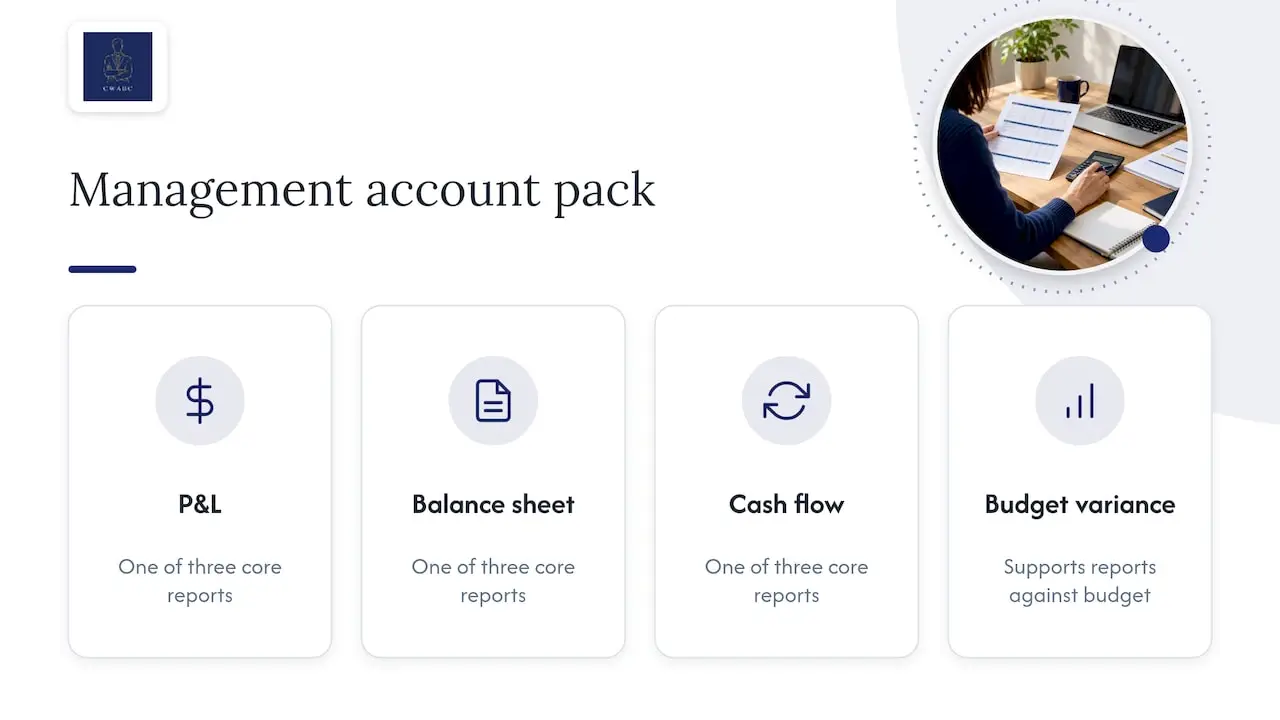
A typical pack for a small business has three core reports and a handful of extras. ICAEW lists the core reports as the profit and loss statement, the balance sheet and the cash flow statement, supported by variance analysis against a budget.
Profit and loss: are you actually making money?
The profit and loss account (P&L) lists your income and your costs for a period and shows what is left. A useful P&L for a small business splits costs into two groups:
- Direct costs, the things you only spend because you made a sale: materials, subcontractors, stock, payment fees.
- Overheads, the costs that tick along regardless: rent, insurance, software subscriptions, vehicle costs.
The gap between sales and direct costs is your gross profit. Divide it by sales and you have your gross margin. Take the overheads off as well and you have your net profit and net margin.
Margins matter more than turnover. Many owners tell me the business is busy, and it is. But busy and profitable are different things, and a P&L is where the difference shows up.
Balance sheet: what you own and what you owe
The balance sheet is a snapshot on one date. It shows:
- what the business owns (cash in the bank, equipment, vehicles, money customers owe you);
- what it owes (supplier bills, VAT, tax, loans, credit cards);
- what is left over for the owner or shareholders.
It is the report people skip, and it is often the most revealing. A healthy bank balance can sit alongside a large VAT bill or a tax liability that has not been paid yet. The balance sheet shows the bills the bank balance has to cover.
Cash flow: when will the money arrive and leave?
Profit is not cash. You can be profitable on paper and still struggle to pay suppliers if customers pay late. A cash flow report, and ideally a short forecast, shows how money moved and what is likely to happen over the coming months. ICAEW’s business finance guide explains that a cash flow forecast shows what your cash position is likely to be over the coming months, and that it can be built in a spreadsheet, an app or online accounting software.
Debtors and creditors: the cash flow traps
Two simple lists sit behind most cash problems.
- Debtors are customers who owe you money. Debtor days is roughly how long they take to pay.
- Creditors are suppliers you owe. Creditor days is roughly how long you take to pay them.
If you wait 45 days to be paid but are expected to pay suppliers in 20, you are funding your customers out of your own pocket. Seeing both figures side by side is often the first time an owner realises why the account feels tight even in a good month.
Budget comparison: actual against plan
A budget does not need to be elaborate. It can be a simple view of what you expected to sell and spend each month. Putting actual results alongside the budget is called variance analysis. It shows quickly where you are ahead and where you are slipping, and it turns a vague worry into a specific question: why were materials 6% higher than planned?
Optional extras
Depending on your business you might add:
- sales by product, service or customer;
- job or project profitability;
- rental income and costs by property, which is handy for landlords;
- staff costs as a share of sales;
- a short list of KPIs, such as average invoice value or hours billed.
Keep it short. A pack you read beats a pack that is impressive and ignored.
A worked example: how the figures drive decisions
The example below is illustrative, not a real client. It is there to show how the reports work together.
Imagine a self-employed kitchen fitter who trades through a limited company. In a typical month the plan looked like this, set against what actually happened.
| Monthly figure | Budget | Actual |
|---|---|---|
| Sales | £16,000 | £18,000 |
| Materials | £5,760 (36% of sales) | £7,560 (42% of sales) |
| Subcontractors | £4,000 | £4,500 |
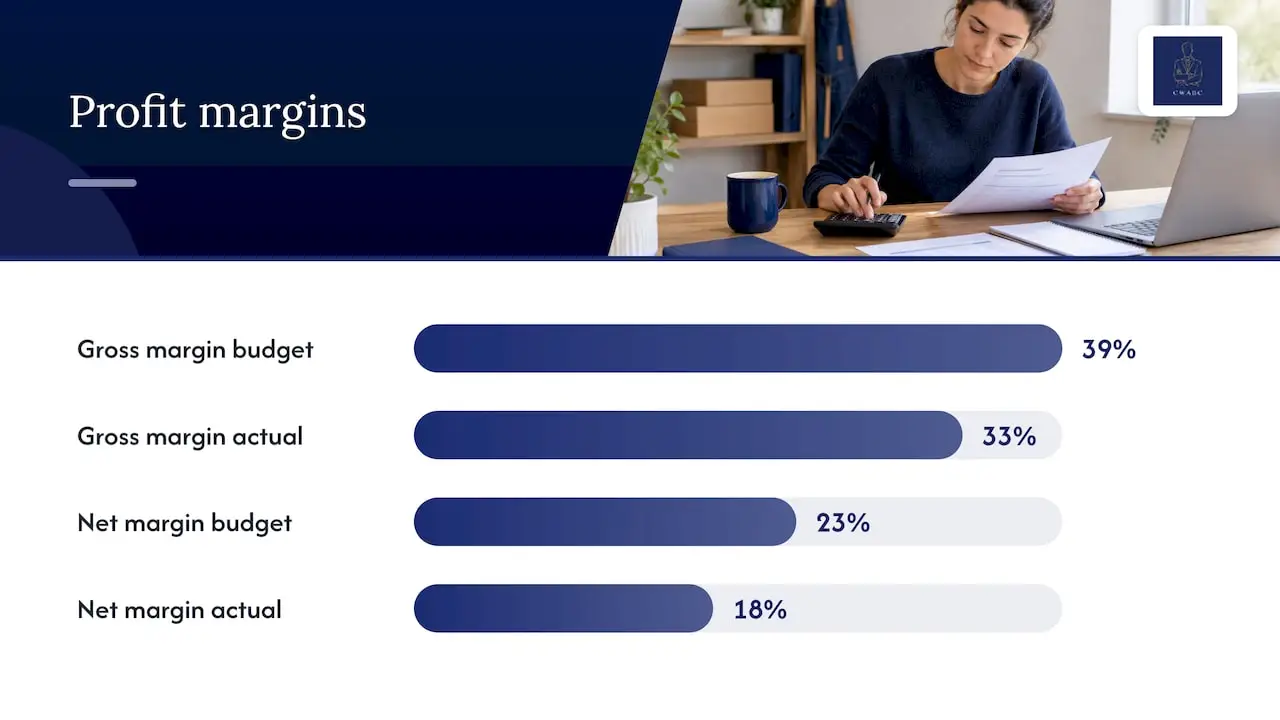
| Gross profit | £6,240 (39%) | £5,940 (33%) |
| Overheads | £2,600 | £2,700 |
| Net profit | £3,640 (23%) | £3,240 (18%) |
On the surface it was a great month, with sales £2,000 ahead of plan. But the P&L shows profit was £400 behind budget. The gross margin fell from 39% to 33%, so something is going wrong on cost.
Now add the balance sheet and debtor information:
- Customers owe £28,800, which on £18,000 monthly sales is roughly 48 days of sales.
- Supplier bills outstanding are £5,000, around 20 days of purchases.
- The bank balance is £9,200, but £4,100 of that is VAT that will be due.
The picture is clearer. The business is selling more, earning less on each job and waiting nearly seven weeks to be paid, while paying suppliers in under three. The bank balance flatters the position because part of it belongs to HMRC.
With these figures the owner can make specific decisions instead of guessing:
- Check pricing. Were materials quoted at old prices? A price list update or a materials allowance in each quote could restore the margin.
- Look at the jobs. Is one type of job or one subcontractor responsible for the extra cost?
- Tighten payment terms. Stage payments or a deposit would shorten the 48 days.
- Set the tax money aside. Moving the VAT amount into a separate savings pot means the bank balance is no longer misleading.
- Hold off on a big purchase. A new van might feel affordable at £9,200, but the real spare cash is far lower.
None of that is complicated. It just needs the numbers in front of you early enough to use them. Taking the figures from last year’s accounts, by contrast, would have told this owner about the margin problem long after the jobs had been done.
Why your bank balance is not enough
Many owners run the business from the bank app. It is a natural habit, and it works until it does not. The balance can mislead you because:
- VAT collected from customers is not yours to spend;
- Corporation Tax, Income Tax and National Insurance build up before they are paid;
- deposits for future work are in the bank but the work is still to be done;
- bills you have received but not paid are not yet visible.
HMRC’s own enquiry guidance notes that small business owners do not always keep comprehensive records, and that problems often arise because the books are not written up regularly. You can read the wording in the HMRC Enquiry Manual, EM2851. Regular management accounts are one of the simplest ways to avoid that, because they force the records to be brought up to date every month.
Business.gov.uk also recommends setting aside time each week for bookkeeping so you know what you have, what you owe and what you are owed. Management accounts build directly on that habit.
Which numbers to look at each month
If you take one thing from this article, let it be a short monthly routine. These are the questions I would ask of almost any small business:
- Sales: Up or down on last month and on the same month last year?
- Gross margin: Is it steady, or is it slipping?
- Overheads: Has anything crept up, such as software subscriptions or vehicle costs?
- Net profit: After everything, what is left?
- Debtors: Who owes you, and how overdue is it?
- Creditors: What do you owe, and when is it due?
- Cash and tax: How much of the bank balance is already spoken for?
- Budget: Where are you furthest from plan, and why?
You can answer most of these from a one- or two-page summary. That is enough for many sole traders and landlords. A limited company with employees or several income streams might want a little more detail.
How landlords, sole traders and directors use them differently
Sole traders
For a sole trader, management accounts replace the habit of working out your profit at the end of the tax year. A simple monthly profit figure helps you see whether you can afford to draw more, and how much to set aside for Self Assessment. If you are wondering how the tax bills are built up, my guide to Self Assessment payments on account explains why a second bill can arrive in January and July.
Landlords
Landlords benefit from seeing income and costs by property. Which flat has the highest repairs? Is one tenant regularly late? Is mortgage interest eating up the return? A property-by-property view answers these. If you let property in Kent or anywhere else in the UK, I can set up rental reporting so the numbers are ready for your tax return as well.
Limited company directors
Directors have an extra reason: the company’s money and your own money are separate. Management accounts show whether the company can afford the salary and dividends you plan to take, what Corporation Tax is building up, and how much cash buffer is left after the bills.
CICs and small employers
Community interest companies often need to report to funders and trustees. Management accounts that compare actual spending with grant budgets are very handy here. Small employers can add a payroll cost line to see staffing as a share of income, and construction businesses can track CIS deductions suffered or paid as part of the cash picture.
How cloud software makes this simpler
You no longer have to build everything in a spreadsheet. Packages such as Xero, QuickBooks and FreeAgent pull in your bank feed, match your invoices and bills, and produce a P&L, balance sheet and aged debtor and creditor lists at the click of a button. ICAEW notes that Excel remains an essential tool for many small businesses, but that cloud-based software may provide a robust alternative as an organisation grows.
The catch is that software only reports what has been entered. If bank transactions are left uncategorised, or invoices are missing, the reports will be wrong however polished they look. That is why regular bookkeeping comes first and management accounts second. If you are still working from spreadsheets, my article on moving from Excel to cloud accounting explains how to make the change without losing your history. And if you are starting from scratch, see how to set up an accounting system for a new business.
Where Making Tax Digital fits in
Making Tax Digital (MTD) is HMRC’s programme requiring digital records and regular online reporting. For Income Tax, it applies to sole traders and landlords based on their qualifying income, which is the total of self-employment and property turnover before expenses. GOV.UK explains the thresholds: the requirement began on 6 April 2026 for those with qualifying income above £50,000, and it extends to lower thresholds in later years. Check the guidance to see which year’s income counts for you.
If MTD applies to you, you will be keeping digital records and sending quarterly updates anyway. That makes it a good moment to turn the same records into useful management reports, rather than treating MTD as pure compliance. Records kept regularly for MTD are the same records a monthly P&L needs. For more detail, see my guides to MTD for Income Tax explained and quarterly reporting in 2026, or Making Tax Digital for landlords.
My perspective: numbers should give you confidence, not stress
I spend a lot of my working week with owners who feel they should understand their numbers better and are slightly embarrassed that they do not. Please do not be. Nobody is born knowing what a balance sheet is saying.
What I see most often is owners steering by the bank balance and by turnover. Both are comforting and both can hide a problem. A business can look busy while pricing or costs quietly eat the profit. Management accounts are how I help you see that early, while a small adjustment is still enough.
My approach is simple:
- I start with the bookkeeping, because everything else depends on it.
- I keep the reports short and tailored, so you do not get a 20-page pack you never open.
- I explain what each figure means for your decisions, in everyday language.
- I use cloud software so reports build up as the year goes on, instead of being a month-end scramble.
I also want to be clear about limits. Management accounts describe what has happened and help you plan. They cannot guarantee an outcome, and I am not able to give investment advice. What they can do is take away guesswork.
— Chris
How I can help with management accounts
I run CWABC as a sole practitioner, so when you ask a question about your figures, I am the person who answers it. I am AAT-licensed and work with sole traders, landlords, startups, limited companies, CICs and small employers in Tonbridge, Sevenoaks and across Kent, as well as remotely anywhere in the UK.
Here is what I can do for you:
- Keep your books up to date through my bookkeeping service, so the reports are built on reliable records.
- Set up and tidy your Xero, QuickBooks or FreeAgent file so reports are produced easily, as described on my accounting software setup page.
- Prepare a monthly or quarterly set of management accounts in a format that suits your business.
- Walk you through the results, so you understand what has changed and what to consider doing about it.
- Help you build a simple budget and forecast through my budgeting and forecasting support.
- Make sure the same records support your Self Assessment, VAT, Corporation Tax or MTD obligations.
Fees are tailored to your business and agreed clearly upfront, so you know what you are paying before we begin. If you want to see how I work on a related service, my Self Assessment tax returns start from £250 one-off. I do not promise particular results, but I do promise a clear explanation.
Common mistakes to avoid
- Waiting for the accountant to produce them. If the information arrives three months late, it is history. Aim for figures within a few weeks of month end.
- Too much detail. More lines do not mean more insight. Start with a page.
- Ignoring the balance sheet. Profit is only half the story.
- Mixing personal and business spending. It muddies every report. If this sounds familiar, you may recognise some of the signs your bookkeeping needs professional help.
- Never comparing with a budget. Without a plan, you cannot tell whether a result is good or bad.
- Treating the figures as a verdict. They are information. A bad month is a reason to look closer, not a reason to panic.
Getting started this month
You do not need to wait for a new financial year. A practical first step looks like this:
- Make sure your bank accounts are connected and every transaction from the last month is categorised.
- Raise or chase any invoices that are outstanding and note who is overdue.
- Run a P&L and balance sheet for last month and look at your gross margin and your VAT and tax balances.
- Write down a rough budget for the next three months.
- Book a short review with someone you trust to talk it through. If that is me, I am happy to help.
Repeat that each month. Within a quarter you will see patterns you could not see before.
Need help?
If you would like management accounts that you can actually read, or you want your bookkeeping in shape first, I would be glad to talk it over with you. Tell me about your business and what you want to understand better, and I will explain how I can help and agree the cost with you upfront. You can contact me here.
FAQ
Do small businesses legally need management accounts?
No. There is no legal requirement to produce management accounts, and there is no prescribed format. Statutory accounts and tax returns are the documents the law and HMRC require. Management accounts are optional, but they are one of the most practical ways to run a business with confidence.
How often should I produce management accounts?
Most small businesses find monthly right, because it is frequent enough to act on and not so frequent that it becomes a chore. Very simple businesses may be fine with quarterly accounts, which also fit neatly with quarterly MTD updates. If cash is tight, add a short weekly cash check.
What is the difference between management accounts and annual accounts?
Management accounts are internal, flexible and produced regularly to help you decide what to do next. Annual statutory accounts are formal, follow set rules and are prepared for outsiders such as Companies House and HMRC. Both come from the same bookkeeping records, so accurate books serve both.
Can I produce management accounts myself?
Yes, if your bookkeeping is up to date and you are comfortable reading a P&L and balance sheet. Cloud software can generate the reports automatically. Many owners prefer to have an accountant set up the layout, check the numbers and explain what they mean, at least at the start.
Do sole traders and landlords need them too?
They are not required, but they are useful. A monthly profit figure and a clear view of what to set aside for tax help sole traders avoid nasty surprises. Landlords benefit from seeing income and costs property by property.
Sources
- ICAEW Jobs: Financial Accounting vs Management Accounting
- ICAEW: Cash flow forecasts and inventory
- GOV.UK: Accounts and tax returns for private limited companies
- HMRC Enquiry Manual EM2851
- Business.gov.uk: Setting up business accounting and finance
- GOV.UK: Use Making Tax Digital for Income Tax, before you use this guide