
Most rent in the UK has no VAT on it. Renting out a home as someone’s residence is exempt from VAT. Commercial rent is also exempt unless the landlord has chosen to charge VAT, which is called the option to tax. Holiday accommodation is different, because it is normally taxable at the standard rate of 20%. Which of those three situations you are in decides almost everything else, so this guide takes them in turn, with examples.
If you have been told that “landlords must charge VAT” or that “rent is never subject to VAT”, neither is quite right. Let’s sort it out calmly.
TL;DR
- Ordinary residential lettings are exempt from VAT. You do not charge VAT on the rent, and that income does not count towards the VAT registration threshold.
- Commercial rent is exempt by default. If you opt to tax the building, you charge 20% VAT on the rent, and you can usually reclaim VAT on related costs.
- Holiday lets and serviced accommodation are generally taxable. Once taxable turnover passes £90,000 you must register.
- Being VAT-registered for another business does not turn your residential rent into taxable income.
- Keep property income separate in your bookkeeping, by property and by type of supply, so you can answer HMRC’s questions quickly.
Table of Contents
- The basic rule: land and property are normally exempt
- Residential lettings: no VAT on the rent
- Commercial property: exempt unless you opt to tax
- Registration: when VAT-registered landlords need to act
- Holiday lets and serviced accommodation
- Additional services: when extras change the answer
- Input VAT: what you can and cannot reclaim
- Common mistakes I would watch for
- Questions to ask before you register or opt to tax
- My view: the VAT question is really a bookkeeping question
- How I can help with landlord VAT and bookkeeping
- FAQ
- Need help with VAT on your rental income?
- Sources
The basic rule: land and property are normally exempt
HMRC’s guidance on opting to tax land and buildings explains that supplies of land and buildings, such as selling a freehold, leasing or renting, are normally exempt from VAT. Exempt means no VAT is charged to the tenant. It also means the landlord normally cannot recover VAT on their own related costs.
That last point catches people out. “Exempt” sounds like good news, but it is a trade-off: no VAT on the rent, and no VAT recovery on the roof repair.
Two terms are worth keeping apart:
- Exempt supply: no VAT is charged, and the income does not count as taxable turnover. If everything you sell is exempt, you cannot register for VAT and cannot reclaim VAT on your costs.
- Taxable supply: VAT is charged (20% standard rate, in most property cases), and the income counts towards the registration threshold. You can normally reclaim VAT on costs linked to it.
The HMRC land and property notice is the starting point for all of this. It is long, but it is the rulebook.
Residential lettings: no VAT on the rent
If you let a house or flat to a tenant who lives there, the rent is exempt. That covers a buy-to-let, a room in your own home let to a lodger, and a flat let on an assured shorthold tenancy.
Example. Priya owns three buy-to-let flats in Tonbridge and receives £3,600 a month in rent in total. She charges no VAT. She is not VAT-registered and does not need to be, however large her rental income grows, because exempt income does not count towards the threshold.
A few points that cause confusion:
- Rental income still counts for income tax. VAT and income tax are separate. Residential rent is outside VAT but fully inside Self Assessment. My guide to rental income tax covers that side.
- You do not need to register just because you have lots of properties. The £90,000 threshold applies to taxable turnover, and exempt rent is not taxable turnover.
- Letting agents’ fees often carry VAT. Your agent is usually VAT-registered and charges 20% on its management fee. As a landlord with only exempt income, you generally cannot reclaim that VAT. Allow for it when you work out your profit.
- Repairs and refurbishments carry VAT you cannot recover. A builder’s invoice for a new boiler includes 20% VAT, and with purely residential lettings that is simply part of the cost. For how those costs are treated for income tax, see repairs versus capital improvements.
If you are already VAT-registered for another business
Many landlords also run a trade. A sole trader plumber with a rental flat is a common case. Being VAT-registered for the plumbing does not make the flat’s rent taxable. The rent stays exempt. HMRC’s internal guidance on business and non-business property activity recognises that for many taxpayers property dealings sit alongside a main business, which is why the records need to show each activity separately.
What it does affect is your input VAT. If some costs relate to the exempt rent and some to the taxable trade, you may have to apportion VAT on shared costs. That is the partial exemption area, covered below.
Commercial property: exempt unless you opt to tax
Shops, offices, workshops, warehouses and land let for business use start in the same place: exempt. The landlord can then choose to opt to tax.
Once you opt to tax a building or piece of land, supplies of your interest in it will normally be standard-rated, and you will normally be able to recover VAT on related costs. Your tenant is then charged 20% on top of the rent. You notify HMRC of the option using form VAT1614A, and the details of when you need permission are in the same HMRC notice.
A lease may also state that rent is “plus VAT if applicable”. Check this wording before you assume anything. A landlord’s solicitor can confirm what the lease says. I can then look at how the VAT should appear in your bookkeeping.
Why would a landlord opt to tax?
Usually for input VAT recovery. If you are refurbishing or constructing a commercial unit, the VAT on the works can be large. With an exempt letting you cannot reclaim it. With an option to tax you generally can.
Example. Dan owns a small commercial unit and spends £60,000 plus £12,000 VAT on a refit before letting it. Without an option to tax, the £12,000 is a cost he cannot reclaim. With an option to tax, once he is VAT-registered and charging VAT on the rent, he can normally reclaim it, subject to the normal rules. Those include having a valid VAT invoice in his name.
Why might opting to tax not suit you?
- Your tenant may not be able to reclaim the VAT. A tenant that is itself VAT-exempt, such as certain healthcare or financial businesses, or a very small business that is not registered, bears the 20% as a real cost. That can make your unit less attractive.
- It is not simple to undo. The option has a long reach, covering the whole building or land it relates to, and revoking it is limited. Treat it as a considered decision rather than a tick-box.
- It adds admin. You will be charging VAT, issuing VAT invoices and filing returns, normally through Making Tax Digital for VAT compatible software.
The shop with a flat above
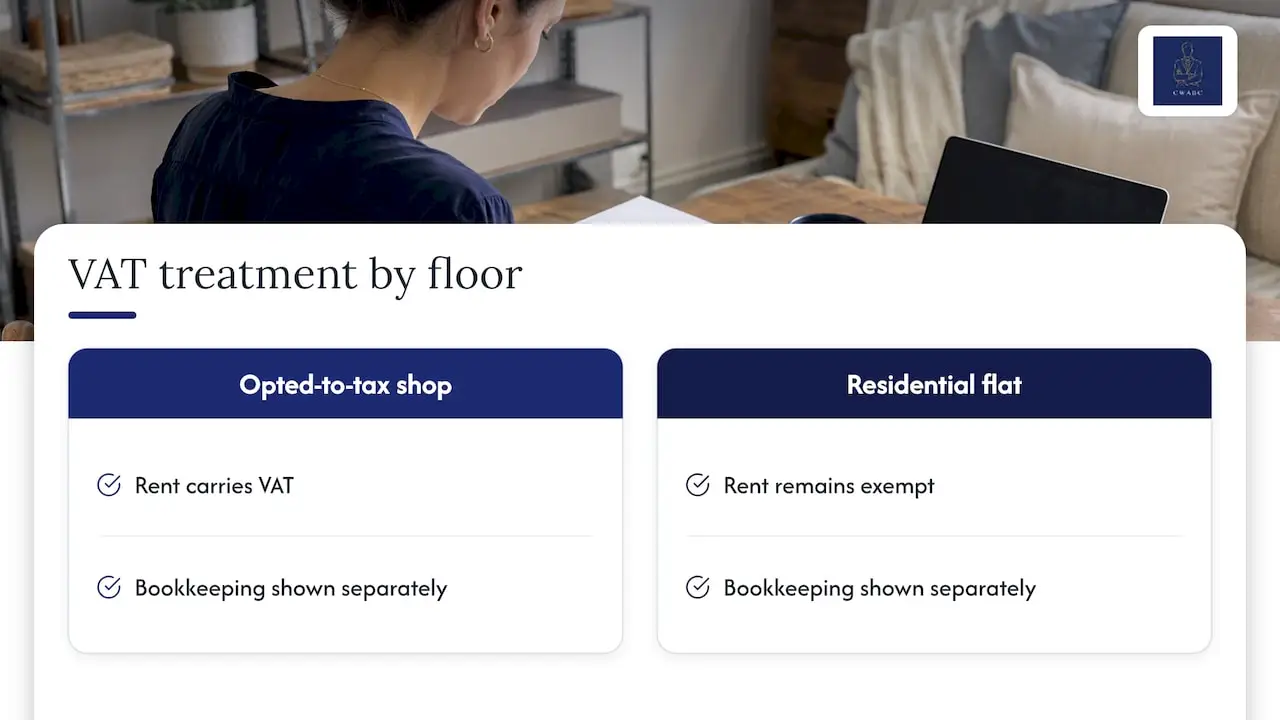
Mixed property is common in Kent high streets. If you let the ground-floor shop (opted to tax) and the flat above as a home, the supplies are treated separately. The shop rent carries VAT. The flat’s rent remains exempt. That means two different VAT treatments inside one building, and your bookkeeping should show each one separately.
Registration: when VAT-registered landlords need to act
You must register if your taxable turnover for the last 12 months goes over £90,000, or if you expect it to go over £90,000 in the next 30 days. Only taxable income counts.
That gives a practical way to think about it:
| Income type | VAT status | Counts towards £90,000? |
|---|---|---|
| Residential rent (assured shorthold tenancy) | Exempt | No |
| Commercial rent, no option to tax | Exempt | No |
| Commercial rent, option to tax made | Standard-rated (20%) | Yes |
| Holiday lets and serviced accommodation | Generally standard-rated | Yes |
| Parking, storage or other services provided separately | Depends on the facts | Often yes |
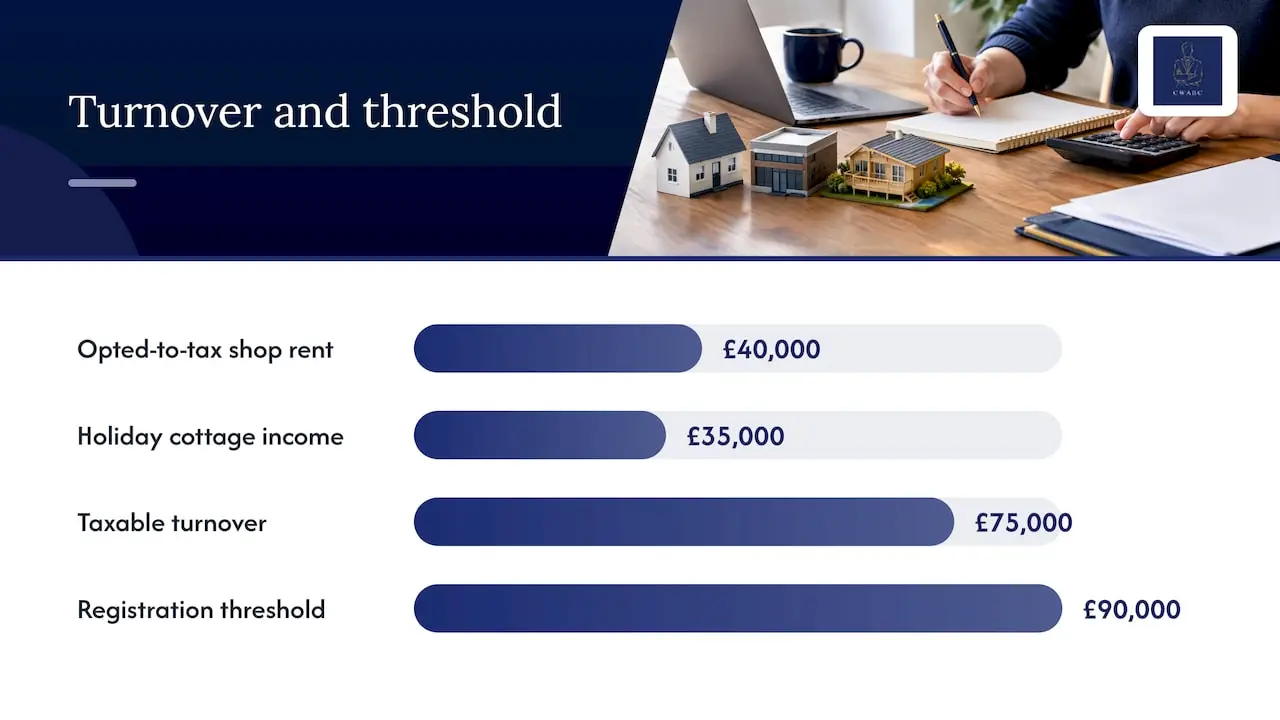
Example. Helen has £40,000 of opted-to-tax shop rent and £35,000 from a holiday cottage. Her taxable turnover is £75,000. If she adds a second cottage and the total passes £90,000 over a rolling 12 months, she must register. Her residential flats are not part of that calculation.
The key word is rolling. It is not based on the tax year. You need to check your total every month, not just at year end. My separate guide to registering for VAT before £90,000 covers the mechanics.
You can also register voluntarily below the threshold. For a landlord with opted-to-tax commercial property and big refurbishment costs, that can make sense. It is worth modelling first.
Holiday lets and serviced accommodation
Here the default flips. Providing holiday accommodation is not the same as renting out a home. HMRC’s guidance on hotels and holiday accommodation says that normal VAT rules apply and VAT should be charged at the standard rate. The temporary reduced rate for tourism and hospitality ended on 31 March 2022.
So a landlord with a holiday cottage, a seaside apartment let by the week, or serviced accommodation with linen, cleaning and changeover services should expect that income to be taxable. It counts towards the £90,000 threshold, and once over it you register and charge 20% on the booking price.
Example. Sam lets a two-bedroom cottage near Sevenoaks as holiday accommodation. Gross bookings come to £28,000 a year. That is below £90,000, so Sam need not register for VAT on that alone. If he registers voluntarily, he charges VAT on the stays but can reclaim VAT on cleaning, repairs and furnishings. If he later buys a second cottage and bookings reach £95,000 across a rolling 12 months, registration becomes compulsory.
A few notes:
- Longer lets may be treated differently. The VAT notice distinguishes short-stay holiday accommodation from longer-term lets. Check the facts of each property against the notice rather than relying on a rule of thumb.
- Booking platforms add a layer. Commission and service fees on your listings may carry VAT, and how guests are billed depends on the arrangement. Keep the statements.
- The income tax rules for furnished holiday lets have changed too. That is a separate subject from VAT, and I cover it in FHL tax rules after April 2026.
Additional services: when extras change the answer
Rent for the right to occupy is one thing. Services you provide on top can be another.
- Service charges that are part of the rent. In commercial leases, charges for building insurance, maintenance and so on usually follow the VAT treatment of the rent. If the rent carries VAT, so does the charge. If the rent is exempt, the charge normally is as well.
- Cleaning, meals or concierge services. These usually point towards a taxable supply, particularly in holiday or serviced settings.
- Parking and storage. Garages and parking spaces are listed by GOV.UK among items where VAT is not always charged, but the treatment depends on how they are let. A garage let with a home is generally treated differently from one let separately to someone who does not rent the home.
- Furnishings. Furnishing a residential let does not make the rent taxable.
Where the package is mixed, it matters how the contract and invoices describe it. If you are unsure, check with HMRC or get advice before you issue the first invoice, not after.
Input VAT: what you can and cannot reclaim
Input VAT is the VAT you pay on costs: agent fees, builders, repairs, professional fees. Whether you can reclaim it depends on what the costs relate to.
- Costs relating only to taxable income (an opted-to-tax shop, a holiday let) can usually be reclaimed if you are registered, with a valid VAT invoice.
- Costs relating only to exempt income (residential lets) cannot be reclaimed.
- Costs shared between both need to be split. Partial exemption rules set out how a business with both taxable and exempt supplies works out what it can recover.
Example. A landlord owns a shop (opted to tax) and a residential flat. A £1,200 plus VAT accountancy fee covers both. Part of the £240 VAT relates to the exempt flat and cannot be reclaimed, while the part relating to the shop can. A sensible, documented method of splitting is needed. The same applies to a building-wide repair such as a roof over both units.
Good coding in your software makes this far easier. If every invoice is tagged to a property and a type of income, the split takes minutes. If it is not, it can take hours at year end.
Common mistakes I would watch for
- Charging VAT on residential rent because “I’m VAT-registered”. Residential rent stays exempt.
- Counting exempt rent towards the £90,000 threshold, and registering unnecessarily.
- Opting to tax and forgetting to notify HMRC, or forgetting that the option affects every future supply of that building.
- Ignoring a holiday let because it feels like “just rent”. It is usually taxable.
- Reclaiming VAT on costs relating to residential lets. This is the one that can lead to repayments and penalties later.
- Mixing everything in one bank account and one spreadsheet. Then nobody can tell which property earned which income.
Questions to ask before you register or opt to tax
- What types of income do I have: residential, commercial, holiday, or a mixture?
- For each property, who is the tenant, and could they reclaim VAT if I charged it?
- What are my taxable sales over the last 12 months, and what do I expect over the next 30 days?
- Do I have big refurbishment or construction costs where VAT recovery matters?
- Are my records split by property and by VAT treatment?
If the answers are messy, that is normal. It usually means the records need tidying before the decision is made.
My view: the VAT question is really a bookkeeping question
In my experience of working with landlords, most VAT worries come from one cause: the records do not show which income is which. People then guess, and guesses are where the expensive mistakes sit.
I see three patterns. Some landlords register unnecessarily because they assume the threshold includes all rent. Some ignore a holiday let that has quietly pushed them towards the threshold. Some opt to tax without thinking about the tenant. All three are fixable with a clear set-up from the start.
My approach is simple. I look at each property, how it is let, and what the lease or tenancy says. Then I set up your software, such as Xero, QuickBooks or FreeAgent, so each property and income type is tracked separately. After that, VAT questions become checks against a clean record rather than detective work. I would rather you ask before you opt to tax than after.
I do not give a verdict on VAT without seeing the facts, because the answer depends on the lease, the use of the property and who the tenant is. What I can do is lay your options out in plain English, so that you make the decision with confidence.
— Chris
How I can help with landlord VAT and bookkeeping
If your rental income is a mix of residential, commercial or holiday lets, I can review your bookkeeping and VAT position with you. I will check how each property is let, how the income is recorded, whether registration is likely to be needed, and how input VAT is being treated.
I can help with:
- rental reporting and bookkeeping, set up by property
- VAT registration and returns, if you are or need to be registered
- cloud accounting software set-up, so that your records are ready for HMRC
- Self Assessment for the income tax side of your rent
I work with landlords in Tonbridge, Sevenoaks and across Kent, and remotely throughout the UK. Pricing is agreed clearly upfront, and I do not promise specific outcomes. For wider reading, see my landlord bookkeeping guide and my explainer on Making Tax Digital for landlords.
FAQ
Do I charge VAT on residential rent?
No. Letting a dwelling as a home is exempt from VAT, so you do not add VAT to the rent. This stays true even if you are VAT-registered for a different business. The rent also does not count towards the £90,000 registration threshold.
Is there VAT on commercial rent?
Only if the landlord has opted to tax the property. Without an option, commercial rent is exempt. With one, VAT at 20% is added to the rent, and the tenant is charged accordingly. Check the lease and ask your landlord or tenant whether an option is in place.
Is the first £85,000 of income VAT-free?
Not any more. The threshold is £90,000 of taxable turnover, not £85,000, and it applies to taxable income only. Residential rent is exempt and does not count towards it. Holiday lets and opted-to-tax commercial rent do count.
Can I reclaim VAT on repairs to a rental property?
It depends on what the repair relates to. If it relates to taxable income, such as an opted-to-tax shop or a holiday let, you can normally reclaim it when registered. If it relates to residential lets only, you cannot. Shared costs must be split fairly.
Do holiday lets need VAT registration?
Once your taxable turnover passes £90,000 over a rolling 12 months, yes. Holiday accommodation is generally standard-rated, so those bookings count. Below the threshold, registration is optional, and may be worth considering if you have large costs you could reclaim.
Need help with VAT on your rental income?
If you are unsure how VAT applies to your properties, or want your bookkeeping set up properly before a registration or option to tax decision, I am happy to talk it through. Contact me here and I will reply as soon as I can.
Sources
- Land and property (VAT Notice 742), GOV.UK
- Opting to tax land and buildings (VAT Notice 742A), GOV.UK
- Hotels and holiday accommodation (VAT Notice 709/3), GOV.UK
- Register for VAT, GOV.UK
- Exemption and partial exemption from VAT, GOV.UK
- When not to charge VAT, GOV.UK
- VATLP03100 Business and non-business: property and business, HMRC manual
- VAT guide (VAT Notice 700), GOV.UK