Most Self Assessment errors are not dramatic. They are small gaps: a bank account you forgot, a CIS deduction left off, a repair that was really an improvement, or a January bill nobody warned you about. The good news is that nearly all of them can be avoided calmly with decent records and a final check before you submit. This guide walks through the mistakes I see most often on 2025/26 returns (6 April 2025 to 5 April 2026), gives you a practical checklist, and explains when paying for help is sensible and when you can reasonably go it alone.
One thing first: not everyone has to file a return. If your income is taxed entirely through PAYE and you have no other income to report, you may not need to. This article is for people who do need to file, or who are not sure.
TL;DR
- For 2025/26, the online return and any tax owed are due by 31 January 2027. If you are new to Self Assessment, the registration deadline was 5 October 2026.
- The most common errors are missing income, wrong expense claims, CIS deductions left out, mixed-up property income, and surprise payments on account.
- Keep your records tidy all year. You do not send receipts with the return, but you must keep them in case HMRC asks.
- Consider an accountant if you have several income sources, rental properties, CIS, capital gains, or a return you have already filed and now suspect is wrong.
- Making Tax Digital for Income Tax is arriving in stages, so your record keeping may soon matter more than your annual filing.
Table of Contents
- The dates that matter for 2025/26
- Mistake 1: Leaving out income
- Mistake 2: Getting expense claims wrong
- Mistake 3: Poor records and the receipts myth
- Mistake 4: Overlooking CIS deductions
- Mistake 5: Muddling rental income
- Mistake 6: Being surprised by payments on account
- Mistake 7: Ignoring Making Tax Digital until it arrives
- A practical 2025/26 checklist
- When you can reasonably do it yourself
- Signs it is time to get an accountant’s help
- What to do if you have already made a mistake
- My view: treat the return as the last step, not the first
- How I can help with your 2025/26 return
- FAQ
- Need help?
- Sources
The dates that matter for 2025/26
Let me start with the calendar, because most of the stress comes from leaving things until the last fortnight.
| Date | What it means |
|---|---|
| 5 October 2026 | Deadline to register for Self Assessment if you are new and need to file for 2025/26 |
| 31 October 2026 | Deadline for paper returns |
| 31 January 2027 | Deadline for the online return and for paying any tax owed for 2025/26 |
| 31 January 2027 | First payment on account for 2026/27 may also be due |
| 31 July 2027 | Second payment on account for 2026/27 may be due |
The HMRC deadlines page confirms the paper and online dates. The registration date is repeated in HMRC’s announcement of the improved registration service, published in September 2026.
If you read this after 5 October and have never filed before, do not panic and do not wait. Register as soon as you can and tell HMRC why. I cover the registration side in more detail in my guide on whether you need to register by 5 October.
Mistake 1: Leaving out income
It is easy to think of income as “the main job” and forget the rest. Missing income usually looks like this:
- A side hustle that started small and was never mentioned
- Bank interest or dividends from an account you rarely look at
- Rent from a spare property or a room let out
- Income paid into a personal account rather than a business one
- Capital gains from selling shares or a second property
HMRC’s guidance for the self-employed says you should report all your business income and claim only allowable expenses. The self-employment help page lists turnover completeness as one of the first things to check.
A simple habit helps: before you start, list every bank account, payment app and platform you used in the tax year. Then ask yourself whether money arrived from each one that was not wages. Matching your sales records to your bank statements catches most omissions.
Mistake 2: Getting expense claims wrong
Expenses go wrong in two directions. Some people under-claim because they do not know what is allowed. Others over-claim, often by treating private costs as business ones.
The areas that most often need a second look are:
- Motor costs. Mileage and actual running costs are treated differently, and private use has to be separated out.
- Working from home. Only the business share of costs can be claimed, and you need a sensible method for working it out.
- Premises costs. Rent and utilities for a genuine business premises are different from household bills.
- Capital items. Equipment and vehicles are usually dealt with through capital allowances rather than as everyday expenses.
- Mixed-use purchases. A phone, laptop or broadband line used for both work and home life needs a fair split.
HMRC also allows eligible sole traders to use the cash basis, but evidence must still be kept. Both points are covered in the HMRC self-employment guidance.
A practical example: you buy a laptop for £900 and use it about 70% for work. Do not simply enter £900 as an expense. Think about how it is treated for tax and how much is business use, and keep a note of your reasoning. If you are unsure, that is exactly the sort of judgement call worth running past an accountant. I go through more of these in my article on common sole trader tax return errors.
Mistake 3: Poor records and the receipts myth
A common belief is that you must upload your receipts with the return. You do not. HMRC says you do not send proof of expenses with the return, but you must keep records in case it asks. That is explained in the self-employment guidance.
That has a practical consequence. A shoebox of faded receipts is not a record system. A tidy digital ledger, with invoices and bank evidence attached to each entry, is far easier to defend and far quicker to work from. It also means January is a review job rather than a rescue job.
If you are still working from spreadsheets and paper, moving to cloud software can remove a lot of manual effort. I explain what that looks like in moving from Excel to cloud accounting and in my sole trader bookkeeping system setup guide.
Mistake 4: Overlooking CIS deductions
If you work as a subcontractor in construction, your contractor may deduct tax before paying you under the Construction Industry Scheme (CIS). Those deductions are not an expense and they are not something to ignore. They are tax already paid on your behalf, and they should be entered on your return so they count against your bill.
The usual causes of under-claiming are missing statements, or deductions that were taken but never matched to the bank receipts. HMRC’s registration announcement highlights better digital handling of Self Assessment data, but your own records still need to be checked against your contractor statements.
A good routine:
- Collect every deduction statement from every contractor for the year.
- Compare the totals with the payments in your bank account.
- Chase any contractor whose statement is missing.
- Enter the total tax deducted in the right place on the return.
If you are newer to the scheme, my pages on CIS for subcontractors and CIS registration explain how it works.
Mistake 5: Muddling rental income
Landlords are caught out in a different way. Recording rent is usually straightforward. The harder part is sorting what the rent was, what it cost to earn, and which page of the return it belongs on.
The points that most often need care:
- The £1,000 property income allowance. HMRC’s property guidance sets out when property income needs to be declared and how the allowance conditions work.
- Gross rent without costs. Entering the rent received without separating allowable costs gives the wrong answer.
- Repairs versus improvements. A like-for-like repair is generally treated differently from an improvement that adds value.
- Finance costs. Loan interest is not treated like other property costs, and personal borrowing should be kept apart from property borrowing.
- Joint ownership. Income and costs need to be split in line with ownership.
- Wrong pages. UK property income goes on the SA105 supplementary pages. Overseas property is reported differently.
If you also have self-employment, keep the two sets of figures well apart. Mixing them up is a frequent reason returns need correcting later.
For more detail, see my guides to rental income tax, types of landlord income that are taxable and the UK landlord property income tax return.
Mistake 6: Being surprised by payments on account
This is the classic January shock. Many people expect to pay one bill. Instead they find the balancing payment for the year just ended, plus a first payment towards the next one, all on 31 January.
Here is how it works. Payments on account are normally required unless last year’s tax bill was under £1,000, or more than 80% of it was collected outside Self Assessment. Each payment is usually half of the previous year’s tax. They fall on 31 January and 31 July, and any balance is due the following 31 January. HMRC’s page on payments on account explains the detail.
A worked example, using round numbers purely for illustration. Suppose your 2025/26 tax bill is £4,000 and you made no payments on account for that year.
- By 31 January 2027 you would owe the £4,000 balance.
- You would also owe a first payment on account for 2026/27 of £2,000 on the same date.
- That is £6,000 in one go, with a further £2,000 due on 31 July 2027.
It is not an extra tax. It is next year’s tax, paid earlier. But if you have not planned for it, it feels like a bill that appeared from nowhere.
HMRC’s reminder in June 2026 points out that you can pay before you file and that payment plans exist to spread the cost. Filing early also tells you the figure sooner, which gives you time to put the money aside. My plain-English article on payments on account goes through this step by step.
Mistake 7: Ignoring Making Tax Digital until it arrives
Making Tax Digital (MTD) for Income Tax is HMRC’s move to digital records and quarterly updates for some sole traders and landlords. It does not replace the annual return. You still submit a Self Assessment return as well.
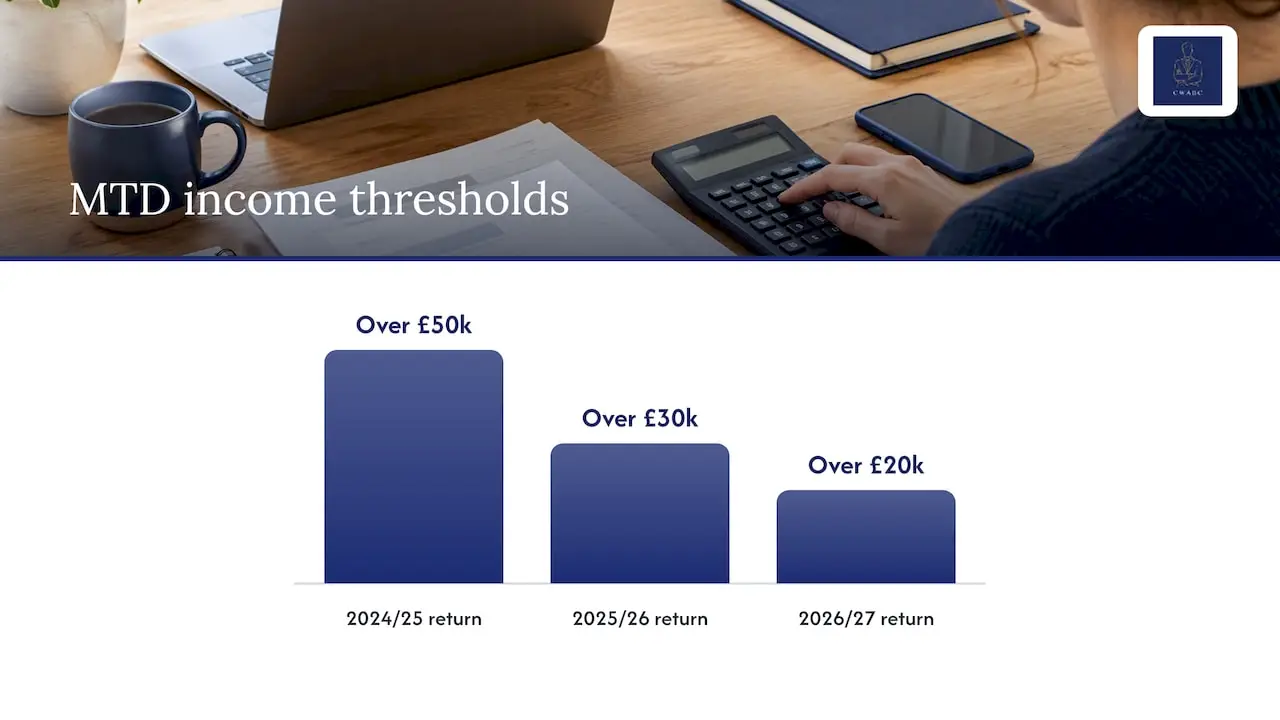
Whether it applies to you depends on your qualifying income, which is your gross income from self-employment and property before expenses. HMRC’s published timetable is:
| Qualifying income | MTD for Income Tax starts |
|---|---|
| Over £50,000 (2024/25 return) | 6 April 2026 |
| Over £30,000 (2025/26 return) | 6 April 2027 |
| Over £20,000 (2026/27 return) | 6 April 2028 |
These dates come from HMRC’s pages on who needs to use MTD for Income Tax and working out your qualifying income. Note that it is turnover, not profit, that counts, and that self-employment and property income are added together. A landlord with several properties and a small side business can cross a threshold without feeling especially “big”.
The sensible way to see MTD is as a bookkeeping project, not a filing project. If your 2025/26 return shows income over £30,000, you will need digital records and quarterly updates from April 2027, so the time to tidy your system is now, while there is no deadline pressure. My guides on MTD quarterly reporting, the MTD requirements checklist and MTD for landlords explain what to expect.
A practical 2025/26 checklist
Work through this list in order. Tick off each line, and you will have done most of the hard work before you open the return.
- Gather bank statements and sales records for 6 April 2025 to 5 April 2026, for every account you use.
- List every income source: self-employment, employment, rent, interest, dividends, pensions, benefits and any capital gains.
- Reconcile CIS statements against bank receipts if you are a subcontractor.
- List allowable expenses with an invoice or receipt for each.
- Separate business and private use for vehicles, phones, home working and anything shared.
- Gather rental schedules and property finance details if you let property, including loan interest and any joint-ownership split.
- Collect PAYE, pension, benefit and interest information for the year.
- Collect capital gains details for any disposals: dates, proceeds, costs.
- Check your payments on account and what you have already paid.
- Confirm which supplementary pages you need. The 2026 return includes SA103 for self-employment, SA105 for UK property and SA108 for capital gains, as listed in HMRC’s guidance on completing the return.
- Review the calculation. Does the tax figure look sensible against last year and against your income?
- Keep your records and submit before 31 January 2027.
If you want a fuller walk-through of the accounts side, my article on how to prepare accounts for a tax return is a good companion.
When you can reasonably do it yourself
I do not think everyone needs an accountant. You may be fine on your own if:
- You have one simple source of self-employment income with a modest number of transactions
- Your records are complete and up to date
- You have no rental property, capital gains or CIS
- You understand which expenses are allowable and why
- You are not close to an MTD threshold
Even then, a quick read-through of the figures before you press submit is worthwhile. Most errors are typos and omissions, not tax technicalities.
Signs it is time to get an accountant’s help
There is no shame in asking for help, and it is often cheaper than fixing a problem later. Consider it when:
- You have several income streams. A job, a side business and a rental flat each follow different rules.
- You are a landlord and are not sure what counts as a repair, how finance costs work, or how to split joint income.
- You work under CIS and your statements do not match your bank.
- You sold something such as shares or a property and need to work out a capital gain.
- Your records are in a mess, or you are behind with bookkeeping. My piece on five signs your bookkeeping needs professional help may sound familiar.
- Your income is near an MTD threshold and you need a system in place for April 2027 or April 2028.
- You think a past return was wrong. That needs prompt, careful handling (see below).
- You simply do not have the time, or the thought of January makes you anxious.
What an accountant does best is not typing numbers into software. It is checking completeness and treatment before you submit: is every income source in, is each expense treated correctly, has tax already deducted been credited, and is the payment calculation right? That review is where most of the value sits.
What to do if you have already made a mistake
Do not leave it and hope. HMRC’s corrections guidance says an online correction is normally available within 12 months of the Self Assessment deadline. After that, you generally need to write to HMRC with supporting details. Overpayment relief may be available up to four years after the end of the tax year concerned.
If income was left out or tax was understated, correcting promptly is safer than staying silent. My guide on how to correct tax return mistakes sets out the process. If the figures are large or the situation is complicated, ask a qualified accountant to look before you contact HMRC.
My view: treat the return as the last step, not the first
I have found that the people who feel calmest in January are not the ones who are best at tax. They are the ones who looked at their numbers during the year.
The return is the end of a process. If your records are organised, your income is captured, and your expenses are sorted as you go, the return becomes a short review rather than a scramble. That is also what Making Tax Digital is pushing everyone towards, so the work is not wasted.
My approach is simple. I work with you directly, in plain English, and I use cloud software such as Xero, QuickBooks or FreeAgent so that your records are accurate and ready for HMRC. I would rather help you set things up properly once than rescue a return at the last minute. I do not promise particular outcomes, because every situation is different, but I do aim to make it clear what you owe, why, and when.
If you take one thing from this article, let it be this: start early, keep your records as you go, and ask a question when you are unsure.
— Chris
How I can help with your 2025/26 return
I prepare Self Assessment returns for sole traders, landlords and individuals with other income. I review your income and expenses, check allowable claims, reconcile CIS deductions and look at payments on account, so that you know the figure before January arrives. Self Assessment returns start from £250 one-off, and I agree the price with you clearly upfront. You can see more on my Self Assessment Tax Returns page.
If your records need work first, my bookkeeping services set up a tidy system, and my Making Tax Digital for Income Tax support helps you prepare for quarterly reporting. I work with clients in Tonbridge, Sevenoaks and across Kent, and remotely throughout the UK.
FAQ
When should I do my Self Assessment?
As soon as you have your records for the year, which for 2025/26 means any time after 5 April 2026. The deadline for the online return and payment is 31 January 2027, but filing earlier tells you the amount due sooner. That gives you time to save or set up a payment plan.
How many years can HMRC go back for unpaid income tax?
I cannot give a single answer, because the time limit depends on whether an error was a genuine mistake, a lack of reasonable care or deliberate. HMRC’s corrections page explains how to put errors right. If you are worried about earlier years, speak to a qualified accountant before contacting HMRC.
Do I send my receipts with my tax return?
No. HMRC says you do not send proof of expenses with the return, but you must keep records in case it asks. A digital ledger with invoices and bank evidence attached is the easiest way to do this.
Does Making Tax Digital mean I no longer file a Self Assessment return?
No. MTD for Income Tax adds digital records and quarterly updates for those who qualify, but you still submit the annual return. Whether it applies to you depends on your gross qualifying income from self-employment and property, as set out in HMRC’s MTD timetable.
What should I ask an accountant before hiring them?
Ask which qualifications and professional body they hold, who will actually do your work, what the fee covers and when it is agreed, and which software they use. Ask also how they handle your specific situation, such as rental income or CIS.
Need help?
If you would like a second pair of eyes on your 2025/26 return, or help getting your records ready, I am happy to talk it through. Get in touch with me here and tell me a little about your situation.
Sources
- Self Assessment tax returns: Deadlines, GOV.UK
- Improved Self Assessment registration service launched, GOV.UK
- Help with self-employment on your Self Assessment tax return, GOV.UK
- Help with property on your Self Assessment tax return, GOV.UK
- Self Assessment: UK property (SA105), GOV.UK
- Understand your Self Assessment tax bill: Payments on account, GOV.UK
- Taxpayers urged to get ahead of July Self Assessment payment deadline, GOV.UK
- Find out if and when you need to use Making Tax Digital for Income Tax, GOV.UK
- Work out your qualifying income for Making Tax Digital for Income Tax, GOV.UK
- Complete your Self Assessment tax return for the last tax year, GOV.UK
- Self Assessment tax returns: Corrections, GOV.UK