If you sell shares outside an ISA or pension and the shares have gone up in value, the profit may be liable to Capital Gains Tax (CGT). For 2026/27 the first £3,000 of your total gains is tax-free, and anything above that is taxed at 18% or 24%, depending on your income. The sums themselves are straightforward. The part that catches people out is working out the right cost for each sale, especially if you have bought the same shares several times, and then reporting it correctly. I’m Chris White, and this guide walks through it calmly, step by step, with a worked example. If you would rather have it done for you, I can help with the calculation and the Self Assessment reporting.
TL;DR
- CGT applies to gains on shares held outside an ISA or pension. Shares in an ISA are not subject to it.
- For 2026/27, the annual exempt amount is £3,000, and the rates are 18% and 24%, depending on your total taxable income.
- Shares of the same class in the same company are usually pooled, but same-day and 30-day purchases are matched first.
- You may need to report a sale even when no tax is due, for example when your total disposal proceeds are over £50,000.
- Keep contract notes and records of every purchase, sale and fee. They are what the calculation is built on.
Table of Contents
- When CGT applies to shares
- The rates and the annual exempt amount for 2026/27
- How to calculate a gain on shares
- A worked example for 2026/27
- Do you need to report it?
- Records worth keeping
- How I can help with CGT on shares
- My view on share gains
- Need help with capital gains tax on shares?
- FAQ
- Sources
When CGT applies to shares
CGT is a tax on the gain, not on the whole sale price. You only have a gain if you sell (or otherwise dispose of) shares for more than they cost you. HMRC, the UK tax authority, says you may have CGT to pay if you make a gain disposing of shares or investments outside an ISA or PEP. A PEP is an older type of tax-free investment plan, now treated like an ISA for this purpose.
“Disposal” is wider than a plain sale. It also covers giving shares away to someone other than a spouse, civil partner or charity, and selling them for less than they are worth. In those cases HMRC substitutes market value for the amount you actually received, so you can have a gain without receiving a penny.
Some disposals do not usually create a CGT charge:
- Shares held in an ISA or PEP.
- Gifts to a spouse, civil partner or charity.
- UK government gilts and qualifying corporate bonds.
- Shares held in an employer Share Incentive Plan, in the circumstances HMRC’s guidance describes.
All of these are listed in HMRC’s overview of tax when you sell shares.
ISAs and pensions
This is why so many investors use an ISA. Gains on shares held inside one are not subject to CGT, and you do not need to put them on your tax return. The same broad idea applies to shares held within a registered pension, where the tax treatment follows the pension rules rather than your personal CGT position. If you sell shares and buy them straight back inside an ISA (often called Bed and ISA), the sale is still a disposal of shares you held outside the ISA, so any gain on that sale is calculated in the normal way. The benefit is that future growth is then sheltered.
Personal shares versus company shares
Everything in this article is about shares you own personally. A limited company that sells shares it owns does not pay CGT. Its gains are chargeable gains within Corporation Tax instead. If you are a director with a company holding investments, that is a different calculation and a different return. My guide to Corporation Tax for UK limited companies covers how a company is taxed.
This guide also does not cover residential property or Business Asset Disposal Relief, which have their own rules. If you are selling a rental property, start with my page on landlord capital gains tax considerations. If you are selling your own business, see Business Asset Disposal Relief.
The rates and the annual exempt amount for 2026/27
The annual exempt amount is the amount of gains you can make in a tax year before CGT is due. For 2026/27 HMRC states an individual annual exempt amount of £3,000, with CGT rates of 18% and 24%. The tax year runs from 6 April to 5 April.
Which rate you pay depends on your income:
- Gains that fit inside your unused basic-rate band are taxed at 18%.
- Any part of the gain above that band is taxed at 24%.
HMRC’s method, set out in its CGT rates guidance, is to work out your taxable income and your total taxable gains, deduct the tax-free allowance from the gains, add the remainder to your taxable income, then apply 18% within the basic-rate band and 24% above it. So the same gain can cost two people different amounts. If you are unsure where your income sits, my UK income tax bands guide for 2026/27 explains the bands.
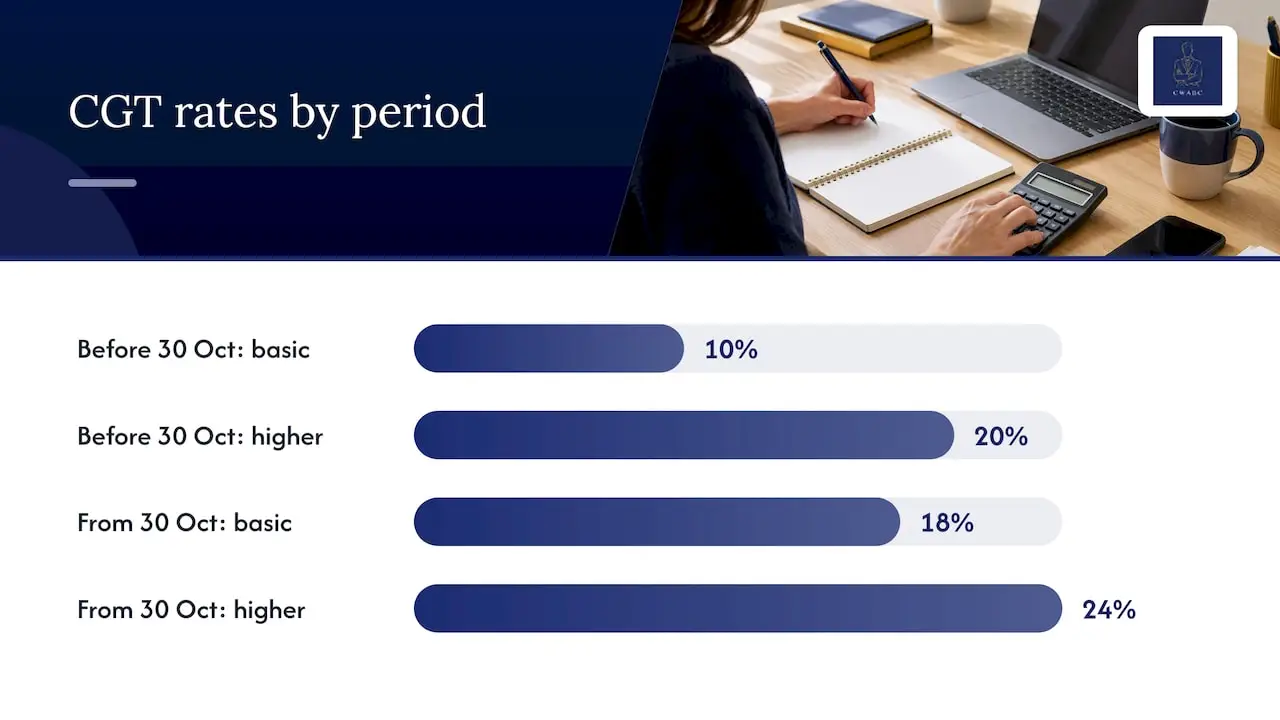
These rates have not always applied. For disposals before 30 October 2024, shares were charged at 10% and 20%. The Autumn Budget 2024 annex records the change to 18% and 24% from that date. If you are looking at older sales, the rate depends on the date of the disposal.
Rates and allowances are set by the government and can change at a Budget, so check the GOV.UK page for the tax year of your sale.
How to calculate a gain on shares
The basic formula is simple. HMRC says a share gain is usually the disposal proceeds less the amount paid for the shares. The detail is in what counts as each part.
Step 1: Start with the sale proceeds
Use the amount you received before deducting selling costs. A contract note from your broker shows it. If you gave the shares away or sold them below their value, market value is used instead.
Step 2: Work out what the shares cost you
This is the price you paid, plus the costs of buying. HMRC allows you to deduct qualifying buying and selling costs, including stockbroker fees and Stamp Duty Reserve Tax paid when buying shares. Platform dealing charges on contract notes are the usual items. Keep every one.
Step 3: Match the sale to the right purchase
This is where most mistakes happen. If you hold shares in one company that you bought on different dates at different prices, you cannot pick the cheapest or most expensive batch. HMRC’s HS284 helpsheet sets an order for matching a sale to purchases:
- Same day. Shares you bought on the same day you sold.
- 30 days. Qualifying shares you bought in the 30 days after the sale. This is often called the “bed and breakfast” rule. It stops you selling to bank a gain or loss and buying straight back.
- The Section 104 pool. Everything else.
The Section 104 pool is the main holding. Identical shares of the same class in the same company are generally treated together, with their acquisition costs pooled and averaged. When you buy more, the pool grows and the average cost moves. When you sell, you remove a proportion of the pool’s cost, not the price of a specific purchase.
HMRC’s own Example 3 for 2026 shows the pool carrying forward: 700 shares sold for £3,360, with £2,931 of pooled cost and £100 of dealing costs, give a £329 gain. The pool is then adjusted for the next disposal.
Step 4: Deduct allowable losses
If you sold other assets at a loss in the same tax year, those losses come off your gains first. HMRC’s guidance on working out if you need to pay says to calculate each asset’s gain, combine the gains for the tax year, and deduct allowable losses before comparing what is left with the annual exempt amount.
Two practical consequences follow. First, your CGT position cannot always be judged from one share sale alone, because gains and losses on other chargeable assets count too. Second, a loss only counts once it is properly recorded with HMRC, so it is worth reporting a loss even if you pay no tax in that year.
Step 5: Apply the annual exempt amount and the rates
Deduct the £3,000 allowance from your total gains for the year. Tax the remainder at 18% or 24% as above.
A worked example for 2026/27
This is an illustration of the method, not a personal tax calculation. The figures are invented and rounded for clarity.
Suppose Sam holds shares in one UK-listed company, outside an ISA:
- Bought 1,000 shares for a total of £8,000, including dealing costs.
- Later bought 500 more for a total of £5,000, including dealing costs.
No same-day or 30-day purchases are involved, so everything sits in the Section 104 pool: 1,500 shares with a total cost of £13,000.
In 2026/27 Sam sells 600 shares for £20 each, £12,000 in total, and pays £50 in dealing costs.
| Item | Amount |
|---|---|
| Sale proceeds (600 × £20) | £12,000 |
| Less selling costs | £50 |
| Less pooled cost of 600 shares (£13,000 × 600 ÷ 1,500) | £5,200 |
| Gain | £6,750 |
| Less annual exempt amount | £3,000 |
| Taxable gain | £3,750 |
Now the rate. It depends on Sam’s other income:
- Lower income. If Sam’s taxable income leaves at least £3,750 of the basic-rate band unused, the whole £3,750 is taxed at 18%. Tax: £675.
- Higher income. Say only £2,700 of the basic-rate band is unused. Then £2,700 is taxed at 18% (£486) and the other £1,050 at 24% (£252). Tax: £738.
Sam has no CGT problem with the £3,000 allowance, but does need to think about reporting. Total proceeds here were £12,000, under £50,000, but the gain before losses was over £3,000, which is itself a reporting trigger (see below).
What if Sam had bought shares within 30 days?
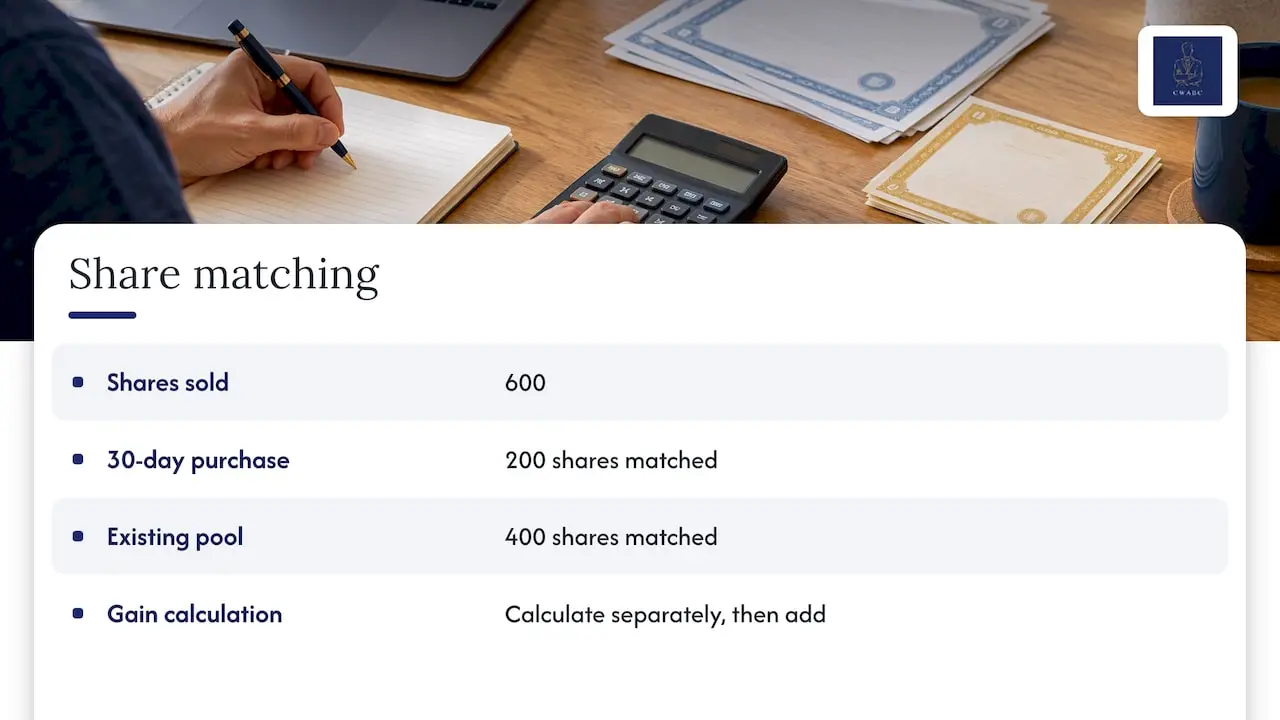
Imagine Sam had also bought 200 more shares of the same company two weeks after the sale. Under the 30-day rule, 200 of the 600 shares sold are matched with that new purchase first, using its actual cost. Only the other 400 come from the pool. The gain is calculated on each part separately and added together. This is why a record of every purchase date matters, even small top-ups through a regular investing plan.
Do you need to report it?
You can owe nothing and still have to report. For 2025/26, HMRC’s SA108 notes say you fill in the Capital Gains summary pages of the Self Assessment return if, among other conditions:
- the chargeable assets you disposed of were worth more than £50,000 in total, or
- your gains before losses were more than £3,000.
HMRC’s guidance adds that if your taxable gains are below the annual exempt amount you do not pay CGT, but if you are registered for Self Assessment you must still report when total disposal proceeds exceed £50,000. The summary pages are not needed if your only disposals are ISA or PEP holdings or UK government gilts, among other excluded categories.
If you are not already in Self Assessment, there is also an HMRC online service for reporting and paying CGT on a disposal, with its own deadlines, set out on GOV.UK’s report and pay page. Check the deadline for the specific tax year, because it depends on which route you use.
If you already complete a tax return, the gain goes on that return, and the tax is paid with your other Self Assessment liability. My guide to Self Assessment payments on account explains how that balance is collected, and the register-by-5-October checklist is useful if you have never filed before.
If you spot an error on a return you have already filed, this guide to correcting tax return mistakes explains the process.
Records worth keeping
Most CGT stress comes from missing paperwork rather than difficult tax. For every holding, keep:
- Contract notes for each purchase and sale, showing date, number of shares and price.
- Records of fees, stamp duty and any platform charges.
- Dividend reinvestment records, share splits and corporate actions, which can change your share count or cost.
- A running record of your Section 104 pool: number of shares and total cost after each transaction.
- Statements from any broker or platform you have closed, since you may need them years later.
Online platforms often provide gain and loss reports, but they may not include shares you held elsewhere, and you should check the matching rules have been applied to your whole picture.
How I can help with CGT on shares
I’m an AAT Licensed Accountant, and I support sole traders, landlords, small company directors and other UK taxpayers with their tax obligations. If you have sold shares and want the calculation checked, I can work through your contract notes, build the Section 104 pool, apply the same-day and 30-day rules, bring in any allowable losses and report the result on your Self Assessment return. My Self Assessment tax return service starts from £250 one-off, and I agree the price clearly upfront for the work involved. I can also provide Capital Gains Tax support alongside the rest of your accounts. You can see what else I offer on my accounting services page.
I work with clients in Tonbridge, Hildenborough, Sevenoaks and across Kent, and remotely throughout the UK, using secure digital workflows so you can send documents without printing anything.
If you also run a business or let property, having your investment gains and your trading or rental income on the same return, handled by the same person, means fewer surprises when the bill arrives. Sole traders may also want to read about Making Tax Digital for Income Tax, which affects how you keep records for your self-employment income.
My view on share gains
Most people I speak to about shares are not worried about the tax rate. They are worried that they have lost a contract note, bought the same fund several times, or forgotten a small sale from years ago.
My advice is simple. Keep a tidy record from the first purchase, and treat each sale as a small project: gather the paperwork, build the pool, apply the matching rules, then check your reporting position before the deadline arrives. It is much calmer than leaving it until January.
I’m not a fan of last-minute mess, and share records are one of the easiest places for it to build up. If you want a second pair of eyes, I will go through your figures with you in plain English and show you how I reached the answer, so you understand your own numbers.
I can only give general guidance in an article like this. Your own position depends on your income, other gains and losses, and the shares you hold, which is why I look at the full picture.
Chris
Need help with capital gains tax on shares?
If you have sold shares and are not sure what to calculate, report or pay, I’m happy to look at it with you. Get in touch via my contact page and tell me a little about what you have sold and when. I will let you know how I can help.
FAQ
Is there Capital Gains Tax on shares in the UK?
Yes, if you sell shares held outside an ISA or pension at a gain, and your total gains for the year are above the annual exempt amount. For 2026/27 that amount is £3,000. Shares held in an ISA are not subject to CGT.
What are the CGT rates on shares in 2026/27?
The rates are 18% on gains within your unused basic-rate band and 24% on the amount above it, as set out in HMRC’s rates and allowances guidance. Your total taxable income decides how much of your gain falls into each band.
Does Bed and ISA avoid Capital Gains Tax?
No, not on the sale itself. Selling shares held outside an ISA is a disposal, so any gain is calculated in the usual way, and the 30-day matching rule is relevant if you buy the same shares back outside the ISA. What the ISA does is shelter future gains on the shares once they are inside it.
Can I use losses to reduce tax on share gains?
Yes. Allowable losses on chargeable assets in the same tax year are deducted from your gains before the annual exempt amount is applied, as HMRC’s guidance explains. Report a loss even when no tax is due, so that it is on record.
Do I have to report a share sale if I owe no tax?
Sometimes. If you are registered for Self Assessment, you must report when total disposal proceeds exceed £50,000, and the summary pages are also needed in other cases, such as gains before losses over £3,000. The SA108 notes list the conditions.
Sources
- Tax when you sell shares: What you pay it on, GOV.UK
- Tax when you sell shares: Work out your gain, GOV.UK
- Capital Gains Tax rates and allowances, GOV.UK
- Capital Gains Tax: what you pay it on, rates and allowances, GOV.UK
- Capital Gains Tax: work out if you need to pay, GOV.UK
- Report and pay your Capital Gains Tax, GOV.UK
- HS284 Shares and Capital Gains Tax (2026), GOV.UK
- HS284 Example 3 (2026), GOV.UK
- Capital Gains Summary notes SA108 (2026), GOV.UK
- Autumn Budget 2024: Annex A, rates and allowances, GOV.UK
Recommended
- Landlord capital gains tax considerations before you sell
- The 60-day CGT return on UK residential property explained
This article provides general information based on UK tax and accounting rules at the time of publication. It is not a substitute for advice tailored to your individual circumstances. Tax legislation and HMRC guidance may change. If you need advice about your specific situation, please contact me at CW Licensed Bookkeeper & Accountant.