Voluntary VAT registration can help a small business when it sells mainly to VAT-registered customers, has large VAT-bearing costs, or sells zero-rated goods. It can hurt when most of your customers are ordinary consumers who cannot reclaim VAT. The answer depends on who you sell to, what you spend and how you price, so it is worth working through with real numbers before you apply.
I am Chris White, and I help sole traders, landlords, startups and small limited companies in Tonbridge, Sevenoaks and across Kent (and remotely across the UK) make this decision calmly. This guide shows you how I think it through. It does not repeat the step-by-step registration process, which I cover elsewhere. It focuses on the question that comes first: is it worth it for you?
TL;DR
- You can register for VAT voluntarily at any turnover, including before you start trading, as long as you are running a business that makes taxable supplies.
- The main gain is reclaiming VAT on your costs. The main cost is charging VAT to customers who cannot get it back.
- Business-to-business sellers often find registration neutral or positive. Consumer-facing sellers usually face a price rise or a margin cut.
- Registration brings VAT Returns, record-keeping and Making Tax Digital for VAT, whatever your turnover.
- Run the numbers on your own costs and customers first. I can help you do that.
Table of Contents
- What voluntary registration actually means
- The five questions that decide it
- Input VAT recovery: the main reason to register
- Customer types: who pays the VAT, really?
- Two fictional examples
- Pricing: three ways to handle the 20%
- VAT schemes that change the maths
- Admin and Making Tax Digital for VAT
- Cash flow: the VAT pot
- When registering voluntarily often makes sense
- When it often does not
- Getting out again
- My perspective
- How I can help you decide
- FAQ
- Need help?
- Sources
What voluntary registration actually means
The compulsory UK VAT registration threshold is £90,000 of taxable turnover. GOV.UK explains that you must register if your taxable turnover goes over that figure, and that you can also choose to register if it is lower. The threshold rose from £85,000 to £90,000 on 1 April 2024, as the government’s announcement sets out.
Two details are worth knowing:
- It is a rolling test. The threshold is not simply your yearly accounts turnover. HMRC looks at taxable turnover over the previous 12 months, and also at what you expect in the next 30 days. My guide to the sole trader VAT threshold walks through this.
- You may not need to wait for sales. HMRC’s VAT Notice 700/1 says you may apply before you start making taxable supplies. You must be in business, or intending to make taxable supplies, and HMRC may ask for evidence of that intention.
If you only sell VAT-exempt goods or services, you do not have to register. Voluntary registration is for businesses whose sales are taxable, including zero-rated ones.
The five questions that decide it
I never start with “should you register?”. I start with five smaller questions. Together they usually make the answer obvious.
- Who are your customers? VAT-registered businesses, or consumers and other non-registered buyers?
- What do you spend, and how much of it carries VAT? Equipment, software, stock, subcontractors and premises all matter.
- What VAT rate applies to what you sell? Standard rate, reduced rate, zero rate or exempt?
- Can your prices absorb VAT, or move up?
- Can you cope with the admin and the cash-flow rhythm of VAT?
The sections below take each in turn.
Input VAT recovery: the main reason to register
When you are VAT-registered, you charge VAT on your taxable sales (output VAT) and reclaim VAT on business costs (input VAT). You pay HMRC the difference, or HMRC pays you if your input VAT is bigger. The Federation of Small Businesses describes the same basic mechanism: VAT on income goes to HMRC, and eligible VAT on costs can be reclaimed through a VAT Return.
This matters most when you have:
- a heavy startup spend (a van, tools, a shop fit-out, a website, computers);
- ongoing costs with VAT in them, such as stock, packaging, advertising, software or professional fees;
- very few costs, in which case there is little to reclaim and registration offers less.
Costs from before you registered
If you buy equipment before you register, some of that VAT may be recoverable under HMRC’s conditions, which is another reason to decide early rather than late. Notice 700/1 also covers the effective date of voluntary registration: you can choose it, you can ask for backdating of up to four years, and once registered the date cannot be changed. Backdating is not a free lunch, because from the effective date you must account for VAT on your standard- and reduced-rated supplies. Choose the date with care and keep invoices safe.
Costs you cannot reclaim
Not all VAT is recoverable. Costs linked to exempt sales, and some items such as certain business entertainment, follow special rules. If you are unsure whether a cost qualifies, ask before you rely on it in a forecast.
Customer types: who pays the VAT, really?
This is the question that changes the answer more than any other.
If your customers are VAT-registered businesses, they normally reclaim the VAT you charge. A £1,000 job becomes £1,200 on the invoice, but to them the real cost is still £1,000. Your registration usually costs your customer nothing, and some larger customers prefer to deal with registered suppliers.
If your customers are consumers, charities buying at full price or other buyers who cannot reclaim VAT, the VAT is a genuine extra cost to them. You have two options: raise your prices by up to 20% (if the standard rate applies) or keep the price and absorb the VAT from your own margin.
If you sell zero-rated goods, such as children’s clothing, the customer pays no VAT. You charge 0%, but you can still reclaim input VAT on your costs. That can mean regular refunds from HMRC. Check the rate for your particular products with HMRC before you plan around it.
| Customer type | VAT on your invoice | Effect on customer | Typical result for you |
|---|---|---|---|
| VAT-registered business | Charged, then reclaimed by them | Little or none | Registration often neutral or positive |
| Consumer or non-registered buyer | Charged, not reclaimable | Pays up to 20% more, or you cut margin | Registration often costs you |
| Zero-rated sales (any buyer) | 0% | None | You can reclaim input VAT; refunds possible |
| Exempt sales only | Not applicable | None | You do not have to register; usually no point |
Two fictional examples
These are invented businesses with round numbers, to show the mechanics. They are not real clients, and your own figures will differ. Standard-rate VAT is 20%.
Example 1: Priya, freelance web designer (sells to VAT-registered businesses)
Priya turns over £48,000 a year, well below the £90,000 threshold. Her clients are marketing agencies and small companies, nearly all VAT-registered. In the year she spends £9,000 plus VAT on a laptop, software and a co-working desk.
| Not registered | VAT-registered | |
|---|---|---|
| Fees charged to clients (excluding VAT) | £48,000 | £48,000 |
| VAT added to invoices | £0 | £9,600 |
| Client pays in total | £48,000 | £57,600 |
| Client reclaims | £0 | £9,600 |
| VAT on Priya’s costs | Cost to her: £1,800 | Reclaimed: £1,800 |
| Net VAT paid to HMRC | £0 | £7,800 |
| Priya’s real position | £1,800 worse off | £1,800 better off, with the same fees |
Priya’s clients are no worse off, because they reclaim the VAT. Her fees stay the same, and she recovers £1,800 she would otherwise lose. The extra work is her quarterly VAT Return. For Priya, registering looks sensible. The one cash-flow point: she holds £9,600 of clients’ VAT that is not hers, so she needs to set it aside.
Example 2: Dan, mobile dog groomer (sells to consumers)
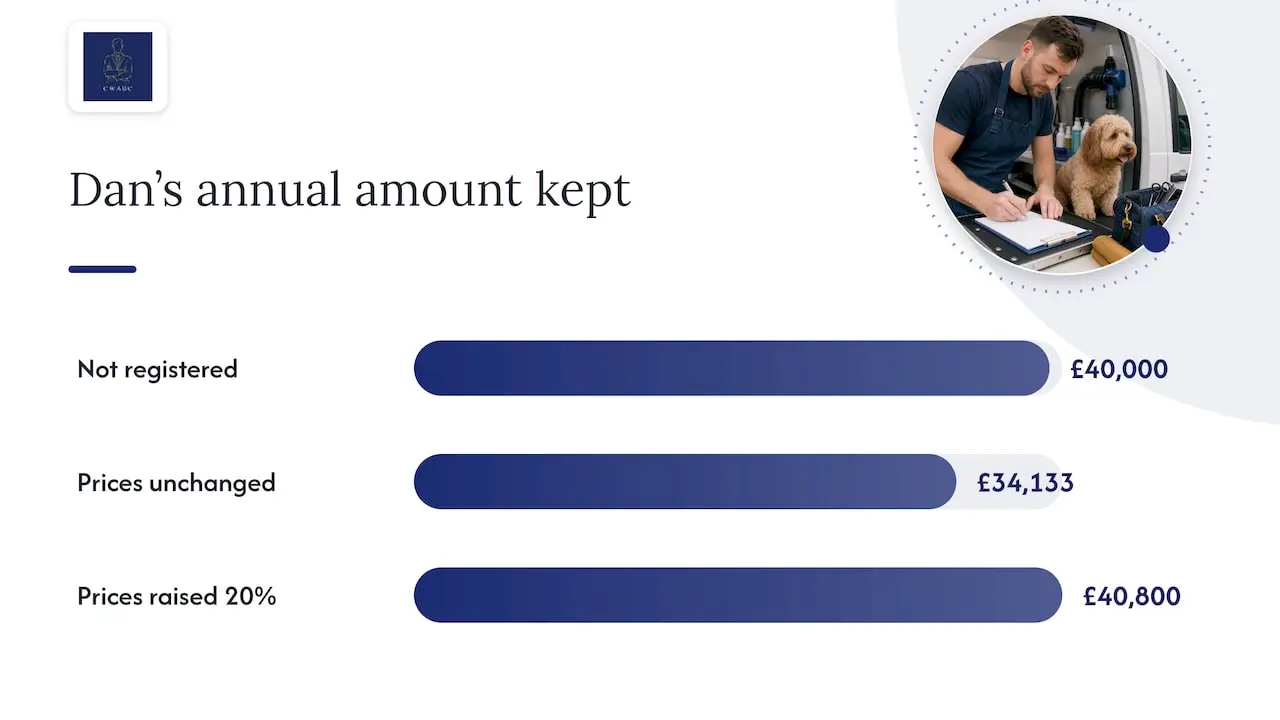
Dan turns over £40,000 a year, all to local households. His costs are £4,800 including VAT, so £800 of that is VAT he could reclaim.
If he registers and keeps his prices the same, his £40,000 of takings now include VAT. The VAT part is one-sixth of the total: £6,667 goes to HMRC and his income before VAT is £33,333. He reclaims £800 on costs.
| Not registered | Registered, prices unchanged | Registered, prices raised 20% | |
|---|---|---|---|
| Customers pay in total | £40,000 | £40,000 | £48,000 |
| VAT due to HMRC | £0 | £6,667 | £8,000 |
| VAT reclaimed on costs | £0 | £800 | £800 |
| Dan keeps, before other costs | £40,000 | £34,133 | £40,800 |
With unchanged prices Dan is about £5,867 a year worse off. If he lifts prices by 20%, his income is slightly higher, but his customers pay more, and some may go elsewhere. His competitors below the threshold will not need to do the same. Unless something else changes, such as a large equipment purchase or a move into selling to businesses, registration probably does not suit Dan yet.
What the two examples teach
The same turnover, the same threshold and the same law produce opposite answers. The difference is who the customer is, and whether they can reclaim the VAT.
Pricing: three ways to handle the 20%
If you do register and sell to consumers, you have three realistic choices:
- Raise prices so your take-home stays the same. This works if your market tolerates it.
- Hold prices and absorb VAT. Only sensible if your margins are healthy, and ideally temporary.
- Re-shape the offer, for example by bundling services, or targeting business customers who do not mind the VAT.
For business customers, the usual approach is to quote prices “plus VAT”, which is standard in B2B trade. Whichever route you pick, put the VAT-registered status and your nine-digit registration number on invoices. HMRC says the number must appear on all invoices you raise.
Online sellers have extra points to consider with marketplaces and overseas sales, which I cover in my guide to VAT registration for online sellers.
VAT schemes that change the maths
Once registered, you can look at schemes designed to simplify VAT or help cash flow. Whether any is right depends on your figures, so treat this as a map rather than a recommendation.
- Flat Rate Scheme. You pay HMRC a fixed percentage of your VAT-inclusive turnover, and you generally do not reclaim VAT on purchases. HMRC’s Flat Rate Scheme page sets out who can join (expected taxable turnover of £150,000 or less) and the percentages. It includes a higher 16.5% rate for businesses classed as “limited cost”, which can make the scheme poor value for businesses with few goods costs. This scheme is rarely a good fit for a business registering voluntarily in order to reclaim input VAT, because the reclaim largely disappears.
- Cash Accounting Scheme. You account for VAT when your customers pay you, and reclaim when you pay suppliers. HMRC’s guidance is useful if you invoice on credit terms, because you do not pay VAT on an invoice that has not yet been paid.
- Annual Accounting Scheme. You make payments towards your VAT during the year and file one return. HMRC explains it here. It reduces the number of returns, though not your record-keeping.
Schemes have their own eligibility rules and conditions, which HMRC can update, so confirm the current terms on the linked pages before you apply.
Admin and Making Tax Digital for VAT
Registration is a continuing commitment, not a one-off form. According to VAT Notice 700/1, a registered business must:
- keep VAT records;
- account for VAT from its registration date;
- submit VAT Returns for every tax period;
- use compatible software for Making Tax Digital, unless exempt.
In practice, that means digital records and returns filed from software, which is a good habit anyway. HMRC keeps VAT records for six years in its guidance on cancellation, so your own should be organised enough to last that long.
If you want to understand what the return itself involves, see my VAT return explained guide. For software requirements, my Making Tax Digital requirements checklist is a calm place to start. If you are choosing software, I set up and train clients on Xero, QuickBooks and FreeAgent through my accounting software setup in Kent service.
One more point: a registered business must pay HMRC any VAT it owes from the date it is registered. If you backdate, make sure your sales records for that period are complete.
Cash flow: the VAT pot
VAT is not your money. Between the date you invoice and the date you pay HMRC, it sits in your bank account and can feel like profit. It is not.
A few habits make this painless:
- Move the VAT portion of each payment into a separate savings pot weekly or monthly.
- Remember that on standard accounting you owe VAT when you invoice, even if the customer has not paid yet. A cash accounting scheme can ease that.
- If you reclaim a lot (startup spending, zero-rated sales), a refund can arrive after a return. Plan for the gap between spending and refund.
- Include VAT in your budget and forecast. If you would like help with that, my budgeting and forecasting support is built for exactly this.
When registering voluntarily often makes sense
This is a general pattern, not personal advice:
- you sell mostly to VAT-registered businesses;
- you sell zero-rated goods or services and have VAT-bearing costs;
- you have large startup or equipment costs coming up;
- you expect to pass the threshold soon, and want to be set up properly before you do;
- you want to be seen as an established supplier by larger customers.
When it often does not
- you sell mostly to consumers and cannot raise prices;
- you have very few costs with VAT;
- your sales are mostly exempt;
- the admin would be a real burden and you are far from the threshold;
- you are close to the threshold only for a short seasonal spike.
Getting out again
Registering is not a life sentence, but leaving is not automatic either. HMRC says a VAT-registered business with taxable turnover below £88,000 can ask to cancel. The business must apply, and must keep charging VAT until HMRC confirms the cancellation date. There are also compulsory cancellation cases, for instance if you stop trading, and HMRC expects notification within 30 days. My guide to the VAT deregistration threshold covers the detail. Because leaving takes thought, I prefer to model the decision before you go in.
My perspective
Most people ask me, “Can I register for VAT?” The better question is, “What will it do to my numbers?” I have spent over 30 years in finance, and I have seen both outcomes: the business that wished it had registered a year earlier, and the business that registered for a badge of respectability and then watched its margins shrink.
My approach is simple and practical. I look at who your customers are, what you actually spend, and how you price. Then I put your own figures into a side-by-side comparison, registered and unregistered, so the decision is based on numbers rather than worry. If you do register, I can help you choose the right VAT scheme, set up cloud software so your records are digital from day one, and file your returns on time.
You deal directly with me, and I explain everything in plain English. I would rather you made a calm, well-informed choice than a rushed one.
Chris
How I can help you decide
If you are weighing up voluntary registration, I can review your sales mix, your costs and your pricing, and give you a clear view of how registration might affect you. If you go ahead, I can handle your VAT registration and returns and set up your bookkeeping so reclaiming input VAT is straightforward. Pricing is agreed clearly upfront, so you know where you stand before we start.
If you are already close to the threshold, my guide on when to register for VAT is a good companion to this one. If you would like tidy digital records behind your VAT, my bookkeeping services are there for that.
FAQ
Can I register for VAT if my turnover is under £90,000?
Yes. HMRC lets you choose to register if your turnover is below £90,000. You must be running a business that makes, or intends to make, taxable supplies. A business that only sells VAT-exempt goods or services does not have to register.
Can I register before I start trading?
Yes, in many cases. Notice 700/1 says you may apply before making taxable supplies if you intend to. HMRC may ask for evidence, such as plans, quotes or a website, so keep that to hand.
Do I still need Making Tax Digital if I register voluntarily?
Yes. Once registered, you must keep digital records and file VAT Returns through compatible software, unless you are exempt or have applied for an exemption. The requirement follows registration, not turnover. My Making Tax Digital explained guide covers the basics.
Can I cancel my voluntary registration later?
Yes, if your taxable turnover is below £88,000, you can apply to HMRC to cancel. It is not automatic, and you must keep charging VAT until HMRC confirms the date. Leaving can have consequences for your pricing and costs, so plan it in advance.
Is voluntary registration worth it for a sole trader?
It depends on who you sell to and what you spend. A sole trader selling to VAT-registered businesses with notable costs often benefits. One selling to the public with few costs often does not. The only reliable way to know is to model your own figures.
Need help?
If you are unsure whether voluntary VAT registration suits your business, I can walk you through it, in plain English and without pressure. Get in touch through my contact page and tell me a little about what you sell and who you sell to. I will take it from there.
Sources
- Register for VAT: When to register for VAT, GOV.UK
- Register for VAT: How to register for VAT, GOV.UK
- Register for VAT: Cancel your VAT registration, GOV.UK
- How VAT works: VAT thresholds, GOV.UK
- Increasing the VAT registration threshold, GOV.UK
- VAT Notice 700/1: Who should register for VAT, GOV.UK
- VAT Flat Rate Scheme, GOV.UK
- VAT Cash Accounting Scheme, GOV.UK
- VAT Annual Accounting Scheme, GOV.UK
- How to register for VAT as a small business, FSB
Recommended
- Ahead of £90,000: VAT Registration for UK Small Businesses by AAT
- VAT return explained: small business guide for 2026
- Sole trader VAT threshold explained: 2026 guide
- Practitioner Test: Flat Rate VAT Scheme for UK SMEs and the 2% Trap
This article provides general information based on UK tax and accounting rules at the time of publication. It is not a substitute for advice tailored to your individual circumstances. Tax legislation and HMRC guidance may change. If you need advice about your specific situation, please contact me at CW Licensed Bookkeeper & Accountant.