
For most small UK businesses, the answer depends on three things: how many people you pay, how much of your month payroll takes, and how comfortable you are with the compliance that comes with it. A single-director company with simple pay can often run payroll in-house with good software. A small employer with several staff, pensions, sick pay and holiday pay to juggle usually saves time and stress by handing the work to an accountant or bookkeeper. One point applies either way: you stay legally responsible for payroll, even when someone else presses the buttons.
This guide walks through both routes calmly and practically, so you can decide without the last-minute mess.
TL;DR
- In-house payroll can work well if you have one or two employees (or just yourself as a director), simple pay and a few spare hours each month.
- Outsourcing tends to suit growing teams, regular statutory payments, pension duties, or owners who would rather spend those hours on the business.
- Responsibility never moves. GOV.UK says the employer remains legally responsible for completing all PAYE tasks, whoever does them.
- Compare total cost, not just the fee. Include your own time, software and the cost of mistakes.
- Start with the questions below. They take ten minutes and point to the right route for you.
Table of Contents
- What running payroll yourself actually involves
- What outsourcing payroll covers
- What stays with you, even when payroll is outsourced
- In-house vs outsourced: a side-by-side view
- The payroll tasks that take the time
- Example 1: a single-director company
- Example 2: a small employer with several staff
- What does each route cost?
- Ten-minute checklist: which route fits you?
- Choosing a provider well
- My perspective
- How I can help with payroll
- Moving from in-house to outsourced without the chaos
- FAQ
- Need help?
- Sources
What running payroll yourself actually involves
GOV.UK sets out two broad options: you can pay a payroll provider, such as a bureau or an accountant, or run payroll yourself using software. Running it yourself means you are the person who:
- registers as an employer with HMRC (His Majesty’s Revenue and Customs, the UK tax authority) and tells HMRC about your employees
- collects and keeps each employee’s details
- works out pay, tax, National Insurance and any deductions every pay period
- sends the figures to HMRC through Real Time Information (RTI) each time you pay someone
- provides payslips and year-end paperwork
- handles workplace pension duties and any statutory payments
If you are setting up for the first time, my guide on setting up PAYE as a first-time UK employer covers the registration steps in plain English.
Good payroll software takes much of the arithmetic out of this. Xero’s UK guidance explains that HMRC-recognised payroll software submits RTI electronically, applies tax-code updates and generates P60s, but it also makes clear that software does not remove your responsibility for reviewing the payroll and meeting your obligations. In other words, software does the sums. You still have to feed it the right information and check what comes out.
What outsourcing payroll covers
“Outsourcing” is a broad word, and it helps to know what you are actually buying. Providers differ, but the common models are:
- Payroll bureau style. The provider works alongside you. Commentary in AccountingWEB describes a bureau handling calculations, RTI submissions, pension contributions and compliance obligations, while you keep oversight and review payroll before it runs.
- Fully outsourced. The process moves almost entirely outside your business, with very little involvement from you on a standard pay run.
- Accountant or bookkeeper run payroll. Payroll sits alongside your bookkeeping and tax, so the person preparing your payslips also sees your accounts, your cash flow and your deadlines. This is the model I offer.
The same AccountingWEB piece makes a fair point: neither model is automatically better. The right choice depends on how complex your payroll is, how much internal resource you have, how much compliance risk you are comfortable with, and where the business is heading.
What stays with you, even when payroll is outsourced
This is the point that surprises many owners. GOV.UK states you must collect and keep the employee details your provider needs, and you remain responsible for completing all PAYE tasks, even if someone else does them for you.
In practice, that means you still:
- tell your provider about new starters, leavers, pay changes, hours, absences and benefits in good time
- review payslips and summaries before they go out
- make sure your provider has what it needs to pay HMRC on time
- make the decisions only an employer can make, such as contracts, pension choices and HR policies
A provider processes payroll. It does not become your employer, and it does not take over those decisions.
There is also a data protection side. Sprintlaw’s UK guidance explains that the employer is generally the UK GDPR controller for payroll data and a payroll provider is generally a processor. That means a sensible written arrangement with whoever handles your employees’ pay data, and a provider who treats security seriously. It is a good thing to ask any provider about, me included.
In-house vs outsourced: a side-by-side view
| What you are weighing | Doing it yourself | Outsourcing to an accountant or bookkeeper |
|---|---|---|
| Your time | You run every pay cycle and keep up with rule changes | Less time on routine runs, though you still supply information on time |
| Software | You choose, pay for and learn HMRC-recognised software | Usually handled by the provider, so check what is included |
| PAYE and RTI submissions | You submit on or before each pay day | Provider submits, you review and approve |
| Pensions | You manage enrolment, contributions and re-enrolment | Provider calculates and reports, you make the employer decisions |
| Statutory payments | You work out sick pay, maternity and similar pay yourself | Provider works them out from the information you give |
| Holiday pay | You calculate entitlement and pay for varied hours | Provider applies the rules to your records |
| Compliance | You keep up to date with changes | Provider keeps up to date, you remain accountable |
| Cost | Software fee plus your own time | A fee for the service, often replacing software and time |
| Best for | Very small teams with simple pay | Growing teams, varied pay, or owners short on time |
The payroll tasks that take the time
It is rarely the routine pay run that catches people out. It is everything around it. Here is where hours tend to go.
Payroll software
If you run payroll yourself you need HMRC-recognised software, and you need to keep it set up correctly: tax codes, pension settings, pay items, year-end rollover. Outsourcing moves that job to someone who works in the software every week. I use cloud systems as part of my work and can also help you set up and learn accounting software in Kent, so your payroll and your bookkeeping talk to each other.
PAYE submissions
Every time you pay someone, the figures go to HMRC. Late filing has a cost: Xero’s UK guidance says late RTI penalties start at £100 per month for small employers, and incorrect tax calculations can lead to back-payments and interest. A diary reminder and a routine fix most of this, but when you are busy or away, a provider who is working to the same calendar can be a safety net.
Pensions
Workplace pension duties arrive as soon as you have eligible staff. They involve assessing employees, enrolling them, calculating contributions each pay run and reporting to the pension provider. Check the current requirements on GOV.UK and with The Pensions Regulator before you start, as thresholds are reviewed. If you outsource, the contribution calculations and reports are usually part of the job, but the employer duties remain yours.
Statutory payments
Statutory sick pay, maternity, paternity and similar payments have their own rules and recovery routes. They are uncommon in a very small team and then arrive all at once. Xero lists support with complex statutory-pay and pension work among the main reasons businesses outsource. Whichever route you take, check the current rates and rules on GOV.UK for the tax year you are in, rather than relying on last year’s figures.
Holiday pay
Holiday pay is straightforward for fixed-hours staff and much trickier for part-time, shift or irregular-hours workers. If your team’s hours vary, this is one of the areas where a second pair of eyes helps, because the way you calculate it has to follow the current rules, and mistakes tend to surface when someone leaves.
Year end
Every April brings year-end reporting and, by 31 May, payslip-style P60s for employees still with you at the end of the tax year. My payroll year-end checklist for small UK employers lists the tasks in order so the period is calm instead of rushed. For wider planning, the small business tax deadline calendar shows where payroll sits among your other dates.
Example 1: a single-director company
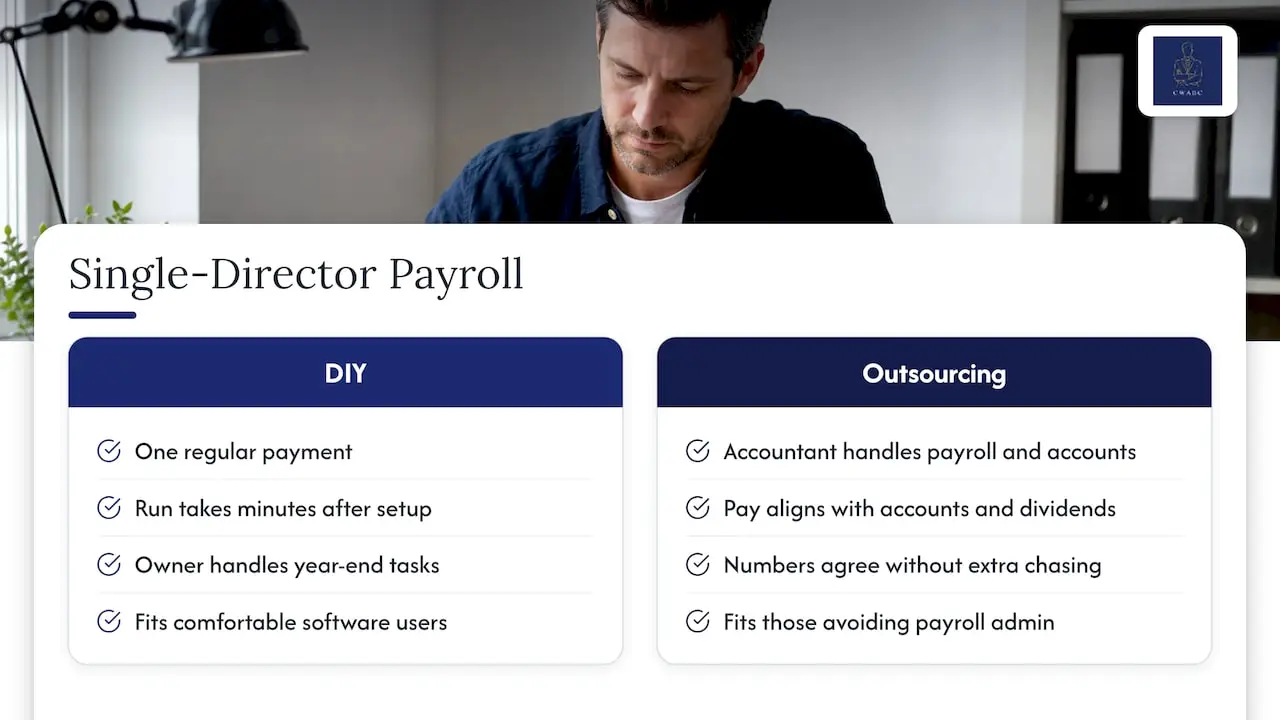
Imagine a limited company with one director and no other staff. The director takes a small salary through payroll and, perhaps, dividends. This is a common set-up for consultants, tradespeople and creative businesses, and the payroll itself is light: one person, one regular payment, one RTI submission per pay period.
Doing it yourself can make sense here. The pay run takes minutes once the software is set up. The risk is not the monthly run but the setup and the extras: choosing a salary that fits your wider tax planning, keeping the year-end tasks in order, and making sure payroll figures match your company accounts.
Outsourcing makes sense if you would rather not think about payroll at all, or if the director’s pay needs to line up with accounts, Corporation Tax and dividends prepared by the same person. Having one accountant look after payroll and year-end accounts means the numbers agree without extra chasing. My Corporation Tax and accounts support sits naturally alongside it.
A sensible rule of thumb for this situation: if payroll takes you only a few minutes and you are comfortable with the software, keep it in-house. If you notice you are putting it off, or you are unsure how salary and dividends should work together, ask for help.
Example 2: a small employer with several staff
Now picture a small business with, say, six employees: a mix of full-time and part-time, one on a variable-hours contract, all in a workplace pension, and one currently off sick. Every pay period now involves several moving parts:
- hours and overtime need collecting and checking
- one employee’s statutory sick pay needs working out
- holiday pay for the variable-hours person needs calculating
- pension contributions need calculating and reporting
- a new starter’s tax code and starter details need handling
- the figures need submitting to HMRC on time
None of it is impossible. But it adds up to a recurring block of owner time, and the risk of a mistake rises with each moving part. Xero suggests that outsourcing may suit businesses with five or more employees, or where payroll takes four or more hours a month. Treat that as a guide, not a rule: it comes from a software company’s own guidance, and your own mix of staff and pay matters more than the headcount.
For a business like this, outsourcing typically gives you back predictable hours, a consistent process and someone who spots problems before they reach an employee’s payslip. If you are in construction, I can also look after CIS and payroll support in the same place.
What does each route cost?
I am not going to quote prices for payroll here, because costs depend on your headcount, pay frequency and how much of the process you want handled. What is useful is knowing what to count on each side.
In-house costs to include:
- the payroll software subscription
- your time for each pay run, year end and rule change (put an hourly value on it)
- time learning new requirements
- the cost of any penalty, interest or back-payment if something goes wrong
Outsourced costs to include:
- the provider’s fee, ideally agreed clearly upfront
- what is and is not included, such as payslips, pension reporting, year-end filings and queries
- the time you still spend providing information and reviewing runs
Xero’s UK guide notes that outsourcing usually costs more than software alone and that service scope and quality vary, which is exactly why you should ask for a written scope before agreeing anything. For a fuller look at this, read what payroll outsourcing really costs UK employers.
The fair comparison is rarely “software fee versus provider fee”. It is “software fee plus my hours plus my risk” versus “provider fee plus my review time”.
Ten-minute checklist: which route fits you?
Work through these questions honestly. They echo the factors Xero recommends considering: employee numbers, time spent on payroll, pay complexity, pension and statutory-pay needs, growth plans, budget and comfort with compliance.
- How many people do you pay now, and in twelve months? Rapid growth favours a provider that can scale with you.
- How long does payroll really take? Include chasing hours, checking figures and filing, not just the pay run.
- How varied is pay? Fixed salaries are simple. Overtime, commission, shifts and variable hours are not.
- Do you have pensions, sick pay or family-related leave to manage? These raise the complexity quickly.
- Who covers when you are away or ill? Payroll deadlines do not move for holidays.
- How would you feel about a penalty letter? If the answer is “anxious”, that is useful information.
- What else could you do with those hours? Selling, serving customers or resting count.
Mostly “simple, small, spare time”: in-house is a reasonable choice. Mostly “varied, growing, short of time”: outsourcing is worth a conversation.
Choosing a provider well
If you do decide to outsource, a few practical checks protect you:
- Agree the scope in writing. Which pay runs, which filings, which employee queries and which year-end tasks are included?
- Know who does the work. With a sole practitioner you deal with one person throughout, which can make communication simpler.
- Agree your deadlines. When must hours and changes reach the provider for each pay date?
- Ask how your data is kept safe. Sprintlaw recommends looking at security measures, data locations, sub-processors, certifications and breach history, and putting a proper data-processing agreement in place.
- Check what happens if something goes wrong. Find out how errors are corrected and how quickly you will be told.
- Keep your own copies of key records. You are responsible for them.
My page on hiring an accountant for a small business has a wider checklist, and why outsourcing bookkeeping helps small businesses explains how payroll and bookkeeping fit together.
My perspective
I come at this as a sole practitioner, so I see payroll as part of the whole picture, not a separate chore. Most payroll problems I would want to prevent start somewhere else: hours not recorded, a starter’s details arriving late, or payroll figures that do not match the books.
That is why I like to look after payroll alongside bookkeeping and tax where I can. When the same person sees your pay runs, your accounts and your deadlines, there are fewer hand-offs and fewer surprises. You deal directly with me, and I explain things in plain English without unnecessary jargon.
I also think you should be able to keep control. Outsourcing does not mean switching off. You still review and approve, and I will tell you what I need and by when. My aim is to cut the admin and the worry, not to make you dependent on me.
If you would prefer to run payroll yourself, I am happy to help you set it up properly so you start on solid ground.
Chris
How I can help with payroll
I am Chris White, an AAT Licensed Accountant based in Hildenborough near Tonbridge, and I support small employers and company directors in Tonbridge, Sevenoaks and across Kent, as well as remotely throughout the UK. I can help you with payroll set-up, regular pay runs, PAYE submissions, year-end tasks and CIS for construction businesses, using secure digital workflows so your records stay organised and ready for HMRC.
If you are not sure whether to keep payroll in-house, we can talk through your situation and work out what would reduce your admin. You can see how it fits with my wider services on my accounting services page, or read about my payroll and CIS support. Pricing is tailored to you and agreed clearly upfront.
Moving from in-house to outsourced without the chaos
Switching mid-year is common and perfectly manageable. A calm handover usually looks like this:
- Choose a start point. Many people start at the beginning of a tax year or a pay period, to keep records clean.
- Gather your records. Employee details, tax codes, year-to-date figures, pension information and recent payslips.
- Agree who does what. Write down deadlines for hours, changes and approvals.
- Run a first cycle with care. Review the first payslips together before they go out.
- Keep a copy of everything. Store your own records securely, as the legal responsibility remains with you.
Going the other way, from outsourced to in-house, follows the same logic in reverse.
FAQ
Is it cheaper to do payroll myself?
Often the software fee is lower than a provider’s fee, but that is only part of the picture. Your own time, the cost of learning rule changes and the risk of penalties all belong in the comparison. For a single-director company with simple pay, in-house can be the cheaper route. As staff numbers and pay complexity grow, outsourcing becomes easier to justify.
If I outsource payroll, who is responsible if there is a mistake?
In law, you are. GOV.UK says the employer remains responsible for completing all PAYE tasks, even when a provider does them. That is why clear scope, deadlines and a review step matter, and why you should agree with your provider how errors are put right.
What is a payroll bureau?
A payroll bureau is a provider that handles payroll calculations and submissions, typically working alongside your own resource while you retain oversight. AccountingWEB describes the bureau model as handling calculations, RTI, pensions and compliance, while fully outsourced payroll takes the process almost entirely out of the business. An accountant can offer either approach.
How many employees before I should outsource?
There is no official number. Xero’s guidance says outsourcing may suit businesses with five or more employees or payroll taking four or more hours monthly, but that is a rule of thumb. A team of three with variable hours and a pension can be harder to run than a team of six on fixed salaries.
Can I switch back to doing payroll myself later?
Yes. You can change route at a sensible point, such as the start of a tax year, as long as records and year-to-date figures are handed over cleanly. Keep your own copies of key employee and payroll records throughout, so a move in either direction is straightforward.
Need help?
If you would like to talk through payroll for your business, whether that is setting it up, taking it off your plate or checking what you currently do, please get in touch with me. I will give you a clear, jargon-free view of the options and agree what is involved upfront. This article is general information, not personal tax or legal advice.
Sources
- GOV.UK: PAYE and payroll for employers, choose how to run payroll
- AccountingWEB: Payroll bureau vs outsourcing, what accountants need to know
- Xero UK: Payroll outsourcing, how it works, costs and benefits
- Xero UK: Payroll software for small businesses, is it worth it?
- Sprintlaw UK: Payroll data in the UK, GDPR, HMRC records and secure handling
Recommended
- What does payroll outsourcing really cost UK employers?
- Why Outsourcing Bookkeeping Helps Small Businesses
- Set Up PAYE in 15 Minutes for First Time UK Employers
- P60s by 31 May: payroll year end checklist for small UK employers, AAT
This article provides general information based on UK tax and accounting rules at the time of publication. It is not a substitute for advice tailored to your individual circumstances. Tax legislation and HMRC guidance may change. If you need advice about your specific situation, please contact me at CW Licensed Bookkeeper & Accountant.