Replacement of Domestic Items Relief lets you deduct the cost of replacing furniture, appliances and similar household items in a residential let, when you work out your taxable rental profit. It covers the replacement of an item you provided, not the first time you furnish a property. This guide explains what qualifies, how upgrades and disposal proceeds change the figure, and how it differs from repairs and capital costs. It ends with a worked example you can copy.
If rental paperwork leaves you feeling unsure, you are in good company. This is one of the areas where landlords either miss a perfectly good deduction or claim something HMRC (His Majesty’s Revenue and Customs, the UK tax authority) would not accept. Let’s take it calmly, step by step.
TL;DR
- The relief gives a deduction for the cost of replacing a domestic item you supplied in a let home. It does not cover the initial purchase.
- You claim the full cost in the year you incur it. There is no spreading over several years.
- If the new item is a genuine upgrade, you can only deduct the cost of a like-for-like equivalent. A sensible modern equivalent is not treated as an upgrade.
- Money you get for the old item reduces the claim, and genuine incidental costs such as delivery can increase it.
- Repairs to the building and fixtures are a separate category, claimed as ordinary property expenses.
Table of Contents
- What the relief is, in plain English
- The four conditions you need to meet
- What counts as a domestic item
- Replacement, repair or capital improvement?
- The exclusion for initial purchases
- Upgrades: what happens if the new item is better
- Disposal proceeds and incidental costs
- Situations where the relief does not apply
- A worked example
- Records to keep
- My perspective as a bookkeeper and accountant
- How I can help with your rental figures
- FAQ
- Need help?
- Sources
What the relief is, in plain English
Before April 2016, furnished landlords could usually choose between a wear and tear allowance and a renewals basis. The current relief came in for spending on or after 6 April 2016, and HMRC’s Property Income Manual explains that it applies to income tax from that date and to corporation tax from 1 April 2016. The rule itself sits in section 311A of the Income Tax (Trading and Other Income) Act 2005.
The idea is simple. Normally, buying something that lasts, such as a sofa, is capital expenditure and cannot be set against rental income. This relief makes an exception for replacing certain items you provided for your tenant’s use. GOV.UK’s rental income guidance confirms that replacing furnishings or equipment is not a maintenance or repair cost, but may qualify for this relief.
It applies whether you are an individual landlord taxed through Self Assessment or a company landlord within corporation tax. This guide focuses on individuals, as most small landlords are.
The four conditions you need to meet
HMRC sets out four conditions. I have put them in everyday language below. If you want a longer walk-through, I have a separate guide on the four conditions to claim replacement of domestic items relief.
- You run a property business that lets a dwelling. A rental of a house or flat is the typical case.
- An old item you provided is replaced by a new one. The new item must be for the exclusive use of the tenant in that home, and the old item must no longer be available to them.
- The cost would normally be blocked only by the capital rule. In other words, it would be a fair business expense if it were not capital.
- You have not claimed capital allowances on that new item.
When all four are met, you can deduct the expenditure on the new item, subject to the adjustments below.
What counts as a domestic item
Think of items that are movable and used in the home, not things fixed to the building. HMRC’s guidance gives examples such as beds, sofas, carpets, curtains, fridges, freezers and kitchenware. In practice, the following usually fit:
| Category | Typical examples |
|---|---|
| Furniture | Beds, sofas, tables, chairs, wardrobes |
| Soft furnishings | Curtains, cushions, bedding, rugs |
| Floor coverings | Carpets and similar coverings |
| Appliances | Fridge, freezer, washing machine, cooker, microwave |
| Household goods | Crockery, cutlery, pots, pans, lamps |
The manual’s list is not exhaustive, and the legislation turns on whether an item is a domestic item rather than a fixture. If you are unsure about a specific item, check the manual page or ask me before you claim it.
Where fixtures and fittings sit
Items that form part of the building, such as a fitted bath, washbasin or integrated boiler, are generally treated differently. Replacing them like for like is usually a repair, claimed as an ordinary property expense. GOV.UK lists the costs of maintenance and repairs as allowable, while significant improvements are not.
Replacement, repair or capital improvement?
This is the question landlords ask me most. Three different treatments can apply to money spent on a rental home:
| Type of spend | Example | Tax treatment |
|---|---|---|
| Repair | Replacing roof tiles blown off in a storm | Deductible as a revenue expense |
| Replacement of a domestic item | New sofa replacing a worn one | Deductible under this relief, subject to conditions |
| Capital expenditure | Building an extension, or first-time furnishing | Not deductible against rental income |
HMRC defines a repair as restoring an asset by replacing subsidiary parts of the whole. A significant improvement beyond the original asset is not a repair. For a checklist on that boundary, see my guide on repairs versus capital improvements.
A quick test I suggest:
- Is it part of the building or fixed to it? Think repair or improvement.
- Is it movable and used by the tenant in the home? Think domestic item.
- Is it the very first time you have provided it? Then it is capital, and not relieved.
The exclusion for initial purchases
This is the rule that catches people out. The relief covers replacement, not the first purchase. If you buy a flat and furnish it from scratch before the first tenant moves in, that spending is capital and is not deductible against rent. HMRC’s manual says the relief allows a deduction for the replacement (not initial purchase) of domestic items.
Two practical points follow:
- Keep the date and invoice for the original items. They help show later that a purchase was a replacement.
- If you add an item the property never had, such as a dishwasher in a kitchen without one, that is not a replacement. It is a new provision.
Upgrades: what happens if the new item is better
You do not have to buy the cheapest item. HMRC’s guidance says that if the new item is of broadly the same standard as the old one and is not an improvement, the deduction is the cost of the new item. The manual adds that a brand new item is not automatically an improvement just because the old one was worn.
It gives the example of a new budget washing machine costing around £200, which is not an improvement over a five-year-old machine that cost about the same.
If the new item is not substantially of the same standard, the deduction is the lesser of:
- the cost of the new item, or
- the cost you would have incurred replacing the old item with a like-for-like equivalent.
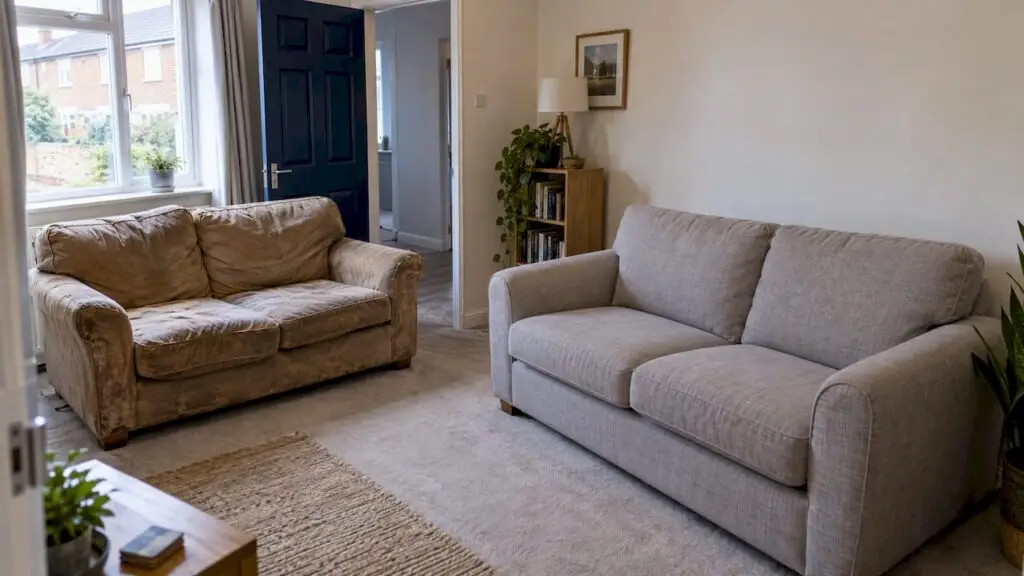
So swapping a basic sofa for a pricey sofa bed means you claim the cost of an equivalent basic sofa, and the extra is disallowed. A reasonable modern equivalent, such as an energy-efficient fridge replacing an old one because that is what shops now sell, is generally not treated as an improvement.
Disposal proceeds and incidental costs
Two adjustments sit around the headline cost:
- Disposal proceeds. If you sell, trade in or otherwise get money for the old item, the deduction is reduced by that amount. A cash payment from a buyer or a trade-in credit counts.
- Incidental costs. If you spend capital money on delivery, installation or disposal of the old item, the deduction is increased. The manual says incidental capital expenditure connected with the disposal of the old item or purchase of the new one increases the deduction.
If you simply give an old item to the tenant, to a charity or to the tip, there are usually no proceeds to deduct. Keep a note of what happened to the old item either way.
Situations where the relief does not apply
The manual also lists cases where relief is not available. The main ones for individual landlords are:
- a dwelling that is, in full or part, a furnished holiday let, which has its own treatment (my guide on furnished holiday let tax changes after April 2026 covers what has altered); and
- a home where you received Rent-a-Room receipts and claimed Rent-a-Room relief on them.
It also does not apply if you claimed capital allowances on the item, and, as above, it does not cover the initial purchase. If your circumstances have changed recently, check the current wording on GOV.UK before relying on an older article, including this one.
A worked example
Here is an illustration, with made-up figures. Say you let a two-bedroom furnished flat in Kent to one tenant, and during the 2026 to 2027 tax year you replace several items.
| Item | New cost | Like-for-like cost | Old item proceeds | Incidental costs | Deduction |
|---|---|---|---|---|---|
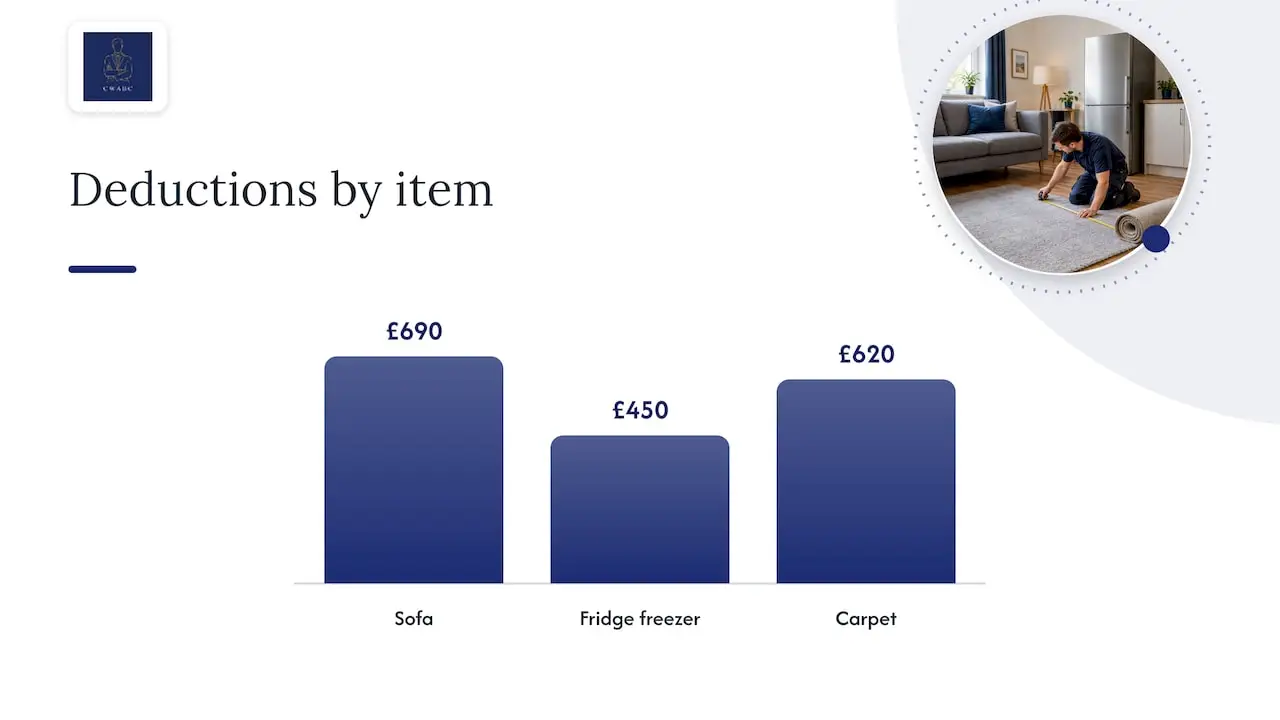
| Sofa (upgraded to a leather corner sofa) | £1,400 | £700 | £40 | £30 delivery | £690 |
| Fridge freezer (modern equivalent) | £450 | £450 | £0 | £0 | £450 |
| Living room carpet | £620 | £620 | £0 | £0 | £620 |
| Total | £1,760 |
How I get each line:
- Sofa. The new one is a clear upgrade, so you use the lesser figure: £700 (the like-for-like cost). Take off the £40 you got for the old sofa and add £30 delivery. That gives £690.
- Fridge freezer. The old one had failed and the new one is a standard current model. Not an improvement, so the full £450 is deductible.
- Carpet. Same standard, so £620.
In the same year, you pay £180 to repair a leaking pipe under the sink. That is a repair to the building and goes in as an ordinary property expense, separate from this relief.
If your rental income for the year is £14,000 and your other allowable expenses are £2,100, your profit calculation looks like this:
- Rent received: £14,000
- Other allowable expenses (including the £180 repair): £2,100
- Replacement of domestic items relief: £1,760
- Taxable property profit: £10,140
The relief is a deduction from profit, not a refund. How much tax it saves depends on your other income and the rates that apply to you, so I would not quote a saving without seeing your whole return.
This example is for illustration only. It is not personal tax advice, and your own figures and evidence will differ.
Records to keep
HMRC can ask how you worked out a deduction. I suggest keeping, for each replacement:
- the invoice or receipt for the new item;
- a note of what it replaced and when the old item was removed;
- any evidence of the like-for-like cost, such as a screenshot of a comparable basic model;
- proof of what you received for the old item, if anything; and
- a short note of why an upgrade, if any, was a reasonable modern equivalent.
For how to set this up simply, see my practical landlord bookkeeping guide. If the figures feed into your return, my guide to the property income tax return shows where they go.
My perspective as a bookkeeper and accountant
The most common mistake I see is not an exotic one. It is mixing everything into a single “repairs” line. A new boiler, a replacement sofa and a patched roof are three different treatments, and lumping them together makes the property income calculation hard to defend later.
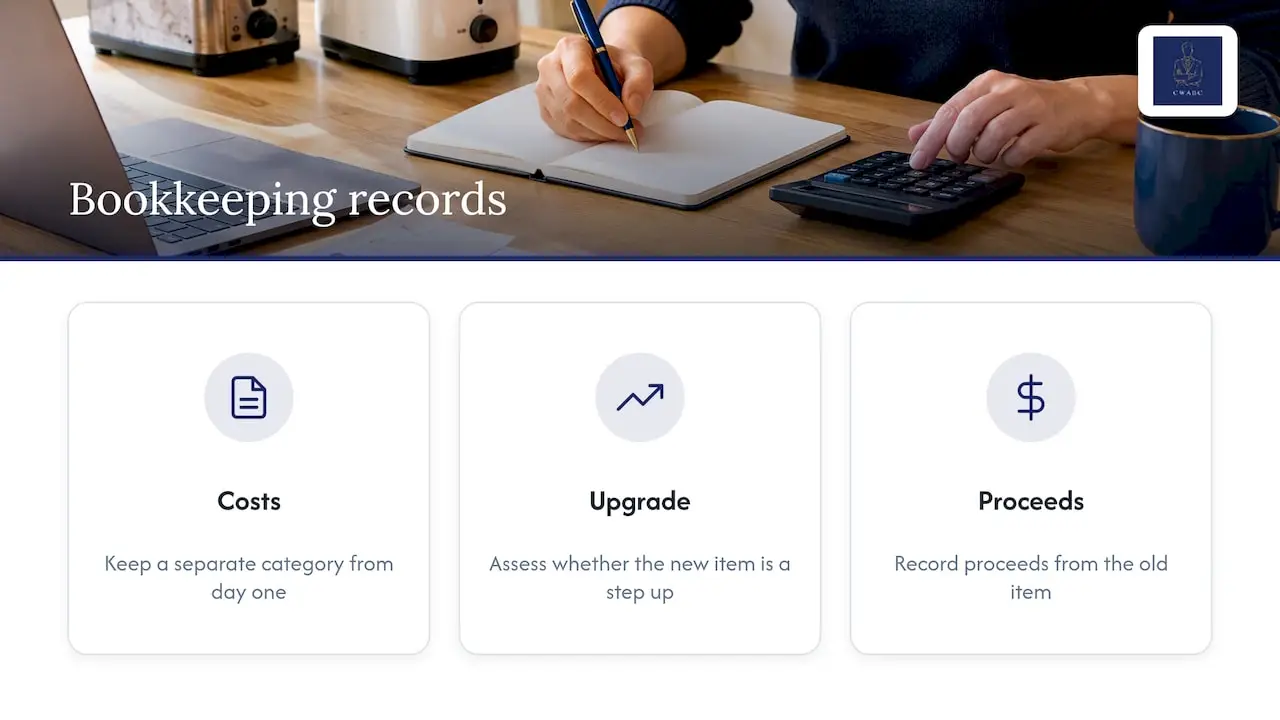
My approach is to keep a separate category in the bookkeeping for replacement domestic items from day one. Then at the end of the year the figures are ready, the upgrade question has already been thought about, and the disposal proceeds have not been forgotten.
I also find landlords worry unnecessarily that a better appliance will wreck their claim. In most cases, buying a sensible modern equivalent is fine. The adjustment bites when the new item is clearly a step up in quality, such as a premium sofa bed in place of a basic sofa.
What matters is a clear record, made at the time, and a calm, honest calculation. That is how I work with clients: directly, in plain English, and without guarantees about outcomes, because the facts of each property decide the answer.
— Chris
How I can help with your rental figures
I am Chris White, an AAT-licensed accountant based in Hildenborough near Tonbridge, and I support landlords across Kent and remotely throughout the UK. Here is how I can help with this topic:
- Going through your receipts to separate repairs, replacement domestic items and capital costs.
- Working out the deduction where you upgraded an item or received money for the old one.
- Setting up your records in cloud software so the rental figures stay organised and ready for HMRC.
- Preparing an accurate property income calculation for your Self Assessment return.
If you would like to see what is on offer, look at my rental reporting and bookkeeping service, or my Self Assessment tax return service, which starts from £250 as a one-off fee. Other work is priced to your situation and agreed clearly upfront.
For wider reading, my guides on residential landlord tax and rental income tax cover the surrounding rules.
FAQ
What qualifies for replacement of domestic items relief?
Movable household items you provided for a tenant’s use in a let home, such as furniture, carpets, curtains, fridges, freezers and kitchenware. The new item must replace an old one that is no longer available to the tenant. Fixtures that form part of the building are usually dealt with as repairs instead.
Can I claim for furnishing a property for the first time?
No. HMRC’s manual says the relief covers replacement, not the initial purchase. First-time furnishing is capital expenditure and is not deductible against rental income. Keep the original invoices so a later replacement is easy to evidence.
Who is responsible for replacing white goods in a rental property?
Generally, if you supply an appliance, you are responsible for keeping it safe and working. GOV.UK’s private renting guidance sets out what landlords must repair. Check your tenancy agreement too, as it should say who deals with items you provide.
Can I spread the claim over several years?
No. The deduction is taken in the tax year you incur the expense, and you cannot stagger it. That is one difference from capital allowances, which you cannot claim on the same item anyway.
Need help?
If you would like help identifying allowable costs and preparing your property income calculation, please get in touch through my contact page. I will explain things in plain English and agree the scope and fee with you upfront.
Sources
- PIM3210: Furnished lettings: Replacement of domestic items relief (HMRC)
- Income Tax (Trading and Other Income) Act 2005, section 311A
- Work out your rental income when you let property (GOV.UK)
- PIM2025: Deductions: repairs: overview (HMRC)
- Private renting: Repairs (GOV.UK)