
Your January bill is often higher because it combines the previous year’s balancing payment with the first payment on account for the next year. These payments on account feel like extra tax, but they are not. They are advance instalments towards a bill you have not finished building up yet, collected early so you are not hit with one enormous payment the following January.
TL;DR:
- Payments on account are based on half of the previous year’s Income Tax and Class 4 NICs, not including Capital Gains Tax or student loan repayments.
- They are only applicable if your last Self Assessment bill was over £1,000 and less than 80% was collected at source through PAYE.
- The total January bill combines the previous year’s balancing payment with the first installment toward the next year, totaling roughly double the last year’s liability in some cases.
- Reducing payments on account is sensible only if you have solid evidence of lower income before the January deadline and are prepared to pay interest if your liability exceeds your reduced estimate.
- Making quarterly digital updates does not affect payment deadlines, which remain at January 31 and July 31, but reconciling records regularly helps avoid surprises.
Table of Contents
- Who has to make payments on account
- How payments on account are calculated, with a worked example
- What’s included in your payments on account, and what isn’t
- Reducing your payments on account: when it’s sensible and when it’s risky
- Deadlines and how to pay what you owe
- Budgeting tips, and what MTD quarterly updates actually mean
- Mistakes I see, and when it’s worth asking for help
- How I can help with Self Assessment and bookkeeping
- FAQ
- Sources
Who has to make payments on account
I get asked this constantly, so let’s clear it up straight away. You usually fall into the payments on account system if your last Self Assessment bill was £1,000 or more, unless more than 80% of your tax was already collected at source, for example through PAYE.
In practice, this catches:
- Sole traders whose profits push their tax bill above the £1,000 threshold.
- Landlords whose rental income results in tax owed above that figure.
- Partners in a business partnership who report their share of profits.
If this is your first year in Self Assessment, you will not have a prior year’s bill to base a payment on account on, so the system kicks in only once you clear that £1,000 mark for the first time.
How payments on account are calculated, with a worked example
The rule is simple once you see it written down: each payment on account is normally half of the tax you owed the previous year. That figure covers Income Tax and Class 4 National Insurance contributions, nothing else.
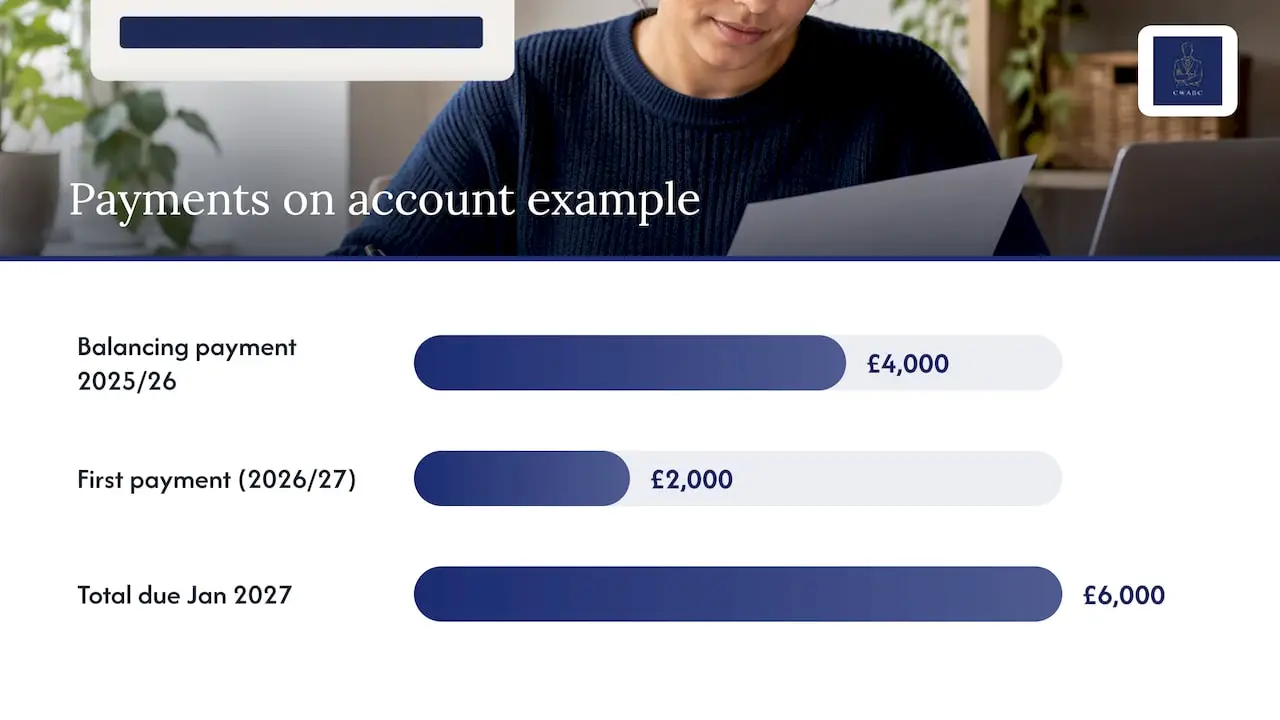
Your January bill often feels higher because it includes both the balancing payment for the past year and the first payment on account towards the next year. This combination can make the total seem larger, even though it simply reflects two payments rather than an error or extra tax.
Here’s a simple example to illustrate payments on account in a first year:
- Suppose your 2025/26 Self Assessment tax bill (Income Tax and Class 4 NICs) is £4,000, exceeding the £1,000 threshold for payments on account.
- Without earlier payments on account, you must pay the full £4,000 balancing payment plus a first payment on account of £2,000 (half of £4,000).
- So, your January 2027 bill totals £6,000.
- Then, your second £2,000 payment on account is due by 31 July 2027, with any remaining balancing payment due the following January after filing your 2026/27 return.
These figures assume no other adjustments and are meant to clarify how advance payments work, not to predict actual liabilities.
None of that £6,000 or £2,000 is additional tax. It is your 2025/26 bill plus an advance slice of 2026/27, paid earlier than you might expect.
What’s included in your payments on account, and what isn’t
Payments on account include only your Income Tax and Class 4 National Insurance contributions from Self Assessment. Other amounts often confused with these payments are:
- Capital Gains Tax, which is worked out and paid separately.
- Student loan repayments collected via Self Assessment.
- Tax collected through PAYE, such as from employment income alongside self-employment.
Separating these helps ensure your budgeting is accurate.
I’ve seen landlords budget for a tax bill that quietly includes a Capital Gains Tax charge from a property sale, then wonder why the January figure from HMRC’s guidance looks smaller than expected. Separating these out before you start forecasting saves that surprise.
Reducing your payments on account: when it’s sensible and when it’s risky
If you genuinely expect your income to fall, you can apply to reduce your payments on account using HMRC’s online service or form SA303. The claim needs to be made by 31 January following the end of the tax year, so timing matters.
- Use this route when you have solid evidence of lower income, such as a lost contract or reduced rental portfolio.
- Filing your return early can also lower your payments on account automatically, because HMRC recalculates based on your actual results.
- Keep records such as forecasts or client correspondence to support your reduction, in case HMRC queries it.
The risk cuts the other way too. If you reduce your payments too far and your actual liability turns out higher, interest is charged on the shortfall from the date the payment was originally due.
Pro Tip: Only reduce payments on account when you have a genuine reason to expect lower income, not simply because cash is tight this month.
Deadlines and how to pay what you owe
Two dates matter every year, and missing either can trigger penalties and interest.
- 31 January covers your balancing payment for the year just ended plus your first payment on account for the coming year.
- 31 July covers your second payment on account for the same coming year.
- You can pay by direct debit, bank transfer or debit card through HMRC’s online services, allowing enough time for the payment to clear before the deadline.
- Check your HMRC online account afterwards to confirm the payment has been received and allocated correctly.
Budgeting tips, and what MTD quarterly updates actually mean
Cash-flow stress around January usually comes from treating the bill as covering one year, not two overlapping liabilities. A bit of forecasting fixes most of it.
- Base your monthly savings pot on last year’s bill, then adjust once you have a clearer picture of this year’s profits by using sales revenue forecasting techniques.
- Set aside a fixed percentage of income each month rather than scrambling in December.
- Use your accounting software’s tax estimate features to track what you are likely to owe as the year progresses.
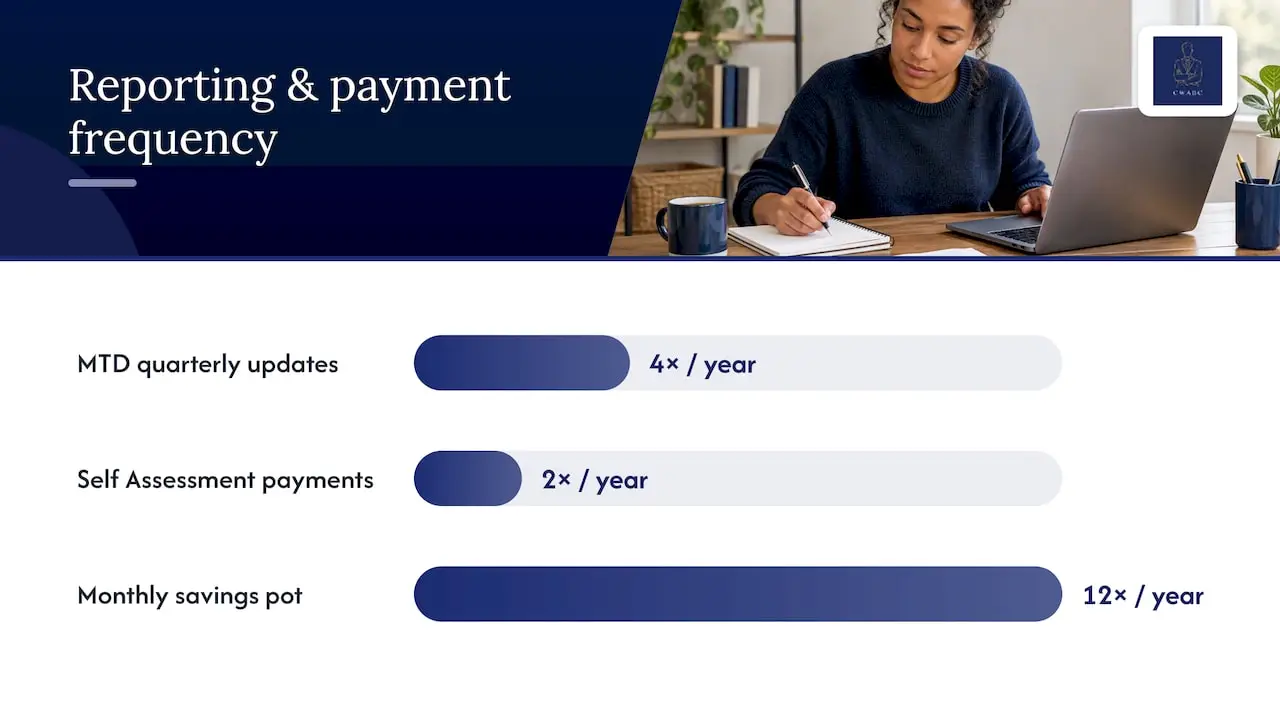
One point trips up a lot of people using Making Tax Digital for Income Tax: quarterly updates are estimates built from your digital records, not quarterly tax payments. Your payment dates stay fixed at 31 January and 31 July regardless of how often you submit updates.
Pro Tip: Reconcile your digital records every quarter, not just at year end, so your January figure never comes as a shock.
Mistakes I see, and when it’s worth asking for help
I hold an AAT licence and run a paperless, technology-led practice using Xero, QuickBooks and FreeAgent to keep client records accurate and ready for HMRC. Over years of preparing Self Assessment returns, the same errors come up repeatedly: allowable expenses left off because a client did not realise they qualified, and payments on account budgeted for as if they were the whole story rather than half of it.
Getting these details wrong rarely causes a disaster, but it does cause stress, usually in January when cash is already tight. If your situation has changed significantly this year, through a new property, a lost contract or a change in trading pattern, that is usually the moment to get a second opinion rather than guess.
— Chris
How I can help with Self Assessment and bookkeeping
If working through balancing payments and payments on account by hand sounds like more admin than you want, I prepare Self Assessment tax returns directly, with pricing agreed upfront rather than buried in small print.

Alongside returns, I offer bookkeeping services to keep your records accurate throughout the year, so your tax estimate is never a guess, and Making Tax Digital for Income Tax support if quarterly reporting requirements apply to you. Clients deal with me directly, so you get the same person explaining the numbers each time, not a rotating queue of staff. If you would like to talk through your own figures, get in touch and we can work out what your January bill is likely to look like before it lands.
FAQ
Why do I have to pay next year’s tax in advance?
HMRC collects tax on account to spread your liability across the year rather than leaving one large bill at the end. Each payment on account is based on half of what you owed the previous year, paid in January and July ahead of your final figures being confirmed.
How do I reduce my payments on account?
You can apply using HMRC’s online service or form SA303 if you expect your income to fall, with the claim made by 31 January following the end of the tax year. Reducing too far means interest is charged on any shortfall once your actual liability is known.
What does a first payment on account mean?
A first payment on account is the instalment due on 31 January towards your next year’s Self Assessment bill, usually half of your previous year’s liability. It sits alongside, not instead of, the balancing payment for the year that has just ended.
How are Self Assessment payments on account calculated?
Each payment on account is normally half of your Income Tax and Class 4 NICs from the previous year’s return, split equally between 31 January and 31 July. Capital Gains Tax and student loan repayments are never included in this calculation.