Private Residence Relief usually exempts the gain for every period you genuinely lived in the property as your main home, plus the final nine months of ownership. If you then let the whole place out to tenants, you must apportion the gain for that letting period and pay Capital Gains Tax on it. Letting Relief will rarely help here since it now only applies where you shared occupancy with a tenant, and you must report and pay any tax due within 60 days of completion.
TL;DR:
- The nine-month final exemption was reduced from 18 to nine months for sales after April 6, 2020, which limits relief for long-term landlords.
- Letting Relief now only applies if you shared occupation with a tenant, meaning full-let properties after moving out generally do not qualify for additional relief.
- The qualifying period is established by detailed occupation and absence records, as deemed occupation rules only apply if the property was your main residence before and after absences.
- Accurate documentation of dates, costs, and occupancy is crucial, especially since the PRR fraction heavily depends on precise timelines and isn’t automatically supportive of Letting Relief.
- UK residents must report and pay Capital Gains Tax within 60 days of property sale, with detailed records required to substantiate your PRR and relief claims if questioned later.
Table of Contents
- Private Residence Relief and what counts as your main residence
- Periods of absence and ‘deemed occupation’ rules
- Letting Relief since 2020: the shared occupancy requirement
- Step-by-step calculation: working out the chargeable gain
- Reporting and paying CGT within 60 days
- Records and evidence to support your PRR claim
- When exclusive business use affects Private Residence Relief
- How I help clients with PRR and CGT calculations
- How joint ownership changes the PRR calculation
- PRR alongside rollover relief and gifted property rules
- What the rules actually reward, and what people get wrong
- Get help calculating and reporting your PRR claim
- Sources
- FAQ
Private Residence Relief and what counts as your main residence
Private Residence Relief, usually shortened to PRR, is the relief that lets most people sell their home without paying Capital Gains Tax on the increase in its value. It applies to the gain built up while the property was your only or main residence, and HMRC’s HS283 Private Residence Relief helpsheet is the primary reference point for the rules.
The legal test is not simply where your name sits on the council tax bill. HMRC looks at where you actually lived, how settled that living arrangement was, and whether it had the quality of permanence you’d expect from a main home rather than a temporary stopgap. Moving in for six weeks before letting a property out rarely satisfies that test on its own.
To work out how much relief you get, you need two numbers: the total period you owned the property, and the period within that when it qualified as your main residence. PRR is given as a fraction of the total gain, based on qualifying months divided by total months of ownership.
Here’s the part that catches people out. The final nine months of ownership are treated as qualifying occupation even if you had already moved out and were letting the property to tenants. This final period exemption was cut from 18 months to nine months for disposals completing on or after 6 April 2020, so if you’re relying on older guidance, it’s out of date.
- Full relief applies when the property was your only or main residence for the entire period of ownership, with no letting or business use.
- Partial relief applies when you lived there for part of the time and rented it out, or used part of it for something else, for the rest.
- The final nine months count as qualifying occupation regardless of what you were doing with the property during that window, with limited statutory exceptions.
- Joint owners each work out their own fraction based on their own occupation and ownership history.
Once you’ve established your qualifying fraction, the rest of the calculation is largely mechanical, which is covered in the worked example further down this guide.
Periods of absence and ‘deemed occupation’ rules
Not every gap in living at the property breaks your PRR claim. HMRC’s rules on “deemed occupation” let certain absences count as if you were still living there, provided specific conditions are met.
The main qualifying categories, as set out in HMRC’s capital gains manual on periods of absence, include:
- Any period of absence for any reason, up to a maximum of three years in total.
- Any period working outside the UK, with no upper limit, as long as you were employed and required to work abroad.
- Up to four years where you couldn’t live in the property because your job required you to live elsewhere in the UK.
The catch is that deemed occupation is never automatic. In nearly every category, the property must have been your main residence both before and after the absence. If you moved out, let the place for five years, then sold it without ever moving back in, that “before and after” condition typically fails, and the absence won’t count as deemed occupation.
Say you lived in a house for three years, then your employer relocated you abroad for two years, and you moved straight back into the same property for a further year before selling. That two year absence can likely be treated as qualifying occupation because you lived there both before and after it, on top of the final nine months automatically included.
Pro Tip: Keep a simple written timeline of every address you’ve lived at since buying the property, with dates and the reason for each move. If HMRC ever queries a deemed occupation claim years later, a contemporaneous record is worth far more than a reconstructed memory.
Letting Relief since 2020: the shared occupancy requirement
Letting Relief used to be one of the most valuable reliefs available to former owner occupiers who became landlords. That changed from 6 April 2020, and the version many people remember reading about no longer applies to most sellers.
Under the reformed rules, Letting Relief now applies only where you shared occupation of the home with your tenant. If you moved out entirely and let the whole property to tenants while living somewhere else yourself, Letting Relief generally won’t reduce your gain at all.
This is the single most common misunderstanding I see. People assume that because they once lived in the house and later rented it out, Letting Relief will automatically cover the letting period on top of PRR. It won’t, unless you were actually living in the property alongside your tenant, for example renting out a spare room while you continued to occupy the rest of the house.
- Whole property letting after you move out no longer qualifies for Letting Relief under the current rules.
- Shared occupancy, such as a lodger living with you in your main home, can still qualify.
- HMRC expects evidence of the shared living arrangement, such as tenancy agreements naming the rooms let and correspondence showing you both lived at the address concurrently.
If you think shared occupancy might apply to part of your ownership period, gather tenancy paperwork and utility bills covering that specific window before you complete your Self Assessment return, rather than trying to reconstruct it after a sale has already gone through.
Step-by-step calculation: working out the chargeable gain
The calculation looks daunting written out in full, but it breaks down into five manageable steps, all of which HMRC’s own worked examples for PRR and Letting Relief follow in the same order.
- Work out the total gain: sale price minus purchase price, minus allowable costs such as legal fees, Stamp Duty on purchase, estate agent fees on sale, and the cost of capital improvements (not routine repairs).
- Establish your total ownership period in months, from completion of purchase to completion of sale.
- Establish your qualifying residence period in months, including the final nine months regardless of use during that window.
- Apply the PRR fraction: qualifying months divided by total ownership months, multiplied by the total gain, gives you the exempt amount.
- If shared occupancy applied for any period, work out Letting Relief as the lowest of three figures: the PRR already given, the gain arising during the letting period, or £40,000.
Worked example. Assume you bought a house for £220,000 in January 2016. You lived in it as your main residence until December 2019, a period of 48 months. You then let the whole property to tenants (no shared occupancy) until you sold it in December 2026 for £340,000, a further 84 months, bringing total ownership to 132 months.
The total gain is £120,000 before costs. Assume £8,000 of allowable buying, selling and improvement costs, leaving a net gain of £112,000.
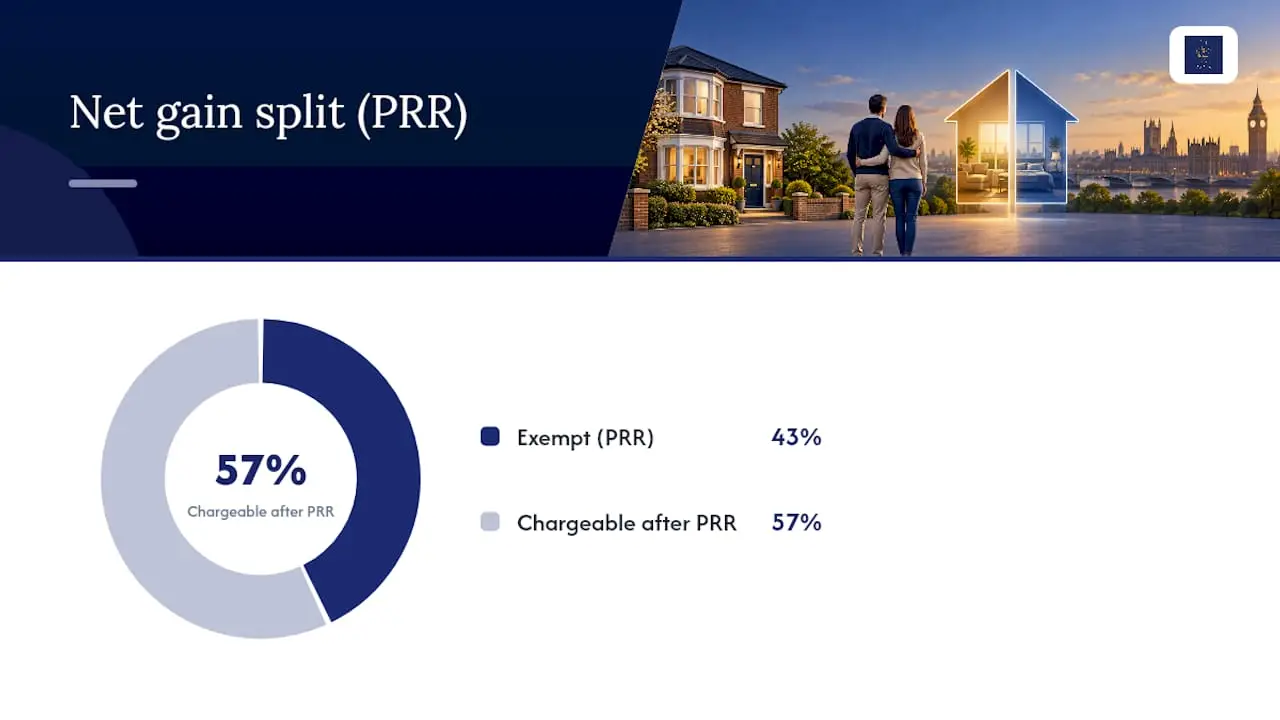
Your qualifying residence period is the 48 months you lived there, plus the final nine months of ownership, giving 57 qualifying months out of 132 total months.
| Figure | Calculation | Amount |
|---|---|---|
| Net gain | £120,000 gain minus £8,000 costs | £112,000 |
| PRR fraction | 57 qualifying months ÷ 132 total months | 43% |
| Exempt under PRR | 43% of £112,000 | £48,000 |
| Chargeable gain before annual exemption | £112,000 minus £48,000 | £63,616 |
Because the whole property was let with no shared occupancy, Letting Relief does not apply here, so the £63,616 chargeable gain is what remains after PRR. From that figure, you’d deduct your annual Capital Gains Tax exempt amount before applying the relevant rate, and this is where getting professional input on rates and any other reliefs available matters, since rates depend on your income tax band and other factors specific to your circumstances.
Improvements genuinely add to your allowable costs; a new kitchen or an extension counts, while routine repairs like repainting or fixing a leak do not. Round figures sensibly for HMRC’s return, but keep your underlying working to the exact day where dates are close to a month boundary, since a few days either side can shift the qualifying month count.
Reporting and paying CGT within 60 days
If you’re a UK resident and you owe Capital Gains Tax on a residential property sale, you must report and pay it within 60 days of completion. This deadline has applied to disposals completing on or after 27 October 2021, and it’s a separate obligation from your annual Self Assessment return, even though the figures also need to appear there later.
Non-residents face the same 60-day deadline, but with an extra layer: special valuation and reporting rules apply to indirect disposals and to assets held before 5 April 2019, and non-residents must report every disposal within the deadline even where no tax is due.
HMRC’s online return asks for a specific set of details, so it’s worth having these ready before you start:
- Exchange and completion dates for both the purchase and the sale.
- Purchase price, sale price, and all allowable costs.
- Details of any reliefs claimed, including PRR and (where genuinely applicable) Letting Relief.
- Your Unique Taxpayer Reference, if you already have one from filing Self Assessment.
Missing the 60-day window triggers penalties and interest, and the clock starts from completion, not exchange, so don’t assume you have longer just because contracts were signed weeks earlier. My guide to the 60-day CGT return on UK residential property walks through the online submission process in more detail.
Records and evidence to support your PRR claim
A PRR claim lives or dies on paperwork, particularly if HMRC opens an enquiry years after the sale. The records worth keeping fall into a few clear categories.
- Purchase and sale completion statements, showing exact dates and prices.
- Council tax records and utility bills, which help demonstrate exactly when you and any tenants lived at the property.
- Tenancy agreements covering every letting period, including any that involved shared occupancy.
- Correspondence, such as employer letters confirming a relocation, if you’re relying on deemed occupation for a period of absence.
- Invoices for capital improvements, clearly separated from routine repair and maintenance receipts.
Digital copies matter more than people think. A folder of scanned invoices and a simple spreadsheet timeline of occupation dates takes an afternoon to put together and can save considerable stress if HMRC ever asks questions. My article on landlord Capital Gains Tax considerations before you sell covers the wider preparation checklist, and if you’re also holding onto property compliance paperwork like EPC certificates, this EPC documentation guide for landlords is a useful companion piece.
Pro Tip: Create one folder per tax year, named by the property address, and drop every relevant document into it as it arrives rather than trying to gather everything retrospectively at completion. Future you will be grateful.
When exclusive business use affects Private Residence Relief
Using a room as an office doesn’t automatically cost you any PRR. The test HMRC applies is exclusive business use, and it’s a genuinely strict one. A room only fails the test if it’s used solely for business purposes with no private use at all, for example a converted outbuilding used only as a consulting room and never for anything domestic.
If you use your spare bedroom as an office during the day but it still doubles as a guest room, or you work from the kitchen table, that dual use almost always preserves full PRR for the whole property. HMRC’s own guidance on business use confirms that occasional or mixed use doesn’t trigger the exclusion.
Borderline cases tend to involve dedicated conversions: a garage turned permanently into a workshop with no domestic function, or an annexe let out as a separate office to a third party. If part of the property genuinely fails the exclusive use test, that part is excluded from PRR for the relevant period, and you’d apportion the gain accordingly, similar in principle to a letting apportionment.
Before claiming full relief where a home office is involved, it’s worth honestly assessing whether any space was truly exclusive to business use throughout ownership. My guide on use of home for business purposes explains how this exclusivity test is applied in practice.
How I help clients with PRR and CGT calculations
As an AAT-licensed accountant running CWABC from Hildenborough near Tonbridge, I work with landlords and former owner-occupiers across Kent and remotely who are navigating exactly this situation: a home lived in, then let, then sold.
The mistakes I see most often are assuming Letting Relief still applies to a wholly-let property, miscounting the qualifying month fraction, and missing the 60-day reporting deadline entirely because sellers assume it’s covered by their annual tax return.
I’d recommend paid support where apportionment involves multiple periods of absence, where you’re a non-resident seller, or where significant capital improvements need documenting against receipts. My Capital Gains Tax support service is built around getting the calculation right the first time and the 60-day return filed on time.
How joint ownership changes the PRR calculation
Joint ownership doesn’t complicate PRR as much as people fear, but it does mean each owner’s claim stands entirely on its own. If you and a partner or spouse jointly own a property, each of you calculates your own qualifying fraction based on your own occupation and ownership history, and each of you reports your own share of the gain separately.
This matters because occupation history can genuinely differ between joint owners. If one partner moved out for a job relocation while the other stayed, or if ownership shares changed at some point (perhaps a partner was added to the deeds partway through), the qualifying fraction for each person may not be identical.
Each owner also has their own annual Capital Gains Tax exempt amount to set against their share of the gain, which can meaningfully reduce the combined tax bill compared with one person owning the whole property outright. Married couples and civil partners who are separating should be particularly careful here, since ownership transfers between spouses can affect who is treated as occupying the property from what date.
Where ownership shares are unequal, say a 70/30 split reflecting unequal contributions to the deposit, the gain is generally apportioned in line with those shares, and PRR is then applied to each owner’s portion of the gain using their own qualifying fraction. Getting the ownership percentages and occupation dates straight for each person before you calculate anything saves a great deal of reworking later.
PRR alongside rollover relief and gifted property rules
PRR sits alongside other Capital Gains Tax reliefs, and understanding where the boundaries fall matters if your situation involves more than a straightforward sale.
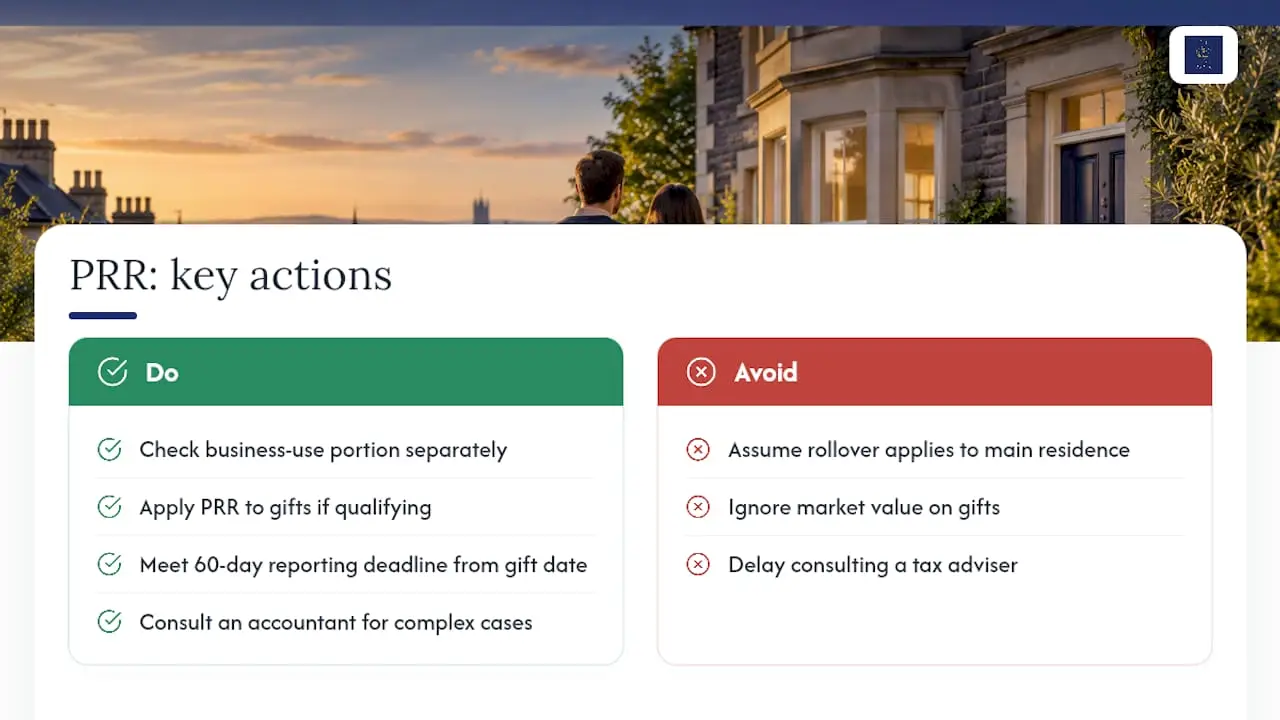
Rollover relief, which lets certain business asset gains be deferred by reinvesting in replacement assets, generally has no direct interaction with PRR on a private home, because rollover relief is aimed at business assets rather than a main residence. Where part of a property was used exclusively for business (as covered earlier), any chargeable gain on that business-use portion might, in principle, be relevant to business asset reliefs, but this is a specialist area and not something to assume applies without checking your specific circumstances.
Gifted property raises a different issue entirely. If you give a property away rather than sell it, Capital Gains Tax can still apply, based on the market value at the date of the gift rather than any sale price, since gifts between anyone other than spouses or civil partners are treated as a disposal at market value for tax purposes. PRR can still reduce or eliminate the gain on a gift if the property was your main residence for the qualifying periods in the normal way, but the 60-day reporting deadline still applies from the date of the gift, not from any later date when the recipient sells.
Where a property has passed through inheritance, gift, or a mix of personal and let use over many years, the interaction of reliefs becomes genuinely complex, and it’s an area where a short conversation with an accountant before any transaction completes tends to save far more than it costs.
What the rules actually reward, and what people get wrong
The conventional advice on this topic tends to focus almost entirely on the final nine-month exemption, as if it’s the main lever available. It isn’t. The bigger lever is almost always the accuracy of your occupation timeline, because the PRR fraction is only as good as the dates feeding it, and a vague memory of “around 2019” instead of a documented completion date can shift a chargeable gain by thousands of pounds.
What’s genuinely underrated is how firmly the 2020 Letting Relief reform closed a door that used to be wide open. Plenty of sellers still budget for a relief that, for a wholly-let former home, simply won’t be available to them. That gap between expectation and outcome is where I see the most stress at completion, not in the arithmetic itself.
If you take one thing from this guide, prioritise your paper trail before you prioritise the calculation. The maths is mechanical once you have accurate dates, costs and occupation evidence. Getting those three things right, early, is what actually protects your relief.
— Chris
Get help calculating and reporting your PRR claim
CWABC gives you a direct line to a qualified accountant who handles your PRR calculation and 60-day return personally, rather than passing your file between departments the way a larger firm often does. As the AAT-licensed accountant behind every client engagement, I work through your occupation timeline, apply the correct qualifying fraction, and check whether shared occupancy genuinely supports a Letting Relief claim before anything gets submitted to HMRC.

A typical engagement covers reviewing your purchase and sale paperwork, confirming your qualifying residence periods, calculating the chargeable gain, and filing your Self Assessment Tax Return alongside the separate 60-day submission where one is due. If your situation also involves ongoing rental income before the sale, I can bring your rental reporting and bookkeeping up to date at the same time, so your figures are consistent across every return you file.
Get in touch through my contact page with your purchase date, letting history, and expected sale date, and I’ll let you know what’s involved before anything is agreed.
This article is general information, not a substitute for advice from a qualified financial advisor. Consult a qualified financial professional about your own circumstances before acting on anything here.
FAQ
Do I pay Capital Gains Tax if I sell my rented property?
Usually yes, on the portion of the gain relating to the period the property wasn’t your main residence, since Private Residence Relief only covers periods of qualifying occupation plus the final nine months. You’d need to report and pay any tax due within 60 days of completion.
What is the nine-month rule for Private Residence Relief?
The final nine months of ownership count as qualifying occupation for PRR purposes even if you’d already moved out and let the property, following the reduction from 18 to nine months for disposals from 6 April 2020. It applies on top of any periods you genuinely lived there.
Can I move back into my rental property to avoid Capital Gains Tax?
Moving back in can extend your qualifying occupation period going forward, but it won’t retrospectively cover years already spent letting the property to a tenant elsewhere. HMRC assesses the whole ownership timeline, not just the period immediately before sale, so moving back in shortly before selling has limited effect on the overall PRR fraction.
Is there a loophole for Capital Gains Tax on a second home?
No reliable loophole exists, and treating any such claim as guaranteed tax avoidance is risky, since HMRC actively checks occupation evidence on second homes and former rentals. The only route to reducing the gain is a properly documented PRR and, where genuinely applicable, Letting Relief claim, ideally checked with an accountant such as through CWABC’s Capital Gains Tax support before you sell.
Does Letting Relief still apply if I rented out my whole former home?
Generally no, because since 6 April 2020 Letting Relief only applies where you shared occupation with a tenant in your main home. Letting the entire property after moving out does not usually meet that condition.