
Yes, transition profits can still change your 2026/27 tax bill, and the reason is simple: HMRC spreads them over five tax years by default, so part of that one-off profit can still land in your return for 2026/27. This is not a new rule. It stems from changes that began in 2023/24, and it applies only to sole traders and individual partners, never to limited companies.
TL;DR:
- Transition profits from the 2023/24 transition year may still impact your 2026/27 tax bill due to the five-year spreading rule unless you accelerate or fully settle the tax early.
- Businesses with non-tax-year accounting periods should carefully deduct overlap relief from their transition profit before applying spread calculations, or risk overpaying.
- The notional tax calculation separates transition profit from normal income, preventing allowances and reliefs from being unfairly reduced by the one-off gain.
- Electing to bring forward a larger share of transition profit into earlier years requires action before the one-year deadline, especially important if expecting lower income later.
- Stopping trading before five years means the remaining transition profit becomes due immediately, potentially increasing the final tax bill significantly.
Table of Contents
- What changed: the switch to tax-year profits and the 2023/24 transition year
- Who is affected and how overlap relief reduces transition profit
- How transition profits are calculated and the notional tax treatment
- Spreading, elections and cessation: the mechanics that make 2026/27 matter
- Practical steps: apportionment, provisional figures, budgeting and a worked example
- Interaction of transition profits with other tax reliefs and allowances
- Guidance on record-keeping and documentation required during the transition period
- Common mistakes and what I would flag early with clients
- How I can help with returns, apportionments and tax planning
- Sources
- FAQ
- Need help?
What changed: the switch to tax-year profits and the 2023/24 transition year
From 2024/25 onwards, sole traders and partners are taxed on profits arising in the tax year itself, the twelve months to 5 April, rather than on the profits of whichever accounting year happened to end during that tax year. If your accounts already run to 31 March or 5 April, this barely touches you. If they run to another date, say 30 June or 31 December, you will have felt the effect a little earlier.
The switch needed a bridge, and 2023/24 was that bridge. HMRC calculated a standard part covering your normal twelve months of trading, plus a transition part covering the extra months needed to stretch your accounts up to 5 April 2024. That transition part is what creates transition profit, and it is what can still be working through your tax affairs in 2026/27.
A few points are worth pinning down early:
- The reform applies only to sole traders and individual partners in partnerships, never to limited companies, which continue to pay Corporation Tax on their own accounting period.
- Businesses already using 31 March or 5 April as their year end saw little practical change, since HMRC’s HS222 guidance confirms the reform targets non-tax-year accounting dates.
- Changing your accounting date to match the tax year is optional, not compulsory, even though many businesses find it simplifies things going forward.
Who is affected and how overlap relief reduces transition profit
You are likely affected if you are a sole trader or an individual partner whose accounting year end falls anywhere other than 31 March or 5 April, and you were trading through the 2023/24 transition year. If that describes your business, you will have both a standard profit figure and a transition profit figure sitting in your 2023/24 return.
Transition profit is not simply the extra months of trading income taxed in full. Most businesses can reduce it using overlap relief, which is unused relief built up from the early years of the business when profits were, in effect, taxed twice under the old rules. HMRC’s guidance on overlap relief confirms that unused overlap relief had to be claimed against the 2023/24 transition calculation, and any relief not used there is now lost.
Practically, that means:
- Work out your overlap relief figure and deduct it from the gross transition profit before anything else.
- If you cannot locate your overlap relief figure, ask HMRC for it as early as possible, since retrieval can take time.
- Where final accounts are not ready in time, file provisional figures on your return rather than missing the deadline, and correct them once accounts are finalised.
How transition profits are calculated and the notional tax treatment
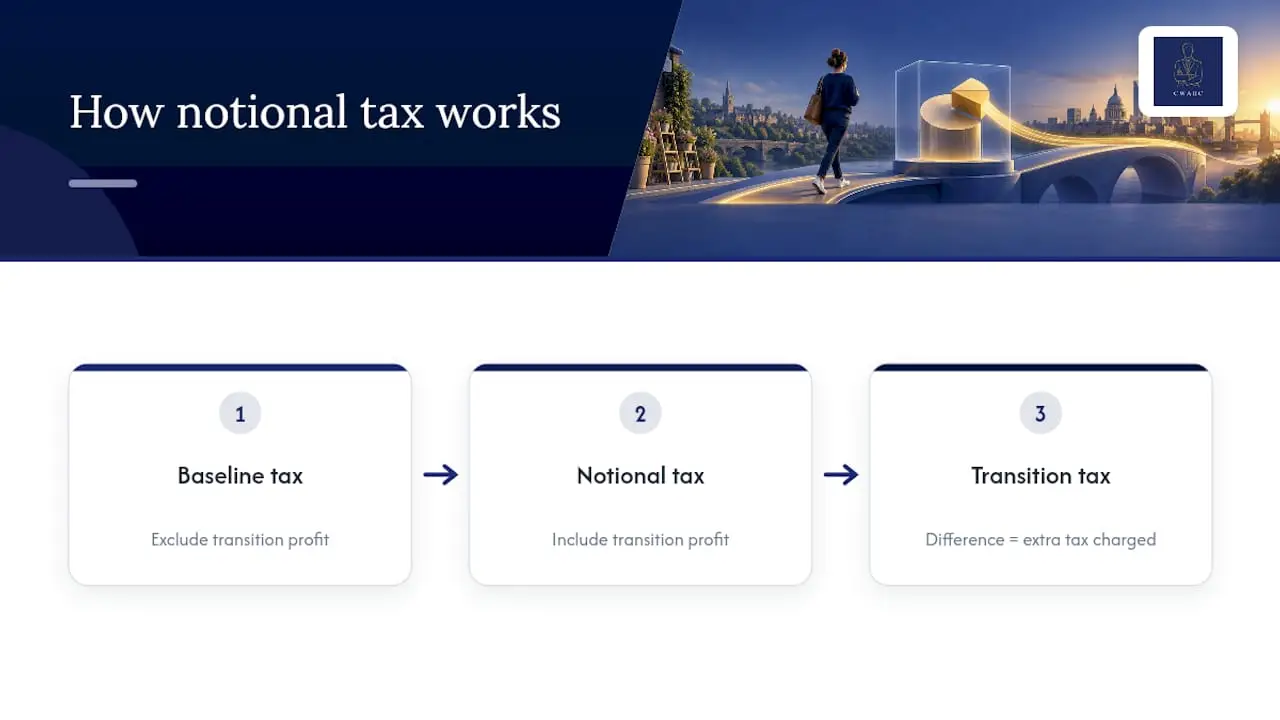
The tax charge on transition profit is not simply added to your other income and taxed at your marginal rate. HMRC uses a modified calculation, described in BIM81320, that keeps the transition component separate from your normal net income.
In practice, HMRC first works out your tax liability as if the transition profit did not exist at all. Then it runs a second, notional calculation that adds the transition profit back in, purely to measure the extra tax that results. That extra amount becomes the tax attributable to the transition profit, charged on top of your ordinary liability, rather than blending seamlessly into your top-rate tax band.
The reason for this separation is fairness. Transition profit is a one-off accounting adjustment, not a genuine increase in your ongoing income, so folding it directly into your net income could push you across thresholds for the Personal Allowance, tax credits or other income-based reliefs that were never designed to react to it. The notional approach charges the tax that results from including the profit, without letting that inclusion quietly strip away allowances elsewhere.
This is technical territory, and the exact mechanics matter more the closer your transition profit sits to a tax band boundary. Where you are unsure whether the notional calculation has pushed you into a higher band or affected an allowance, it is worth checking the figures against HMRC’s Business Income Manual or getting a second opinion before you file.
Spreading, elections and cessation: the mechanics that make 2026/27 matter
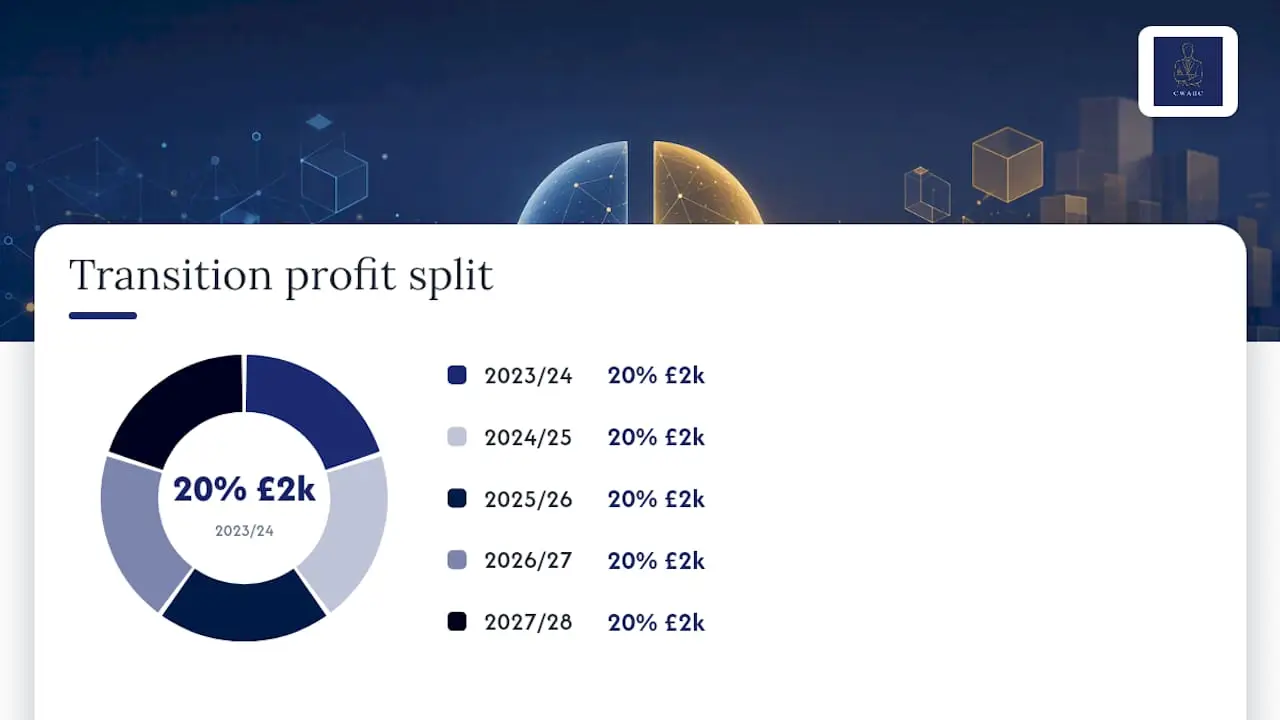
Once your transition profit figure is settled, HMRC does not tax it all in 2023/24. BIM81310 sets out the default spreading rule: 20% of the transition profit is treated as arising in each of the first four tax years, with the remaining balance falling into the fifth year.
- The five years covered are 2023/24, 2024/25, 2025/26, 2026/27 and 2027/28, which is precisely why a profit generated back in 2023/24 can still show up on your tax bill for 2026/27.
- You can elect to bring forward a larger share of the transition profit into an earlier year than the default spread would otherwise apply, which can suit businesses expecting lower income, or higher tax rates, in later years.
- That election has a time limit tied to the first anniversary of the normal filing deadline for the relevant tax year, so it needs deciding well before the return is due, not as an afterthought.
- If you stop trading before the five years are up, any transition profit not yet taxed is accelerated in full into the year you cease, which can produce a noticeably larger bill exactly when cash flow is tightest.
That cessation trap catches people out more often than the spreading itself. A trader who closes down in 2026/27, having assumed the remaining transition profit would trickle in gently over the next year or two, can find the whole outstanding balance due at once.
Practical steps: apportionment, provisional figures, budgeting and a worked example
If your accounting date does not match the tax year, you will need to apportion profits from two accounting periods to arrive at the tax-year figure each year, at least until you either change your year end or the transition period runs its course. A sensible working order looks like this:
- Identify the standard part of your profit for the tax year and the transition part carried forward from the 2023/24 calculation.
- Deduct any unused overlap relief from the transition profit before applying the spreading rules.
- Use provisional figures on your return where final accounts are not ready, as HMRC’s Agent Update guidance recommends, then amend once the real numbers are in.
- Keep a clear record of how each year’s spread amount was calculated, since you will need it again for 2026/27 and 2027/28.
Payments on account deserve attention too. If the addition of transition profit pushes your total tax liability up, your payments on account for the following year rise with it, and an unexpected increase can catch you off guard if you have not budgeted for it. Adjusting your own estimate, or making a voluntary payment ahead of the deadline, can soften the impact rather than facing a lump sum plus interest later.
Some businesses will still see transition profit affecting their return in 2026/27. HMRC’s HS222 helpsheet confirms that, depending on how the spread falls, transition amounts can still be included in the 2025/26 and 2026/27 tax years.
Say a sole trader had a transition profit of £10,000 after overlap relief, with no election to accelerate. Under the default spread, £2,000 (20%) is treated as arising in each of 2023/24, 2024/25, 2025/26 and 2026/27, with the remaining £2,000 falling into 2027/28. That means £2,000 of extra taxable profit lands in the 2026/27 return purely because of a decision made years earlier, on top of whatever the business earns normally that year.
Interaction of transition profits with other tax reliefs and allowances
Because transition profit is measured separately through the notional calculation described earlier, it interacts with allowances and reliefs in ways that are easy to overlook. The notional approach protects your Personal Allowance from being tapered purely because of the transition addition, but the underlying transition profit still counts as income for other purposes, such as calculating your adjusted net income for pension annual allowance tapering or for the High Income Child Benefit Charge.
If you make pension contributions, it is worth checking whether the year in which transition profit lands pushes your total income closer to a threshold that would otherwise have been comfortably avoided. The same applies to Marriage Allowance eligibility and to means-tested benefits calculated on income, where transition profit in a particular year could tip a borderline case.
Trading losses and capital allowances are claimed in the normal way against your standard profit for the year, but they cannot be set against the transition profit component itself, since that figure is fixed by the 2023/24 calculation and simply spread forward. If you are carrying losses from another source, it is worth checking with a professional how they interact with a year that also carries a slice of transition profit, rather than assuming the two simply net off.
Guidance on record-keeping and documentation required during the transition period
Because the spread runs across five tax years, from 2023/24 through to 2027/28, you need records that will still make sense to you, or to HMRC, at the end of that period. Keep the original 2023/24 transition calculation safe, including how the standard and transition parts were split and exactly how much overlap relief was deducted.
For every subsequent return, note down the amount of transition profit brought into that year’s figures and confirm it matches the spread you originally calculated, or the accelerated amount if you made an election. If you used provisional figures at any point, keep a note of when they were finalised and what, if anything, changed.
This matters practically because HMRC can query figures years after the event, and reconstructing a spreading calculation from scratch in 2027/28, without the original working papers, is far harder than it needs to be. A simple spreadsheet or a folder of correspondence with HMRC covering the overlap relief request is often enough. If you use cloud accounting software such as Xero, QuickBooks or FreeAgent, storing the transition workings alongside your annual accounts in the same digital record keeps everything together for whoever prepares your return each year.
Common mistakes and what I would flag early with clients
The mistakes I see most often are overlooking overlap relief entirely, guessing at provisional figures rather than working them out properly, missing the election deadline for accelerating transition profit, and forgetting that stopping trading early accelerates whatever is left. Accelerating transition profit can make sense if you expect higher marginal rates ahead and can afford the tax now, but it is a cash flow decision as much as a tax one. I help clients by checking their overlap relief figures, preparing sound provisional figures, and adjusting payments on account before they become a surprise.
— Chris
How I can help with returns, apportionments and tax planning
Sorting out overlap relief, apportioning two accounting periods and checking whether an election makes sense is fiddly work, and getting it wrong tends to cost more than getting it checked properly the first time. As an AAT-licensed practitioner working directly with clients rather than through layers of staff, I go through the figures with you in plain language and explain exactly what each number means for your bill.

If any of this sounds like it applies to your business, here is where to start:
- Book a review of your Self Assessment tax return so I can check your transition profit and overlap relief figures are correct.
- Get your accounts and provisional figures organised properly with bookkeeping support built around Xero, QuickBooks or FreeAgent.
- Ask me to request your overlap relief figures from HMRC early, before a filing deadline forces the issue.
Get in touch through the contact page and I will talk you through what your own transition profits mean for the years ahead.
This article is general information, not a substitute for advice from a qualified financial advisor. Consult a qualified financial professional about your own circumstances before acting on anything here.
FAQ
Am I affected by basis period reform?
You are affected if you are a sole trader or an individual partner whose accounting year end is not 31 March or 5 April and you were trading during the 2023/24 tax year. Limited companies are never affected, since they remain within Corporation Tax rather than Income Tax.
What changes will HMRC make to self-assessment taxes in 2026?
There is no new basis period reform arriving in 2026. The reform took effect from the 2023/24 transition year, and 2026/27 simply falls within the five-year default spread that HMRC’s guidance already set out for transition profits.
How many years can HMRC go back for capital gains tax?
This depends on the reason for the enquiry and is not fixed by the basis period reform, so it falls outside the scope of this guide. For a specific case, it is worth checking current HMRC guidance or speaking to a professional directly.
Is CGT changing in April 2026?
This article is not the place to confirm Capital Gains Tax rate changes, since that is a separate area of policy from basis period reform. Check current HMRC guidance or speak to an adviser for the position that applies to your situation.
Need help?
If you would like a second look at your transition profit figures, your overlap relief claim or how the spread affects your 2026/27 return, get in touch through my contact page and I will talk you through the options.