
If your contractor has deducted more through the Construction Industry Scheme (CIS) than you owe in tax and National Insurance, you can claim the difference back from HMRC. How you claim depends on how you trade. Sole traders and partners claim through their Self Assessment return. Limited companies set deductions against their payroll bill during the year and claim any balance after the year ends. I’m Chris White, an AAT Licensed Accountant near Tonbridge, and I prepare these returns and claims for subcontractors. Below I explain the process step by step, calmly and in plain English, so you know what to gather and where claims tend to go wrong.
No one can promise a refund or a processing time, because the amount depends on your profit, your expenses and what HMRC’s records show. What you can control is how accurate and complete your paperwork is.
TL;DR
- CIS deductions are advance payments towards your tax, not an extra tax. If they come to more than you owe, HMRC pays back the difference.
- Sole traders and partners report their pay before deductions as income, and the deductions separately, on their Self Assessment return.
- Limited companies use their payroll submissions to offset deductions, then claim any leftover refund once the tax year has ended.
- Most delays come from figures that do not match HMRC’s records: missing statements, unreported income or unpaid balances.
- I can prepare the records and the return or claim for you, so the numbers agree before they reach HMRC.
Table of Contents
- How CIS deductions work
- Why a refund may arise
- Sole trader or limited company: two different routes
- The records you need
- Allowable expenses that can reduce your tax
- How to claim, step by step
- How the deductions are reconciled
- Why refunds get delayed
- A rule change worth knowing about
- Who this does not cover
- My view: accurate records first, refund second
- How I can help with your CIS refund
- FAQ
- Sources
How CIS deductions work
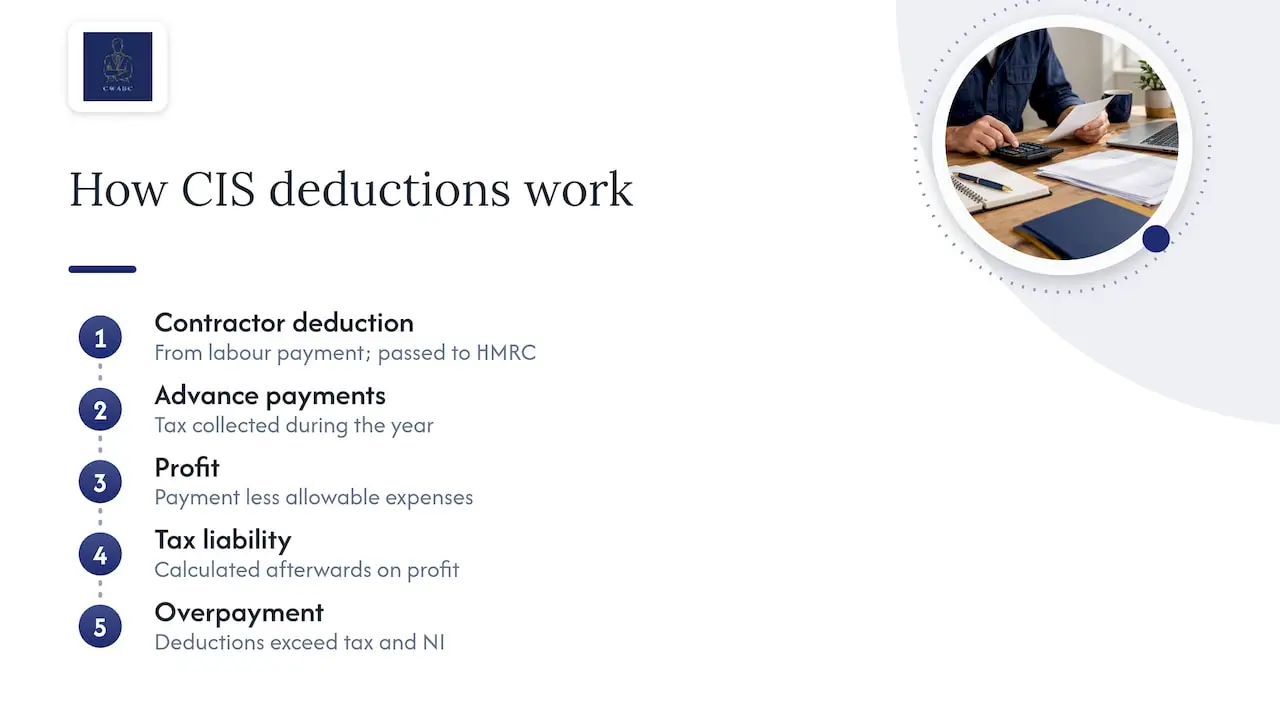
Under CIS, a contractor takes a deduction from what they pay you for labour and passes it to HMRC. HMRC’s guidance describes these deductions as advance payments towards your tax, which is the idea to hold on to. The scheme collects tax during the year. Your real bill is only worked out afterwards.
That is why refunds happen. The deduction is a percentage of your payment, taken before you have counted your costs. Your actual liability is based on your profit, which is what is left after allowable expenses. If the deductions exceed the tax and National Insurance on that profit, you have overpaid.
The rate your contractor deducts depends on your registration and status. I cover registration, rates and what each means in my guide to CIS for subcontractors and the one on CIS registration for subcontractors, so I won’t repeat that here. This article starts where those end: you have been paid net of deductions and you want to know what comes back.
Why a refund may arise
A refund is never automatic. It is simply what the sums produce. These are the common reasons the deductions end up higher than the bill:
- Expenses. Tools, protective clothing, van costs, insurance and other business costs reduce your profit, but the contractor deducted from your gross labour figure without knowing about them.
- Part-year work. If you started subcontracting late in the tax year, or work stopped for weeks, your annual profit may sit well below what the deductions assumed.
- Personal allowances and lower bands. Income that falls within your personal allowance or lower tax bands carries little or no tax, yet deductions were taken from every payment.
- Seasonal or uneven income. A busy spring followed by a quiet winter can leave a total liability smaller than the running deductions suggest.
- Stopping trading. If you stop, deductions already taken may exceed what is due on the final profit.
None of this guarantees a refund. If your profit is high, the deductions may fall short and you will owe a balance instead. The point of the return is to find out which applies.
Sole trader or limited company: two different routes
This is the point that trips people up most. The two routes work in different ways and use different forms and records.
| Sole trader or partner | Limited company | |
|---|---|---|
| Where the deductions are reported | Self Assessment return | Payroll submissions (FPS and EPS) |
| What you offset against | Income tax and National Insurance | PAYE and National Insurance owed through payroll |
| What happens to any leftover | HMRC pays it back after the return is processed | Claim a refund once the tax year has ended |
| Must not use | A separate company route | The Corporation Tax return to pay tax with deductions |
A Full Payment Submission (FPS) is the report a company sends HMRC each time it pays people through payroll. An Employer Payment Summary (EPS) is the extra monthly report where, for CIS purposes, the company tells HMRC the year-to-date deductions it wants to use.
If you are a sole trader or partner
On your Self Assessment return you report your total pay before deductions as income, and the total deductions as CIS deductions. HMRC then calculates your tax and takes the deductions off. According to HMRC’s guidance, if a refund is due, HMRC pays it back, and any remaining tax is due by 31 January after the tax year ends.
The key phrase is “before deductions”. Many first-time subcontractors enter the amount that landed in their bank account. That understates income and the deductions no longer reconcile, which is a classic cause of a stalled claim.
If you run a limited company
HMRC’s guidance says a limited company must use its payroll scheme to pay tax with its CIS deductions: it sends the FPS plus an EPS showing the year-to-date CIS deductions. Leftover deductions can be carried forward within the same tax year. The same page warns that using the Corporation Tax return to pay tax with deductions can lead to a penalty, so keep them separate.
If, after the year ends, the deductions are still more than the company needs to pay, the company or its agent can claim a refund. Before HMRC pays anything back, it applies the deductions to any overdue PAYE or Corporation Tax. Whatever remains can be refunded or used towards VAT or upcoming Corporation Tax.
If you are a director weighing up the corporation tax side, my guide on how to pay corporation tax correctly sets out how that bill is worked out and paid.
The records you need
A refund claim is only as strong as the paperwork behind it. Gather these before you start.
- Payment and deduction statements. Each contractor who deducts tax from you should give you one for every tax month. Keep every one. They show the gross payment, the deduction and the amount you received.
- Bank statements. They prove what actually arrived in your account. For a limited company, HMRC’s guidance says you can include statements and bank statements if you know the figures do not match.
- Invoices and a sales record. These show what you billed, so your income figure is complete and not just what the statements cover.
- Receipts for expenses. Dated, itemised and kept together by category.
- Your identifiers. Your Unique Taxpayer Reference (UTR) for Self Assessment. For a company, the PAYE reference and Corporation Tax UTR.
- Payroll records, if you are a company. The FPS and EPS submissions for the year, plus monthly CIS returns if you also act as a contractor.
The statements are the backbone of the whole claim. If one is missing, ask the contractor for a copy promptly rather than estimating the figure. Missing statements are one of the most frequent reasons the numbers fail to agree later.
If your records live in a shoebox, a spreadsheet and a few banking app screenshots, this is where a good system pays for itself. I set up and train clients on cloud software such as Xero, QuickBooks and FreeAgent, so statements, invoices and receipts sit in one place from the start of the year.
Allowable expenses that can reduce your tax
Because the deduction is taken from gross pay, your expenses are what bring the final bill down. Typical costs for a subcontractor include:
- tools and small equipment
- protective clothing and work boots
- van running costs, or mileage if you use the simplified method
- public liability and other business insurance
- accountancy and bookkeeping fees
- phone, software and CIS-related admin costs
- training directly linked to your trade
The test is whether the cost was incurred wholly and exclusively for the business. A cost with a personal element needs apportioning. I have written practical examples in my guide to sole trader tax deductions, and it is worth reading before you add anything to your return.
A worked example
This is an illustration with round numbers, not a forecast of your result or a tax calculation.
Suppose a sole trader is paid £20,000 for labour across the tax year, before deductions. The contractor deducts a total of £4,000. The subcontractor’s allowable expenses come to £6,000, so the profit is £14,000. The tax and National Insurance due on £14,000 is lower than £4,000, so HMRC works out the liability, subtracts the £4,000 already paid and the difference is due back.
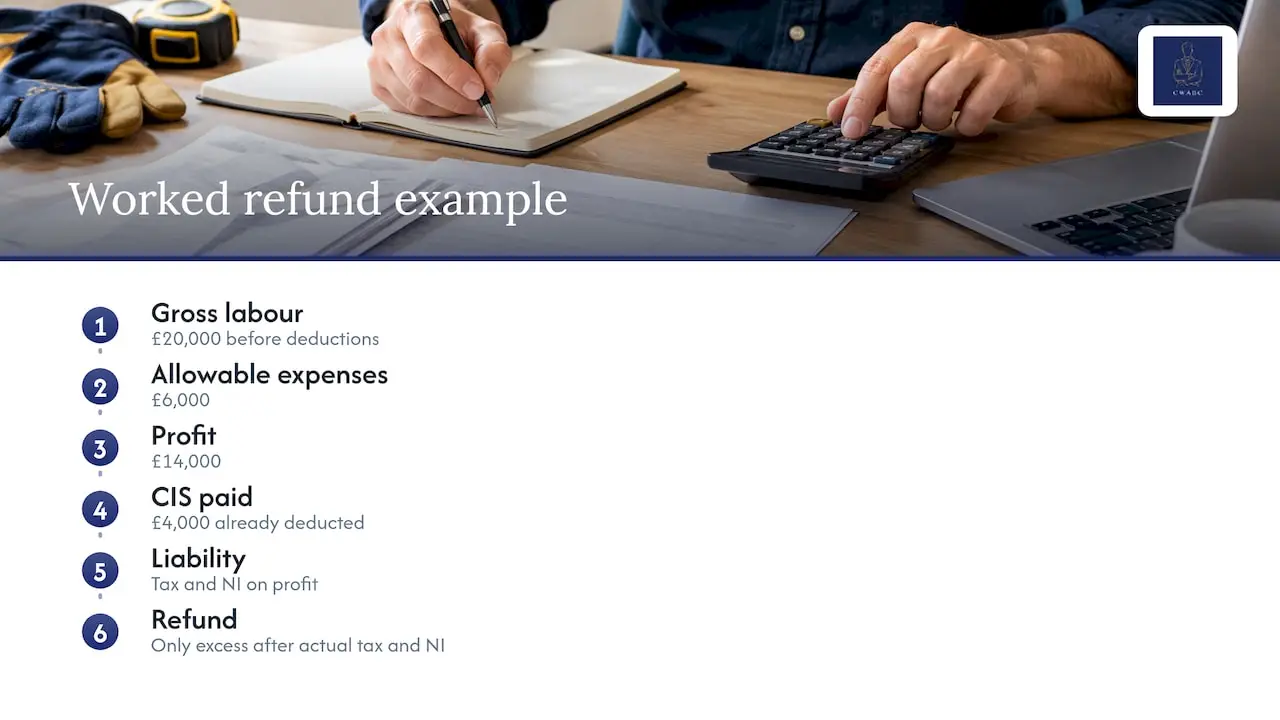
Now change one thing. If the same person had entered only the £16,000 received in the bank as income, the profit would be understated and the deductions would not match the contractors’ records. HMRC may query it, and the claim slows down. The numbers in the return must agree with the statements.
How to claim, step by step
For sole traders and partners
- Wait for the tax year to end. The tax year runs from 6 April to 5 April. Most subcontractors claim through their return after 5 April.
- Add up your statements. Total the gross payments and the total deductions across every contractor.
- Work out your profit. Take your income and subtract allowable expenses.
- Complete the Self Assessment return. Enter total pay before deductions as income and the total deductions in the CIS deductions box.
- File and keep your working papers. HMRC may ask to see the statements behind the figures. HMRC’s internal manual notes that you may submit payment and deduction statements with the return, though it is not obligatory.
- Check the calculation. HMRC will show the refund or balance due. Any tax owing is payable by 31 January after the tax year ends.
This is the step where I take the load off. I prepare your Self Assessment tax return, starting from £250 one-off, working from your statements so that income, deductions and expenses all reconcile before the return is sent.
Claiming during the tax year
Some sole traders and partners may be able to claim in-year. The online form (or paper form CIS40) lets an individual subcontractor claim repayment of deductions in the current tax year. HMRC’s guidance for its staff says in-year repayment depends on the accounting period that determines your profit having ended, and that if the details are doubtful, repayment is refused until after the year ends and the return is received. Partnerships use a different form, with all partners’ consent. If you are unsure whether you qualify, ask before filing, because a rejected claim just costs time.
For limited companies
- Finish the payroll submissions. Every FPS and EPS for the tax year needs to have been sent, along with monthly CIS returns if the company is also a contractor, and the Company Tax returns.
- Wait for the year to end. HMRC’s guidance says a company can claim once the tax year has ended, online or by post for the past six tax years, and by post for earlier years. A claim within the current year is only allowed if the business has stopped trading or deductions were taken after it changed to gross payment status.
- Calculate the overpayment. CIS deductions minus the tax paid using them, taken from the monthly statements and your FPS and EPS records.
- Make the claim. Online, with sign-in details linked to the company’s Corporation Tax and PAYE accounts, or by post with a letter marked CIS. You will need the overpayment amount, company name, telephone number, address, PAYE reference, Corporation Tax UTR and payment details.
- Respond to any HMRC query. If HMRC thinks a claim is wrong, it may ask for evidence or require the claim to be changed. If you do not reply by the deadline, HMRC changes the claim using its own information and no more claims can be made for that year, although you can appeal.
That last point matters. An unanswered letter can cost more than an incorrect figure ever would, so open HMRC post promptly.
How the deductions are reconciled
Reconciliation just means matching three sets of figures: what your statements say, what your own books say and what HMRC holds. Contractors report the deductions they have taken on their monthly CIS returns, so HMRC can see your side of the story from the other end. If your return disagrees with theirs, the claim is likely to be checked.
A simple monthly routine prevents most trouble:
- Record each payment as gross, with the deduction shown separately.
- Tick off every payment and deduction against the statement for that tax month.
- Chase any missing statement while the contractor still remembers the job.
- Compare the year’s totals with your bank statements before you file.
CIS months run from the 6th to the 5th, which does not match the calendar month. It is a common source of small mismatches, and one reason I like cloud software with the dates built in. If you also act as a contractor, my guide to CIS monthly returns covers the filing side.
Why refunds get delayed
HMRC’s guidance says it usually responds to a limited company’s CIS claim within eight weeks. That is a general indication and not a promise, and a claim that does not line up with the records can take longer. These are the usual reasons:
- Figures that do not match. The deductions on your claim differ from what contractors reported.
- Income entered net, not gross. As in the example above.
- Missing or late submissions. Unsent FPS or EPS reports, missing monthly CIS returns or Company Tax returns for a company.
- Unpaid balances. HMRC applies deductions first to overdue PAYE or Corporation Tax, so the refund shrinks or disappears.
- Incomplete details. A wrong reference number, missing payment details or a letter that is not marked CIS.
- Unclear expenses. Large or unusual costs without receipts invite questions.
If HMRC writes to ask for more information, answer within the deadline and send exactly what is asked. Keep a copy of everything.
A rule change worth knowing about
From 6 April 2026, HMRC’s powers changed where a business makes a construction payment, or files a return containing a CIS credit, and knew or should have known it was linked to deliberate non-compliance. HMRC can remove gross payment status immediately and charge a penalty of up to 30% of the tax lost, and the business cannot reapply for gross payment status for five years. This is aimed at deliberate abuse. For an honest subcontractor claiming deductions that were genuinely taken, the practical lesson is simple: only claim what your statements support, and keep the evidence.
Who this does not cover
If you pay subcontractors as a contractor and need monthly returns or verification, that is a different job from claiming a refund. My CIS services page covers that side.
My view: accurate records first, refund second
Most of the subcontractors who contact me about a CIS refund are not trying to be clever. They have simply been paid net for months and have never seen what the year looks like as a whole.
My approach is to start with the records, not the refund. I work with you directly, using cloud software and secure digital workflows, so the statements, invoices and receipts are in order and the return reflects what really happened. I explain each figure in plain English as we go.
I would rather you file one return that agrees with your contractors’ records than a quick one that bounces back. A refund can’t be promised, because it depends on your profit and what HMRC holds, but accurate paperwork gives your claim the best footing.
Chris
How I can help with your CIS refund
I’m an AAT Licensed Accountant based in Hildenborough, near Tonbridge, supporting subcontractors across Kent and remotely throughout the UK. For sole traders I prepare the Self Assessment return, from £250 one-off, working through your payment and deduction statements, your income and your allowable expenses. For limited companies I can help with payroll and CIS submissions, annual accounts and Corporation Tax, so deductions are reported in the right place.

If you want the records kept tidy throughout the year, my bookkeeping services and payroll and CIS support mean the statements are matched as you go, not found in a panic after April. Pricing beyond the Self Assessment figure is tailored and agreed clearly upfront.
Need help? If you would like to talk through your CIS deductions, get in touch with me here.
FAQ
Can I claim a CIS tax refund before the tax year ends?
Sometimes. An individual subcontractor can use the online form or form CIS40 to claim in-year repayment, but HMRC may refuse it if the details are doubtful until the return is filed after the year ends. A limited company can only claim in the current year if it has stopped trading or deductions were taken after it changed to gross payment status. Most claims are made after 5 April.
How long does a CIS refund take?
HMRC usually responds to a limited company claim within eight weeks, but that is a guide and not a promise. Claims that do not match HMRC’s records, or that are incomplete, can take longer. Accurate statements and a return that agrees with them give the claim the best chance of moving smoothly.
Do I get a refund if I am a limited company?
Only if more CIS deductions were taken than the company needs to pay in tax. HMRC first applies deductions to any overdue PAYE or Corporation Tax. What is left can be refunded, or used towards VAT or upcoming Corporation Tax.
What records should I keep?
Keep every payment and deduction statement, your bank statements, invoices and expense receipts, and your UTR and payroll references. Companies should also keep their FPS, EPS and, where relevant, monthly CIS returns. Keeping these in cloud software through the year makes the claim far easier.
Sources
- What you must do as a CIS subcontractor: pay tax and claim back deductions (GOV.UK)
- Claim a refund of CIS deductions if you’re a limited company (GOV.UK)
- Claim repayment of subcontractor deductions, form CIS40 (GOV.UK)
- CISR72050: deductions, credit and repayment (HMRC manual)
- SAM110100: in-year repayments (HMRC manual)
- Labour supply chain assurance: potential implications for businesses (GOV.UK)
Recommended
- CIS for subcontractors: registration and deductions explained
- CIS registration for subcontractors: rates, forms and next steps
- CIS monthly returns: your step-by-step filing guide
This article provides general information based on UK tax and accounting rules at the time of publication. It is not a substitute for advice tailored to your individual circumstances. Tax legislation and HMRC guidance may change. If you need advice about your specific situation, please contact me at CW Licensed Bookkeeper & Accountant.