If you run a small business in Tonbridge, a good bookkeeper keeps your bank, sales, expenses and VAT records accurate and up to date. That way your tax return, VAT return or year end becomes a calm routine rather than a last-minute mess. I’m Chris White, an AAT Licensed Accountant based in Hildenborough, just outside Tonbridge. I work directly with sole traders, landlords, startups, limited companies, CICs and small employers, in person locally or remotely anywhere in the UK. This guide explains what a bookkeeper actually does, when it makes sense to hand the work over, and what to look for before you choose one.
TL;DR
- Bookkeeping is the day-to-day record of your money: bank reconciliation, invoices, expenses, VAT records and reports. HMRC expects those records to be accurate and kept up to date.
- Consider outsourcing when records slip behind, VAT or payroll arrives, or Making Tax Digital for Income Tax applies to you.
- Look for a recognised qualification, a licence from a professional body, cloud software you can see into, and a clear scope and fee agreed upfront.
- I’m based in Hildenborough and work with clients across Tonbridge, Sevenoaks, Tunbridge Wells and remotely throughout the UK. You deal with me directly.
Table of Contents
- What a bookkeeper does for a small business
- What records HMRC expects you to keep
- When it makes sense to outsource your bookkeeping
- Making Tax Digital: a reason to get your records in order now
- What to look for in a bookkeeper
- Bookkeeping needs by type of business
- What affects the cost of bookkeeping
- Local, remote or both?
- How I can help with your bookkeeping
- My view on choosing a bookkeeper
- FAQ
- Need help?
- Sources
What a bookkeeper does for a small business
Bookkeeping is record-keeping. ICAEW’s small business guide draws the line clearly: a bookkeeper records the numbers, while an accountant adds professional analysis, advice and responsibility for compliance with HMRC (His Majesty’s Revenue and Customs, the UK tax authority) and Companies House. Many small businesses use both, depending on budget and how much time they have in-house.
When I take on bookkeeping, this is what the work covers.
Bank reconciliation
Reconciliation means matching every line in your bank account to a record in your books. It is the single best check that nothing is missing or entered twice. In cloud software such as Xero, QuickBooks or FreeAgent, bank feeds bring transactions in automatically, so the job becomes reviewing and coding them rather than typing them.
Invoicing and money owed
Sales invoices need to go out promptly and be recorded properly, so you can see who owes you what. Keeping on top of this is one of the simplest ways to protect your cash flow. The same applies to bills you owe: knowing what is due and when avoids nasty surprises.
Expense categorisation
Every payment needs to go in the right category: materials, travel, software, subscriptions, insurance and so on. Done consistently through the year, this makes your Self Assessment or company accounts far quicker, and it helps you claim what you are entitled to without guesswork.
VAT records
If you are VAT registered, your records need to support each VAT return. Keeping VAT codes tidy as you go is much easier than untangling a quarter’s worth of transactions at the deadline. If you are close to the registration threshold, my guide on when to register for VAT explains what to watch, and I can handle VAT returns once you are registered.
Management reports
A profit and loss report and a balance sheet show whether the business is making money and where it is going. Clear, plain-English reports let you make decisions from real numbers rather than a feeling about the bank balance.
Year-end preparation
At year end, the books need to be complete, reconciled and queried where something looks odd, so that the figures can go into your tax return or company accounts. If your books are behind, I follow a reconcile-first clean-up approach that sorts the backlog in a sensible order.
You can see how I set this up on my Tonbridge bookkeeping services page.
What records HMRC expects you to keep
The rules are not optional, so it helps to know them. GOV.UK says self-employed people must keep records of all sales and income, all business expenses, VAT records if registered, PAYE records if you employ people, and personal income records. Records must be accurate and show which transactions belong to the business.
On how often to update them, the Tax Confident campaign advises updating weekly or monthly, photographing receipts promptly, and keeping records for at least five years after the tax return deadline. For the 2025-26 tax year, that means until at least 31 January 2032.
If you run a limited company, the same duty applies to the company. The Insolvency Service’s director guidance on keeping records says directors must keep up-to-date records of income and expenditure and store documents safely, with digital files backed up.
A paperless set-up makes most of this easier. Receipts photographed into your software on the day, bank feeds and automatic backups cover a lot of that list without extra effort.
When it makes sense to outsource your bookkeeping
Most people don’t hand over their books because they love paying for help. They do it because the books have become a source of worry. These are the common moments when it makes sense.
- Your records are behind. If you dread opening the spreadsheet or the shoebox, the work is already costing you in stress and time. My article on five signs your bookkeeping needs professional help goes through them.
- You are about to register for VAT. Quarterly returns, VAT codes and digital records add a layer of discipline that is easier to build from the start.
- You are taking on staff or subcontractors. Payroll and the Construction Industry Scheme (CIS, the scheme under which contractors deduct tax from subcontractors’ payments) have fixed monthly deadlines. See my payroll and CIS support if that is you.
- You are a landlord with several properties. Rental income and costs need clean records, especially now Making Tax Digital applies to some landlords. My landlord bookkeeping guide covers the detail.
- You are starting up. Setting up the right software and habits on day one is far cheaper than repairing a messy first year.
- Your time is worth more elsewhere. If an hour of bookkeeping costs you an hour of paid work or an evening with your family, handing it over often makes sense.
Outsourcing does not mean switching off. Business Wales points out that even with an accountant or bookkeeper, you remain responsible for knowing what is happening with your finances. A good bookkeeper makes that easy by giving you reports you can read and explaining them in plain language.
Making Tax Digital: a reason to get your records in order now
Making Tax Digital (MTD) is HMRC’s programme requiring digital records and software-based reporting. For Income Tax, GOV.UK explains that from 6 April 2026 some sole traders and landlords must use compatible software to keep digital records of their self-employment and property income and expenses, send quarterly updates to HMRC, and submit their tax return by 31 January the following year.
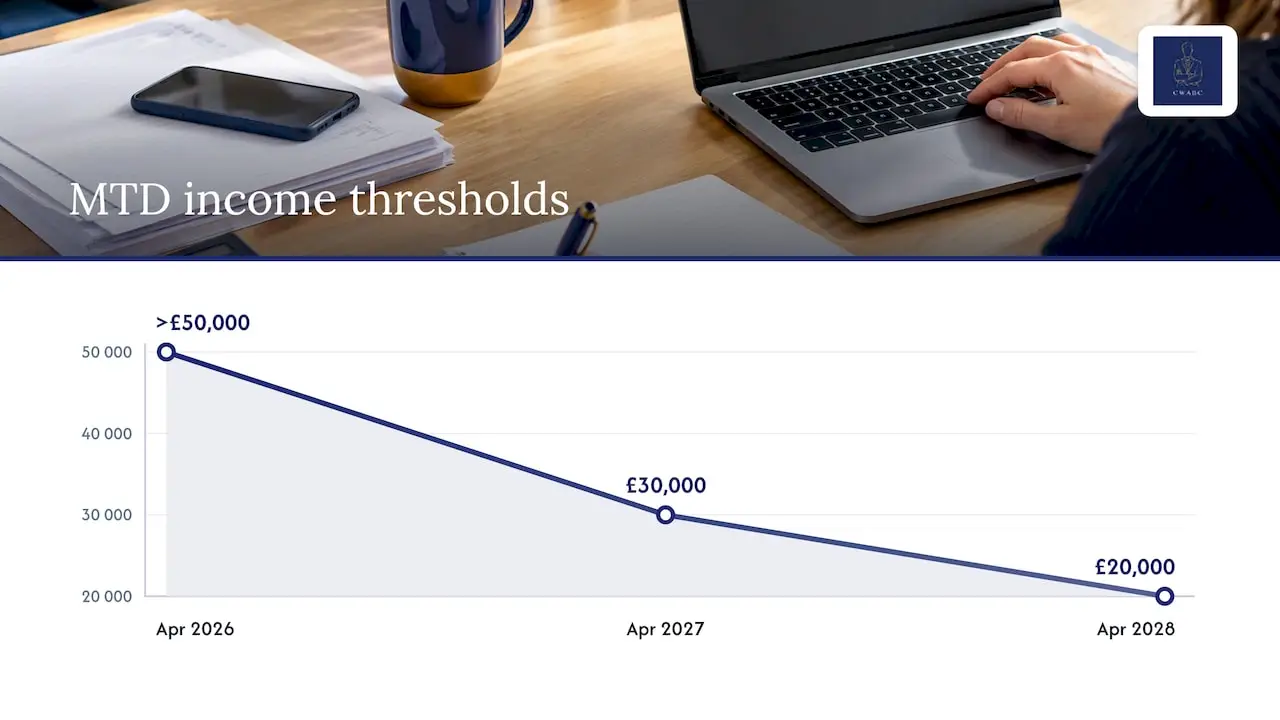
Who is affected depends on qualifying income. The Income Tax (Digital Obligations) Regulations 2026 set the thresholds at above £50,000 from April 2026, £30,000 from April 2027 and £20,000 from April 2028, with exemptions including for people who are digitally excluded. If you are a landlord who is also a sole trader, your rental and business income are added together to test the threshold.
The practical point is simple. MTD runs on records that are up to date, so a bookkeeping routine that already runs through the year makes the quarterly updates a short job instead of a scramble. I explain the process in my guides to quarterly reporting and the sole trader transition, and I offer Making Tax Digital for Income Tax support if you want someone to set it up and talk you through it.
What to look for in a bookkeeper
Bookkeeping in the UK is not a protected title in the way some professions are, so it pays to ask a few sensible questions before you hand over your records.
A recognised qualification and licence
Look for a qualification from a professional body and, ideally, a licence to practise. AAT (the Association of Accounting Technicians) licenses members to offer bookkeeping and accountancy services to the public, and its licensed membership page explains that AAT Licensed Bookkeepers and AAT Licensed Accountants are approved for different sets of services. I am an AAT Licensed Accountant and a member of AAT (MAAT, AATQB), so the services I offer sit within that licence.
Software you can see into
Your books should live in software you can log in to, not on your bookkeeper’s private spreadsheet. nibusinessinfo suggests checking that the package fits your business size, its cost and add-ons, statutory compliance, HMRC recognition, setup and training support, backups and compatibility with your accountant’s package. I work with Xero, QuickBooks and FreeAgent, and I can set up and train you in whichever suits you.
A clear scope and fee
Ask exactly what is included: how often your books are reconciled, whether VAT returns, payroll or year-end work are part of the deal, and how the fee is set. Pricing at CWABC is tailored to each client and agreed clearly upfront, so you know what you are paying for before work starts. The one price I publish is for Self Assessment tax returns, which start from £250 one-off.
Plain-English explanations
A bookkeeper who can’t explain your own numbers to you is not much use. You should come away from each conversation knowing something more than you did before.
Someone who knows what comes next
Bookkeeping feeds everything else: Self Assessment, VAT, corporation tax, payroll and MTD. Choosing someone who can also handle those, or work smoothly alongside whoever does, saves you passing the same figures around.
Bookkeeping needs by type of business
The same core routine applies to everyone, but the emphasis shifts.
| Your situation | What matters most in your books | Where I can help |
|---|---|---|
| Sole trader | Income and expense records that feed Self Assessment and, where it applies, MTD | Self Assessment and bookkeeping |
| Landlord | Rental income and allowable costs by property, ready for quarterly updates | Landlord bookkeeping and MTD for landlords |
| Startup or side hustle | The right software and habits from day one | Software setup and training |
| Limited company | Records that support annual accounts and corporation tax | Corporation tax and annual accounts |
| Employer or construction business | Payroll runs and CIS returns on time | Payroll and CIS |
| CIC | Bookkeeping, annual accounts and compliance | Accounting services |
What affects the cost of bookkeeping
I can’t give you a fair figure without knowing your business, because several things move the price:
- Volume of transactions. A sole trader with a few dozen entries a month is a different job from a shop with hundreds.
- The state of your records. A tidy set of books takes less time than a year of unreconciled backlog.
- Which extras are included. VAT returns, payroll, CIS and management reports each add to the scope.
- How often you want work done. Monthly bookkeeping costs differ from a once-a-year catch-up.
- Your software. Well-set-up bank feeds and rules cut the manual work.
That is why I agree a fee upfront once I understand what you need, rather than quote a one-size-fits-all package.
Local, remote or both?
I’m based in Hildenborough, close to Tonbridge, and I support clients across Tonbridge, Sevenoaks and Tunbridge Wells. Many of my clients never need a meeting at all, because secure digital workflows and cloud software let me work with you remotely anywhere in the UK. If you prefer a conversation about your books with someone who knows the area, I can do that too. There is more on my Hildenborough page. I’m a sole practitioner, and you deal directly with me from the first call.
How I can help with your bookkeeping
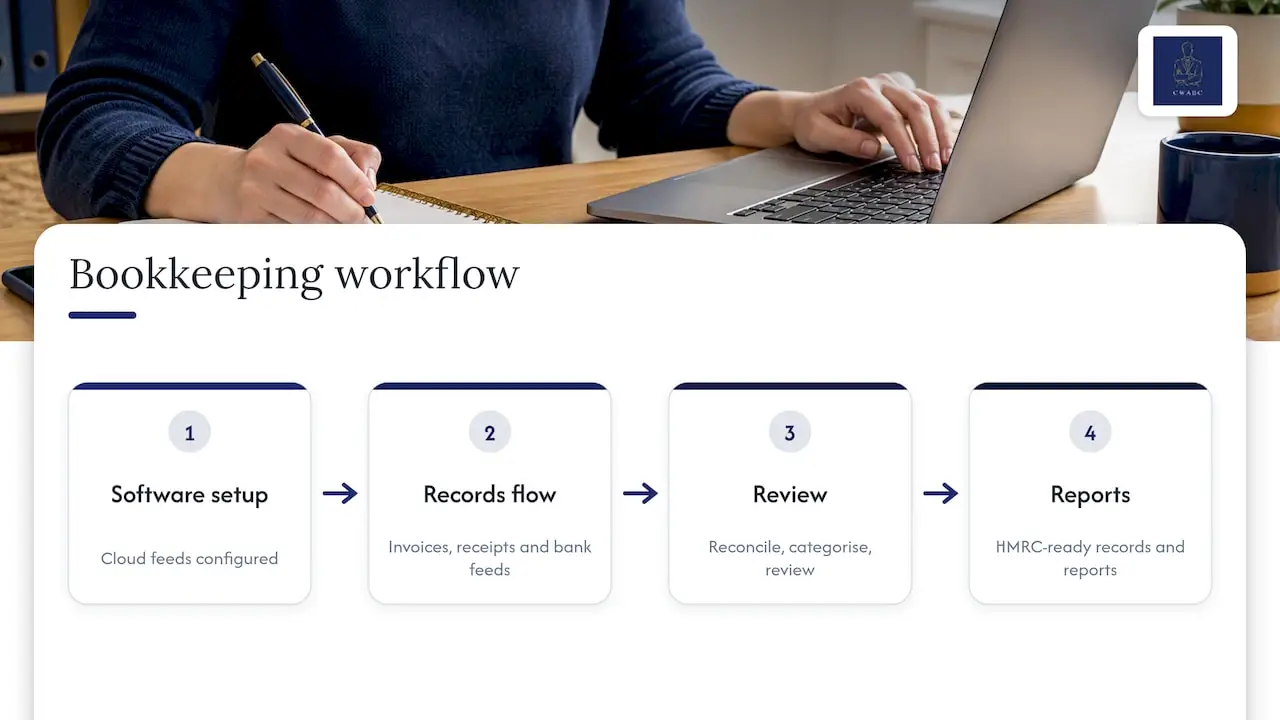
My bookkeeping work is system-led: I set up your cloud software so that bank feeds, invoices and receipts flow in with as little manual typing as possible, then I reconcile, categorise and review. You get reports that make sense, records that are ready for HMRC, and someone to ask when something doesn’t look right.
From there I can take on VAT returns, payroll and CIS, Self Assessment, limited-company accounts and corporation tax, so your numbers stay in one place. If you would like to talk it through, start with my Tonbridge bookkeeping services page.
If you are not sure where you stand, a short conversation about your records is a good place to start. I’ll explain in plain English what I would do and agree the fee clearly before any work begins.
My view on choosing a bookkeeper
The businesses that feel calm about money are rarely the ones with the most sophisticated systems. They are the ones whose records are up to date, so there are no nasty surprises.
That is why I focus on a simple, repeatable routine: software set up properly, bank feeds connected, transactions reviewed regularly and reports you can actually read. With over 30 years of finance experience behind me, I know how much stress comes from the last-minute rush, and how much of it can be avoided.
I also think you should deal with the person doing your books. When you contact me, you reach me, not a call centre, and I will explain things without unnecessary jargon. Making Tax Digital makes this even more worthwhile, because regular, accurate digital records are now part of the job for many sole traders and landlords.
Chris
FAQ
Do I need a bookkeeper or an accountant?
A bookkeeper keeps your day-to-day records. An accountant adds tax preparation, accounts and advice. Many small businesses need both, and I can cover bookkeeping and the tax and accounts work that follows from it, so your figures only need to be handled once.
How often should my bookkeeping be updated?
Official guidance points to weekly or monthly. Business Wales suggests updating records ideally once a week. The right rhythm for you depends on how many transactions you have, and I agree it with each client.
Can you work with me if I’m not in Tonbridge?
Yes. I’m based in Hildenborough and support clients across Tonbridge, Sevenoaks and Tunbridge Wells, and I work remotely with UK clients using cloud software and secure digital workflows.
What software do you use?
I work with Xero, QuickBooks and FreeAgent. If you already use one, I can usually work in it. If you are starting out, I can help you choose and set it up, and train you to use it.
Need help?
If you would like a bookkeeper in Tonbridge who explains things plainly and works directly with you, get in touch with me here and tell me a little about your business.
Sources
- Hiring an accountant: a small business guide, ICAEW
- Business records if you’re self-employed, GOV.UK
- How to keep records as a small business, Tax Confident
- Director information hub: keeping records, GOV.UK
- Managing finance effectively, Business Wales
- Choose the right software for Making Tax Digital for Income Tax, GOV.UK
- The Income Tax (Digital Obligations) Regulations 2026, legislation.gov.uk
- Choosing the right accounting package, nibusinessinfo.co.uk
- Licensed membership, AAT
Recommended
- Accountant Tonbridge: your 2026 tax guide
- 10 things to look for when choosing an accountant in Tonbridge
- Bookkeeping Services in Tonbridge
- Sole Trader Accountant in Tonbridge
This article provides general information based on UK tax and accounting rules at the time of publication. It is not a substitute for advice tailored to your individual circumstances. Tax legislation and HMRC guidance may change. If you need advice about your specific situation, please contact me at CW Licensed Bookkeeper & Accountant.