
If you employ people in Kent, payroll is a routine you cannot afford to get wrong: staff expect the right pay on the right day, and HMRC (His Majesty’s Revenue and Customs, the UK tax authority) expects accurate reports every time you pay them. I run payroll for small employers personally, as an AAT Licensed Accountant based in Hildenborough, near Tonbridge. I work with businesses across Tonbridge, Sevenoaks, Tunbridge Wells and the rest of Kent, and remotely anywhere in the UK. You deal with me directly, not with a call centre or a rota of junior staff.
This guide explains what a good payroll service in Kent should cover, what the monthly and yearly cycle looks like, where small employers usually go wrong, and how I can take the routine off your plate calmly.
TL;DR
- Payroll is more than payslips: each pay period you report pay and deductions to HMRC, and each year you close the books with P60s and benefit reporting.
- Even if you pay a payroll provider, the employer stays legally responsible for every PAYE task, so a careful, qualified practitioner matters.
- A good Kent payroll service covers PAYE, RTI submissions, payslips, starters and leavers, statutory payments, pension assessments and year end reporting.
- I deliver the service myself, in person around Tonbridge and Hildenborough or remotely, with pricing agreed upfront. Get in touch to talk through your payroll.
Table of Contents
- What payroll services in Kent should actually include
- Do you need to register as an employer?
- The pay-period routine, step by step
- Employer National Insurance and the Employment Allowance
- Starters and leavers
- Statutory payments
- Pension assessments
- Year end: P60s, final submission and benefits
- Common payroll problems I see small employers worry about
- Why hand payroll to a qualified practitioner
- How I can run payroll for your Kent business
- Working with me from Tonbridge, Hildenborough, Sevenoaks and Tunbridge Wells
- How payroll connects with your bookkeeping and accounts
- What to ask before choosing payroll support in Kent
- FAQ
- Need help with payroll in Kent?
- Sources
What payroll services in Kent should actually include
The phrase “payroll services” covers very different things. Some providers simply produce a payslip. Others take on the whole cycle. For a small employer in Kent, I would expect a proper service to cover:
- PAYE set-up and management: PAYE (Pay As You Earn) is the system through which you deduct Income Tax and National Insurance from wages and pass them to HMRC.
- RTI submissions: RTI (Real Time Information) simply means you report pay and deductions to HMRC online every time you pay someone.
- Payslips for every employee, accurate and on time.
- Starters and leavers: the right tax code, the right paperwork and the right final pay.
- Statutory payments: sick, maternity, paternity, adoption and similar pay.
- Pension assessments: checking whether each employee must be enrolled in a workplace pension.
- Year end reporting: closing the tax year and producing P60s and benefit reports.
- Plain-English support when something looks wrong.
If you also run construction work and pay subcontractors, the Construction Industry Scheme adds a monthly return of its own. I cover that on my payroll and CIS page.
Do you need to register as an employer?
Not every business with a worker has to run a full payroll, but many do sooner than they expect. According to GOV.UK, you must register for PAYE if any employee is paid £96 or more a week, receives expenses or company benefits, gets a pension, has had another job, or has received certain benefits such as Jobseeker’s Allowance. Even where registration is not needed, you still have to keep payroll records.
If you are taking on your first employee, my guide to setting up PAYE as a first-time employer walks through the registration steps. Taking on a worker on irregular hours is a common starting point too, and I cover that in my guide to payroll for zero hours workers.
The pay-period routine, step by step
Here is what the cycle looks like each tax month, which runs from the 6th of one month to the 5th of the next. This is the routine as GOV.UK sets it out, and it is the routine I run for clients.
- Record pay. Gather hours, salaries, overtime, bonuses and any changes for the period.
- Calculate deductions. Work out Income Tax and employee National Insurance, plus employer National Insurance where it applies.
- Produce payslips. Each employee gets one, showing pay and deductions.
- Send the Full Payment Submission (FPS). This is the RTI report of what you paid and deducted. It goes to HMRC on or before payday, and new employees are reported on or before their first payday.
- Send an Employer Payment Summary (EPS) if needed. You use it to claim reductions, such as statutory pay you have already paid out, and it is due by the 19th of the following tax month. If you paid nobody in a month, you send an EPS instead of an FPS.
- Pay HMRC. The balance is due by the 22nd of the month if paying electronically, or the 19th if paying by post.
A small employer who expects to pay HMRC less than £1,500 a month can ask HMRC about paying quarterly instead. That is worth knowing if you employ one or two part-timers.
The step that catches people out is rarely the sums. It is the timing. A late or missing FPS can trigger a late filing notice and possibly a penalty, as GOV.UK explains. When I look after payroll, I work to your pay dates and HMRC’s deadlines so submissions go in when they should, and you can see what has been filed.
Employer National Insurance and the Employment Allowance
The numbers behind payroll have moved recently. From 6 April 2025, employer National Insurance rose to 15% on earnings above a secondary threshold that was cut from £9,100 to £5,000 a year. At the same time, the Employment Allowance, a reduction in your employer National Insurance bill, increased from £5,000 to £10,500, and the old £100,000 eligibility limit was removed.
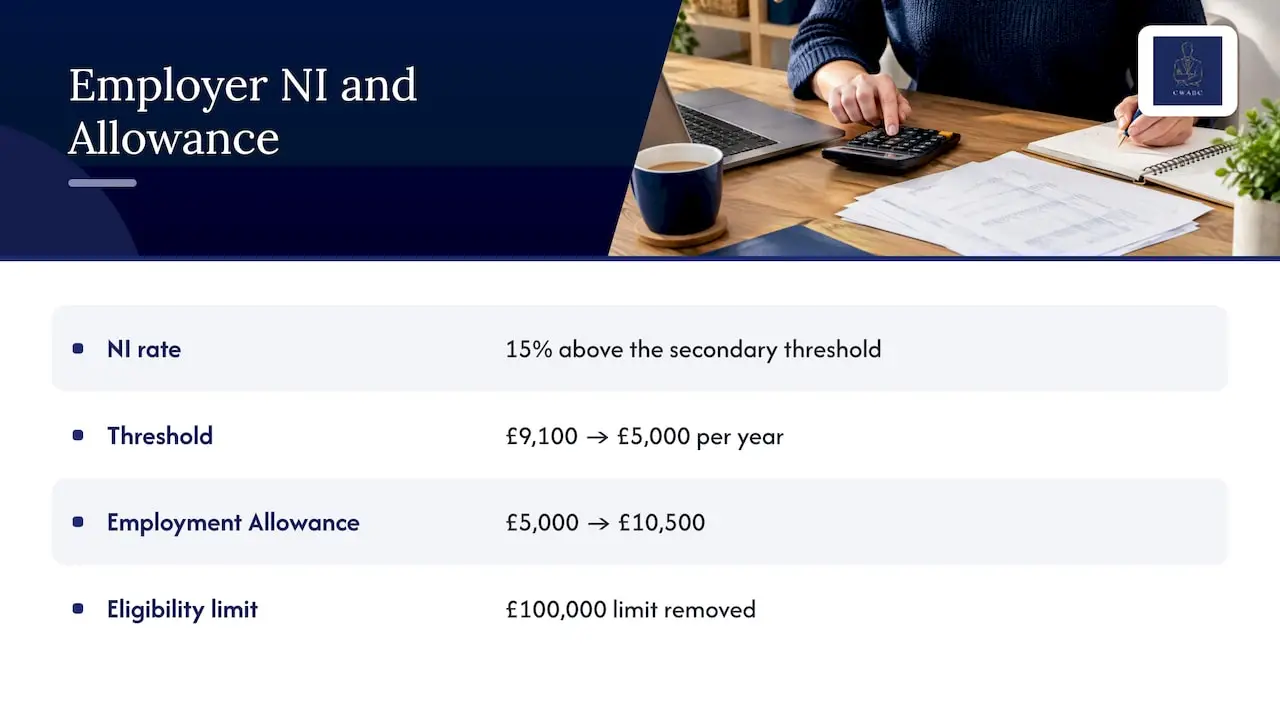
For a small Kent employer, that means more businesses may now be able to claim the allowance, and it is worth checking whether you are eligible and whether it is being applied correctly through your payroll. I check this when I set up or review a payroll.
Minimum wage rates also change each year on 1 April. The GOV.UK rates page shows the National Living Wage for those aged 21 and over is £12.71 an hour from April 2026. Every April, I make sure the rates in your payroll are updated for the new tax year.
Starters and leavers
Most payroll errors happen when somebody joins or leaves.
Starters. You need the employee’s details, a start date and either a P45 from their last job or a starter checklist so the right tax code is used. You then add them to payroll, report them to HMRC on or before their first payday, and assess them for a workplace pension.
Leavers. You process final pay, including any holiday pay owed, report the leaving date in the next FPS, and give the employee their P45. Getting the leaving date wrong is one of the most common causes of tax code problems for the person who leaves, and of awkward phone calls afterwards.
I handle both ends of this for the businesses I support, so you only need to tell me who is starting or leaving and when.
Statutory payments
Statutory sick pay, maternity, paternity, adoption, parental bereavement, shared parental and neonatal care pay all have to be recorded in your payroll and taxed like normal pay. Each has its own eligibility rules, notice requirements and evidence. Most small employers meet these only once or twice, which is exactly why mistakes happen: the rules are unfamiliar, and the first time is stressful for everyone.
When a member of staff tells you they are pregnant or off sick for a long period, I can help you work out what is due, record it correctly and claim back what you are entitled to through your EPS. I do not give legal advice on employment disputes, but I can make sure the payroll side is right.
Pension assessments
If you employ staff, you have automatic enrolment duties: assessing each worker against age and earnings rules, enrolling those who qualify, and paying contributions. The rules apply even to very small employers, and the thresholds are reviewed by government each year, so I always check the current figures with the Pensions Regulator and GOV.UK before assessing anyone. A payroll service that ignores pensions leaves you with a gap that can become costly later.
I carry out the assessments as part of the payroll run, so that a new starter or a pay rise that pushes someone over a threshold does not slip through.
Year end: P60s, final submission and benefits
Year end is where good record keeping pays off. GOV.UK’s annual reporting guidance sets the calendar:
- Send your final payroll report on or before the last payday of the tax year.
- Give each employee a P60 by 31 May.
- Report employee expenses and benefits to HMRC by 6 July.
My step-by-step payroll year end checklist goes through each task in order. If you provide benefits such as private medical insurance or a company car, my P11D guide for small employers explains the reporting.
There is a change coming that is worth planning for. From 6 April 2027, HMRC will require employers to payroll certain benefits in real time, including company cars, car fuel, vans, van fuel and medical insurance, through the FPS. Those will no longer need a P11D. Most other benefits follow from 6 April 2028. If you offer any of these, it is much easier to prepare now than to scramble in the spring.
Common payroll problems I see small employers worry about
These are the issues small employers most often ask me about, and what usually sits behind each one.
| Problem | What usually causes it | What helps |
|---|---|---|
| Late FPS or EPS | Pay dates change, or someone forgets the deadline | A fixed calendar tied to your actual paydays |
| Wrong tax codes | Missing P45 or starter details | Collecting starter information before the first payday |
| Employer NI wrong | Employment Allowance not claimed, or claimed incorrectly | Checking eligibility each tax year |
| Missed pension duties | Nobody assesses new starters or pay changes | Assessment built into every payroll run |
| Statutory pay confusion | Unfamiliar rules, rare events | Checking eligibility before the first payment |
| Messy records | Payroll kept separately from the books | Payroll figures matched to bookkeeping |
| Year end rush | Errors found only in April or May | Regular checks through the year |
None of these is unusual. They are the natural result of a busy owner doing payroll between everything else.
Why hand payroll to a qualified practitioner
Here is the honest reasoning, whatever size your business. GOV.UK is clear that you remain legally responsible for completing all PAYE tasks even if you pay a bureau or accountant to run payroll, and that you must collect and keep the employee records your provider needs. So the real question is not whether payroll is still your responsibility. It is who you want to be looking at it.
A qualified practitioner brings three things:
- Accuracy you do not have to check twice. Rates, thresholds and deadlines change each year, and keeping up is part of my job.
- Time back. Payroll tends to take longer than expected, especially around starters, leavers and year end. That time is better spent on customers.
- Joined-up advice. Payroll feeds directly into your bookkeeping, your VAT and your accounts. One person looking across all of it spots problems earlier.
If you are weighing this up, my article on outsourcing payroll versus doing it yourself goes through the decision in more detail, and what payroll outsourcing really costs explains what affects a quote. Pricing for my payroll work is tailored to your business and agreed clearly upfront, before I start.
How I can run payroll for your Kent business
I am Chris White, an AAT Licensed Accountant with over 30 years of finance experience. When you ask me to look after your payroll, I personally handle the work, from the first conversation to the year end.
In practice that means I can:
- set up or take over your PAYE scheme;
- run each pay period and submit the FPS and EPS to HMRC;
- produce payslips for your staff;
- process starters and leavers;
- calculate and record statutory payments;
- carry out pension assessments;
- prepare your year end reporting, including P60s;
- explain each step in plain English, so you know what is happening and why.

If your business also needs bookkeeping, VAT returns or accounts, I can look after those alongside payroll, so your figures sit in one place. You can see the full range on my accounting services page and my bookkeeping services. I offer no promise of outcomes, but I do promise a clear, calm process and straight answers.
Working with me from Tonbridge, Hildenborough, Sevenoaks and Tunbridge Wells
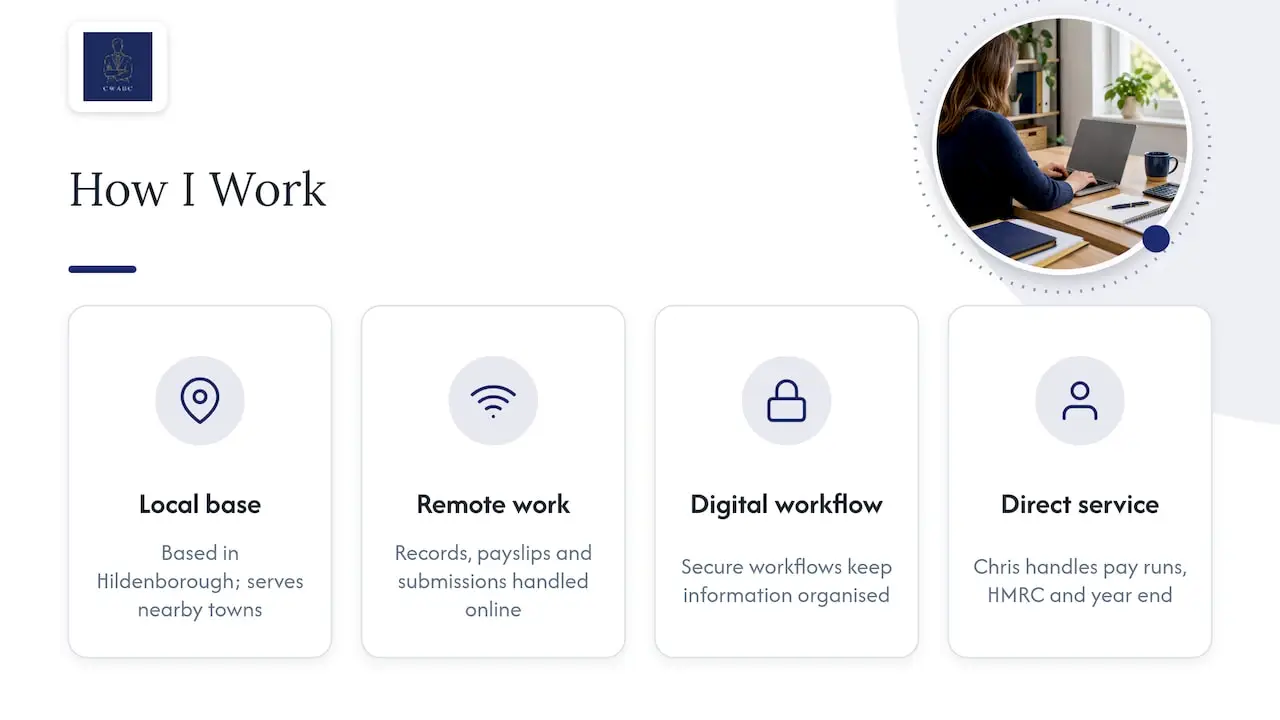
I am based in Hildenborough, near Tonbridge. I do not run offices in the surrounding towns, but I work with employers in Tonbridge, Sevenoaks and Royal Tunbridge Wells, and further across Kent, including Kings Hill. Where it helps, I can meet you locally. Many clients prefer to work remotely, and payroll suits that well: your records, payslips and submissions can all be handled securely online, whether you are down the road or elsewhere in the UK.
That is how I work: paperless, technology-led and using secure digital workflows to keep your information accurate, organised and ready for HMRC.
Perspective
After a lifetime in finance, the thing I notice most about small employers is how many of them feel quietly worried about payroll. Nobody is careless. They simply have a business to run, and payroll deadlines do not move because it has been a busy week.
I built CWABC around a simple idea: you should deal with the person who actually does your work. When you hire me for payroll, I handle your pay runs, your HMRC submissions and your year end myself, and I explain what I am doing without jargon. I would rather you understood your payroll than simply handed it over.
I also think payroll belongs alongside your bookkeeping rather than in a separate silo. When both sit with one qualified practitioner, the numbers agree, the questions are fewer and HMRC deadlines stop feeling like a threat. That is what I aim to give every Kent employer I work with.
Chris
How payroll connects with your bookkeeping and accounts
Payroll is not a standalone task. The wages, tax and National Insurance you pay each month feed directly into your accounts. If your payroll says one thing and your bookkeeping another, the gap tends to show up at year end, or when HMRC asks a question.
Keeping them connected means:
- wages and HMRC payments are matched against your bank account each month;
- employer costs, including National Insurance and pension contributions, are recorded properly;
- limited company directors’ pay is consistent with their accounts and Corporation Tax computation;
- your cloud accounting software reflects what is really owed to HMRC.
If your books are behind, my bookkeeping clean-up checklist shows how I bring them back to a reliable position, and five signs your bookkeeping needs professional help will tell you whether that applies to you. For company directors, I also prepare Corporation Tax and annual accounts, which can sit alongside payroll.
What to ask before choosing payroll support in Kent
Whoever you choose, it helps to know what you are getting. Here are sensible questions for any payroll provider:
- Who will actually run my payroll, and will I speak to them directly?
- Which tasks are included: RTI, payslips, pensions, statutory pay, year end?
- How will my records be shared and stored securely?
- Is the price agreed in writing before work starts, and what does it cover?
- What qualifications does the person doing the work hold?
- Can the same person help with my bookkeeping, VAT or accounts?
My answers are simple. I run it personally, I cover the full cycle, I work digitally and securely, I agree the fee upfront, I am AAT licensed, and I can support the wider accounting side too.
FAQ
How much do payroll services cost in Kent?
It depends on the number of employees, how often you pay them and whether you need pensions, statutory pay or extra reporting. My pricing is tailored to each business and agreed upfront. My guide on what payroll outsourcing really costs explains the factors that move a quote.
Is it worth outsourcing payroll for a small business?
For many small employers it is, particularly once you have several staff, irregular hours, pensions to manage or statutory payments to handle. You remain responsible to HMRC either way, so the benefit is having a qualified person get it right and keep to the deadlines. My comparison of outsourcing or doing it yourself helps you decide.
Do I need payroll if I only have one employee?
Possibly. You must register for PAYE if an employee earns £96 or more a week, or receives benefits, a pension, or has had another job, among other conditions. Even if you do not need to register, you must keep payroll records. I can look at your situation and tell you what applies.
Can you run payroll remotely?
Yes. I work with employers across Kent in person where it helps, and remotely across the UK. Records, payslips and HMRC submissions are handled through secure digital workflows.
Need help with payroll in Kent?
If you would like to talk about your payroll, whether you are taking on your first employee or want to hand over an existing pay run, I would be glad to hear from you. Tell me how many people you pay, how often and what is worrying you, and I will explain how I can help. Contact me here.
Sources
- Running payroll: Overview, GOV.UK
- PAYE and payroll for employers: Introduction to PAYE, GOV.UK
- PAYE and payroll for employers: Choose how to run payroll, GOV.UK
- Running payroll: Reporting to HMRC, GOV.UK
- Running payroll: Employees’ pay, GOV.UK
- Payroll: annual reporting and tasks, GOV.UK
- December 2024 Employer Bulletin, GOV.UK
- Prepare for mandatory payrolling of benefits in kind, GOV.UK
- National Minimum Wage and National Living Wage rates, GOV.UK
Recommended
- What does payroll outsourcing really cost UK employers?
- Outsourcing Payroll or Doing It Yourself: What Suits a Small Business?
- Set Up PAYE in 15 Minutes for First Time UK Employers
- Payroll for Zero Hours Workers: A Guide for UK Employers
This article provides general information based on UK tax and accounting rules at the time of publication. It is not a substitute for advice tailored to your individual circumstances. Tax legislation and HMRC guidance may change. If you need advice about your specific situation, please contact me at CW Licensed Bookkeeper & Accountant.