
Standard outsourced payroll in the UK typically costs a few pounds per employee per month, but that figure only tells half the story. Most providers also charge a minimum monthly fee, often £25 to £60, and for a business with two or three staff, that minimum can push your effective cost per employee far higher than the headline rate suggests.
Here’s the part many small employers miss: outsourcing payroll doesn’t transfer your legal responsibility. You remain accountable for RTI submissions and workplace pension duties even when someone else runs the numbers, so it’s worth checking exactly what indemnity your provider offers if they get something wrong.
Before you accept any quote, get these basics confirmed in writing:
- The per-employee rate and whether it applies PEPM or per payslip
- Any minimum monthly charge and at what headcount it kicks in
- Setup or onboarding fees, and whether year-end processing costs extra
- What happens, cost-wise, if you run an ad hoc payslip mid-month
Pro Tip: Ask any provider to show you a sample invoice for a month with a starter, a leaver, and a statutory sick pay adjustment. That single document tells you more about real-world pricing than any headline rate.
Key Takeaways
Outsourced payroll cost in the UK depends less on the headline PEPM rate than on minimum fees, add-ons, and how well a quote is itemised.
| Point | Details |
|---|---|
| Headline range | Expect £4 to £12 per employee per month, with a minimum monthly fee of £25 to £60 often applying to small teams. |
| Minimum fees distort small quotes | For teams under five employees, the minimum fee usually determines the real cost more than the PEPM rate does. |
| Core service versus add-ons | Payslips, RTI, and P60s are standard; pension admin, CIS, and P11D reporting typically cost extra. |
| Liability stays with the employer | RTI accuracy and pension duties remain your legal responsibility even when payroll is outsourced. |
| Get quotes itemised | CWABC provides transparent, itemised payroll quotes tailored to your headcount, frequency, and complexity. |
Table of Contents
- How much does payroll outsourcing cost? Pricing models explained
- What’s included in a standard payroll service, and what costs extra?
- What factors actually push your payroll quote up?
- Is in-house payroll cheaper than outsourcing?
- How do I get an accurate, comparable payroll quote?
- What does payroll actually cost for a typical small UK employer?
- How I advise Kent clients on payroll costs and choosing a provider
- A more affordable way to get payroll sorted properly
- Where to check the facts yourself
- Need help?
- Sources
How much does payroll outsourcing cost? Pricing models explained
Providers don’t all charge the same way, and understanding the model behind a quote matters more than the number itself. Four structures dominate the UK market.
- Per employee per month (PEPM): you pay a flat rate for each person on the payroll, regardless of how often they’re paid within that month. This is the most common structure for small and mid-sized employers.
- Per-payslip pricing: you’re charged for every payslip issued, which matters if you run weekly payroll for some staff and monthly for others.
- Fixed monthly fee: a flat charge covering payroll up to an agreed headcount, common with accountancy practices bundling payroll into a wider service.
- Tiered or bespoke pricing: rates step down as headcount rises, typically used once you pass 20 to 30 employees.
Real-world ranges vary by service level. Basic processing tends to sit at £3 to £6 per employee per month for the simplest payrolls, with £4 to £12 covering the bulk of standard UK small-business quotes. Full-service packages that bundle pension administration, HR support, or employee self-service portals can push the per-employee rate higher.
Frequency changes the maths considerably. A business paying 10 staff weekly generates roughly four times as many payroll runs annually as one paying monthly, and if your provider charges per run or per payslip rather than a flat PEPM rate, that difference shows up directly on the invoice. Even under a PEPM model, some providers add a supplement for weekly processing because it increases their administrative workload. If you’re weighing up frequency changes for other reasons, factor the payroll cost implications in before you switch.
What’s included in a standard payroll service, and what costs extra?
A baseline payroll service should cover the essentials without additional charges. Expect these as standard:
- Payslip production and distribution each pay period
- RTI submissions to HMRC every time you pay staff, as required by law
- P60s issued to every employee at the end of the tax year
- Starter and leaver processing, including P45s
Beyond that baseline, several services commonly attract extra fees. Pension auto-enrolment administration, including assessing new joiners, managing opt-outs, and submitting contributions to your pension provider, is one of the most frequent add-ons. CIS processing for contractors and subcontractors adds verification steps that most providers price separately. P11D and benefits-in-kind reporting, bespoke payment file generation for your bank, and employee self-service portal access can all carry a supplement too.
Setup and onboarding fees are worth budgeting for separately. These commonly range from a modest one-off charge to several hundred pounds depending on how much historical data needs migrating and how many employees you have. Some providers also levy a year-end processing fee on top of the monthly rate, so ask about this explicitly rather than assuming it’s bundled in.

What factors actually push your payroll quote up?
Quotes vary wildly between businesses that look similar on paper, and the differences usually come down to a handful of controllable factors.
- Headcount and the minimum fee trap. A provider quoting £8 PEPM sounds attractive until you realise their £40 minimum monthly fee means a three-person payroll actually costs over £13 per employee. Always calculate the effective rate against your real headcount, not the headline figure.
- Payroll frequency. Weekly runs cost more to process than monthly ones, whether charged per payslip or via a frequency supplement.
- Pay complexity. Bonuses, commission, multiple pay schedules, variable hours, and overtime calculations all add administrative time that providers price into more complex quotes.
- Statutory pay and staff turnover. Frequent starters and leavers, along with statutory sick pay, maternity pay, or paternity pay calculations, increase the workload each run.
- Sector-specific requirements. CIS processing for construction businesses and pension auto-enrolment re-enrolment cycles (which happen roughly every three years) both add periodic administrative spikes.
- Data migration and integration. Moving from a previous system or connecting payroll output to your accounting software can add one-off setup costs.
Pro Tip: If your business has irregular hours or seasonal staff, ask specifically how the provider handles variable pay. Some quote a flat PEPM regardless of complexity; others charge more the moment overtime or bonus calculations enter the mix.
Is in-house payroll cheaper than outsourcing?
The honest answer is: it depends entirely on your headcount and complexity, and the comparison is rarely as simple as software cost versus provider fee.
Running payroll yourself means budgeting for HMRC’s Basic PAYE Tools or a paid cloud payroll subscription, which is often the cheapest visible cost. But the real expense sits elsewhere: the time someone in your business spends learning payroll legislation, processing runs, staying current with rate changes, and covering absences when that person is off sick or on holiday. Hidden costs like salary time, employer National Insurance on that person’s own pay, and training routinely make in-house payroll more expensive than it first appears once you account for everything properly.
For a genuinely simple payroll, perhaps two directors paid the same amount every month with no pension complications, DIY with cloud software can be the most cost-effective route. Once you add employees, variable pay, pension auto-enrolment, or frequent staff changes, the administrative burden usually tips the balance towards outsourcing.
One point applies regardless of which route you choose: the employer remains legally liable for RTI accuracy and pension compliance, whether payroll is run in-house or by a bureau. Outsourcing shifts the workload, not the ultimate responsibility. That’s precisely why checking a supplier’s indemnity terms for their own errors matters as much as comparing their fees.
How do I get an accurate, comparable payroll quote?
Getting quotes that you can genuinely compare side by side takes a bit of preparation, but it saves you from nasty surprises later.
- Prepare your data before you ask. Have your employee count, pay frequency, pension staging details, and CIS status ready, along with a rough estimate of how many ad hoc payslips (bonuses, leavers mid-month) you expect annually.
- Request a fully itemised quote. It should separately show the setup fee, per-run cost, per-employee rate, minimum monthly charge, and pricing for each likely add-on.
- Ask about indemnity. Find out explicitly what happens, and who pays, if the provider makes an error that leads to an HMRC penalty.
- Check turnaround times and support. Ask how quickly they process a payslip request, what their support response time looks like, and whether you get a named contact or a shared inbox.
- Confirm notice periods and exit costs. Some contracts lock you in for 12 months or charge a fee to release your payroll data if you want to switch providers.
Pro Tip: During onboarding, ask how the provider handles a mistake on your first live run. Their answer tells you more about how they’ll treat you as a client than anything in their marketing.
What does payroll actually cost for a typical small UK employer?
Numbers land better with real scenarios attached, so here’s how the headline ranges play out for different sizes of business.
A micro employer with two employees paid monthly might get quoted £6 PEPM, sounding like £12 a month total. But if the provider’s minimum monthly fee is £35, that’s the real charge, working out closer to £17.50 per employee. This is exactly the scenario where the minimum fee matters more than the advertised rate.
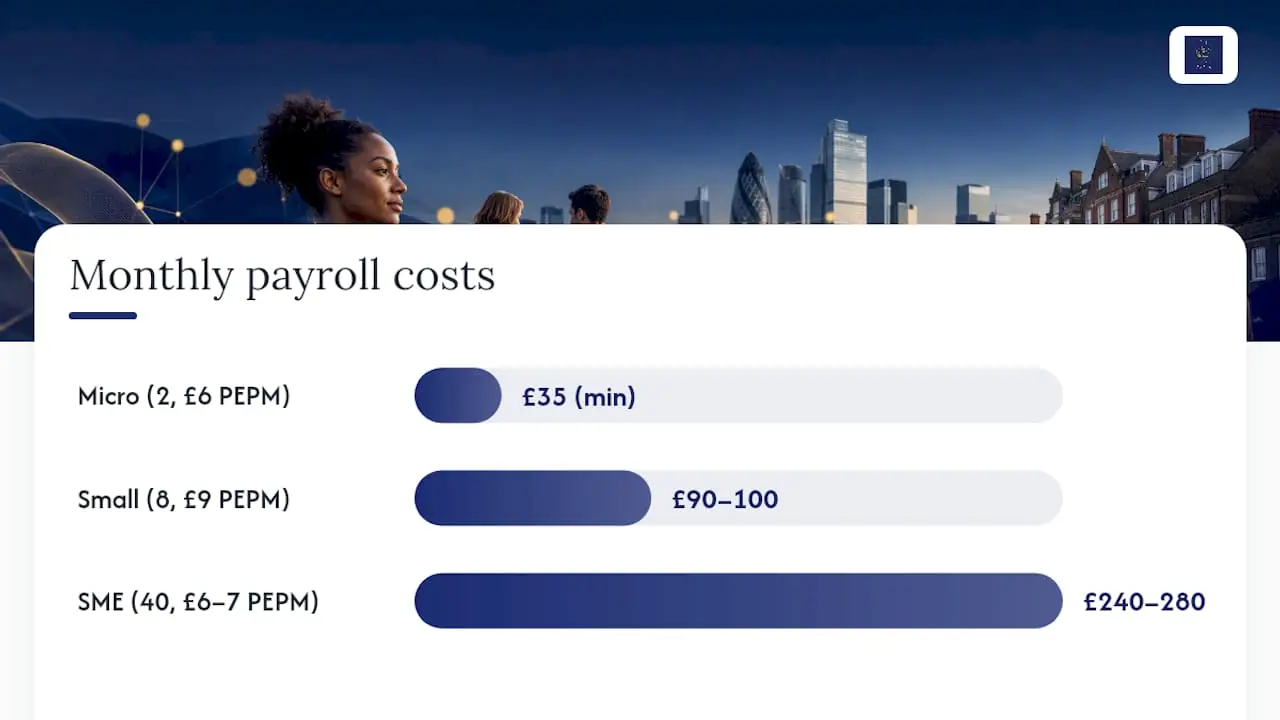
A small team of eight employees paid monthly at £9 PEPM comes to £72 a month for core processing. Add pension administration at a typical supplement, and you might be looking at £90 to £100 monthly once auto-enrolment assessment and contribution reporting are included.
A growing SME with 40 employees often benefits from tiered pricing, where the rate might drop to £6 or £7 PEPM once you pass a threshold, bringing monthly costs to roughly £240 to £280 before add-ons. At this size, some providers start offering dedicated support as standard rather than as a paid extra.
Switching from monthly to weekly pay for even a subset of staff changes the maths meaningfully. If your provider charges per payslip rather than a flat PEPM, moving ten employees from monthly to weekly can roughly quadruple the annual run count for that group, which shows up directly in your invoice total.
How I advise Kent clients on payroll costs and choosing a provider
When clients ask me about payroll costs, I always start the same way: get everything itemised before comparing anything. A quote that hides the minimum fee, the setup charge, or the pension supplement in small print isn’t a quote worth accepting.
For businesses with straightforward payroll and a handful of staff, I often recommend cloud software with accountant oversight rather than a full bureau service. It’s a middle ground that keeps costs sensible while ensuring RTI submissions and pension duties are handled correctly. For anything with CIS, multiple pay schedules, or frequent staff changes, full outsourcing usually earns its fee back in time saved and errors avoided.
I work with Xero, QuickBooks, and FreeAgent because clean data flow between payroll and your accounts prevents reconciliation headaches later. Whichever route you choose, remember the legal responsibility for accuracy stays with you as the employer, so confirm exactly what your contract says about liability before signing anything.
— Chris
A more affordable way to get payroll sorted properly
CWABC gives you a genuine alternative to the bundled, opaque pricing you’ll find at many payroll bureaux: an itemised, upfront quote agreed directly with me, with no hidden minimum fees buried in the small print.

If you’ve read this far, you already know that comparing payroll quotes properly means asking the right questions about minimums, add-ons, and indemnity. I build every payroll engagement the same way, starting with your actual headcount, pay frequency, and pension status, then quoting transparently against exactly what you need rather than a one-size-fits-all package. That’s the same approach I bring to bookkeeping and accounts, so if payroll sits alongside other things you’d rather hand over, bundling it with outsourced bookkeeping often works out better value than paying separately for each. Whether you run two employees or fifty, visit my payroll and CIS support page to request a tailored quote based on your actual payroll, not a generic price list.
Where to check the facts yourself
- Register as an employer with HMRC
- What payroll information to report to HMRC
- HMRC’s Basic PAYE Tools
- Construction Industry Scheme guidance
Need help?
If you’d like a clear, itemised payroll quote based on your actual headcount and pay frequency rather than a generic price list, get in touch via my contact page and I’ll talk you through exactly what’s involved.