
A P11D is the form you use to tell HMRC about taxable expenses and benefits you have given an employee or director that were not put through payroll. A P11D(b) is the companion return that tells HMRC how much Class 1A National Insurance you owe on those benefits. If you gave anyone a company car, private medical insurance, a cheap loan or similar, you probably have something to report. You usually file by 6 July after the tax year ends and pay any Class 1A by 22 July if you pay electronically.
If that sounds like one more thing to worry about, it does not need to be. Most small employers only have a handful of benefits to deal with, and a calm, organised approach through the year makes the July deadline routine. This guide walks through it in plain English.
TL;DR
- A P11D reports taxable benefits and expenses for each employee or director that were not payrolled. A P11D(b) reports the Class 1A National Insurance you owe, and you still file it if you payroll everything.
- Typical reportable items are company cars, private medical insurance, beneficial loans, living accommodation and personal expenses you pay for someone.
- Some items are exempt, such as qualifying trivial benefits, and some minor or irregular items can be settled with a PAYE Settlement Agreement instead.
- Forms must be filed online, and late or wrong returns can lead to penalties, so keep records as you go.
- Mandatory payrolling of benefits is planned, so check the current status on GOV.UK before you plan your next tax year.
Table of Contents
- What is a P11D, and who needs to file one?
- What counts as a benefit in kind?
- Which expenses and benefits go on a P11D?
- Three worked examples
- Exemptions: what you do not need to report
- P11D(b) and Class 1A National Insurance
- Deadlines to put in your diary
- What happens if you file late or get it wrong?
- Payrolling benefits: how it changes your reporting
- Keeping records so the P11D takes minutes, not days
- My perspective
- How I can help with P11D and payroll
- Frequently asked questions
- Need help?
- Sources
What is a P11D, and who needs to file one?
A P11D reports the taxable expenses and benefits you provided to an employee or director during the tax year (6 April to 5 April). According to GOV.UK’s guidance on reporting and paying, you complete a P11D for each employee who received taxable expenses or benefits that were not payrolled. A P11D(b) is the return that reports the Class 1A National Insurance you owe.
In practice that means:
- One P11D per person, not one per business. If you gave a company car to one director and medical insurance to two staff, that is three P11Ds.
- One P11D(b) per employer, covering the Class 1A National Insurance due on everything reported.
- Directors count as employees for this purpose. Directors of small limited companies are often the main recipients of benefits, so this catches many owner-managed businesses.
If you gave no taxable benefits and no taxable expenses in the year, you generally have nothing to report. If you are unsure whether that is you, the sections below will help you check.
Online filing only
From 6 April 2023, employers have had to file P11D and P11D(b) returns online unless they are digitally exempt. As ACCA explains, the options are commercial payroll software or HMRC’s PAYE Online service. Paper forms are no longer the normal route.
What counts as a benefit in kind?
A benefit in kind is something of value you give an employee or director on top of their pay, such as a car they can use privately or health cover paid for by the business. It is not paid through the normal salary, but HMRC can still treat it as taxable earnings. The employee may owe income tax on it, and you owe Class 1A National Insurance.
The key question is always the same: is this a cost of the business, or is it a personal benefit to the person?
Benefits and expenses are not the same thing
Ordinary business expenses are costs an employee incurs wholly, exclusively and necessarily to do the job, and you reimburse them. Train fares to a client meeting, or a laptop used only for work, are typical examples. These generally do not need reporting.
A taxable benefit or expense arises when the item has a private element, or when you pay for something personal. The distinction matters because it decides whether anything goes on the form at all.
| Situation | Usually a business expense | Usually a reportable benefit |
|---|---|---|
| Travel | A train ticket to a client site | A company car the director also uses for family trips |
| Insurance | Insurance on business premises | Private medical cover for an employee |
| Finance | Salary advance repaid in full quickly | A low-interest or interest-free loan above the HMRC threshold |
| Home | A phone used purely for work | Living accommodation provided to a director |
| Personal bills | None | Paying an employee’s personal gym membership or school fees |
This table is a rule of thumb. The right treatment depends on the facts, and HMRC’s own guidance is the final word.
Which expenses and benefits go on a P11D?
The form groups benefits into sections. The ones I see most often when working with small employers are below. HMRC’s guidance on completing forms P11D sets out all the sections and how each one is valued.
- Company cars and vans. A car available for private use, including home-to-work travel for most people, is a taxable benefit. Fuel provided for private journeys is a separate benefit.
- Private medical insurance. Health, dental or similar cover paid for by the business is usually taxable.
- Beneficial loans. A loan to an employee or director on little or no interest can create a taxable benefit, subject to a threshold.
- Living accommodation. Property provided for an employee or director to live in can be taxable, with some exceptions.
- Payments made on behalf of the employee. Examples include personal bills, subscriptions or school fees paid by the business.
- Assets given or lent for private use. Examples include a computer or other item the person can use as their own.
- Other items. This covers anything that does not fit elsewhere and is not exempt.
If an item is on this list but you are not sure it is taxable, do not guess. Check how it is valued, or ask me to review it.
Three worked examples
The figures below are illustrative only, so you can see the logic. They are not tax advice for your own situation, and the percentages and rates change, so always use the figures for the relevant tax year from GOV.UK.
Example 1: a company car
Imagine a director of a small limited company has a company car and uses it privately. To value the benefit, you generally start with the car’s list price and apply a percentage based on its CO2 emissions or electric range. If you also pay for private fuel, that is valued separately. The director reports the benefit through Self Assessment or via a tax code change, and you report the car on their P11D and pay Class 1A National Insurance on its cash equivalent.
Practical points:
- Keep the car’s registration date, list price, emissions details and the dates it was available.
- If the car was available for only part of the year, the value is reduced accordingly.
- If the director reimburses you for private use, that can reduce the figure, so record any payments.
Example 2: private medical insurance
Suppose you take out a business policy that covers two employees. The cash equivalent of that benefit is generally the cost to you of providing it for each person. If the policy costs £1,200 a year for one employee, then £1,200 is the starting point for that employee’s P11D entry, and Class 1A is due on it at the current rate. Keep the insurer’s schedule so you can split the cost per person if it is a group policy.
Example 3: a beneficial loan
A director borrows money from their company on an interest-free basis. If the loan is above the threshold HMRC sets, the benefit is based on the difference between the official rate of interest and the interest actually paid. The loan needs tracking through the year: balances, dates and repayments all matter. If the director’s loan account is overdrawn, there are also company tax issues to consider, so it is worth looking at the whole picture. My guide to common corporation tax filing mistakes covers some of the director-related traps.
Exemptions: what you do not need to report
Not every perk creates a reporting duty. HMRC’s expenses and benefits toolkit explains the main rules, and two of them matter most to small employers.
Trivial benefits
According to HMRC’s toolkit, trivial benefits are exempt from tax and National Insurance when they cost £50 or less, are not cash or a cash voucher, are not a reward for work or performance, and are not part of the employee’s contract. For directors of close companies, and their family members, there is an annual cap of £300.
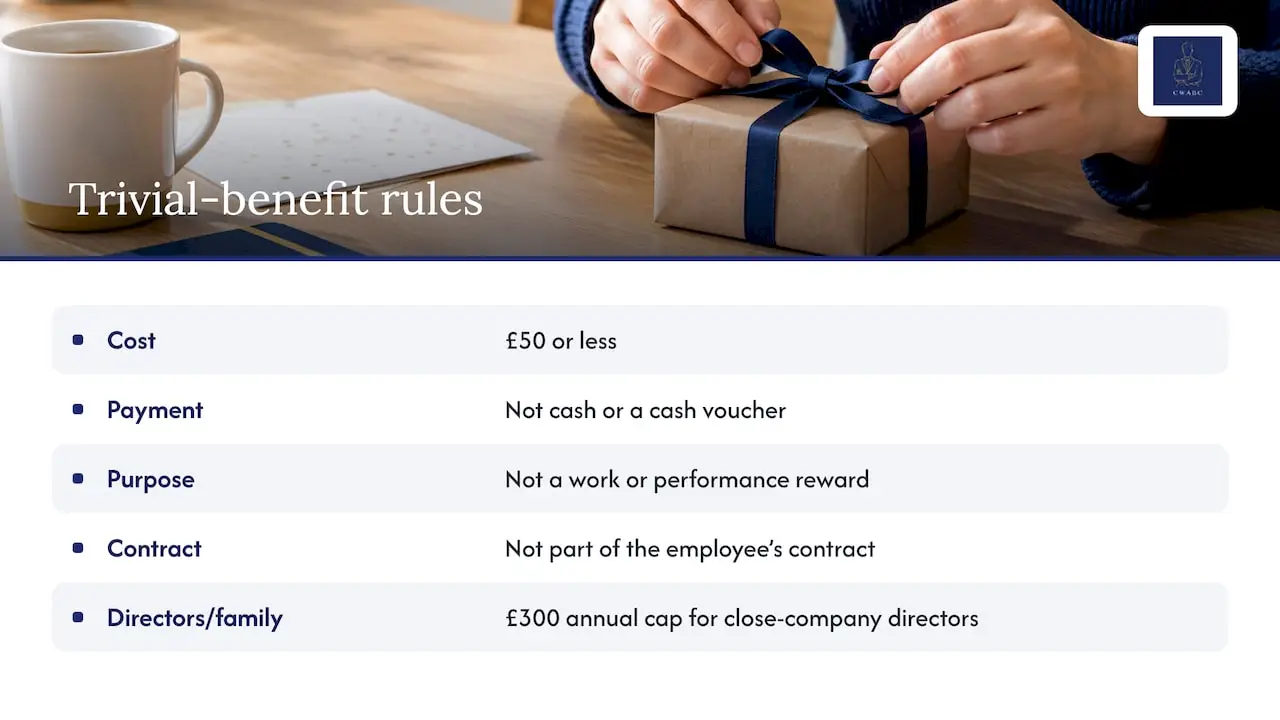
A birthday gift of flowers or a box of chocolates for a member of staff is the classic case. A £50 gift every month to the same person is a different matter, because it can look like a reward or a contractual perk.
PAYE Settlement Agreements
A PAYE Settlement Agreement (PSA) lets you pay the tax and National Insurance on certain items yourself, in one go, rather than reporting them person by person. The same HMRC toolkit says a PSA can be used for minor items, irregular items, or items where it is impractical to operate PAYE or to value the benefit for P11D purposes. Staff parties, taxi fares and incidental travel costs are typical examples. Where a PSA is in place, those items are not reported on a P11D.
A PSA needs to be agreed with HMRC, and it has its own payment arrangements. It is not automatic and it is not a way to avoid tax: you take on the cost instead of the employee. ICAEW’s TAXguide 08/24 confirms that PSAs will remain available and will not be affected by the mandatory payrolling of benefits in kind.
P11D(b) and Class 1A National Insurance
Class 1A National Insurance is paid by the employer only. The employee pays no National Insurance on benefits in kind. ACCA notes that the rate for 2023/24 was 13.8%. The rate can change between tax years, so always confirm the figure for the year you are reporting on GOV.UK.
The sums are simple in principle:
- Add up the cash equivalent of all benefits you reported on P11Ds, and any other amounts that attract Class 1A.
- Apply the Class 1A rate for the tax year.
- Report the total on the P11D(b) and pay it by the deadline.
Example: if the cash equivalent of all your reported benefits is £10,000, your Class 1A bill is £10,000 multiplied by the Class 1A rate for that year. That is the amount you enter on the P11D(b).
The P11D(b) is also where you declare the total, even if you have payrolled some benefits. GOV.UK confirms that if all of an employee’s benefits are payrolled you do not need a P11D for them, but you must still submit a P11D(b) for the Class 1A National Insurance owed.
Deadlines to put in your diary
The pattern repeats every year, so it is easy to plan around.
| What | When |
|---|---|
| Tax year covered | 6 April to 5 April |
| File P11Ds and P11D(b) | By 6 July after the tax year ends |
| Give employees a copy of their P11D information | By 6 July |
| Pay Class 1A National Insurance (electronic) | By 22 July |
| Pay Class 1A National Insurance (post or cash) | By 19 July |
The filing date of 6 July is as set out in ICAEW’s tax news. The payment dates follow HMRC’s guidance, which for 2025/26 gave 19 July 2026 for post or cash and 22 July 2026 for electronic payment. Those are the dates for that tax year, so check GOV.UK for the current year if a weekend or other change affects them.
I add these to the clients’ calendars at the start of the year. If you would like to see how they fit with the rest of your obligations, my small business tax deadline calendar is a good place to start, and my payroll year-end checklist covers the tasks that sit around it.
What happens if you file late or get it wrong?
Penalties exist, and they are worth knowing about so you can avoid them rather than worry about them. ICAEW reports that late filing of a P11D(b) may attract a penalty of £100 per 50 employees (or part) for each month or part-month until payment is received. An incorrect P11D can carry a maximum penalty of £3,000 per form. Interest can also apply to late payment.
The same ICAEW article notes that HMRC accepts only one electronic P11D submission per PAYE reference using payroll software. If you find an error after filing, you must send the amendment electronically using HMRC’s correction service, because amended paper forms are not accepted.
That is another reason to do a short review before you submit, not after. A calm check against your records in June is much easier than a correction in August.
A simple pre-filing check
- Does every benefit have a start date, an end date and a cost?
- Have you matched the benefits to the right person?
- Are any benefits already payrolled, so they should not appear on the P11D?
- Have you applied the trivial benefit and PSA rules correctly?
- Do the P11D totals agree with the P11D(b)?
Payrolling benefits: how it changes your reporting
Payrolling means you add the value of the benefit to the employee’s pay through your payroll software, and tax is collected through PAYE during the year, instead of after the year ends through a tax code change or Self Assessment.
According to GOV.UK’s payrolling guidance, to payroll benefits voluntarily you must register before the start of the tax year in which you want to begin, and you cannot change how benefits are reported for the current year. The same guidance says you must send employees a written notification by 1 June after the end of each tax year. It should explain that you are payrolling benefits, give details of the benefits and their cash equivalent, and say that the employee will not be taxed twice.
What this means for your forms:
- Payrolled benefits are not reported on a P11D.
- Non-payrolled benefits still go on a P11D.
- Class 1A still needs a P11D(b), whether or not you payroll.
- Loans and living accommodation may need separate thought, so check how they are treated before you register.
Mandatory payrolling
Government has set out plans to make payrolling of benefits in kind compulsory, and ICAEW’s TAXguide refers to mandatory payrolling as a policy that has been announced. Because start dates and details for a change like this can move, I check the current position on GOV.UK before advising any client on timing, and I recommend you do the same before you plan your next payroll year. If you are not ready, it is far easier to make the switch deliberately than in a rush.
A practical approach is to choose payroll software that supports benefits payrolling, then gather your list of benefits and their values well before the start of the tax year. If you are new to running payroll, my guide to setting up PAYE explains the basics.
Keeping records so the P11D takes minutes, not days
The form itself is rarely the hard part. Gathering the figures is. A few habits help:
- Keep a benefits register. One spreadsheet or a section in your accounting software, listing each person, each benefit, the dates and the cost.
- Code things properly in your books. Private medical premiums, car costs and loan movements should not be lost in a general expenses account. Good bookkeeping makes the year-end summary quick.
- Review when something changes. A new company car, a new hire on the medical scheme or a loan to a director are all moments to note the details.
- Decide who is responsible. In a small business, if nobody owns it, it is forgotten until July.
- Agree the treatment of private contributions. If someone reimburses you for private use, record when and how much.
If you are a director and your company also needs to account for corporation tax, the cost of benefits and the Class 1A National Insurance are part of what your accounts need to reflect. My guide to corporation tax for UK limited companies explains how that fits together.
My perspective
Most small employers I speak to are not trying to avoid anything. They simply did not know that the company car, the private health cover or the director’s loan counted as something to report, and they find out when July is close.
My view is that P11D is a records problem more than a tax problem. If you capture benefits as they happen, the form becomes a summary of what you already know. If you wait until the deadline, it becomes an archaeology project through bank statements and emails.
That is why I like to start with a review of your payroll records and your accounts through the year, rather than at the end. Looking at what you have paid for staff and directors, I can help you spot items that may need reporting, items that may be covered by an exemption or a PSA, and items that are ordinary business costs. You then decide how to handle them, with a clear explanation and no jargon.
I work with cloud software and secure digital workflows, so your records stay organised and ready for HMRC, and you deal with me directly throughout.
Chris
How I can help with P11D and payroll
I am an AAT Licensed Accountant based in Hildenborough, near Tonbridge, and I support small employers and company directors across Tonbridge, Sevenoaks and Kent, and remotely across the UK. For benefits reporting, I can:
- review your payroll records and accounts to identify benefits that may need reporting;
- help you work out whether an item is a taxable benefit, an exempt item or a normal business expense;
- prepare your P11Ds and P11D(b), and explain the Class 1A National Insurance figure;
- talk through whether payrolling or a PSA could suit your business;
- keep your payroll, bookkeeping and year-end deadlines organised.
You can see the services I offer for employers on my accounting and payroll page. I agree pricing clearly upfront, tailored to what you need.
Frequently asked questions
Do I need a P11D if I only have one director and no other staff?
Possibly. Directors are treated as employees for P11D purposes, so if your company gave a director a taxable benefit, such as a company car or private medical insurance, it may need to be reported. If there are no taxable benefits or expenses, there is usually nothing to file. Check your records for the year to be sure.
Is a gift to an employee always taxable?
Not always. A small gift can fall under the trivial benefits exemption if it costs £50 or less, is not cash or a voucher that works like cash, is not a reward for work and is not in the employee’s contract. For directors of close companies, an annual cap of £300 applies. Anything outside those conditions needs a closer look.
Do I still file a P11D(b) if I payroll all benefits?
Yes. If every benefit for every employee is payrolled, you do not need P11Ds, but GOV.UK says you must still submit a P11D(b) to report the Class 1A National Insurance you owe.
What if I find a mistake after I have filed?
Tell HMRC as soon as you can. If you used payroll software, HMRC only accepts one electronic submission per PAYE reference, so the amendment needs to go through its correction service, not on paper. Acting early helps limit penalties and interest.
Is a P11D the same as a P60?
No. A P60 summarises an employee’s pay and deductions for the year, while a P11D reports taxable benefits and expenses that were not payrolled. They are separate, and you may need both for the same person.
Need help?
If you are unsure whether you have benefits to report, or you would like a second pair of eyes on your payroll records before July, I am happy to talk it through calmly and practically. Please get in touch via my contact page and tell me a little about your business, and I will reply as soon as I can.
Sources
- GOV.UK: Expenses and benefits for employers, reporting and paying
- GOV.UK: Guidance on how to complete P11D forms
- GOV.UK: Voluntarily payrolling employees’ benefits and expenses
- HMRC: Expenses and benefits from employment toolkit
- ACCA: P11D, avoid late-submission penalties
- ICAEW: Employers have until 6 July to file P11Ds
- ICAEW: TAXguide 08/24, payrolling of benefits-in-kind and expenses
Recommended
- Set Up PAYE in 15 Minutes for First Time UK Employers
- Small business tax return explained: 2026 guide
- P60s by 31 May: payroll year end checklist for small UK employers, AAT
This article provides general information based on UK tax and accounting rules at the time of publication. It is not a substitute for advice tailored to your individual circumstances. Tax legislation and HMRC guidance may change. If you need advice about your specific situation, please contact me at CW Licensed Bookkeeper & Accountant.