
If your directors loan account (DLA) is overdrawn, you owe your company money. Nothing dramatic happens on the day the balance tips over, but a clock starts. If the balance is still unpaid nine months and one day after your company’s accounting period ends, the company has to pay a section 455 Corporation Tax charge of 33.75% of what is outstanding. You may also face a personal tax charge, and in some cases the loan can be questioned as an unlawful payment.
That sounds worrying, but it is usually very manageable when you catch it early. This guide walks through what an overdrawn DLA means, what the deadline is, what your repayment options are and how the company and personal tax consequences differ. It finishes with a simple worked example and an explanation of how I review these balances when I prepare company accounts.
TL;DR
- An overdrawn DLA means you have taken more money out of the company than you have put in or been paid through salary, dividends or expenses. You owe the difference to the company.
- Repay it within nine months and one day of the company’s year end and no section 455 tax is due. Leave it and the company pays 33.75% of the balance (32.5% for loans made before 6 April 2022).
- Section 455 tax is a company charge and can be reclaimed once the loan is repaid, released or written off. Interest paid on that tax is not refunded.
- Separate personal consequences can follow: a benefit-in-kind charge if the loan is beneficial, or Income Tax and National Insurance if the loan is written off.
- Check the balance monthly, not once a year. Clearing it properly, with the right paperwork, is far cheaper than fixing it late.
Table of Contents
- What an overdrawn directors loan account actually is
- The nine-month deadline: when the clock starts and ends
- What section 455 tax is, and what it costs
- Your repayment options
- Company tax versus personal tax: keeping the two apart
- Beneficial loans and the benefit-in-kind charge
- Unlawful dividends: the risk of clearing the balance the wrong way
- A simple worked example
- Other situations worth knowing about
- How I review directors loan balances when preparing company accounts
- A calm checklist if your account is overdrawn now
- Perspective: why I prefer to look at the account every month
- How I can help with an overdrawn directors loan account
- FAQ
- Need help?
- Sources
What an overdrawn directors loan account actually is
A director’s loan is money you take from your company that is not salary, a dividend or an expense repayment, as GOV.UK explains. The company has to keep a record of everything you borrow from it or pay into it, and that record is normally the directors loan account. GOV.UK’s fact sheet on director’s loan accounts sets out that expectation.
The account is overdrawn when the balance runs in the company’s favour. In plain English: you owe the company.
Money owed by the director versus money owed to the director
People often mix up the two directions, so it is worth being clear.
| Overdrawn DLA (owed by you) | Credit DLA (owed to you) | |
|---|---|---|
| What happened | You took out more than you were entitled to | You put money in, or paid company costs personally |
| Who owes whom | You owe the company | The company owes you |
| In the accounts | A debtor (an asset) of the company | A creditor (a liability) of the company |
| Section 455 tax | Can apply if unpaid after nine months | Does not apply |
| Typical cause | Personal spending from the business account, withdrawals with no salary or dividend behind them | Startup funding, paying invoices from a personal card |
A credit balance is generally a comfortable place to be. You can usually take repayments of it out of the company without a tax charge, subject to the company having the cash. It is the overdrawn side that needs attention.
How accounts end up overdrawn
In my experience of how these things usually arise, the causes are ordinary rather than reckless:
- Transfers to a personal account that were meant to be a dividend, but no dividend was ever declared.
- A salary that is lower than what you actually drew each month.
- Personal purchases put through the business card and never coded properly.
- A dividend that was declared on the basis of expected profit, then the profit did not materialise.
- Money taken in the final months of the year, planning to “sort it out later”.
The common thread is a lack of regular bookkeeping. If the records are only looked at once a year, the problem appears when the accounts are prepared, which is often too close to the deadline. My guide to monthly bookkeeping for limited company directors explains the routine that stops this.
The nine-month deadline: when the clock starts and ends
The deadline runs from the end of the company’s Corporation Tax accounting period, not from the date you took the money. GOV.UK says that if the loan is not repaid within nine months of the accounting period end, the company must pay Corporation Tax on the outstanding amount. The charge is due nine months and one day after the period ends, as the HMRC Directors’ Loan Accounts Toolkit confirms.
So for a company with a 31 March year end, the nine months end on 31 December, and the tax falls due on 1 January. The clock is measured against the balance at the end of the accounting period, so a loan taken just before the year end and cleared a few weeks later is in a very different position from one that sits for months.
Two practical points:
- Your company’s year end matters. If you took a loan in the first month of a new accounting period, you have almost twenty-one months before the charge applies to it. If you took it in the last month, you have just over nine.
- The charge is calculated on the balance outstanding at the deadline. Part-repayments reduce the tax, because the charge applies only to what is still owed.
The due date for this charge is the same as the one for the company’s normal Corporation Tax payment for most small companies, so the two are often paid together. My guide to paying Corporation Tax correctly covers how to make that payment so it is allocated properly.
What section 455 tax is, and what it costs
Section 455 tax (often written s455) is a charge on close companies that make loans to participators. A close company is, broadly, one controlled by a small number of people, and most owner-managed companies fall into that group. A participator is typically a shareholder, and a director who owns shares is both.
The current rate is 33.75% of the outstanding amount, or 32.5% where the loan was made before 6 April 2022. That rate matches the upper rate of dividend tax, which is why the charge is often described as a temporary deposit rather than a penalty.
It is a company cost, not a personal one
This is the most common source of confusion. Section 455 tax is paid by the company, through its Corporation Tax return (CT600). It is not a personal Income Tax charge and it does not go on your Self Assessment return. If the company does not have the cash, you can end up needing to put money into the company or take further action, but legally the liability is the company’s.
Reclaiming the tax
The good news is that the charge is refundable. The company can reclaim the tax once the loan is repaid, released or written off, although it cannot reclaim any interest paid on the tax. Relief generally cannot be claimed until nine months and one day after the end of the accounting period in which the loan was repaid. That means the cash can be tied up for a long time, and cash flow is usually the real cost.
Watch out for repaying and redrawing
If you repay a loan and then take the money out again straight afterwards, you may think the problem is solved. HMRC looks at this closely. The toolkit explains that relief is restricted where loans are repaid and then redrawn under linked arrangements. The same applies to clearing a balance shortly before the deadline with money that comes back out soon afterwards. If you are planning a repayment close to the year end or the deadline, talk it through with your accountant first, because the timing and the reason behind it both matter.
Your repayment options
There is more than one way to clear an overdrawn balance. Each has different consequences, and which suits you depends on the company’s profits, its cash and your personal tax position.
Option 1: pay the money back
The simplest route is a personal transfer back into the company bank account, ideally with a clear reference. It is clean, easy to evidence and has no further tax consequences. The practical challenge is that many directors do not have personal savings to hand, which leads to the next options.
Option 2: declare a dividend
If the company has enough distributable profit, a properly declared dividend can be set against the balance. The dividend is paid by crediting your loan account rather than by sending cash, which clears some or all of the debt. Three things must be right:
- There must be sufficient retained profits at the time of the dividend, based on up-to-date records.
- The dividend must be properly declared, with board minutes and a dividend voucher.
- Dividend tax will fall on you personally, through Self Assessment, if the dividend takes you above your tax-free allowance.
If you want to understand how the amount of salary and dividend interacts with your personal tax, I explain that separately in my director salary tax examples, so I will not repeat it here.
Option 3: pay a bonus or salary through payroll
A bonus or additional salary can be paid by crediting your loan account, but it must go through payroll. That means PAYE Income Tax and National Insurance, and possibly employer National Insurance on the company side. It is usually more expensive than a dividend, but it can make sense where there are not enough profits for a dividend.
Option 4: write the loan off or release it
The company can formally release you from the debt, but this is the option with the heaviest personal consequences. GOV.UK states that if a loan is written off or released, the company must deduct Class 1 National Insurance through payroll, and you must report the amount as income on your Self Assessment return and pay Income Tax on it. I would never treat this as a casual clean-up. It needs a decision on record, a payroll treatment and a clear view of the personal tax.
Option 5: leave it and pay the section 455 charge
Sometimes a director cannot clear the loan in time. The company then pays the s455 tax, and can reclaim it when the loan is eventually cleared. This is legitimate, but it ties up cash and may add interest if the payment is late, so it is a fallback rather than a plan.
Company tax versus personal tax: keeping the two apart
One of the biggest sources of confusion with overdrawn loans is who pays what. The table below separates them.
| Situation | Company consequence | Personal consequence |
|---|---|---|
| Loan unpaid after nine months and one day | Section 455 tax at 33.75% (32.5% for pre-6 April 2022 loans), reclaimable on repayment | None from the s455 charge itself |
| Loan is beneficial (low or no interest) | Possible Class 1A National Insurance and P11D reporting | Income Tax on the taxable benefit |
| Loan written off or released | Class 1 National Insurance through payroll | Income Tax on the amount, reported on Self Assessment |
| Cleared by dividend | Dividend must be lawful and documented | Dividend tax if above the allowance |
| Repaid in cash | No tax cost, subject to the redrawing rules | None |
The table is a guide to how the pieces fit together, not tax advice for your situation. The rate and thresholds change, so it is worth checking the current position on GOV.UK or with an adviser before you act.
Beneficial loans and the benefit-in-kind charge
Separate from section 455, an overdrawn loan can be a “beneficial loan” for tax purposes. Broadly, that means the company has lent you money at no interest, or at less than HMRC’s official rate, so you are treated as receiving a benefit.
The toolkit says that if a DLA is overdrawn at any point during the year, it should be assessed to see whether it is a beneficial loan that needs reporting on form P11D. That is the benefit-in-kind return an employer files for each director and employee who receives taxable benefits.
The official rate of interest used to measure the benefit is 3.75% from 6 April 2026. If the company charges you interest at that rate or higher, there is no taxable benefit from the interest. If it charges less, the shortfall is the benefit, and:
- You pay Income Tax on that benefit through your personal tax position.
- The company pays employer Class 1A National Insurance on it and files the P11D.
There is an exemption for small loans below a set balance, but I always check the current limit and the conditions on GOV.UK rather than rely on memory, because the exemption depends on the total outstanding across the year.
A point that catches people out: if the company charges you interest on the loan, that interest is income for the company, so it forms part of the company’s taxable profit. Meanwhile, interest you pay on an overdrawn DLA does not get personal tax relief, because HMRC’s guidance says it does not qualify under section 383 of the Income Tax Act 2007. So charging interest solves the benefit-in-kind issue but creates a small tax cost of its own. It is a trade-off to consider rather than an automatic fix.
Unlawful dividends: the risk of clearing the balance the wrong way
Declaring a dividend to clear an overdrawn account is a common and sensible solution, but only if the company can lawfully pay it. A dividend can only come from profits that are available for distribution. If the company does not have those profits, the dividend is unlawful, even if you have paperwork for it.
The consequences can be serious. In practice, an unlawful dividend can be treated as a debt you owe to the company, which puts you back where you started, now with the added problem of a defective dividend. It also affects the accounts, because the numbers the dividend was based on may be wrong. The risks include:
- The dividend being treated as a loan again, with section 455 consequences.
- A liquidator or administrator seeking recovery if the company later fails.
- Disagreements between directors and shareholders when records are unclear.
This is why I do not like backdated dividends or dividends declared after the books are finished. They should be based on up-to-date management accounts and be properly minuted. If a dividend would leave the company without enough reserves, a different route may be better.
A simple worked example
Here is an illustration with round numbers. It is not a real client and not tax advice.
Sam is the sole director and shareholder of a small design company. The company’s year end is 31 March 2026. During the year Sam draws money for personal use, and at the year end the DLA shows Sam owes the company £12,000.
Step 1: the deadline. Nine months after 31 March 2026 is 31 December 2026. If the £12,000 is not repaid by then, the s455 tax is due on 1 January 2027.
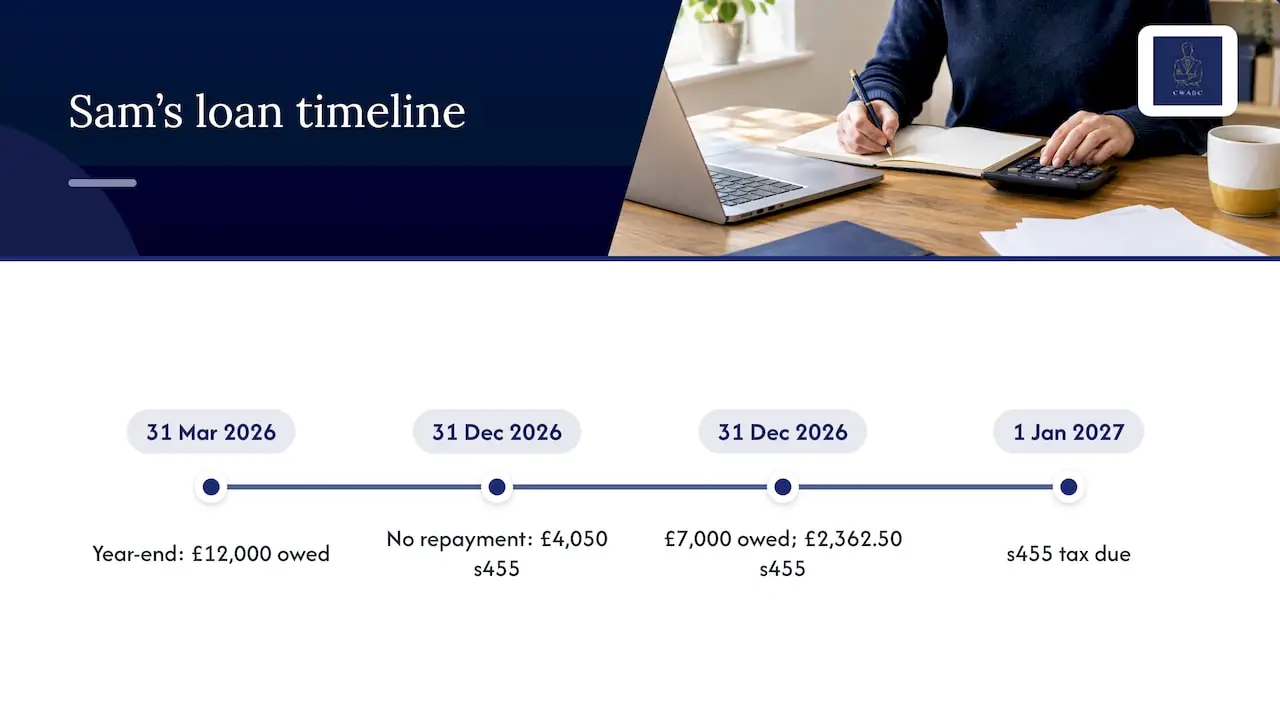
Step 2: the cost if nothing is done. 33.75% of £12,000 is £4,050. The company pays this to HMRC. It is not a penalty, and the company can reclaim it later when the loan is cleared, but the reclaim is not immediate.
Step 3: part-repayment. Suppose Sam repays £5,000 from personal savings before the deadline. The outstanding balance is £7,000, and the s455 charge falls to £2,362.50 (33.75% of £7,000).
Step 4: clearing the rest. If the company has enough distributable profit, Sam could declare a dividend of £7,000 with proper minutes and a voucher, credit it to the loan account and clear the balance. No s455 tax is due. Sam would then consider dividend tax on that amount personally, based on the rest of Sam’s income for the tax year.
Step 5: beneficial loan check. While the loan was outstanding, the company did not charge interest. Depending on the balance during the year and the current exemption, a P11D benefit might arise at the official rate, which is 3.75% from 6 April 2026. On an average balance of £12,000 that would be £450 of taxable benefit, before any exemption or averaging adjustments.
The lesson from this is not that the numbers are terrible. It is that the cost depends heavily on timing and on how the account is cleared, and that a month-by-month view would have shown Sam the pattern long before the year end.
Other situations worth knowing about
Loans over £10,000 and shareholder approval
If the directors are not also the shareholders, GOV.UK’s fact sheet says that shareholder approval is needed before a loan of £10,000 or more is made to a director. Without consent, taking the loan could be treated as misfeasance or theft. In an owner-managed company where you are the only shareholder this is easily dealt with, but it should still be recorded.
If the company becomes insolvent
An overdrawn balance does not disappear if the company fails. The same fact sheet explains that director’s loans must be repaid even on insolvency, and liquidators can take legal action to recover the debt. If your company is struggling, talk to a licensed insolvency practitioner about your own position, because I do not give insolvency advice.
Do you need the DLA on your own tax return?
A simple overdrawn balance, on its own, does not appear on your personal Self Assessment. Things that do affect it include dividends used to clear the account, loans that are written off, and benefits in kind. If any of those have happened, your Self Assessment return needs to reflect them.
How I review directors loan balances when preparing company accounts
When I prepare limited company accounts, the directors loan account is one of the first things I look at, because it affects both the accounts and the Corporation Tax return. My review follows the same steps each time:
- Reconcile the account. I check every entry in the DLA against bank statements and receipts, and split personal spending from genuine business costs that were put in the wrong place.
- Establish the direction and size of the balance. I look at the balance at the year end and the highest balance during the year, as well as whether it moved from credit to overdrawn and back.
- Check the deadline. I work out the nine-month and one-day date from your year end, and tell you in plain English how long you have.
- Test the clearing options. I look at whether the company has distributable profits for a dividend, what that would mean for your personal tax, and whether a part-repayment would be cheaper.
- Assess beneficial loan reporting. I consider whether the loan was overdrawn during the year, whether interest was charged and whether a P11D is needed.
- Reflect s455 on the CT600. Where tax is due, I include it in the Corporation Tax return and flag the cash needed, so it is not a surprise. Where tax was paid previously and the loan has now been cleared, I check whether a reclaim can be made.
- Check the rates. I verify the s455 rate, the official interest rate and any thresholds against GOV.UK before relying on them.
A lot of the pain with these balances comes from the filing stage. Some of the typical problems are covered in my guide to Corporation Tax filing mistakes, and the wider rules are in my Corporation Tax guide for limited companies.
A calm checklist if your account is overdrawn now
You do not need to panic. Work through these steps in order:
- Find the current balance and the date of your company’s year end.
- Work out your deadline: nine months and one day after that year end.
- Check the bookkeeping is up to date, so you are working from real numbers.
- Decide how you want to clear it: repay, dividend, payroll or a combination.
- Check the company has distributable profits before declaring any dividend.
- Record everything: minutes, vouchers, bank references and a note of why.
- Ask whether interest should be charged, or whether a P11D is needed.
- Do not repay and then redraw straight away without getting advice.
Perspective: why I prefer to look at the account every month
I have found that most overdrawn directors loan accounts are not the result of bad intentions. They are the result of a business owner being busy, taking money as it is needed, and not seeing the running balance until the accounts are prepared.
That is why I like to work with a system. When your bookkeeping is kept up to date in cloud software such as Xero, QuickBooks or FreeAgent, the directors loan balance is visible all year. If it starts to move into overdrawn territory, we can talk about it early, while there is still time to decide calmly between a dividend, a repayment or a change to how you are paid.
I deal with clients directly, so you get a plain-English explanation of what the numbers mean and what your options are. I do not promise outcomes, because every company’s profits, cash and personal tax position are different, but I do aim to make sure you meet your obligations on time and are never caught out by a deadline you did not know about.
Chris
How I can help with an overdrawn directors loan account
If you are a limited company director in Tonbridge, Sevenoaks or elsewhere in Kent, or you work with me remotely from anywhere in the UK, I can help you get your directors loan account under control. That includes tidying up the bookkeeping, working out your nine-month deadline, preparing your company accounts and Corporation Tax return with the DLA properly dealt with, and explaining the personal tax side in plain English.

I can also set up your cloud accounting software so the loan balance is visible every month. You can see everything I offer on my accounting services page, or look at my bookkeeping services if the first step is getting your records in order. Pricing is agreed clearly upfront, based on what your company needs.
FAQ
How do I calculate interest on an overdrawn directors loan account?
There are two different interest questions. If the company charges you interest, you multiply the balance by the rate over the period it was outstanding, and that interest is income for the company. If the company charges nothing or less than HMRC’s official rate, which is 3.75% from 6 April 2026, the shortfall may be a taxable benefit. Interest you pay does not get personal tax relief.
What happens to an overdrawn directors loan account if the director dies?
The debt does not simply vanish. It is a balance owed to the company, so it generally becomes a matter for the director’s estate and the company to deal with, and the tax treatment of any release depends on the facts. This is a situation for a solicitor and an accountant to look at together, rather than something to guess at.
Do I have to pay section 455 tax if I repay the loan late?
If the balance is still outstanding nine months and one day after the year end, the company owes the s455 charge even if you repay shortly afterwards. The company can then reclaim it once the loan has been repaid, but only after the relevant waiting period, and it cannot get back any interest paid on the tax. Repaying as soon as you can still reduces the time the cash is tied up.
Can I clear an overdrawn account with a dividend?
Yes, provided the company has enough distributable profits and the dividend is properly declared and documented. A dividend that the company cannot lawfully pay can leave you with a debt and a defective dividend. You will also need to consider dividend tax personally on any amount above your allowance.
Is an overdrawn directors loan the same as a salary advance?
No. A salary advance is paid through payroll, so PAYE and National Insurance are dealt with at the time. A directors loan is money taken outside payroll that you are expected to repay, which is why section 455 and benefit-in-kind rules come into play.
Need help?
If your directors loan account is overdrawn, or you are not sure what the balance should be, I would be happy to look at it with you and explain your options in plain English. Please get in touch with me to talk through your situation.
Sources
- Director’s loans: Overview, GOV.UK
- Director’s loans: If you owe your company money, GOV.UK
- Fact sheet: Director’s loan accounts, GOV.UK
- Directors’ Loan Accounts Toolkit, HMRC
- Beneficial loan arrangements (480: Chapter 17), GOV.UK
- Beneficial loan arrangements, HMRC official rates, GOV.UK
Recommended
- Small business director salary tax examples: 2026 guide
- How to pay corporation tax correctly: UK director’s guide
- Ten corporation tax filing mistakes small company directors make
- Associated companies rules: avoid halved tax limits for UK directors
This article provides general information based on UK tax and accounting rules at the time of publication. It is not a substitute for advice tailored to your individual circumstances. Tax legislation and HMRC guidance may change. If you need advice about your specific situation, please contact me at CW Licensed Bookkeeper & Accountant.