
If your company controls, or is controlled by, another company under common ownership, the associated companies rules apply, and your £50,000 and £250,000 corporation tax thresholds shrink accordingly. With one associated company, both limits halve. Map every shareholding now, because these rules have applied since 1 April 2023 and HMRC expects you to have already worked out your position.
TL;DR:
- The number of associated companies reduces both corporation tax thresholds proportionally, requiring you to recalculate limits based on the actual associate count.
- Control is defined strictly by voting rights, shareholding, or rights to income or assets, and lookback periods extend to 12 months before the accounting period end.
- Dormant companies and passive holding companies with no trading activity can be excluded from the associate count, but careful activity checking is essential.
- Family and related parties are considered associates only if substantial interdependence exists, such as shared finance, staff, or customers; otherwise, they may not be included.
- The rules reintroduced in April 2023 make associated company calculations more relevant for all small and medium-sized firms, affecting thresholds, instalment payments, and planning.
Table of Contents
- What counts as an associated company under the rules?
- How do the £50,000 and £250,000 thresholds change?
- Which companies can you leave out of the count?
- How do family shareholdings and connected parties affect the count?
- Do associated companies change your instalment payment obligations?
- What should directors check and record right now?
- How I help clients with associated company checks
- What happens to group relief when companies are associated?
- Does being associated affect employment allowance or other reliefs?
- Common law tests versus the statutory control test
- What changed in the associated companies rules recently?
- How do associated companies rules interact with CFC rules?
- Practical perspective: review this now, not at year end
- Need help? Getting your associated company position right
- Sources
- FAQ
What counts as an associated company under the rules?
Two companies are associated when one has control of the other, or when the same person, or group of people, controls both. This definition comes straight from Corporation Tax Act 2010, Part 10, which borrows its control test from the rules originally written for close companies.
Control, in this context, is not about who runs the business day to day. It is about who holds the levers: voting power, ordinary share capital, or rights to income and assets on a winding up. CTM03710 sets out HMRC’s working definition of control for these purposes in more detail.
The lookback matters as much as the snapshot. If two companies were associated at any point in the 12 months before the end of the current accounting period, they count as associated for that whole period, even if the connection was broken partway through. A director who sells their shareholding in March cannot simply ignore that company for a December year end. HMRC will still look back across the preceding 12 months.
One point trips up plenty of directors with international interests: a company does not need to be UK resident to count as an associate. If you control a trading company registered overseas, and you also control a UK limited company, both can be associated for UK corporation tax purposes, regardless of where the overseas company pays its own local taxes. Directors with cross-border holding structures should also check how EU holding company rules interact with UK control tests, since the two frameworks do not always align neatly.
How do the £50,000 and £250,000 thresholds change?
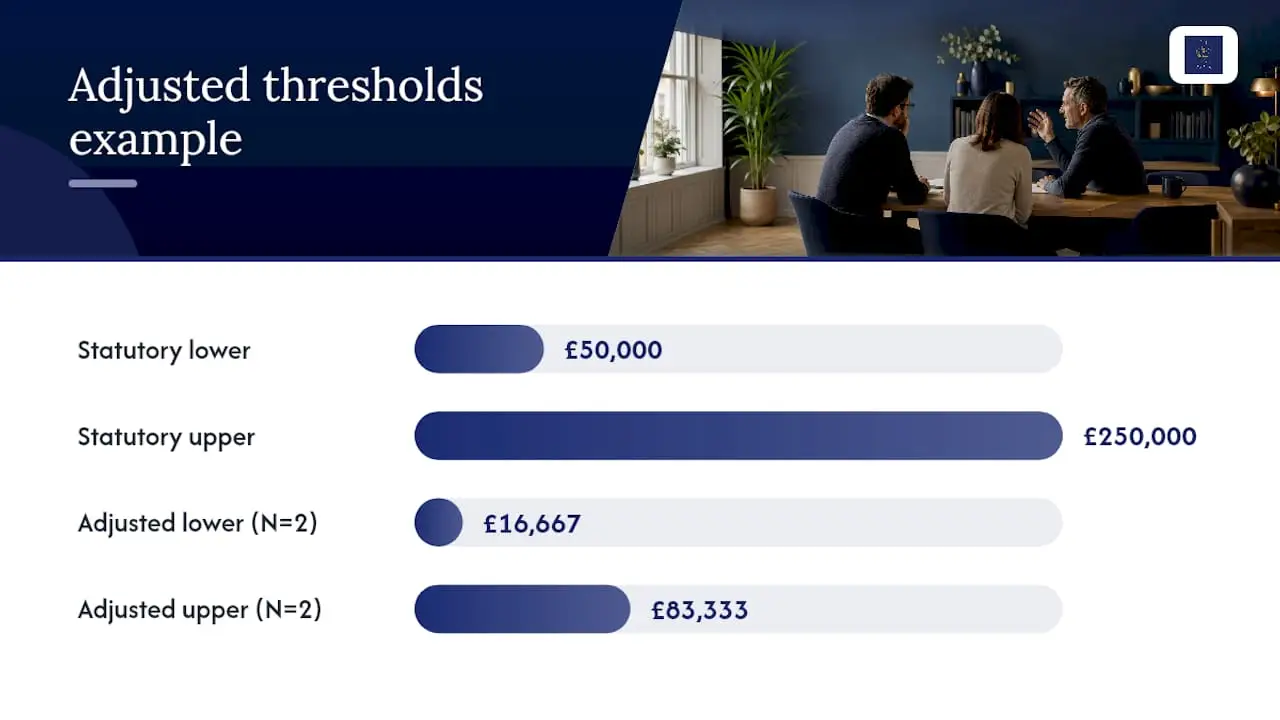
The formula is simple once you see it written out: take the statutory threshold and divide it by (1 + N), where N is the number of associated companies that are not dormant. One associate means dividing by two. Two associates means dividing by three, and so on.
Since 1 April 2023, the statutory lower limit is £50,000 and the upper limit is £250,000. Below the adjusted lower limit, profits are taxed at the small profits rate of 19%. Above the adjusted upper limit, the full 25% main rate applies. Between the two, marginal relief tapers the rate gradually using a standard fraction of 3/200, applied against the difference between the upper limit and actual profits.
Pro Tip: Marginal relief calculators exist on GOV.UK, but they only work once you have the right adjusted limits plugged in. Get the associate count wrong and the whole calculation is wrong.
Here is a worked example. Say a company has two associated companies, neither of them dormant. N = 2, so both thresholds divide by three:
- Adjusted lower limit: £50,000 ÷ 3 = £16,667
- Adjusted upper limit: £250,000 ÷ 3 = £83,333
Without the associated companies, the same £40,000 would have fallen comfortably under the standard £50,000 limit and attracted the small profits rate cleanly.
Short accounting periods add another layer. Both the statutory thresholds and the associate-adjusted versions are reduced pro rata for periods shorter than 12 months, so a nine-month period carries thresholds scaled down to nine-twelfths of the annual figures before the associate division is even applied.
Which companies can you leave out of the count?
Not every company you control needs to go into the count. HMRC disregards a company that has not carried on any trade or business at any time during the accounting period, meaning genuinely dormant companies drop out entirely. CTM03940 confirms this, and GOV.UK’s dormant company guidance explains exactly what counts as dormant for corporation tax rather than for Companies House purposes, since the two definitions are not identical.
A passive holding company can also be excluded in some circumstances under the conditions in section 18F CTA 2010, though this is a narrow carve out and worth checking carefully rather than assuming it applies.
Work through it in this order:
- List every company you or your co-owners control, directly or indirectly.
- Check each one’s trading status for the whole accounting period, not just at the year end.
- Flag any company that was dormant for only part of the period, since HMRC accepts disregard for the dormant portion.
- Confirm whether any holding company might qualify for the passive holding exclusion.
- Recalculate N once dormant and excluded companies are stripped out.
Pro Tip: A company that held one small bank transaction, such as a bank charge or a one off dividend receipt, may not be dormant for tax purposes even if Companies House filings describe it as dormant. Check the actual activity, not just the label.
How do family shareholdings and connected parties affect the count?
Associates, in the legislation’s sense, include spouses, civil partners, relatives, business partners, trustees, and nominees. When one of these people holds shares in a company, their rights can sometimes be attributed to you when working out control, which can drag companies into association that would otherwise look entirely separate.
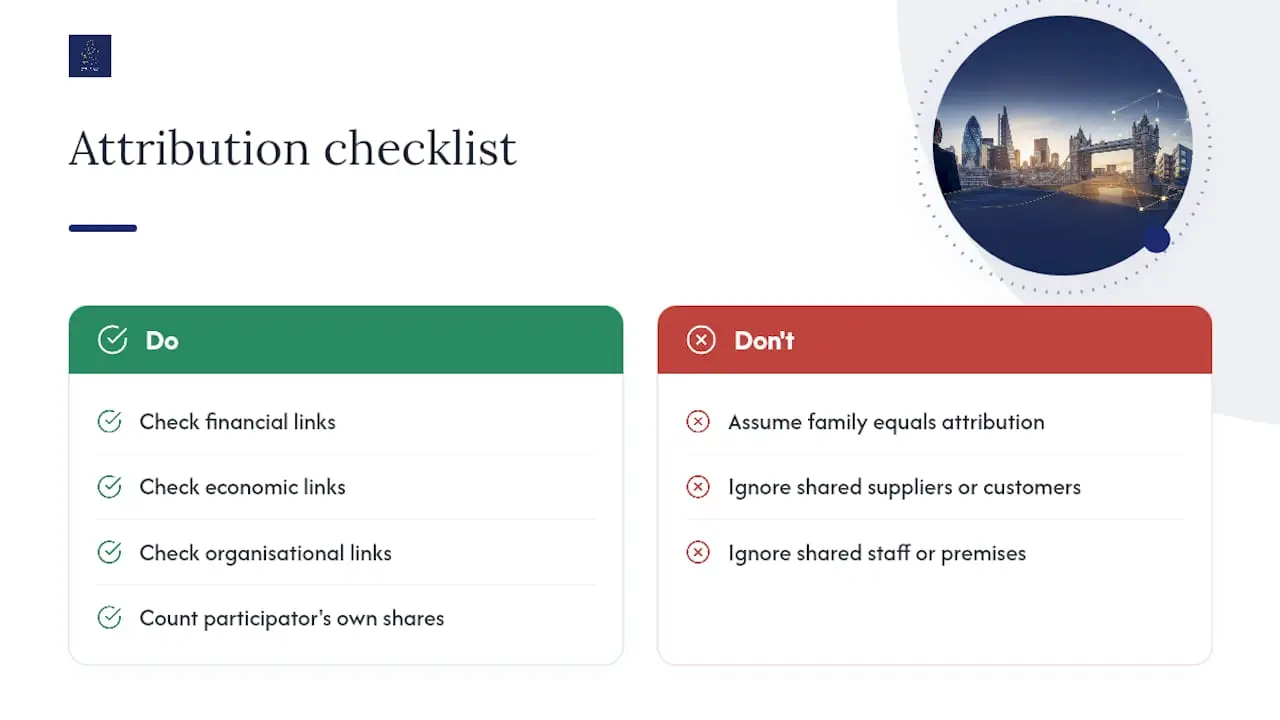
Attribution is not automatic, though. HMRC only attributes an associate’s rights where there is substantial commercial interdependence between the companies concerned. This test looks at three things: financial interdependence (one company funds or guarantees the other), economic interdependence (they share customers, suppliers, or objectives), and organisational interdependence (shared management, employees, or premises).
A practical example: if you run a company and your spouse independently owns and runs a completely unconnected business, with no shared finance, no shared customers, and no shared staff, the two companies are unlikely to be associated despite the family connection. But if your spouse’s company relies on yours for most of its income, or the two share a bookkeeper, an office, and a bank guarantee, interdependence is far more likely to be found.
The participator’s own shareholding always counts, full stop. It is only the associate’s rights that require this extra interdependence test before they get pulled into your control calculation. Directors reviewing family owned structures should ask themselves plainly: does this other company rely on mine financially, share my customers, or share my staff? If the honest answer is no across the board, attribution is far less likely to bite.
Do associated companies change your instalment payment obligations?
Yes, and this catches out growing companies more often than the small profits threshold does. A company becomes “large” once its profits, divided by (1 + N), exceed £1.5 million, triggering quarterly instalment payments rather than the usual nine month and one day deadline. Cross £20 million on the same adjusted basis and it becomes “very large,” with instalments due even earlier in the accounting period, as set out in GOV.UK’s guidance for very large companies.
The £10,000 de minimis threshold below which instalments are not required stays fixed and is not divided by the associate count. For a company with several associates, the £1.5 million large company threshold might adjust down to a few hundred thousand pounds, meaning instalment obligations arrive far sooner than a single-company forecast would suggest. Monitor group-wide profit growth carefully if you have multiple associated entities, since a cashflow surprise here is entirely avoidable with early planning.
What should directors check and record right now?
Treat this as a live compliance task, not a year-end afterthought. Start with an ownership matrix: a simple spreadsheet listing every company you or connected parties control, the percentage shareholding, voting rights, and the date any control position changed. This single document does most of the heavy lifting.
- Confirm each associated company’s trading status for the accounting period, flagging dormant periods separately.
- Record the exact date control began or ended for any company that changed hands, since the 12 month lookback depends on precise dates.
- Note which companies you believe qualify for the passive holding or dormant disregard, with your reasoning.
- Check whether any accounting period straddles a change in association, since CTM03955 sets out special treatment for split periods.
On the CT600, you enter the total number of associated companies in the relevant box, which HMRC uses to check your marginal relief calculation matches the adjusted thresholds. Getting this number wrong is one of the more common triggers for HMRC queries, covered in more detail in common corporation tax filing mistakes small company directors make.
Pro Tip: Update your ownership matrix the moment a shareholding changes, not at year end. The 12 month lookback means today’s decision can still matter well into next year’s tax return.
If your structure involves several entities, family shareholdings, or overseas companies, get professional input before you file rather than after HMRC raises a query.
How I help clients with associated company checks
I map ownership structures and calculate adjusted thresholds for clients across Tonbridge, Sevenoaks, and Kent, as well as remotely. That means building the ownership matrix, confirming trading status for each entity, and preparing the figures that go on your CT600.
Working in Xero, FreeAgent, and QuickBooks creates a clear digital trail of when control changed, which is exactly the evidence HMRC expects if it ever queries your associate count. As an AAT-licensed practice, I handle this alongside full corporation tax compliance work for limited companies.
What happens to group relief when companies are associated?
Group relief and the associated companies rules are separate mechanisms, and mixing them up is one of the most common mistakes directors make.
That said, the two frequently overlap in practice. When that happens, a company can be both claiming group relief for losses and having its small profits threshold reduced by the same associate count in the same accounting period. Neither rule cancels the other out.
This matters for planning. A loss-making subsidiary might shelter profits elsewhere in the group through group relief, reducing the group’s overall tax bill, while the profitable companies still face reduced thresholds because of the associate count. Directors sometimes assume that surrendering losses “fixes” the threshold problem. It does not. The threshold reduction is based purely on the number of non-dormant associated companies, regardless of how much relief flows between them. Model both effects separately when forecasting your group’s total corporation tax liability, ideally with the same ownership matrix you use for the associate count feeding straight into the group relief calculation.
Does being associated affect employment allowance or other reliefs?
Employment allowance, which reduces employers’ National Insurance liability, has its own separate connection test rather than borrowing the corporation tax associate definition directly. Under the employment allowance rules, connected companies (broadly, those under common control) can only claim the allowance once between them, shared however they choose, rather than each claiming it separately.
The practical effect mirrors the corporation tax position even though the legal test differs slightly: directors who control multiple companies often lose out on multiple allowance claims in exactly the same structures that trigger reduced corporation tax thresholds. If you run three companies under common control, you likely get one employment allowance claim to share across all three, not three separate claims.
Other reliefs can be affected too, though the rules vary by relief rather than following one universal pattern. Research and development relief, for instance, has its own group and connection definitions that again do not map exactly onto the corporation tax associate test. The safest approach is never to assume a relief follows the same connection rules as your corporation tax thresholds. Check each relief’s own qualifying conditions separately, because HMRC has drafted connection tests independently for different reliefs over the years, and treating them as interchangeable is a reliable way to miscalculate what you are entitled to claim.
Common law tests versus the statutory control test
Directors sometimes ask whether older common law ideas of “control,” drawn from company law generally, still matter for corporation tax. They largely do not. The associated companies rules rely entirely on the statutory control test written into CTA 2010, not on any wider common law concept of influence or de facto control developed through case law in other contexts.
The statutory test is narrower and more mechanical than a general commercial idea of control. It asks specifically about voting power, ownership of ordinary share capital, and rights to income or assets on a winding up. A person might have significant practical influence over a company’s decisions, through a personal relationship with the directors or a dominant commercial position as a supplier, without meeting the statutory control test at all.
This distinction matters because directors occasionally over-think the question, searching for a nuanced commercial judgement call when the actual test is a straightforward mechanical check against percentages and rights. Where the position genuinely is unclear, such as with complex trust arrangements or unusual share classes carrying different rights, that is when HMRC’s own attribution and interdependence guidance becomes the relevant framework, not a general common law standard borrowed from elsewhere in company law.
What changed in the associated companies rules recently?
The rules themselves are not new. What changed on 1 April 2023 was the reintroduction of the two-rate system that made the associated companies count matter again in a way it had not since 2015, when a single flat corporation tax rate had made the associate calculation largely irrelevant for most small companies.
Before April 2023, most companies paid a single flat rate regardless of profit level or associate count, so directors could reasonably ignore the associated companies rules for years. The reintroduction of the small profits rate and the main rate, alongside marginal relief, brought the entire mechanism back into daily relevance. Directors who have not actively reviewed a company’s structure since before 2015 are the group most likely to be caught out, simply because the rules affecting their tax bill went quiet for the best part of a decade and then came back into force.
Professional commentary from bodies including the ICAEW and ACCA has consistently flagged this as an area where directors underestimate their exposure, precisely because the rules feel unfamiliar after such a long gap. If your accountant has not specifically asked about associated companies since 2023, it is worth raising the question yourself rather than assuming it has been covered.
How do associated companies rules interact with CFC rules?
Controlled foreign company rules and the associated companies rules both use control as their starting point, but they exist to solve different problems and should not be confused. CFC rules aim to stop UK companies from artificially diverting profits into low-tax overseas subsidiaries, taxing certain profits of a foreign controlled company back in the UK under specific anti-avoidance conditions.
The associated companies rules, by contrast, exist purely to stop a company splitting its trade across multiple entities to claim the small profits rate repeatedly. They are a rate-threshold mechanism, not an anti-avoidance regime targeting profit shifting.
Where the two can genuinely intersect is in groups with overseas subsidiaries. As covered earlier, a non-UK resident company controlled by the same person as a UK company can still count as an associate for threshold purposes, entirely separately from whether that overseas company also falls within the CFC rules because of how its profits are taxed locally. A director with an overseas trading subsidiary may need to consider both frameworks side by side: does this company count towards my associate total, reducing my UK thresholds, and separately, does any part of its profit need to be attributed back to the UK under CFC rules? Getting one right does not automatically answer the other, and the two calculations should be worked through independently.
Practical perspective: review this now, not at year end
The reintroduction of the two-rate system in April 2023 means guesswork is no longer good enough. Too many directors still confuse associated companies with a Companies Act group, or assume a VAT group registration settles the question. It does not; each test is entirely separate, with its own definition and its own consequences.
Document your ownership structure while the details are fresh, and get advice if a family shareholding or an overseas company muddies the picture.
— Chris
Need help? Getting your associated company position right
Working out who is associated with whom, and what that does to your thresholds, is exactly the sort of task that benefits from a second pair of eyes before you file rather than after HMRC queries the return. I handle ownership mapping, threshold recalculations, and CT600 preparation directly for clients across Tonbridge, Sevenoaks, and Kent, and remotely throughout the UK.

If you are unsure whether a family shareholding, an old dormant company, or an overseas interest changes your position, a short initial review usually clears it up quickly. I work through your ownership structure using Xero, FreeAgent, or QuickBooks to keep a clean, dated record of when control changed, which is the exact evidence HMRC looks for if it ever questions your associate count. For a broader look at where thresholds and marginal relief bite, my guide to small business corporation tax covers the mechanics in more depth. Get in touch through my contact page to book a review before your next accounting period closes.
FAQ
Can a husband and wife have associated companies?
Only if substantial commercial interdependence exists between the companies, such as shared finance, customers, or staff. Purely separate businesses run by spouses with no financial or organisational overlap are unlikely to be associated.
How do I determine if a company is associated with mine?
Check whether you, or the same group of people, control both companies through voting power, share capital, or rights to income and assets, applying the CTA 2010 control test and the 12 month lookback.
When did the associated companies rules change?
The rules themselves are long-standing, but they became relevant again for most companies from 1 April 2023, when the small profits rate, main rate, and marginal relief were reintroduced.
What is the difference between an associated company and a group company?
Associated company status depends on the corporation tax control test under CTA 2010, while a Companies Act group depends on parent and subsidiary relationships, and a VAT group depends on separate VAT registration rules. A company can meet one definition without meeting the others.
Does a dormant company still count as associated?
No. A company that has not carried on any trade or business at any point during the accounting period is disregarded from the associate count, though partial-period dormancy needs careful checking against CTM03940.