
Bookkeeping prices in the UK typically run from £20 to £55 an hour for freelance help, with monthly retainers around £80 to £150 for sole traders, £150 to £350 for small limited companies, and £300 to £700 or more for growing VAT-registered SMEs. These are market examples, not fixed rules, since scope varies enormously. The single most useful next step is to ask any provider, including CWABC, for a written scope setting out included tasks, frequency, and add-ons before comparing figures.
TL;DR:
- Most UK freelance bookkeeping costs range from £20 to £55 per hour, with monthly retainers for small businesses typically between £80 and £700+ depending on scope.
- Fixed monthly packages are now the most common, offering cost certainty but potentially including scope creep if business needs change.
- Transaction volume, VAT registration, payroll, and record quality are primary drivers that significantly influence bookkeeping prices.
- Quotes often vary by hundreds of pounds for similar work due to scope differences, so precise scope details are essential for comparison.
- Outsourcing generally costs less than hiring an in-house bookkeeper once all employment overheads are factored in.
Table of Contents
- Bookkeeping pricing models: hourly, fixed monthly and per-transaction
- What do UK bookkeeping rates typically look like?
- What actually changes your bookkeeping cost?
- What are the common bookkeeping add-on fees?
- In-house vs outsourced bookkeeping: which costs less?
- How to compare bookkeeping quotes properly
- What does bookkeeping cost for different types of business?
- How I price bookkeeping work at CWABC
- Get a tailored bookkeeping quote from CWABC
- Sources
- FAQ
Bookkeeping pricing models: hourly, fixed monthly and per-transaction
Three pricing structures dominate the UK bookkeeping market, and each shifts the risk and the incentives between you and whoever does the work.
Hourly billing suits one-off or unpredictable jobs. If you need six months of receipts sorted before a VAT deadline, or a single messy quarter tidied up before your accountant can file, paying by the hour makes sense because nobody knows in advance how long the mess will take to untangle. The obvious drawback is unpredictability: a bookkeeper who quotes £30 an hour sounds cheap until a catch-up job runs to twenty hours instead of the five you budgeted for.
Fixed monthly retainers have become the default for ongoing work, and for good reason. A defined scope, covering a set number of transactions, bank reconciliations, and perhaps a VAT return every quarter, means you know your cost before the month starts. Industry commentary suggests fixed-fee monthly pricing is now the most common primary billing method among UK bookkeepers, largely because it gives both sides budgeting certainty. The trade-off is that scope creep becomes the battleground: if you open a second bank account or start invoicing in a foreign currency, your “fixed” fee often needs renegotiating.
Per-transaction pricing charges a small fee for every invoice, receipt, or bank line processed. It suits businesses with very predictable, low-complexity volumes, such as a landlord with two rent payments a month, but it can become expensive fast if transaction counts spike unexpectedly, for example during a sale event or a new product launch.
Tiered packages bundle a set of services (bookkeeping, VAT, payroll) into named bands, “Starter”, “Growth”, “Scale”, with each tier adding scope and cost. These work well when your business fits neatly into a described tier, but they can feel restrictive if your needs sit awkwardly between two bands.
Deciding between hourly and fixed monthly usually comes down to predictability of workload:
- Choose hourly if your bookkeeping needs are irregular, seasonal, or you’re doing a one-off catch-up before a filing deadline.
- Choose fixed monthly if you want cost certainty and your transaction volume, VAT status, and bank accounts are reasonably stable month to month.
- Choose per-transaction if your volume is low and consistent, such as a small landlord portfolio with few monthly movements.
- Choose a tiered package if you want the simplicity of a named plan and your business genuinely matches one of the tiers on offer.
A fixed-fee accounting arrangement, where the scope is agreed upfront, tends to reduce the anxiety that comes from an open-ended hourly clock, provided the written scope is specific enough to stop disputes later.
What do UK bookkeeping rates typically look like?
Numbers help you sanity-check any quote you receive, so here’s what current UK market data actually shows.
Xero’s guide to hiring a bookkeeper puts typical freelance hourly rates at £20 to £50, with the top end reserved for specialists handling complex VAT schemes, multi-currency transactions, or CIS reporting. The 6 Figure Bookkeeper’s pricing survey found a median hourly rate of around £33.36, sitting comfortably inside Xero’s range and giving a useful midpoint for budgeting.
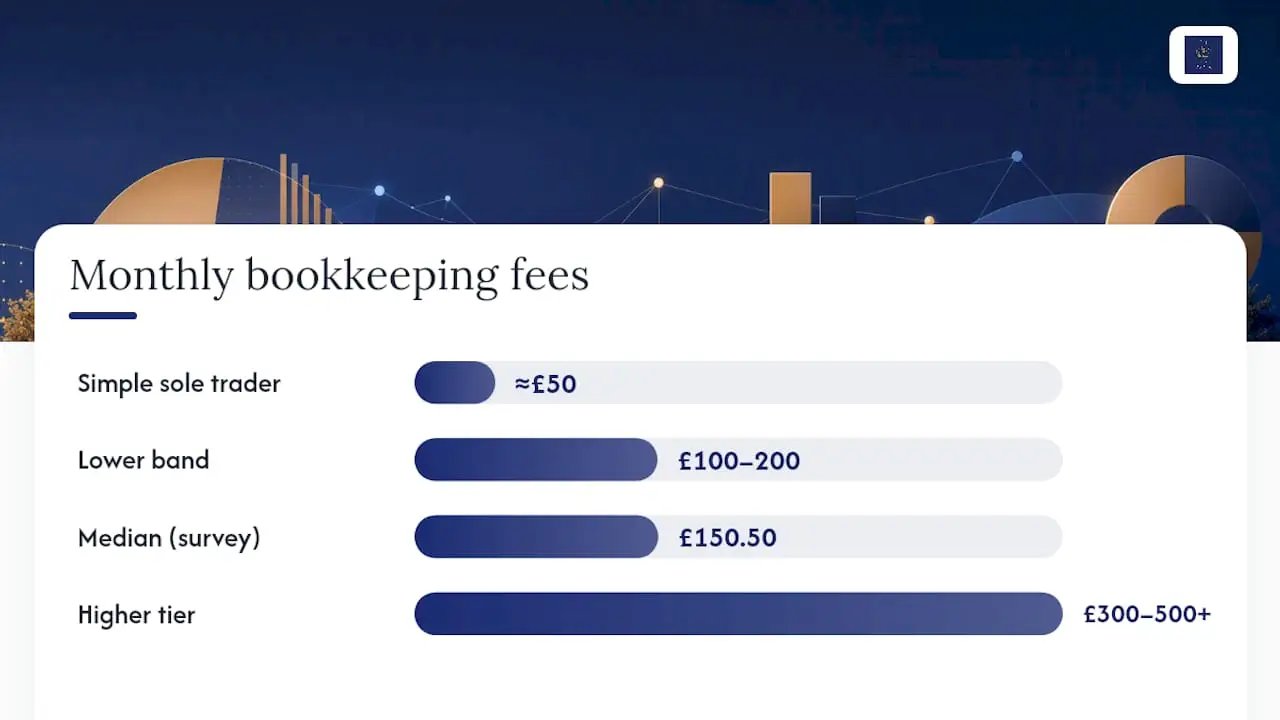
Monthly retainers tell a more interesting story. The same 6 Figure Bookkeeper survey found a median monthly fee of roughly £150.50, but that median hides a genuinely two-tiered market.
Market snapshot: Many UK bookkeepers cluster in a lower band of roughly £100 to £200 a month for straightforward sole trader work, while a second, distinct group charges £300 to £500 or more a month for packaged, higher-touch services or specialist expertise such as CIS or multi-entity accounts.
That gap between the median and the higher-charging tier matters because it explains why two quotes for what sounds like “the same job” can differ by three or four times. A bookkeeper charging £120 a month and one charging £450 a month might both call it “monthly bookkeeping”, but the second is probably including VAT returns, payroll oversight, or faster turnaround as standard.
Broader market roundups put ongoing outsourced bookkeeping anywhere from around £50 a month for the simplest sole trader setups to several thousand pounds a month for complex SMEs with high transaction volumes, multiple entities, or group reporting.
A few points worth holding onto when you compare these figures against a quote you’ve received:
- Median figures describe the typical UK bookkeeper, not the typical price for your specific situation.
- Location within the UK still moves the needle, with London and the South East generally sitting above the national averages quoted here.
- Experience and specialisation (CIS, multi-currency, charity accounts) push hourly and monthly rates towards the top of the range.
- A quote well below the £100 to £200 monthly band for a sole trader is worth questioning, since it may exclude reconciliations or VAT support you assumed were included.
What actually changes your bookkeeping cost?
Price differences between two seemingly similar businesses almost always trace back to five drivers: transaction volume, VAT status, payroll, record quality, and software.
- Transaction volume drives time, and time drives cost. A sole trader with forty transactions a month needs a fraction of the reconciliation time of a business processing four hundred. Multiple bank accounts multiply this further, since each account needs its own reconciliation even if the total transaction count stays similar.
- VAT registration expands the scope significantly. Once you cross the VAT registration threshold, currently £90,000 of taxable turnover, quarterly VAT returns become a legal obligation, and Making Tax Digital rules require compatible digital record-keeping. That’s a recurring quarterly task layered on top of routine bookkeeping, and it typically adds a defined fee per return rather than being absorbed into a base retainer.
- Payroll and CIS are near-universal add-ons, not inclusions. Running payroll for even one employee brings recurring monthly administration, real-time HMRC reporting, and auto-enrolment pension duties. Construction Industry Scheme (CIS) work adds monthly contractor returns and verification checks on top of that.
- Catch-up and correction work is priced separately, and it’s where budgets go wrong. Handing over a shoebox of unsorted receipts for the last financial year is a fundamentally different job to monthly upkeep, and most bookkeepers will quote it as a one-off fee, often hourly, precisely because nobody can estimate the hours involved until they’ve seen the state of the records.
- Software choice changes how much manual work exists in the first place. Cloud platforms like Xero, QuickBooks, and FreeAgent pull transactions directly from your bank via live feeds, cutting out manual data entry almost entirely. A business still working from spreadsheets or paper ledgers will always cost more to service than one already running clean digital feeds, because the bookkeeper’s first job becomes data entry rather than review and reconciliation.
Pro Tip: Before you ask for a quote, spend twenty minutes counting last month’s bank transactions and listing every account you use for the business, including PayPal or Stripe. That single number, more than anything else you can tell a bookkeeper, determines the price you’ll be quoted.
Poor record quality compounds every one of these factors. If you’re regularly missing receipts or mixing personal and business spending, read through practical guidance on avoiding common bookkeeping errors before you go shopping for quotes, since fixing habits first can meaningfully reduce the catch-up fee any provider will need to charge.
What are the common bookkeeping add-on fees?
Beyond the core monthly or hourly rate, most UK bookkeeping quotes carry a handful of predictable extras. Knowing the typical shape of each one helps you spot a quote that’s hiding costs behind a deceptively low headline figure.
- VAT return preparation is usually charged per return rather than folded into the base fee, reflecting the quarterly (or sometimes monthly) filing cycle and the reconciliation work each return demands.
- Payroll is typically charged per employee per month, often with a minimum monthly fee regardless of headcount, since setting up and running the payroll system carries fixed administrative overhead even for a single employee. Auto-enrolment pension administration, assessing eligibility and processing contributions, is usually included in that per-employee charge but worth confirming explicitly.
- CIS reporting for contractors and subcontractors adds monthly contractor verification and return-filing charges, distinct from standard payroll, because the compliance requirements differ.
- Annual accounts and Self Assessment are usually billed separately from ongoing bookkeeping as a yearly fee, since they represent a distinct piece of compliance work completed once a year rather than monthly.
- One-off catch-up or clean-up work is almost always priced outside the regular retainer, commonly on an hourly basis, precisely because the scope can’t be known until the records have been reviewed.
- Software licences are handled differently by different providers: some pass through the cost of your Xero, QuickBooks, or FreeAgent subscription directly, some build a software allowance into the monthly fee, and some expect you to hold and pay for your own licence. Xero’s own pricing tiers start at a modest monthly cost and scale with the features you need, so it’s worth checking which model your quote assumes.
If you’re weighing up whether to bring payroll in-house or hand it to your bookkeeper or accountant, a closer look at what payroll outsourcing typically costs is worth ten minutes of your time before you commit either way.
In-house vs outsourced bookkeeping: which costs less?
Hiring an employed bookkeeper feels like the “proper” solution to many small business owners, but the fully loaded cost rarely matches the advertised salary.
The National Careers Service lists typical UK bookkeeper salaries around £24,000 to £35,000 a year. Add employer National Insurance contributions, minimum pension contributions, sick pay, holiday pay, a laptop, software licences, and the management time spent recruiting and supervising, and that headline salary understates the real cost by a wide margin.
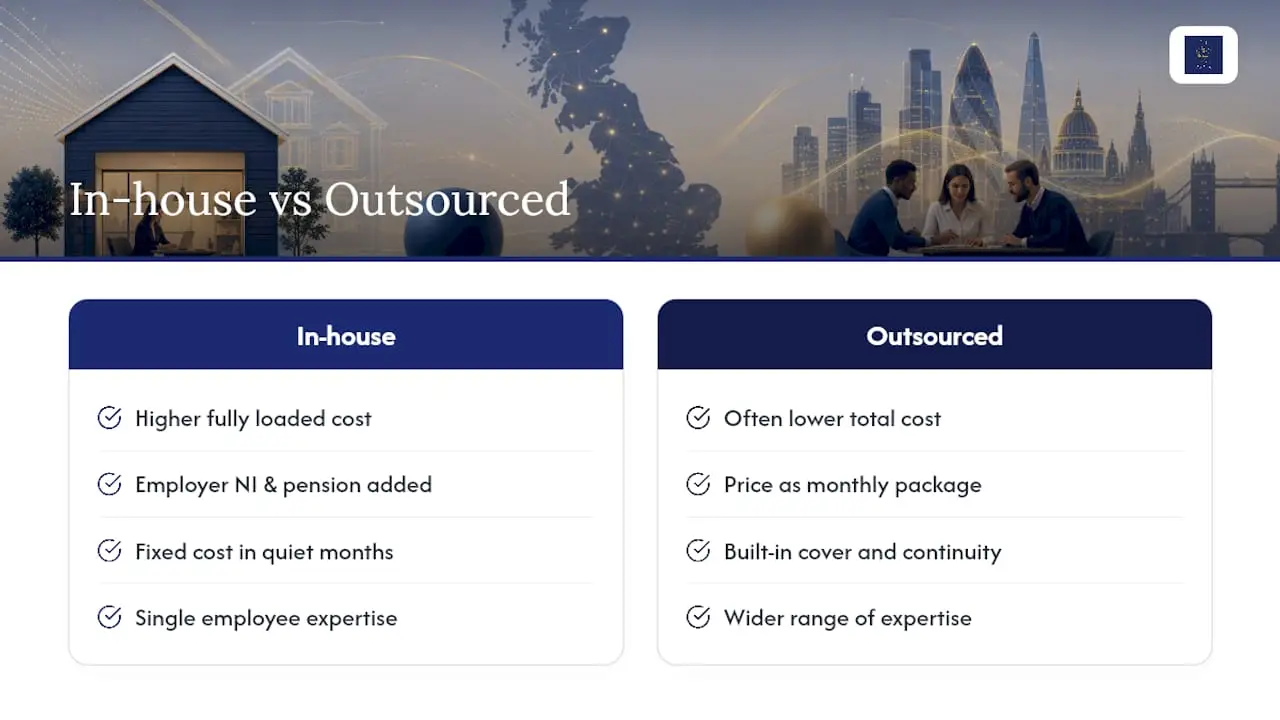
The comparison that matters: Once you add employer National Insurance, pension contributions, software, and overheads to a bookkeeper’s salary, the fully loaded annual cost of an in-house hire often runs well above the advertised figure, frequently landing at or above the total annual cost of an outsourced monthly package covering the same workload.
That doesn’t make outsourcing automatically right for every business. An in-house hire makes sense once your transaction volume and complexity genuinely justify a full-time role, and when you want someone physically present who understands your business day to day, sitting in on meetings and flagging issues in real time. Outsourcing tends to win for smaller and mid-sized businesses because you get continuity (a sick day doesn’t stop your books being done), built-in cover, and access to a wider range of expertise than one employee could offer alone, without carrying the fixed employment costs through quiet months.
The trade-off is response time and control: an outsourced provider works to agreed turnaround times rather than being available at your desk on demand, so it’s worth confirming what response times a quote actually promises.
How to compare bookkeeping quotes properly
Two quotes that look identical on price can represent wildly different amounts of work, which is why comparing the headline figure alone is close to useless.
- Ask for the full scope, not just the price. A proper quote lists exactly what’s included: number of bank reconciliations, VAT return preparation, payroll processing, management accounts, and how often each task happens.
- Confirm the software being used and who pays for it. Some quotes assume you already hold a Xero, QuickBooks, or FreeAgent licence; others include it. That single line item can shift the effective price by £20 to £30 a month either way.
- Ask about turnaround times for filings. A quote with no stated turnaround for VAT returns or payroll submissions leaves you exposed if deadlines slip.
- Check what happens with catch-up or correction work. Open-ended phrases like “additional charges may apply” without a rate or estimate attached are a red flag, since they leave the ceiling on cost entirely undefined.
- Ask how data handover and backups work. You should own your data and be able to move it, or export it, if you ever change provider.
Normalising two different-looking quotes is straightforward once you break each one into its components. If Quote A is £150 a month with VAT included and Quote B is £110 a month with VAT charged separately at £60 a quarter, Quote B actually costs roughly £130 a month once averaged, closer to Quote A than the headline figures suggest. Vague scopes, undefined catch-up wording, and the absence of any stated filing commitment are the three clearest warning signs that a cheap-looking quote will cost more than expected once the real workload appears.
What does bookkeeping cost for different types of business?
Matching your own situation to the nearest example below gives a more honest sense of where you’re likely to land than any single average figure.
- Sole trader, under 50 transactions a month: typically sits in the lower monthly band, often £80 to £150, usually covering bank reconciliation, categorisation, and basic reporting, with Self Assessment filed as a separate annual fee.
- Landlord with rental income across several properties: costs rise with each additional property because each one needs its own reconciliation and expense tracking, and Making Tax Digital for Income Tax will bring quarterly digital reporting obligations for many landlords over the coming years, adding further recurring work once it applies.
- Small limited company with payroll and occasional VAT: typically £150 to £350 a month, reflecting the added complexity of statutory accounts preparation, payroll for one or two employees, and periodic VAT returns.
Why the range widens so sharply: A VAT-registered SME running multiple bank accounts, regular payroll, and higher transaction volumes commonly moves into the £300 to £700+ monthly band, because each additional account, VAT return, and payslip adds a fixed slice of recurring work that a simpler business simply doesn’t generate.
- Growing SME with multiple accounts, VAT, and payroll: sits at the top of the market range, with cost driven primarily by transaction volume and the number of recurring compliance tasks stacked on top of core bookkeeping.
If you’re a landlord unsure whether your rental income even needs to go through Self Assessment, it’s worth reading why landlords register for Self Assessment before assuming your bookkeeping needs are as simple as a single rent payment each month.
How I price bookkeeping work at CWABC
Every quote I put together starts from the same question: what does this specific business actually need, not what does a generic package say it should need. I’m AAT-licensed, based in Hildenborough near Tonbridge, and I work with sole traders, landlords, and limited companies both locally across Kent and remotely UK-wide, using cloud platforms like Xero, QuickBooks, and FreeAgent to keep everything paperless and easy to review.
When I quote for bookkeeping services, I ask for a realistic sense of monthly transaction volume, how many bank accounts and platforms are in play, whether VAT or payroll applies, and how far behind the records currently are. That last point matters more than people expect: a business with twelve months of unreconciled transactions needs a genuinely different quote to one that’s simply switching providers with clean, up-to-date books. Sometimes a short call or a look at recent bank statements tells me everything I need; sometimes it takes a proper review of the existing records first.
What I won’t do is hand out a one-size-fits-all headline price, because the ranges discussed throughout this guide exist precisely because scopes differ so much. Every quote I give is written down, clear on what’s included, and agreed before any work starts.
— Chris
Get a tailored bookkeeping quote from CWABC
CWABC is the alternative to guessing your way through a generic price list: instead of a fixed rate card that ignores your transaction volume or VAT status, you get a written quote built around what your business actually needs, agreed before any work begins.
I offer Self Assessment Tax Returns alongside tailored bookkeeping services, VAT registration and returns, payroll and CIS support, and Making Tax Digital for Income Tax preparation, all quoted individually rather than sold from a rigid tier list.
To get an accurate quote, send me: your typical monthly transaction count, which software you’re using (or planning to use), whether VAT or payroll applies to your business, and how many months or years of catch-up work are involved if your records aren’t currently up to date. That handful of details is usually enough for me to put together a clear, honest figure rather than a rough guess.
If you’d rather talk it through first, get in touch here and I’ll come back to you with a written scope and price, no obligation attached.
Sources
- Pricing Report: what UK bookkeepers charge (and what to do next) – The 6 Figure Bookkeeper
- Hire a bookkeeper: when to and what it costs in the UK – Xero UK
- Gov
FAQ
How much does a bookkeeper cost in the UK?
UK freelance bookkeepers typically charge £20 to £50 an hour, with a median hourly rate around £33.36. Monthly retainers commonly range from £80 for simple sole trader work up to £700 or more for VAT-registered SMEs with payroll, depending entirely on transaction volume and scope.
How much should I charge for bookkeeping?
There’s no single correct rate, but current UK market data offers a sensible anchor: a median hourly rate of roughly £33.36 and a median monthly fee around £150.50. Rates above that median typically reflect specialist skills such as CIS, multi-currency work, or faster turnaround commitments.
Is a bookkeeper cheaper than an accountant?
Bookkeepers generally charge less per hour than qualified accountants, since bookkeeping covers day-to-day transaction recording while accountancy involves higher-level tax planning, statutory accounts, and advisory work. Many UK small businesses use both: a bookkeeper for ongoing records and an accountant for annual accounts and tax returns, though some practices, including CWABC, offer both under one roof.
How much are accountants charging for MTD?
There’s no single published UK rate for Making Tax Digital support, because cost depends on whether you need software setup, ongoing quarterly submissions, or both. MTD for Income Tax requires eligible self-employed people and landlords to keep digital records and report quarterly, which typically adds a recurring fee on top of existing bookkeeping costs rather than replacing them.
Need help?
If you’d like a clear, written quote for your bookkeeping, VAT, or payroll needs, get in touch with CWABC and I’ll talk you through exactly what’s involved before you commit to anything.